The Cost of Going Silent: What Happens When Brands Stop Advertising
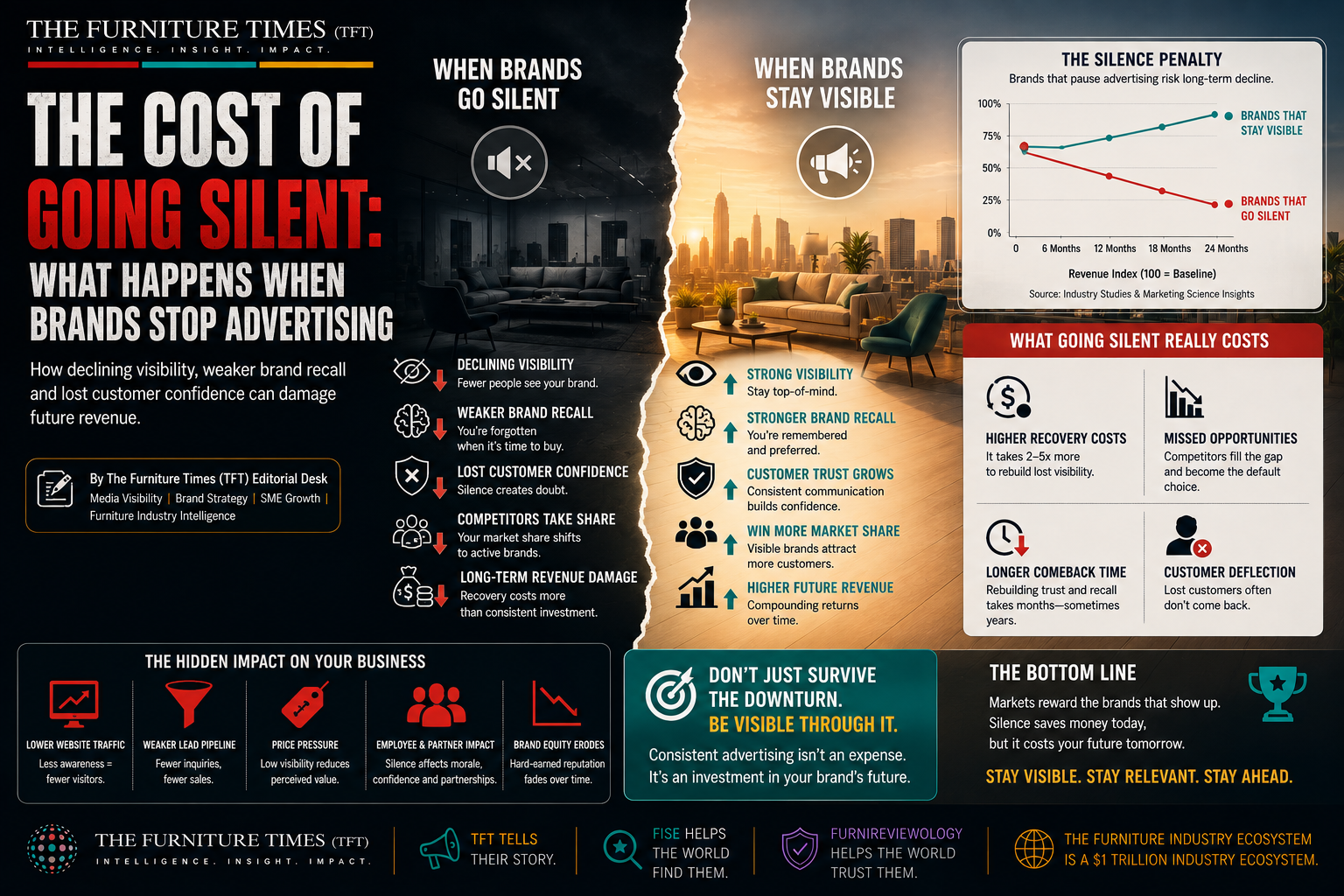
How declining visibility, weaker brand recall and lost customer confidence can damage future revenue
By The Furniture Times (TFT) Editorial Desk | Media Visibility | Brand Strategy | SME Growth | Furniture Industry Intelligence
When markets become difficult, many businesses make the same defensive decision: they stop advertising.
Management sees sales slowing, operating costs rising and customers delaying purchases. Cash becomes precious, uncertainty increases and advertising appears to be one of the easiest expenses to remove.
The savings are immediate and visible. The consequences are delayed and much harder to measure.
A company can identify exactly how much money it saved by cancelling a campaign, reducing media placements or suspending its content program. It cannot easily calculate how many potential customers stopped remembering the brand, how many distributors selected another supplier or how much future revenue was lost because the company disappeared from search results and industry conversations.
That is the hidden cost of going silent.
A brand does not remain frozen in the customer’s memory when it stops communicating. Its position can gradually weaken while competitors continue advertising, publishing, building reviews and appearing in search and AI-generated recommendations.
The danger is particularly serious for furniture manufacturers, retailers, suppliers and service providers. Furniture is generally not purchased every day. The buying cycle can be lengthy, and customers may research products months before making a decision.
If a company advertises only when it urgently needs sales, it may arrive too late. The customer may already have built a shortlist containing brands that remained visible during the research period.
Going silent may protect this month’s budget—but it can damage next year’s revenue.
01 — Visibility Is Not Permanent
Some companies assume that customers will continue remembering them because they have operated for many years.
Longevity can support trust, but it does not guarantee permanent awareness.
Markets constantly introduce:
- New competitors
- New products
- New retail platforms
- New social channels
- New search experiences
- New AI recommendation systems
- New customer generations
- New design preferences
Customers are exposed to more commercial messages than ever before. Brands must continue providing meaningful reminders of who they are, what they offer and why they are relevant.
When communication stops, customer attention does not remain empty. It moves toward companies that continue appearing.
Visibility must therefore be maintained, refreshed and earned repeatedly.
02 — The First Loss Is Usually Share of Voice
Share of voice refers to the visibility a company holds relative to competitors.
It can include presence across:
- Paid advertising
- News coverage
- Search results
- Social media
- Trade publications
- Industry directories
- Marketplaces
- Events
- Reviews
- AI-generated answers
When a company stops advertising, its relative presence can decline even if its products remain unchanged.
This is important because customers cannot evaluate a business they do not encounter.
WARC describes “excess share of voice” as the situation in which a brand’s advertising visibility exceeds its current market share. Historical marketing evidence has associated this condition with stronger potential for long-term market-share growth. WARC’s marketing-effectiveness glossary
During difficult periods, many companies reduce media activity simultaneously. A disciplined business that maintains a sensible presence may consequently gain a larger relative share of attention without dramatically increasing its budget.
The company that goes silent gives competitors space.
03 — Brand Recall Begins to Weaken
Brand recall is the customer’s ability to remember a company when considering a purchase.
This is different from brand recognition.
A customer may recognize a retailer’s name when seeing its showroom sign but fail to remember that retailer independently when searching for a new sofa.
Advertising, news coverage, search visibility and customer communication reinforce memory. When these reminders disappear, recall can gradually decline.
This matters because customers frequently begin with a limited consideration set.
They do not usually investigate every furniture brand in the market. Instead, they compare a manageable number of familiar, recommended or easily discovered options.
A company that falls outside this shortlist may never receive the enquiry.
04 — Silence Can Be Interpreted as Weakness
When an established company suddenly stops communicating, stakeholders may create their own explanations.
Customers, employees, suppliers and distributors may wonder:
- Is the company still operating?
- Is it experiencing financial problems?
- Has it stopped introducing products?
- Is its website abandoned?
- Can it still fulfill large orders?
- Has it withdrawn from the market?
- Will warranties continue to be honored?
These assumptions may be completely incorrect. However, the absence of current information allows doubt to grow.
During hard times, communication should reassure the market through evidence.
A company can publish information about:
- Current operations
- New collections
- Customer projects
- Export activity
- Quality improvements
- Partnerships
- Certifications
- Workforce development
- Delivery capabilities
- Digital transformation
Visibility can communicate stability without pretending that market conditions are easy.
05 — Competitors Occupy the Customer’s Mind
The market does not pause when one company stops advertising.
Competitors continue:
- Buying relevant search advertisements
- Publishing educational content
- Collecting reviews
- Launching products
- Updating their websites
- Appearing in trade publications
- Attending exhibitions
- Sending newsletters
- Building social communities
- Improving AI visibility
Over time, customers may begin associating the category with those active competitors.
A manufacturer that once appeared to lead an industry segment can become less influential—not because its products worsened, but because its voice disappeared.
The visible competitor may be newer, smaller or technically less capable. Yet customers can only evaluate the evidence available to them.
Invisibility allows perception to move ahead of reality.
06 — Sales Teams Receive Colder Leads
Advertising does not replace salespeople. It prepares the market for them.
A salesperson contacting a buyer who already recognizes the company begins with an advantage. The prospect may have seen the brand in search results, read a news article, visited its website or encountered customer reviews.
Without this familiarity, the salesperson must establish:
- Awareness
- Relevance
- Credibility
- Trust
- Product value
- Commercial urgency
This makes every sale more difficult.
When marketing stops, management may place greater pressure on the sales department. Yet salespeople are asked to compensate for the company’s declining visibility.
A healthy commercial system allows marketing and sales to reinforce each other.
Marketing creates awareness and interest. Sales turns qualified interest into relationships and revenue.
07 — Search Visibility Can Decline
Stopping advertising is often accompanied by stopping other communication activities.
Companies may stop publishing articles, updating product pages, issuing press releases or improving their websites. Over time, this can affect search performance.
Search engines favor useful, accessible and current information. A neglected website may develop:
- Outdated products
- Incorrect prices
- Broken links
- Missing images
- Old contact details
- Slow pages
- Unanswered reviews
- Discontinued collections
- Inaccurate showroom hours
Meanwhile, competitors continue strengthening their digital assets.
Paid advertising and organic search are different, but they can support a shared objective: helping customers find the company.
A brand that disappears from paid placements and neglects its organic presence may lose visibility across the entire search journey.
08 — AI Discovery Creates a New Silence Penalty
Consumers increasingly ask AI assistants to identify products, compare brands and recommend suitable businesses.
A customer might ask:
- Which furniture brands produce durable outdoor collections?
- Where can I find ergonomic office furniture in Malaysia?
- Which companies manufacture hotel furniture in Southeast Asia?
- What are the most trusted furniture retailers near me?
- Which furniture brands offer strong after-sales service?
AI systems require accessible information to understand a company.
Relevant signals may include:
- Current product pages
- Business listings
- News articles
- Press releases
- Customer reviews
- Independent coverage
- Company history
- Certifications
- Product specifications
- Clear policies
A company that stops publishing and allows its information to become outdated may be less likely to appear in AI-generated answers.
This creates a significant strategic risk: the brand may still exist physically but become invisible in the systems customers use for discovery.
09 — Going Silent Weakens Pricing Power
Strong brands do not compete through price alone.
Customers may pay more when they believe a company offers:
- Better quality
- Greater reliability
- Stronger design
- Safer materials
- Longer warranties
- Better customer service
- More dependable delivery
- Trusted after-sales support
Advertising and communication help explain these differences.
When a company stops telling its value story, products can begin looking like commodities. Customers compare them primarily through price because they cannot identify meaningful distinctions.
This may force the company to offer deeper discounts.
Google’s research on profitable growth notes that reducing marketing investment can weaken brand differentiation, increase price sensitivity and erode profitability. Google’s Unlocking Profitable Growth report
This produces a dangerous cycle:
- Advertising is cut to protect margins.
- Brand differentiation weakens.
- Customers demand lower prices.
- Margins fall further.
- The company has even less money for visibility.
10 — Discounts Become a Dangerous Substitute
Many companies stop brand advertising but continue offering discounts.
The objective is understandable: generate immediate sales.
However, repeated discounting can train customers to wait for the next promotion.
It can also:
- Lower perceived value
- Compress margins
- Create channel conflict
- Upset customers who paid full price
- Make normal prices difficult to restore
- Attract price-sensitive buyers with limited loyalty
Discounts can be useful when applied strategically, but they cannot explain craftsmanship, durability, design, reliability or customer service.
Furniture companies should communicate total value, including:
- Expected product life
- Repairability
- Warranty
- Material quality
- Replacement parts
- Maintenance requirements
- Delivery and installation
- Customization
- Lifecycle cost
Reducing price is not the same as building demand.
11 — Customer Confidence Becomes Harder to Maintain
Furniture purchases involve risk.
Customers want confidence that:
- The product will match its description.
- The dimensions are correct.
- The materials are genuine.
- Delivery will happen as promised.
- Installation will be handled properly.
- The company will remain available after purchase.
- Warranty claims will be addressed.
Regular, transparent communication reduces uncertainty.
When a company becomes silent, customers may find fewer recent signals confirming that the business remains reliable.
An old website and inactive social account can create doubt, especially when competitors provide current product information, recent reviews and responsive customer support.
Confidence is built from multiple small signals. Silence removes many of them.
12 — Existing Customers Can Feel Forgotten
Advertising is not only about acquiring new customers. Communication also reminds existing buyers that the company remains available.
Past customers may later need:
- Additional furniture
- Replacement products
- Matching pieces
- Spare parts
- Repair services
- Commercial refurnishing
- Recommendations for friends
- New collections
If the company stops communicating, customers may form new relationships with active competitors.
A furniture brand should maintain appropriate contact through:
- Email updates
- Product-care guidance
- Service reminders
- New collection announcements
- Warranty information
- Loyalty benefits
- Company news
Customer retention may be more efficient than repeatedly acquiring entirely new buyers.
13 — Distributors May Lose Confidence
Manufacturers often depend on retailers, dealers, agents, interior designers, architects and project consultants.
These partners want products that customers recognize and request.
If a manufacturer stops advertising, dealers may find themselves carrying an unfamiliar brand that requires more explanation and sales effort.
Over time, distributors may allocate:
- More showroom space
- Better placement
- Larger orders
- Greater sales attention
to brands that actively support demand.
Manufacturers should remember that advertising also supports channel partners. It signals commitment to the market and helps dealers sell.
14 — Product Launches Lose Momentum
Companies sometimes suspend marketing during a downturn but continue developing new products.
When the collection is ready, management expects the market to respond immediately.
However, launching into silence is difficult.
A strong product launch requires:
- Existing audience attention
- Search visibility
- Media relationships
- Updated customer databases
- Distributor engagement
- Social reach
- Credible product information
- Review activity
These assets cannot always be rebuilt instantly.
A company that preserves baseline visibility during difficult conditions is better prepared to introduce new products when confidence returns.
15 — Recruitment and Employee Morale Can Be Affected
External silence can influence internal confidence.
Employees may interpret the absence of advertising as evidence that the company is retreating. Sales teams may feel unsupported, while talented applicants may view competitors as more innovative and stable.
Active communication can help demonstrate:
- Business direction
- Product development
- Workplace culture
- Training
- Sustainability initiatives
- Expansion plans
- Leadership
Advertising should not create a false picture. But honest communication can strengthen confidence among employees and potential recruits.
16 — The Company Creates a Recovery Debt
Many businesses describe advertising cuts as temporary.
They assume they can restart communication when economic conditions improve. Yet rebuilding a weakened brand can be more expensive than maintaining a basic level of visibility.
Nielsen has reported that recovering from extended periods without advertising may require years of consistent brand-building effort. Nielsen’s analysis of long-term marketing and business longevity
The returning company may need to:
- Reintroduce its identity
- Restore customer confidence
- Rebuild website traffic
- Recover search visibility
- Reconnect with journalists
- Regain distributor attention
- Collect current reviews
- Restart advertising data
- Explain its period of silence
This can be considered a recovery debt.
The company saved money during the downturn but created a larger future obligation.
17 — The Cost Appears After the Decision-Makers Have Moved On
One reason advertising cuts are attractive is that their long-term effects may not appear within the same reporting period.
A manager can reduce the budget and immediately report lower expenses. The decline in awareness, customer consideration and future demand may become visible much later.
By then, the original decision may be difficult to connect with the resulting revenue weakness.
This delay can create false confidence.
Management may conclude that advertising was unnecessary because sales did not collapse immediately after the cut. In reality, the company may still be benefiting from awareness created by earlier investment.
When that stored visibility eventually weakens, restoring it becomes more difficult.
18 — Not All Advertising Deserves Protection
The argument against silence is not an argument for waste.
Businesses should stop or redesign campaigns that:
- Reach the wrong audience
- Promote unavailable products
- Generate low-quality enquiries
- Use weak creative work
- Cannot be measured
- Ignore customer reality
- Damage the brand
- Depend on misleading claims
- Produce no useful commercial outcome
Hard times should encourage disciplined review.
The strategic goal is to cut inefficiency while protecting meaningful visibility.
A company should ask:
- Which customers still have demand?
- Which products generate acceptable margins?
- Which channels create qualified enquiries?
- Which messages remain relevant?
- Which markets are recovering?
- Which communication supports existing customers?
- What is the minimum budget required to remain visible?
19 — A Minimum Viable Visibility Plan
A business unable to maintain its full advertising budget can preserve a smaller, focused presence.
Protect high-intent search
Remain visible when customers actively search for relevant products, services and locations.
Keep the website current
Ensure that products, prices, contact details, opening hours and delivery information remain accurate.
Communicate with existing customers
Use permission-based email and direct customer service to protect established relationships.
Maintain business listings
Update search profiles, industry directories and showroom information.
Continue collecting authentic reviews
Recent, genuine customer feedback supports confidence and AI discoverability.
Publish meaningful company news
Use press releases and news articles to document genuine developments.
Improve product information
Complete specifications can improve conversion without requiring expensive media.
Use focused retargeting
Reach customers who have already demonstrated interest without overwhelming them.
Measure commercial outcomes
Track calls, enquiries, appointments, quotations and revenue—not only clicks.
20 — Press Releases Can Preserve Public Visibility
Press releases can be valuable during periods of limited advertising expenditure.
A genuine announcement can document:
- A new collection
- Market expansion
- A showroom opening
- A sustainability certification
- A project completion
- Manufacturing investment
- A partnership
- Workforce training
- Digital transformation
- Community support
A release can provide information to media, customers, distributors, search engines and AI systems.
It should not be treated as an artificial backlink scheme. The announcement must contain real news and verifiable information.
For furniture SMEs, press releases can help transform private business achievements into public, searchable records.
21 — Content Can Build Visibility Without Constant Selling
Advertising during difficult times should not consist entirely of sales messages.
Furniture companies can create useful content answering customer questions.
Examples include:
- How to measure a room before ordering furniture
- How to select outdoor materials
- How to evaluate sofa construction
- How to care for timber furniture
- How to choose ergonomic office seating
- How to prepare for furniture delivery
- How to identify reliable warranties
- How to compare product materials
Helpful content allows the company to remain visible while serving the customer.
It also creates information that can be discovered through search and AI platforms.
22 — The Message Must Change During Hard Times
Maintaining advertising does not mean ignoring economic conditions.
Customers may be more cautious, price-sensitive and concerned about value. Communication should reflect that reality.
Relevant messages may focus on:
- Durability
- Warranty
- Multifunctionality
- Space efficiency
- Repairability
- Product life
- Reliable delivery
- Low maintenance
- Honest pricing
- After-sales support
A luxury message disconnected from customer anxiety may appear insensitive.
Businesses should maintain confidence without pretending that customers face no pressure.
23 — Who Wins When a Brand Goes Silent?
The first winners are visible competitors.
They gain greater access to:
- Customer attention
- Search results
- Media coverage
- Distributor interest
- Reviews
- Social conversations
- AI recommendations
Challenger brands can also benefit.
A smaller company may not need to outspend a major competitor. It can focus on a specific category, location or customer need while larger brands retreat.
Platforms also benefit because silent businesses become increasingly dependent on paid re-entry. When the company returns, it may need to spend more to rebuild traffic and awareness.
The final winner is often the company that combines financial discipline with consistent communication.
24 — A Practical Visibility Decision Framework
Before cutting advertising, leadership should assess four areas.
Financial survival
Can the company meet payroll, essential operating costs and immediate obligations?
Operational capacity
Can it fulfill orders and support customers reliably?
Market demand
Which products, customer groups and geographic markets remain active?
Visibility consequences
What will happen to search presence, customer confidence and channel relationships if communication stops?
The decision should balance short-term liquidity with long-term commercial health.
25 — The Furniture Industry Cannot Afford Collective Silence
The furniture industry contains thousands of manufacturers, retailers, component suppliers, designers, logistics providers and service companies.
Many SMEs perform excellent work but remain poorly documented online.
They rely on:
- Personal networks
- Exhibitions
- Messaging applications
- Printed catalogs
- Existing agents
- Referrals
These channels remain valuable, but they do not always create permanent public visibility.
When difficult conditions cause companies to stop advertising and publishing, the entire industry becomes harder to discover.
Buyers then encounter only the largest and most digitally active brands, creating a distorted picture of the market.
Industry-specific media, search and review platforms are essential for helping smaller companies remain visible.
Final Analysis: Silence Is Not Neutral
Stopping advertising does not preserve a company’s current market position.
It changes that position.
Brand recall can weaken. Search visibility may decline. Customer confidence can become less certain. Sales teams receive colder leads, distributors shift attention and competitors occupy the space the company abandoned.
The financial consequences may not appear immediately, but delayed damage is still damage.
A business facing severe financial pressure must protect survival. It should not continue wasteful campaigns or spend money it cannot afford. But the choice should not be reduced to full spending or complete silence.
There is a strategic middle ground:
- Cut waste
- Protect high-value channels
- Maintain accurate information
- Communicate with customers
- Publish real news
- Preserve search presence
- Collect authentic reviews
- Prepare for recovery
The strongest companies do not advertise blindly during hard times. They communicate deliberately.
They understand that demand may slow, but customer memory continues changing. Search results continue evolving. AI systems continue gathering information, and competitors continue presenting their stories.
A company can pause a campaign. It cannot pause the market.
The true cost of going silent is not simply the sales lost today. It is the future revenue that goes to competitors because the customer no longer remembers, finds or trusts the brand.
Key Takeaways
01 — Visibility is not permanent; it must be maintained.
02 — Competitors occupy the attention abandoned by silent brands.
03 — Brand recall can weaken before sales decline becomes visible.
04 — Silence may be interpreted as inactivity or instability.
05 — Salespeople face greater difficulty without marketing support.
06 — Poor digital activity can reduce search and AI discoverability.
07 — Reduced differentiation can increase customer price sensitivity.
08 — Repeated discounting cannot replace long-term brand building.
09 — Existing customers and distributors also need communication.
10 — Restarting after a long silence can create a costly recovery debt.
11 — Businesses should cut waste without eliminating visibility.
12 — A minimum viable visibility strategy can protect future demand.
The Furniture Times (TFT) & Furniture Industry Search Engine (FISE)
“TFT tells their story. FISE helps the world find them.”
FurniReviewology helps the world trust them.
The furniture industry ecosystem is a $1 trillion industry ecosystem.