
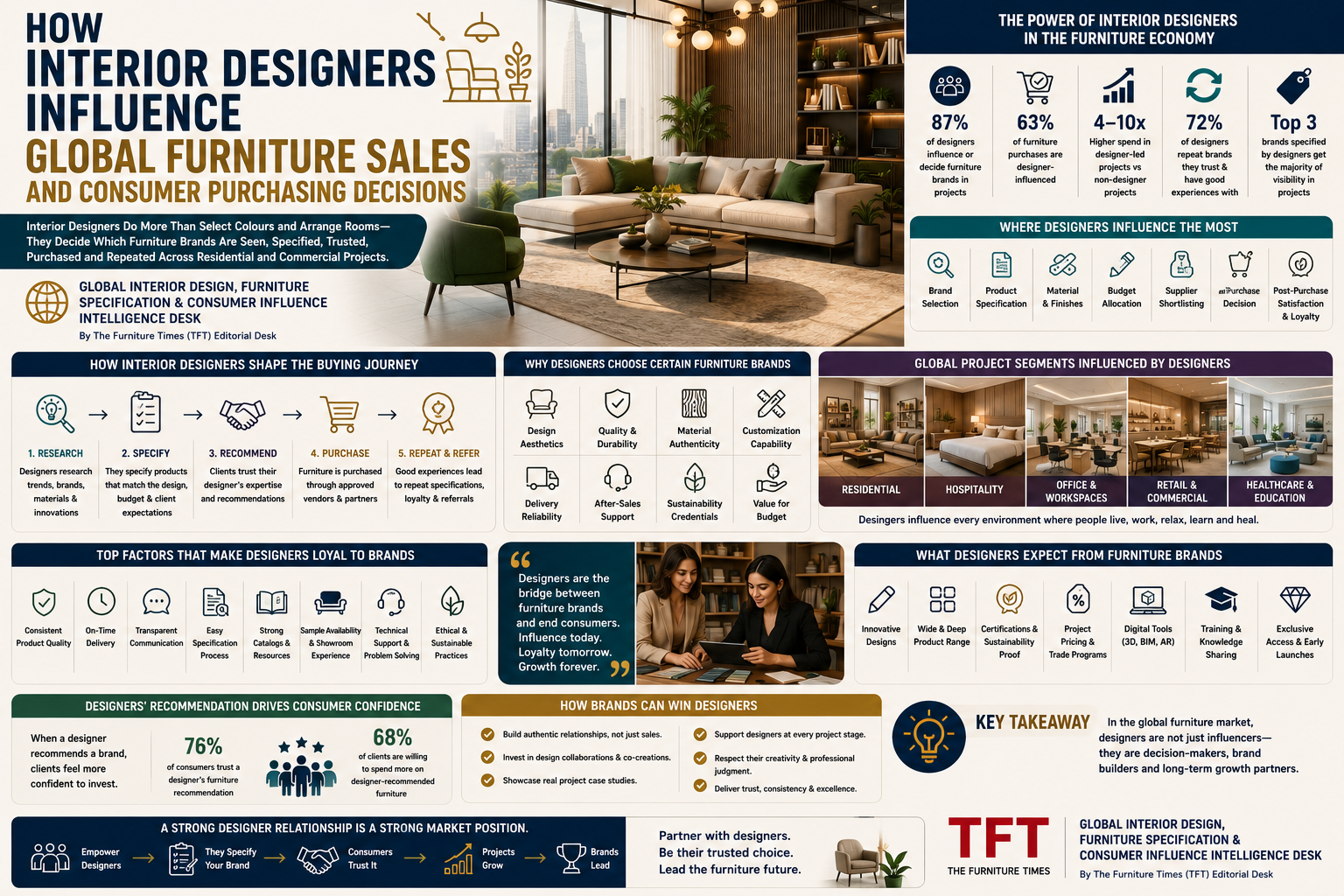
How Interior Designers Influence Global Furniture Sales and Consumer Purchasing Decisions
Interior Designers Do More Than Select Colours and Arrange Rooms—They Decide Which Furniture Brands Are Seen, Specified, Trusted, Purchased and Repeated Across Residential and Commercial Projects
Global Interior Design, Furniture Specification & Consumer Influence Intelligence Desk
By The Furniture Times (TFT) Editorial Desk
Interior designers are among the most influential decision-makers in the global furniture industry ecosystem.
They connect consumers, architects, property developers, furniture brands, manufacturers, contractors, retailers, craftspeople and procurement specialists.
Their recommendations can determine:
- Which furniture brands enter a project
- Which products customers consider
- Which materials are accepted
- Which suppliers receive quotation requests
- Which furniture is included in specifications
- Which designs appear in completed homes, hotels and offices
- Which products are photographed and shared online
- Which brands gain credibility with future buyers
A consumer may enter a furniture showroom with only a general idea of what they want.
An interior designer enters with a more complete understanding of:
- Room dimensions
- circulation
- colour
- proportion
- materials
- lighting
- furniture scale
- lifestyle
- project budget
- delivery schedule
- technical limitations
Professional interior designers may develop concepts, create plans and three-dimensional presentations, select and specify furniture and materials, coordinate with contractors, oversee budgets and manage procurement or installation. These responsibilities place designers directly between the furniture brand and the final purchasing decision.
This influence is not limited to luxury homes.
Interior designers affect furniture purchasing across:
- Apartments
- villas
- rental properties
- hotels
- resorts
- restaurants
- cafés
- offices
- healthcare facilities
- schools
- universities
- retail stores
- senior-living communities
- public buildings
In many commercial projects, the designer does not simply recommend a visual style. The designer may prepare furniture schedules, write product specifications, evaluate samples, review shop drawings, coordinate procurement and inspect installation.
The designer therefore influences both consumer desire and commercial purchasing power.
Interior Designers Translate Human Needs Into Furniture Demand
Most consumers do not begin a design project with a detailed furniture specification.
They begin with a need or feeling:
- The home feels incomplete.
- The apartment lacks storage.
- The living room is uncomfortable.
- The hotel looks outdated.
- The office does not support hybrid work.
- The restaurant needs a stronger identity.
- The property needs to feel more valuable.
The interior designer translates these concerns into practical furniture requirements.
For example, “We need a more welcoming living room” may become:
- A modular sofa
- two lounge chairs
- a larger rug
- layered side tables
- better lighting
- concealed media storage
“We need a more efficient hotel room” may become:
- A compact desk
- integrated luggage storage
- a custom wardrobe
- a durable headboard
- accessible power points
- a commercial-grade chair
The designer converts an emotional or operational problem into a furniture purchase.
The Designer Is a Gatekeeper Between Brands and Buyers
Furniture brands frequently focus their marketing on the final consumer.
However, many purchases are influenced or controlled by professionals before the customer enters a showroom.
A designer may determine:
- Which brands appear in a mood board
- Which products are presented to the client
- Which suppliers receive the project brief
- Which materials are sampled
- Which products satisfy the required budget
- Which alternatives are rejected
- Which supplier is trusted to deliver
A furniture company that is unknown to designers may remain invisible even when its products are technically suitable.
A company that builds strong professional relationships may be specified repeatedly across several projects.
This makes interior designers powerful commercial gatekeepers.
The Four Levels of Interior Designer Influence
Interior designers influence furniture sales through four primary roles.
1. Inspiration
The designer introduces consumers to styles, products, brands and materials they may not have discovered independently.
2. Recommendation
The designer narrows the market and recommends products suited to the client.
3. Specification
The designer records the required product, material, size, colour or performance within project documentation.
4. Procurement
The designer or associated procurement team may obtain quotations, place orders, coordinate delivery and oversee installation.
The British Institute of Interior Design identifies sourcing and supplying furniture, fixtures and equipment as a key component of many interior-design projects. A designer may act as an agent advising the client or as a principal supplying the FF&E directly.
The closer the designer moves from inspiration toward procurement, the greater their direct influence over furniture revenue.
Inspiration: Designers Shape What Consumers Want
Interior designers influence consumer interest before a project begins.
Their work appears through:
- Completed-project photography
- design magazines
- websites
- social media
- video tours
- show houses
- hotel interiors
- restaurants
- exhibitions
- awards
- property developments
Consumers see these spaces and begin searching for similar products.
A designer may popularise:
- Curved sofas
- natural timber tables
- modular storage
- sculptural chairs
- upholstered beds
- outdoor daybeds
- concealed home offices
- vintage furniture
- handmade products
The furniture brand may receive attention even when consumers do not know the exact model.
They may search:
- Sofa used in designer living room
- Luxury hotel lobby chair
- Curved sofa similar to this image
- Dining table seen in interior project
- Interior designer furniture brands
Interior designers therefore create downstream search demand.
Designers Reduce Consumer Choice Overload
Furniture customers face thousands of options.
They may need to compare:
- Dimensions
- styles
- materials
- prices
- fabrics
- finishes
- delivery times
- warranties
- brands
This can become overwhelming.
The designer reduces the number of choices.
Instead of presenting 200 sofas, the designer may present three.
Instead of asking the client to review hundreds of fabrics, the designer may create a controlled material palette.
This selection process saves time and reduces the fear of making a mistake.
The designer’s authority makes the remaining options appear safer and more relevant.
Designers Influence Brand Trust
Consumers are more likely to trust an unfamiliar furniture brand when it is recommended by a professional.
The customer may think:
- The designer understands quality.
- The designer has worked with this supplier before.
- The designer knows whether the dimensions are suitable.
- The designer can identify material differences.
- The designer will help if something goes wrong.
This transfer of trust can be commercially powerful.
A small manufacturer may lack broad consumer recognition but still win valuable business through designer recommendations.
Professional endorsement can help an emerging brand compete against larger retailers.
Designers Influence Furniture Budgets
Interior designers do not always push customers toward the most expensive product.
Their role may be to distribute a limited budget intelligently.
A designer may recommend spending more on:
- A high-use sofa
- a supportive mattress
- commercial dining chairs
- durable outdoor furniture
- quality wardrobe hardware
The designer may reduce spending on:
- Occasional tables
- decorative furniture
- guest-room pieces
- temporary products
- lower-use areas
This creates a save-and-invest strategy.
The designer helps the customer understand where premium furniture creates value and where affordable alternatives are acceptable.
The Designer Shapes Perceived Value
Without professional explanation, two sofas may appear similar.
A designer may explain differences involving:
- Frame construction
- foam density
- fabric performance
- stitching
- modularity
- proportions
- seat depth
- replacement covers
- warranty
This allows the customer to understand why one product costs more.
Designers can therefore strengthen premium furniture sales by converting technical features into customer value.
They can also protect customers from paying a premium that is not supported by meaningful differences.
Furniture Specification: Where Influence Becomes Commercial Power
In professional projects, the designer may create a furniture specification.
A specification can identify:
- Product name
- manufacturer
- model number
- dimensions
- material
- finish
- upholstery
- colour
- quantity
- intended location
- performance requirements
- approved equivalent conditions
Once a brand enters the specification, it gains a strong commercial advantage.
The contractor or procurement team may be required to obtain that exact product or an approved equivalent.
The specification therefore acts as a bridge between design and purchasing.
Named Specifications
A designer may specify one exact furniture brand and model.
For example:
- Manufacturer
- collection
- product code
- selected finish
- approved fabric
This creates a direct opportunity for the named supplier.
However, the product may still face substitution if:
- It exceeds the budget
- lead times are too long
- stock is unavailable
- shipping costs are excessive
- local support is weak
- compliance documentation is incomplete
Furniture brands must therefore protect specifications through operational performance, not only design appeal.
Performance Specifications
Instead of naming one exact product, the designer may describe the required performance.
A commercial chair specification may include:
- Seat dimensions
- frame material
- upholstery performance
- structural testing
- commercial warranty
- fire requirements
- stackability
- weight limit
This allows several brands to compete.
Manufacturers that provide complete technical information are more likely to satisfy performance-based specifications.
Designers Influence Material Demand
Interior designers help determine which materials become commercially desirable.
They may recommend:
- Solid timber
- veneer
- engineered wood
- aluminium
- stainless steel
- stone
- glass
- natural leather
- performance textiles
- recycled materials
- bamboo
- rattan
Their decisions are influenced by:
- Design concept
- price
- durability
- climate
- maintenance
- sustainability
- safety
- availability
A material trend can move from professional projects into the broader consumer market.
For example, a material first used in premium hotels may later appear in restaurants, apartments and mass-market retail collections.
Designers Influence Colour and Finish Sales
Furniture sales are affected not only by the product shape but also by the selected finish.
Interior designers may create demand for:
- Natural oak
- dark walnut
- painted timber
- brushed metal
- warm neutrals
- bold upholstery
- textured fabrics
- matte surfaces
- stone finishes
A furniture company may have a strong product but lose the specification because its colour range does not coordinate with the project palette.
Brands serving designers need flexible finish systems and reliable colour consistency.
Designers Influence Product Dimensions
Consumers often select furniture according to appearance before confirming whether it fits.
Designers begin with spatial planning.
They examine:
- Room dimensions
- doors
- windows
- circulation
- furniture clearances
- ceiling height
- visual balance
- delivery access
This can shift demand toward:
- Compact sofas
- custom tables
- narrow consoles
- lower furniture
- modular systems
- made-to-measure storage
The designer does not merely choose furniture.
The designer determines the correct scale.
Designers Influence Custom Furniture Sales
Standard furniture cannot solve every project requirement.
Designers may create custom products when:
- The room has unusual dimensions
- the design requires a unique identity
- standard products waste space
- the material must match architectural finishes
- a hotel brand requires a particular feature
- commercial functionality is specialised
Custom furniture categories include:
- Sofas
- banquettes
- reception counters
- wardrobes
- headboards
- dining tables
- retail displays
- office storage
- outdoor furniture
Interior designers create substantial opportunities for:
- Specialist manufacturers
- joinery companies
- upholsterers
- metal fabricators
- craftspeople
- stone suppliers
Designers Influence Commercial Furniture Procurement
In hotels, offices, restaurants and other commercial environments, furniture must satisfy more than visual expectations.
It may need to provide:
- Commercial durability
- accessibility
- cleanability
- fire performance
- replacement availability
- brand consistency
- installation coordination
- technical documentation
Design professionals may review submissions, samples, shop drawings and specifications while coordinating budgets, suppliers and installation.
This gives designers direct influence over large procurement packages.
One hotel project may include:
- Hundreds of beds
- bedside tables
- wardrobes
- desks
- dining chairs
- lobby sofas
- outdoor loungers
- restaurant tables
The designer’s product decisions can therefore affect millions in furniture revenue.
Hotel Interior Designers
Hotel designers influence furniture through:
- Guest-room planning
- brand standards
- public-area concepts
- food-and-beverage environments
- spa design
- outdoor spaces
- custom FF&E
They evaluate:
- Guest comfort
- photography
- operational efficiency
- maintenance
- replacement cycles
- housekeeping access
- property identity
A successful hotel interior can influence consumer furniture demand because guests may later seek similar beds, chairs, lighting or materials for their homes.
Hospitality design acts as a global furniture showroom.
Restaurant and Café Designers
Furniture determines:
- Seating capacity
- customer comfort
- table turnover
- brand atmosphere
- social-media visibility
- cleaning efficiency
Restaurant designers select furniture according to:
- Space
- cuisine
- service style
- customer profile
- indoor or outdoor use
- durability
- stackability
- acoustic performance
A visually distinctive chair may become part of the restaurant’s identity.
Workplace Interior Designers
Office designers influence demand for:
- Task chairs
- height-adjustable desks
- meeting furniture
- collaborative seating
- acoustic booths
- lockers
- reception furniture
- breakout areas
Their decisions increasingly respond to:
- Hybrid work
- employee wellbeing
- flexibility
- technology
- collaboration
- sustainability
A designer may recommend modular or reconfigurable systems rather than fixed furniture, creating new demand for products that adapt over time.
Healthcare Interior Designers
Healthcare furniture requires attention to:
- Cleanability
- infection-control practices
- accessibility
- patient support
- staff needs
- stability
- maintenance
- durability
The designer helps balance clinical performance with a less institutional and more reassuring visual environment.
Education Interior Designers
Designers working in schools and universities influence demand for:
- Adjustable desks
- flexible classrooms
- library furniture
- collaborative tables
- student housing
- technology-enabled furniture
- outdoor learning furniture
The traditional fixed classroom is increasingly supplemented by adaptable learning environments.
Residential Designers Influence Whole-Home Spending
A consumer buying furniture independently may purchase one room at a time.
A designer-led project can create a coordinated whole-home order.
It may include:
- Living room
- dining room
- bedrooms
- home office
- storage
- outdoor areas
- decorative furniture
The designer increases the average project value by showing how separate products work together.
However, the designer may also control unnecessary spending by preventing unsuitable or duplicate purchases.
Interior Designers and Furniture Retailers
Furniture retailers benefit from designers through:
- Qualified customers
- larger orders
- repeated projects
- professional product selection
- fewer unsuitable purchases
- stronger premium conversion
Many retailers create trade programmes offering:
- Professional pricing
- dedicated advisers
- material samples
- early product access
- specification support
- customisation
- delivery coordination
- project quotations
A strong trade programme should provide genuine project support rather than merely a discount.
Interior Designers and Furniture Manufacturers
Manufacturers can work with designers through:
- Standard collections
- custom manufacturing
- product adaptations
- exclusive collections
- private labels
- prototypes
- material development
Designers provide manufacturers with valuable market intelligence.
They understand:
- Customer frustrations
- missing dimensions
- material concerns
- changing lifestyles
- regional preferences
- project requirements
A manufacturer that listens to designers can identify unmet product demand earlier.
Designers as Product Collaborators
Furniture brands frequently collaborate with established designers to create collections.
These partnerships can generate:
- New design identity
- media attention
- professional credibility
- retailer interest
- international exposure
- premium positioning
A designer collaboration succeeds when it combines the designer’s vision with the manufacturer’s production capability.
It fails when the collaboration is only a name placed on an ordinary product.
Trade Discounts and Designer Compensation
Designer purchasing arrangements vary by market and project.
A designer may:
- Charge the client a professional fee
- receive a purchasing fee
- apply a disclosed markup
- receive a trade discount
- act as the client’s purchasing agent
- supply furniture directly as principal
The BIID notes that legal and commercial responsibilities differ depending on whether the designer acts as agent or principal in sourcing FF&E. Clear agreements are therefore important for clients, designers and suppliers.
Transparency protects trust.
The client should understand:
- Who is supplying the furniture
- who receives the payment
- what fee or markup applies
- who manages defects
- who carries delivery risk
- who holds the warranty relationship
Why Designers Reject Furniture Brands
A product may be visually attractive but unsuitable for professional specification.
Common reasons include:
- Missing dimensions
- unclear materials
- no technical documents
- poor samples
- inconsistent finishes
- unrealistic lead times
- weak communication
- no commercial warranty
- no replacement parts
- limited customisation
- unreliable delivery
- no project references
Furniture brands often assume designers choose only according to style.
Professional designers also evaluate operational risk.
Product Information Is a Sales Tool
Furniture brands serving designers should provide:
- Product dimensions
- technical drawings
- CAD files
- three-dimensional models
- material composition
- finish options
- fabric performance
- commercial-use guidance
- testing information
- warranty
- lead time
- price or quotation route
- installation requirements
- care instructions
- environmental documentation
ASID descriptions of professional design work include selecting and specifying furnishings, materials and finishes, coordinating procurement, reviewing samples and overseeing installation. Brands that make these tasks easier are more likely to be used repeatedly.
Samples Influence Purchasing Decisions
Interior designers depend heavily on physical samples.
They may request:
- Timber samples
- veneer samples
- fabric swatches
- leather samples
- metal finishes
- stone samples
- panel finishes
- complete product samples
Samples help the designer evaluate:
- Colour
- texture
- quality
- finish consistency
- relationship with other materials
- performance
A delayed or poorly prepared sample can cause a furniture brand to miss the project approval deadline.
Mock-Ups Create Confidence
For large commercial projects, designers may request:
- Prototype chairs
- sample hotel rooms
- full-size headboards
- reception-counter mock-ups
- custom table prototypes
- outdoor furniture samples
Mock-ups allow the project team to test:
- Scale
- comfort
- construction
- appearance
- usability
- maintenance
Manufacturers that produce accurate prototypes gain a competitive advantage.
Lead Time Influences Specification
Designers work within project schedules.
A product may be perfect aesthetically but unusable if it will arrive after:
- The property opening
- the client move-in date
- the photography session
- the hotel launch
- the office relocation
Brands should communicate:
- Sample lead time
- drawing lead time
- production lead time
- shipping time
- installation time
- potential delay risks
Reliability is often more valuable than an optimistic promise.
Designers Influence Furniture Search Behaviour
Consumers may begin digital searches using professional language introduced by designers.
Examples include:
- Performance fabric sofa
- fluted wood cabinet
- modular sectional
- boucle chair
- cantilever dining chair
- sintered stone table
- custom banquette
- Japandi furniture
- biophilic office furniture
- hospitality-grade outdoor furniture
Designers educate consumers in the language of:
- Materials
- styles
- construction
- colour
- product types
This changes how customers search and compare furniture.
Social Media Has Expanded Designer Influence
Interior designers no longer influence only their direct clients.
Through digital platforms, one project can influence thousands or millions of consumers.
Design content may include:
- Room transformations
- material selections
- project walkthroughs
- furniture sourcing
- before-and-after images
- showroom visits
- installation videos
- design explanations
A single widely shared interior can generate demand for:
- A sofa style
- dining-chair shape
- timber finish
- bed design
- storage solution
- outdoor collection
Furniture brands should make products easy to identify and purchase after digital exposure.
Designers Influence Visual Search
Consumers may save a photograph without knowing the furniture brand.
They may then use:
- Image search
- visual search
- social platforms
- AI assistants
- direct questions to the designer
Brands need strong digital product records connecting images with:
- Product name
- manufacturer
- dimensions
- material
- price or quotation route
- availability
A beautiful product that cannot be identified may generate inspiration but no attributable sale.
AI Is Changing the Designer–Consumer Relationship
AI tools can assist with:
- Mood boards
- layout ideas
- product discovery
- colour coordination
- furniture comparisons
- visualisation
- initial budgeting
This may allow consumers to complete some early design research independently.
However, professional designers remain important because real projects involve:
- Accurate measurements
- technical coordination
- material evaluation
- budget decisions
- supplier verification
- procurement
- installation
- problem resolution
AI may reduce time spent on routine exploration while increasing the importance of professional judgment.
AI Search Can Amplify Designer Recommendations
Consumers may ask:
- Which brands are commonly specified by interior designers?
- What furniture suits this designer-inspired room?
- Find alternatives to this designer chair.
- Compare these recommended sofa materials.
- Which commercial furniture meets this specification?
Brands with complete product information, project case studies and professional recognition may become easier for AI systems to identify.
Designers Influence Sustainable Furniture Demand
Interior designers increasingly influence:
- Certified timber selection
- product transparency
- recycled content
- repairability
- refurbishment
- furniture reuse
- low-emission materials
- end-of-life planning
AIA’s design guidance encourages teams to prefer manufacturers with stronger product transparency and to consider extended producer responsibility for furniture, fixtures and equipment.
Designers can ask manufacturers for:
- Environmental Product Declarations
- Health Product Declarations
- material certifications
- timber documentation
- recycled-content information
- repair guidance
- take-back programmes
When designers repeatedly request this information, suppliers have a commercial incentive to improve.
Designers Influence Circular Furniture Sales
A designer does not always recommend new furniture.
They may propose:
- Reusing existing products
- reupholstering sofas
- refinishing timber
- purchasing vintage furniture
- refurbishing office systems
- combining old and new furniture
- sourcing pre-owned designer pieces
This expands the furniture economy beyond manufacturing.
It creates demand for:
- Restoration
- upholstery
- resale
- authentication
- repair
- furniture rental
- logistics
- storage
Regional Differences in Designer Influence
North America
Designers influence:
- Residential renovation
- luxury homes
- hospitality
- corporate offices
- healthcare
- senior living
Clients often expect detailed budgets, samples, project coordination and procurement support.
Europe
European designers influence:
- Premium furniture
- kitchens
- heritage renovation
- circularity
- certified materials
- compact living
- hospitality
Design history and strong manufacturing clusters provide close connections between designers and furniture producers.
Asia-Pacific
Designer influence is expanding through:
- Rapid urbanisation
- apartment development
- hospitality
- luxury property
- social media
- branded residences
Markets such as China, India, Japan, South Korea, Singapore, Malaysia, Indonesia and Australia contain distinct design cultures and consumer expectations.
Middle East
Interior designers play a powerful role in:
- Luxury villas
- hotels
- resorts
- branded residences
- restaurants
- corporate offices
Projects may require international sourcing, custom production and large FF&E packages.
Africa
Designers influence growing markets in:
- Luxury urban homes
- hospitality
- offices
- cultural tourism
- retail
- public buildings
There is significant opportunity to connect contemporary design with local timber, weaving, metalwork and craftsmanship.
Latin America
Designers influence:
- Urban apartments
- premium residences
- hospitality
- restaurants
- local furniture manufacturing
- custom wood furniture
Regional material traditions can provide strong differentiation.
Designers Influence Local Craft Economies
Interior designers can connect craftspeople with higher-value markets.
They may commission:
- Handwoven chairs
- carved timber furniture
- custom metalwork
- bamboo products
- rattan furniture
- stone tables
- handmade upholstery
The designer can help translate traditional skills into products suited to contemporary spaces.
This can generate:
- Rural employment
- cultural preservation
- premium pricing
- tourism value
- export opportunities
However, designers and brands should respect:
- Fair compensation
- intellectual ownership
- production capacity
- material sourcing
- realistic timelines
Designers Influence Property Value Perception
Furniture and interiors affect how buyers and tenants perceive a property.
A well-furnished show unit can help consumers imagine:
- Room functionality
- lifestyle
- storage
- furniture scale
- social status
Developers use interior designers to create:
- Model apartments
- sales galleries
- furnished residences
- common areas
- clubhouses
- lobbies
Furniture becomes part of property marketing.
A product specified in a successful show unit may receive orders from individual property buyers.
Designers Influence Hospitality Revenue
In hotels and restaurants, furniture affects:
- Customer comfort
- length of stay
- photography
- reviews
- social-media sharing
- space utilisation
- food-and-beverage capacity
The designer’s furniture selection can influence both the cost of the project and the future earning ability of the space.
A rooftop chair is not only a chair.
It is part of the customer experience and revenue model.
Designers Influence Furniture Replacement
Interior designers often enter a project during:
- Renovation
- relocation
- brand refresh
- hotel refurbishment
- office reconfiguration
- family change
They may recommend:
- Keeping some furniture
- repairing some products
- replacing unsuitable pieces
- relocating furniture
- purchasing new items
Their professional assessment can accelerate replacement demand or extend product life.
How Furniture Brands Can Become Designer-Friendly
Furniture brands should:
- Create a professional trade programme.
- Assign knowledgeable project contacts.
- Provide fast samples.
- Publish exact dimensions.
- Offer technical drawings.
- Provide CAD and 3D files where appropriate.
- Explain materials accurately.
- State commercial-use suitability.
- Publish realistic lead times.
- Offer customisation clearly.
- Maintain finish consistency.
- provide project quotations.
- Coordinate delivery and installation.
- Offer replacement components.
- Document completed projects.
- Provide sustainability information.
- Respond quickly to specification questions.
- protect designer-client relationships.
- avoid approaching the designer’s client improperly.
- support the project after installation.
The Importance of Protecting the Designer Relationship
Designers may hesitate to introduce clients to suppliers if they fear the supplier will:
- Bypass them
- offer conflicting prices
- change the agreed specification
- communicate directly without permission
- reveal confidential project information
- fail to respect professional fees
Furniture brands should establish clear communication protocols.
Trust between designer and supplier can lead to years of repeat business.
One careless action can end the relationship.
Trade Programmes Should Offer More Than Discounts
A valuable designer programme may include:
- Dedicated pricing
- quotation support
- sample libraries
- priority production
- custom finishes
- product training
- delivery coordination
- installation services
- project tracking
- warranty assistance
Discount alone does not solve the designer’s project responsibilities.
Designers need suppliers who reduce work and risk.
Furniture Showrooms Should Support Designers
Designer-friendly showrooms should provide:
- Quiet meeting areas
- large working tables
- material samples
- product specifications
- trained advisers
- accurate pricing
- appointment systems
- photography permission
- project storage
- client presentation support
The showroom can become an extension of the design studio.
Furniture Brands Should Publish Project Case Studies
A case study should explain:
- Project type
- location
- client need
- designer
- furniture supplied
- material
- customisation
- installation
- performance requirement
- final outcome
Case studies provide evidence that the brand can perform in real projects.
They help designers evaluate whether a supplier has relevant experience.
Designer Recognition Creates Brand Visibility
Furniture brands should credit interior designers appropriately when publishing project images.
Recognition supports:
- Professional relationships
- content sharing
- designer reputation
- brand credibility
- future collaboration
The project should also credit photographers, architects and other collaborators when appropriate.
Designers Need Accurate Pricing
A furniture brand can lose trust through:
- Frequent price changes
- hidden delivery fees
- unclear trade pricing
- inconsistent quotations
- unavailable stock
- unexpected custom charges
Designers prepare budgets for clients.
One inaccurate supplier price can force changes across several products.
Brands should provide:
- Quotation validity
- currency
- taxes
- freight
- installation
- customisation fees
- expected price-change risks
Designers Need Reliable Warranties
The designer’s reputation can be affected when a product fails.
Designers therefore consider:
- Warranty period
- exclusions
- claim process
- replacement lead time
- local service
- spare parts
A strong after-sales system makes the designer more comfortable specifying the brand again.
Common Mistakes Furniture Brands Make With Designers
Treating Designers Only as Discount Seekers
Professional designers provide access to clients and projects, but they also carry significant responsibilities.
Sending Incomplete Catalogues
A visual catalogue without dimensions, materials or lead times is difficult to specify.
Responding Slowly
Project deadlines do not wait for the supplier.
Offering Unlimited Customisation Without Systems
Customisation must be priced, documented and approved properly.
Changing Materials Without Approval
Unauthorised substitutions damage trust.
Failing to Protect Specifications
A brand may lose its own specification because it cannot provide samples, stock or documentation.
Ignoring Small Design Studios
A small studio may manage high-value clients and repeated projects.
Strategic Recommendations for Interior Designers
Interior designers should:
- Understand the client’s real lifestyle and operational needs.
- Establish the budget early.
- Explain furniture priorities clearly.
- Verify product dimensions.
- Review material claims.
- evaluate supplier reliability.
- document specifications.
- obtain samples.
- compare lifecycle value.
- clarify procurement responsibilities.
- disclose fees and commercial arrangements.
- coordinate delivery access.
- inspect furniture after installation.
- maintain product records.
- recommend repair or reuse where appropriate.
Strategic Recommendations for Furniture Manufacturers
Manufacturers should:
- Treat designers as long-term business partners.
- Build specification-ready product data.
- offer rapid sample services.
- improve custom manufacturing processes.
- create professional project teams.
- provide accurate shop drawings.
- strengthen quality control.
- maintain material consistency.
- develop commercial warranties.
- provide spare parts.
- document sustainability.
- build digital libraries.
- invite designers into product development.
- track products most frequently specified.
- measure designer-generated revenue.
Strategic Recommendations for Furniture Retailers
Retailers should:
- Create verified trade accounts.
- assign dedicated advisers.
- provide project pricing.
- maintain accurate inventory.
- offer samples.
- create client presentation areas.
- support delivery scheduling.
- provide installation.
- respect designer communication boundaries.
- build designer referral systems.
- host professional product education.
- document completed installations.
- manage defects quickly.
- support after-sales enquiries.
- develop local designer communities.
The Future of Designer-Led Furniture Commerce
Interior designers will remain highly influential, but their tools and responsibilities will evolve.
The future will include:
- AI-assisted product discovery
- digital sample libraries
- augmented-reality placement
- virtual showrooms
- real-time product availability
- automated furniture schedules
- Digital Product Passports
- lifecycle-cost data
- furniture reuse platforms
- global supplier search systems
Designers will be able to discover products from more countries and smaller manufacturers.
However, greater choice will increase the need for verification.
Designers will need to confirm:
- Supplier legitimacy
- material accuracy
- production capacity
- delivery capability
- compliance
- warranty support
Interior Designers Are Furniture Industry Multipliers
One consumer may buy furniture for one home.
One interior designer may influence furniture purchases across:
- Dozens of homes
- multiple hotels
- restaurant groups
- office portfolios
- property developments
- international projects
This makes the designer a commercial multiplier.
A strong relationship with one design studio can produce:
- Repeat specifications
- multiple-project orders
- professional referrals
- project photography
- brand visibility
- product-development insight
The Designer Does Not Replace the Consumer—The Designer Strengthens the Decision
The final client still has preferences, financial limits and approval power.
The designer’s role is to make the decision more informed, coordinated and appropriate.
The designer helps answer:
- Will it fit?
- Will it function?
- Does it match the project?
- Is the material suitable?
- Is the price justified?
- Can the supplier deliver?
- Will it last?
Furniture brands that help designers answer these questions gain an advantage.
Furniture Sales Begin Long Before the Purchase Order
The sale may begin when a designer:
- Saves a product image
- requests a sample
- visits a showroom
- adds a product to a mood board
- contacts a sales representative
- includes a brand in a specification
The final purchase order may arrive months later.
Furniture businesses need systems that support this long decision journey.
The Brands Designers Trust Become the Brands Consumers Discover
Interior designers shape rooms, but their commercial influence extends far beyond the physical space.
They shape:
- Consumer aspiration
- furniture vocabulary
- material trends
- brand recognition
- product specifications
- procurement decisions
- sustainability expectations
- replacement behaviour
The strongest furniture brands will not treat designers merely as another sales channel.
They will recognise designers as partners who translate furniture into complete human environments.
A chair displayed alone is a product.
A chair selected by a designer and placed correctly within a home, hotel, restaurant or office becomes part of an experience.
That experience creates trust, photographs, recommendations, searches and future sales.
Interior designers influence global furniture sales because they do not simply tell customers what to buy. They demonstrate why a product belongs in the space, how it supports the user and whether the brand can be trusted to fulfil the promise behind the design.
