
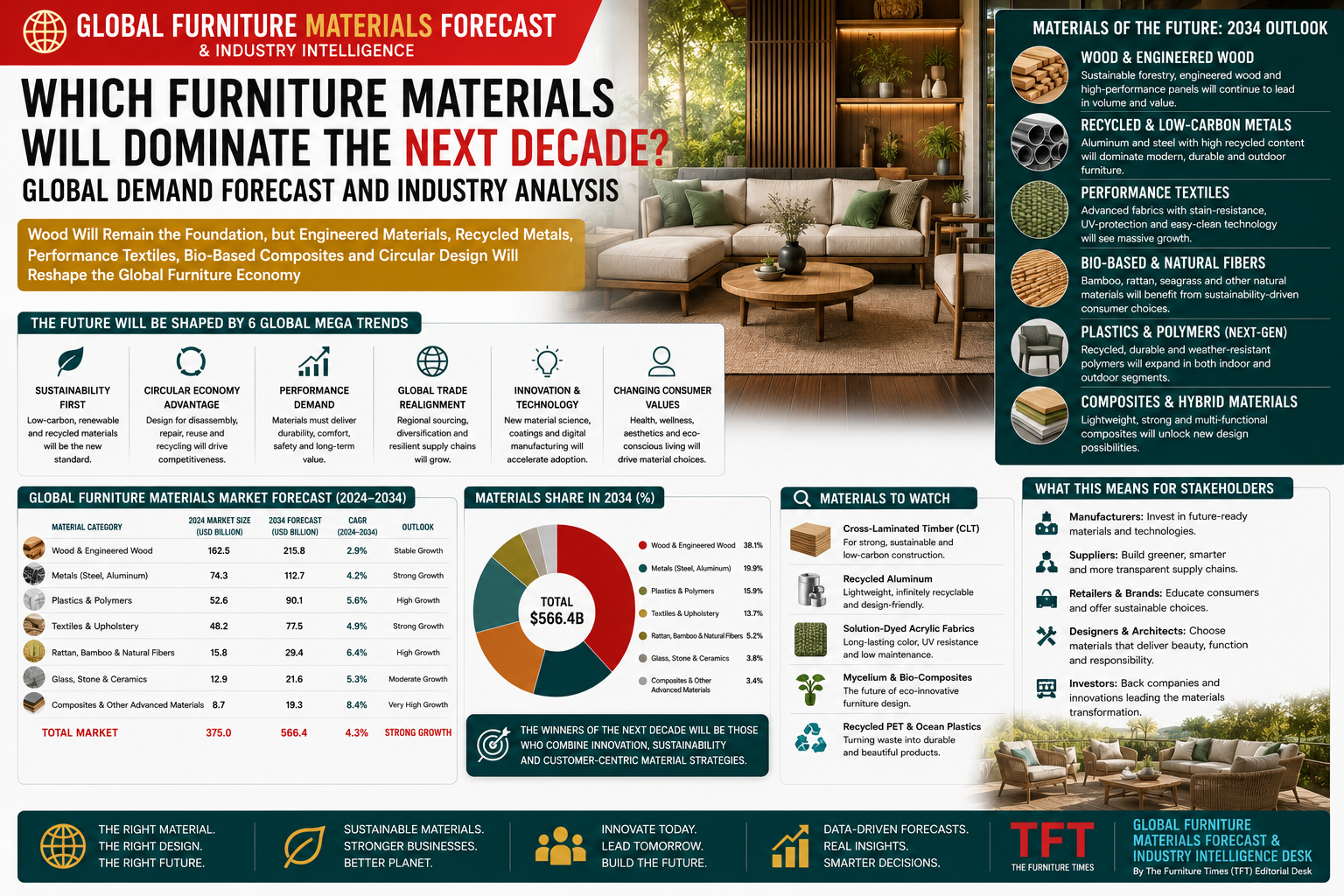
Which Furniture Materials Will Dominate the Next Decade? Global Demand Forecast and Industry Analysis
Wood Will Remain the Foundation, but Engineered Materials, Recycled Metals, Performance Textiles, Bio-Based Composites and Circular Design Will Reshape the Global Furniture Economy
Global Furniture Materials Forecast & Industry Intelligence Desk
By The Furniture Times (TFT) Editorial Desk
The next decade of furniture manufacturing will not be defined by the complete replacement of one material with another.
Wood will not disappear because bamboo is growing rapidly. Metal will not replace upholstery. Recycled plastic will not eliminate virgin polymers immediately. Natural stone will not become a mass-market solution, and experimental bio-materials will not suddenly take over global factories.
Instead, the furniture industry is moving toward a more complex material economy in which products are expected to become:
- More durable
- Easier to repair
- Lighter to transport
- More transparent in their composition
- Better suited to regional climates
- Less wasteful in production
- More efficient to manufacture
- Easier to disassemble
- More compatible with recycling
- More credible in their environmental claims
The global furniture market itself is expected to expand substantially through the next decade. One current estimate values the market at approximately US$786.1 billion in 2025, increasing from about US$831.6 billion in 2026 to US$1.33 trillion by 2033. Another major estimate projects growth from approximately US$629.2 billion in 2026 to US$996.4 billion by 2034. The difference reflects variations in market definitions, product coverage and research methodology, but both forecasts point toward significant long-term expansion.
As furniture demand grows, the material question will become increasingly important.
The winning materials will not necessarily be those with the lowest purchase price. They will be those that provide the strongest combination of availability, performance, manufacturability, affordability, transport efficiency, regulatory acceptance, customer trust and end-of-life value.
The Expected Material Leaders Through 2035
Based on current global direction, the materials most likely to shape furniture manufacturing over the next decade can be grouped into five strategic positions.
Tier One: The Volume Leaders
These materials will continue accounting for the largest amount of global furniture production:
- Engineered wood and certified timber
- Steel and aluminium
- Plastic and polymer materials
- Upholstery textiles, foam and performance fabrics
Tier Two: The High-Growth Natural Materials
These materials are likely to gain greater visibility and commercial investment:
- Bamboo
- Rattan and cane
- Fast-growing plantation timber
- Reclaimed and recycled wood
Tier Three: The Premium and Architectural Materials
These will remain smaller by volume but influential in value, luxury and design:
- Natural and engineered stone
- Glass
- Stainless steel, brass and speciality metals
- Leather and premium textile materials
Tier Four: The Circular-Economy Materials
These are expected to move from niche applications toward wider industrial adoption:
- Recycled aluminium and steel
- Recycled polymers
- Recycled textile panels
- Agricultural-waste boards
- Wood-plastic composites
- Remanufactured furniture components
Tier Five: The Emerging Experimental Materials
These may not dominate total volume by 2035, but they could become important innovation platforms:
- Mycelium-based materials
- Bio-based foams
- Natural-fibre composites
- Plant-based leather alternatives
- Low-carbon adhesives and binders
- Advanced lightweight composite cores
Number One: Engineered Wood Will Remain the Global Volume Leader
Engineered wood is positioned to remain one of the most commercially important furniture material groups through 2035.
The category includes:
- Particleboard
- Medium-density fibreboard
- High-density fibreboard
- Plywood
- Laminated boards
- Veneered panels
- Oriented strand board
- Finger-jointed timber
- Laminated structural components
- Recycled-wood panels
Its strength comes from industrial efficiency.
Engineered wood supports standard dimensions, automated cutting, drilling, edge banding, nesting and flat-pack manufacturing. It allows producers to manufacture wardrobes, kitchens, desks, shelves, cabinets, television units and storage systems at a scale that would be difficult to achieve using solid timber alone.
Why Engineered Wood Will Continue to Lead
Affordability
Engineered boards enable manufacturers to use wood fibres, chips, veneers and smaller timber sections more efficiently.
This supports affordable furniture for expanding urban populations and first-time household buyers.
Compatibility With Automation
Panel furniture is well suited to:
- CNC machining
- Automated drilling
- Robotic handling
- Digital production planning
- Mass customisation
- Ready-to-assemble construction
Design Versatility
Decorative laminates, veneers, printed surfaces and coatings can provide a broad range of colours and textures.
Transport Efficiency
Panel furniture can often be designed for flat-pack delivery, reducing shipping volume and warehouse requirements.
The Challenges Engineered Wood Must Overcome
Future growth will depend on improvement in:
- Moisture resistance
- Edge durability
- Formaldehyde and chemical emissions
- Adhesive performance
- Screw-holding ability
- Repairability
- Recycled content
- Component separation
- End-of-life recovery
Low-quality engineered-wood furniture can create a disposable cycle in which products are difficult to repair and uneconomical to move.
The next decade will favour better-engineered boards, stronger connections, replaceable panels and products designed for repeated assembly rather than one-time installation.
Number Two: Certified and Responsibly Sourced Wood Will Remain the Trust Leader
Natural wood will retain a powerful position because consumers associate it with warmth, craftsmanship, authenticity and longevity.
Wood is unlikely to be displaced as the emotional foundation of furniture.
The global forest-products sector remains economically significant. FAO reported that global exports of wood and paper products reached approximately US$486 billion in 2024, increasing by US$7 billion from the previous year. FAO’s latest statistical work also tracks wooden furniture as an important secondary processed wood product within international forest-product trade.
Wood Categories Likely to Remain Important
- Oak
- Beech
- Ash
- Walnut
- Pine
- Birch
- Rubberwood
- Acacia
- Eucalyptus
- Teak
- Plantation hardwoods
- Reclaimed timber
- Thermally modified wood
Why Wood Will Remain Dominant
Long-Term Consumer Appeal
Natural grain and variation cannot be reproduced perfectly by synthetic surfaces.
Repairability
Solid wood can often be sanded, refinished, repaired or altered.
Premium Value
Well-designed wood furniture can command higher prices and retain resale value.
Regional Manufacturing Potential
Countries with managed forests and plantation resources can build local manufacturing industries rather than depend entirely on imported materials.
The Future Will Not Support Untraceable Wood
Wood’s continued dominance will depend on stronger proof of:
- Legal harvesting
- Responsible forest management
- Species identification
- Country of origin
- Chain of custody
- Carbon and environmental claims
- Durability and product lifespan
Furniture companies that use vague descriptions such as “natural wood,” “hardwood” or “eco wood” without providing meaningful information may face increasing buyer scepticism.
The strongest brands will turn traceability into a commercial advantage.
Number Three: Aluminium Will Become One of the Decade’s Most Strategic Furniture Metals
Steel will remain larger in many applications, but aluminium is positioned to gain strategic importance—particularly in outdoor, hospitality, transportable, modular and contemporary furniture.
Why Aluminium Demand Is Likely to Grow
Lightweight Performance
Aluminium lowers handling weight and can reduce delivery difficulty.
This matters for:
- Outdoor furniture
- Balcony furniture
- Café seating
- Hotel projects
- Movable office furniture
- Modular products
- Rental furniture
Corrosion Resistance
Properly specified aluminium performs well in humid and outdoor environments.
Design Flexibility
Extrusion and casting enable manufacturers to create detailed profiles, curves, frames and connection systems.
Recycling Potential
Aluminium has established recycling value, although the environmental benefit depends on collection, alloy separation and the energy source used in processing.
Where Aluminium Will Grow Fastest
- Residential outdoor furniture
- Hotel and resort furniture
- Restaurant terraces
- Poolside furniture
- Urban balcony products
- Folding and stacking furniture
- Mixed-material table systems
- Lightweight modular furniture
Aluminium’s Main Risks
- High raw-material costs
- Alloy-quality inconsistency
- Thin, weak profiles in low-cost products
- Poor welding
- Low-quality powder coating
- Instability in strong winds
- Misleading “rustproof” claims
The winners will not be manufacturers that use the least aluminium. They will be those that optimise wall thickness, alloy, structure, welding and finishing to achieve long-term value.
Number Four: Steel Will Remain the Structural Workhorse
Steel will continue serving as one of the most important furniture materials because it provides strength, availability, manufacturing precision and competitive cost.
It will remain essential in:
- Office furniture
- Storage systems
- School furniture
- Hospital furniture
- Restaurant chairs
- Table frames
- Beds
- Shelving
- Reclining mechanisms
- Sofa mechanisms
- Hardware and fittings
Why Steel Will Continue to Dominate Structural Applications
Steel supports high load-bearing capacity with relatively slim sections.
It is compatible with:
- Laser cutting
- Tube bending
- Robotic welding
- Powder coating
- Automated fabrication
- High-volume production
It also has an established global recycling infrastructure.
The Future of Steel Furniture
Demand will increasingly favour:
- Recycled steel content
- Lower-carbon steel production
- Reduced material thickness through better engineering
- Replaceable structural components
- Improved corrosion protection
- Mechanical assembly instead of permanent welding where appropriate
- Product-level material disclosure
Steel’s greatest opportunity lies in becoming lighter and more circular without compromising safety.
Number Five: Performance Textiles Will Outgrow Traditional Upholstery Thinking
Upholstery is entering a performance-driven era.
Customers no longer evaluate fabric only through colour, texture and softness. They increasingly ask whether it can resist stains, sunlight, pets, moisture, abrasion and frequent cleaning.
This is expanding demand for:
- Solution-dyed acrylic
- High-performance polyester
- Recycled polyester
- Commercial-grade woven fabrics
- Antimicrobial surfaces where genuinely required
- Easy-clean materials
- UV-resistant textiles
- Removable and washable covers
- Quick-dry outdoor textiles
- Recycled and traceable fibres
Why Performance Textiles Will Gain Market Share
Lifestyle Changes
Homes increasingly include children, pets, home offices and multifunctional rooms.
Hospitality Requirements
Hotels and restaurants need fabrics that can withstand intensive use and frequent cleaning.
Outdoor Living
Outdoor sofas, daybeds and cushions require fabrics that resist ultraviolet exposure and moisture.
Longer Product Lifespans
Replaceable covers can extend the life of upholstered furniture without requiring the entire product to be discarded.
The Major Challenge: Material Complexity
Many upholstery fabrics combine different fibres, coatings, backings and chemical treatments.
This may improve performance but make recycling difficult.
The future will favour textiles that balance performance with:
- Fibre transparency
- Reduced harmful chemistry
- Recyclability
- Replaceability
- Repairability
- Verified environmental claims
Number Six: Recycled Plastics Will Gain Faster Than Conventional Plastic Furniture
Plastic will remain important because it supports low-cost, lightweight and moulded furniture.
However, virgin plastic products will face growing environmental and regulatory pressure.
The next decade is likely to produce a division between two plastic-furniture markets.
Market One: Disposable Low-Cost Plastic
This segment will remain present in price-sensitive markets but may face stronger resistance because of:
- Short product lifespans
- UV degradation
- Breakage
- Weak recycling systems
- Waste accumulation
- Low brand differentiation
Market Two: Durable Circular Polymer Furniture
This segment is likely to grow through:
- Recycled polymer content
- Single-material designs
- Replaceable parts
- Take-back systems
- Improved UV stability
- Better structural engineering
- Premium moulded design
- Material identification
The strongest future plastic products will not be marketed merely as “recycled.”
They will need to prove that they are durable, safe, repairable and recyclable again.
Recycled content without durability can simply delay disposal rather than solve the waste problem.
Number Seven: Bamboo Will Move From Alternative Material to Industrial Material
Bamboo is one of the materials with the greatest growth potential, but its success will depend on industrialisation rather than sustainability messaging alone.
Bamboo and rattan are increasingly promoted as nature-based materials capable of replacing certain plastic applications and contributing to lower-waste production systems.
Why Bamboo Could Grow Rapidly
- Fast biological growth
- Strong availability in parts of Asia, Africa and Latin America
- Distinctive natural appearance
- Ability to support rural employment
- Compatibility with engineered boards and laminates
- Growing interest from architects and designers
- Potential use in furniture structures, panels and surfaces
Furniture Applications Likely to Expand
- Laminated bamboo tables
- Bamboo chairs
- Cabinet panels
- Decorative veneers
- Hospitality furniture
- Shelving and storage
- Small-space furniture
- Natural-fibre composites
- Outdoor and semi-outdoor collections
- Modular furniture components
What Could Restrict Bamboo Growth
- Inconsistent treatment
- Insect damage
- Moisture movement
- Weak joint engineering
- Limited grading systems
- Poor-quality adhesives
- Lack of consumer education
- Fragmented supply chains
- Misleading environmental claims
Bamboo will not dominate simply because it grows quickly.
It will dominate particular applications only when manufacturers provide consistent quality, structural testing, treatment, attractive design and scalable supply.
Number Eight: Rattan and Cane Will Lead the Craft-Luxury Natural Material Segment
Rattan and cane are positioned to benefit from the growing preference for natural texture, craftsmanship and biophilic interiors.
Unlike commodity materials, their value is strongly connected to skilled labour.
Why Demand May Increase
Consumers and hospitality designers increasingly seek furniture that feels:
- Handmade
- Natural
- Culturally meaningful
- Tactile
- Lightweight
- Relaxed but premium
- Suitable for resort and lifestyle interiors
Rattan and cane can perform well in:
- Hotel rooms
- Resort lounges
- Restaurants
- Bedrooms
- Living rooms
- Decorative cabinets
- Headboards
- Lighting
- Accent furniture
The Economic Constraint
Natural rattan furniture is difficult to scale without skilled craftspeople.
Future growth will therefore depend on:
- Craft-training programmes
- Improved treatment
- Consistent grading
- Better frame engineering
- Digital pattern development
- Fair compensation
- Responsible harvesting
- Stronger design protection
Rattan is unlikely to become the largest material by volume. It can, however, become one of the most valuable materials per unit when craftsmanship and brand storytelling are developed properly.
Number Nine: Reclaimed Wood Will Become a Stronger Premium Category
Reclaimed wood provides material history, texture and potential environmental value.
It may come from:
- Old buildings
- Railway structures
- Boats
- Industrial facilities
- Discarded furniture
- Construction timber
- Agricultural buildings
Why Reclaimed Wood Will Grow
- Demand for distinctive products
- Interest in circular design
- Reduced dependence on newly harvested timber
- Storytelling value
- Premium hospitality demand
- Growth of restoration and remanufacturing
Why It Will Remain Limited
Reclaimed timber requires:
- Nail and metal detection
- Cleaning
- Drying
- Grading
- Stabilisation
- Careful machining
- Documentation of origin
- Management of unknown coatings or contamination
It is therefore unlikely to become a low-cost mass-market material.
Its strongest position will be in premium tables, hospitality interiors, feature furniture, wall systems and limited-edition collections.
Number Ten: Stone Will Continue Growing in Premium Furniture
Natural stone, engineered stone, ceramic surfaces and sintered slabs are likely to gain visibility in luxury and architectural furniture.
Demand will be supported by preferences for:
- Visual permanence
- Sculptural furniture
- Natural texture
- High-value dining tables
- Premium hospitality interiors
- Statement coffee tables
- Mixed-material designs
Natural Stone Will Remain Important
Marble, travertine, granite, quartzite and onyx will continue carrying strong premium associations.
However, natural stone presents difficulties involving:
- Weight
- Slab variation
- Cracking
- Surface staining
- Freight
- Installation
- Floor loading
- Replacement matching
Engineered and Sintered Surfaces Will Grow Faster
These materials can provide:
- Greater dimensional consistency
- Larger surface formats
- Controlled appearance
- Resistance to certain stains and heat
- Reduced thickness
- Compatibility with modern production
Their long-term market position will depend on accurate performance claims, repair options and transparent disclosure of material composition.
Number Eleven: Glass Will Become More Expressive, Not Necessarily More Dominant
Glass will retain an important role in tables, cabinets, shelving, office furniture and decorative products.
Its next stage will move beyond clear rectangular tabletops.
Growth opportunities include:
- Coloured glass
- Cast glass
- Recycled glass
- Textured glass
- Laminated decorative glass
- Fluted glass
- Curved glass
- Glass combined with lighting
- Sculptural glass furniture
Glass is unlikely to dominate mass furniture because it is heavy, fragile and expensive to package safely.
Its future lies in high-visibility applications where transparency, reflection, texture and colour create value that cannot easily be achieved through other materials.
Number Twelve: Natural-Fibre and Agricultural-Waste Composites Will Become Commercially Important
One of the decade’s most promising material fields is the conversion of agricultural and industrial waste into usable furniture panels and components.
Potential feedstocks include:
- Rice husks
- Coconut fibre
- Palm residues
- Hemp
- Flax
- Kenaf
- Sugarcane bagasse
- Straw
- Coffee waste
- Textile waste
- Sawdust
- Recycled paper fibre
Why These Materials Could Grow
- Reduced reliance on virgin resources
- Additional income for agricultural communities
- Waste-diversion potential
- Lightweight panel opportunities
- Distinctive textures
- Regional manufacturing
- Demand for alternative materials
What Must Be Proven
New composites must demonstrate:
- Structural strength
- Moisture resistance
- Fire performance
- Emission safety
- Consistency
- Machinability
- Fastener performance
- Repairability
- End-of-life options
- Price competitiveness
A material is not commercially sustainable merely because it is made from waste.
It must also function reliably, be manufactured safely and remain economically realistic.
Materials Unlikely to Dominate by 2035
Some highly publicised materials are likely to remain specialised rather than dominate global volume.
Mycelium Materials
Mycelium may gain applications in packaging, acoustic panels and low-load furniture components.
However, durability, moisture resistance, production consistency and cost may restrict its use in structural mass-market furniture.
Carbon Fibre
Carbon fibre provides exceptional strength-to-weight performance but remains costly and difficult to recycle.
It is more likely to remain in specialist, luxury or performance applications.
Pure Bio-Based Plastics
Bio-based polymers may grow, but feedstock availability, price, durability and end-of-life infrastructure will determine whether they can compete at scale.
“Bio-based” also does not automatically mean biodegradable or environmentally superior in every application.
Experimental Leather Alternatives
Plant-based and waste-derived coverings will attract investment, but many still depend on plastic coatings, binders or textile backings.
Their long-term success will depend on durability, repairability, material transparency and credible end-of-life solutions.
How Regulation Will Change Material Demand
Furniture materials will increasingly be influenced by environmental policy and product-data requirements.
The European Union’s Ecodesign for Sustainable Products framework is designed to promote products that are more durable, resource-efficient, repairable and circular. It also establishes Digital Product Passports that can electronically provide sustainability-related product information and support informed purchasing and regulatory checks.
For furniture manufacturers, this direction is likely to increase demand for material data covering:
- Material composition
- Recycled content
- Country of origin
- Chemical content
- Repair instructions
- Replacement components
- Product lifespan
- Disassembly
- Recycling and disposal
The exact requirements and timelines will depend on future product-specific rules. Companies should not assume that every furniture product already requires a Digital Product Passport.
However, the strategic direction is clear: manufacturers will need better information about what is inside their products.
The Rise of Material Passports
By 2035, professional furniture buyers may increasingly expect every significant product to carry a digital material identity.
A material passport could include:
- Timber species
- Forest certification
- Metal alloy
- Polymer type
- Recycled percentage
- Textile composition
- Foam specification
- Adhesive information
- Surface coating
- Replacement-part numbers
- Repair guidance
- Disassembly instructions
This will affect supplier selection.
Furniture manufacturers will no longer be able to depend entirely on verbal assurances from material suppliers. They will need structured, verifiable and transferable data.
Residential Material Demand Through 2035
Residential buyers will continue prioritising affordability and appearance, but several preferences are expected to strengthen.
Growing Residential Demand
- Moisture-resistant engineered wood
- Modular storage systems
- Solid-wood feature furniture
- Easy-clean upholstery
- Pet-friendly fabrics
- Recycled plastic outdoor furniture
- Lightweight aluminium furniture
- Bamboo accessories and furniture
- Stone-look surfaces
- Removable sofa covers
- Replaceable furniture components
Main Residential Buying Questions
Consumers will increasingly ask:
- Will it last?
- Is it easy to clean?
- Can it be repaired?
- Is the material genuine?
- Will it survive humidity or sunlight?
- Is it safe for children and pets?
- Can I obtain replacement parts?
- Can it be moved to another home?
- Is the sustainability claim trustworthy?
Commercial and Hospitality Material Demand Through 2035
Professional buyers will focus more strongly on total lifecycle cost.
A hotel, restaurant, hospital or office does not simply need furniture that looks attractive when installed. It needs products that can perform through thousands of uses.
Commercial Materials Likely to Gain
- Powder-coated aluminium
- Stainless steel in demanding locations
- High-performance textiles
- Replaceable upholstery systems
- Commercial-grade engineered boards
- Certified solid timber
- Sintered stone and ceramic surfaces
- Recycled metal
- UV-stabilised polymers
- Modular metal frames
- Repairable rattan and woven components
Professional Procurement Priorities
- Fire and safety compliance
- Abrasion resistance
- Moisture performance
- UV stability
- Cleaning requirements
- Replacement availability
- Warranty
- Product continuity
- Installation
- Repair cost
- Material documentation
Commercial suppliers that provide technical evidence will be better positioned than those that rely only on attractive catalogues.
Regional Materials Forecast
Asia-Pacific
Asia-Pacific will remain the largest centre for material processing and furniture manufacturing. The region held approximately 38.5% of global furniture revenue in 2025 under one major market estimate.
Expected material leaders include:
- Engineered wood
- Plantation timber
- Steel
- Aluminium
- Plastic
- Bamboo
- Rattan
- Upholstery materials
- Agricultural-fibre composites
China will remain important across almost every material class. Vietnam, Indonesia and Malaysia will retain strengths in wood and natural materials. India is likely to expand across engineered wood, metal, plastic and upholstered furniture.
Europe
Europe will influence global material standards through regulation, design and circular-economy policy.
Demand is expected to favour:
- Certified timber
- Recycled metal
- Recycled textiles
- Reclaimed materials
- Repairable upholstery
- Low-emission boards
- Product traceability
- Modular construction
North America
North American demand will remain strong for:
- Upholstery
- Mattresses and foam systems
- Solid-wood furniture
- Engineered-board furniture
- Steel office furniture
- Aluminium outdoor furniture
- Recycled plastic products
- Stone and glass statement furniture
Convenient maintenance, delivery, warranties and replacement services will influence material choices.
Middle East
The Middle East will support strong demand for:
- Natural and engineered stone
- Premium upholstery
- Glass
- Metal
- luxury timber
- Aluminium outdoor furniture
- High-UV-resistance textiles
- Hospitality-grade materials
Africa
Africa has significant long-term potential in:
- Bamboo
- Local timber
- Metal furniture
- Recycled polymers
- Agricultural-waste panels
- Institutional furniture
- Repairable, affordable furniture
Material industrialisation could reduce import dependence and create manufacturing employment.
Latin America
Latin America is positioned for growth in:
- Plantation timber
- Reclaimed wood
- Leather and textiles
- Steel
- Aluminium
- Natural fibres
- Agricultural-residue composites
Global Furniture Materials Outlook to 2035
Highest Overall Volume
Engineered wood
Its affordability, scalability and compatibility with automated production will preserve its dominant position.
Strongest Natural-Material Position
Certified and responsibly sourced wood
Its emotional value, repairability and premium appeal will remain difficult to replace.
Strongest Structural Growth Material
Aluminium
Outdoor living, hospitality, modularity and transport efficiency will expand its role.
Most Essential Industrial Material
Steel
It will remain fundamental to structures, mechanisms, commercial products and hardware.
Fastest Circular-Economy Opportunity
Recycled plastics and recycled metals
Growth will be supported by waste pressure, procurement standards and material-efficiency goals.
Highest-Potential Emerging Natural Material
Engineered bamboo
Its success will depend on quality control, treatment, scale and product engineering.
Strongest Craft-Luxury Material
Natural rattan and cane
The category will benefit from demand for handmade, tactile and culturally distinctive products.
Strongest Premium Surface Growth
Sintered stone, ceramics and engineered mineral surfaces
These materials offer premium appearance with controlled technical properties.
Most Important Comfort Material
Performance upholstery textiles
Comfort, cleanability and replacement systems will make textiles central to residential and commercial growth.
Most Promising Innovation Platform
Agricultural-waste and natural-fibre composites
Their commercial future will depend on testing, cost and scalable manufacturing.
Strategic Priorities for Furniture Companies
Furniture manufacturers should prepare for the next decade by taking the following actions:
- Map every major material used in each product.
- Record supplier, country-of-origin and composition data.
- Calculate total lifecycle cost rather than purchase cost alone.
- Reduce unnecessary material combinations.
- Design products for disassembly.
- Introduce replaceable covers, cushions, hardware and surfaces.
- Test recycled materials before making performance claims.
- Invest in moisture, UV, abrasion and structural testing.
- Separate residential and commercial specifications.
- Develop climate-specific material standards.
- Improve timber traceability.
- Increase recycled metal and polymer content where appropriate.
- Explore bamboo and agricultural residues regionally.
- Build repair and refurbishment services.
- Prepare structured data for future product passports.
- Avoid unsupported environmental language.
- Train sales teams in material knowledge.
- Explain realistic maintenance requirements.
- Protect skilled crafts such as joinery, weaving and upholstery.
- Treat waste as a potential future material supply.
The Next Decade Will Be Won by Hybrid Material Intelligence
No single material will dominate every room, climate, price range and buyer group.
The most successful furniture products will use hybrid material strategies.
A future dining table may combine a certified timber top, recycled aluminium structure, replaceable hardware and a digital material record.
A hotel sofa may use a repairable metal frame, replaceable foam modules and removable recycled-performance fabric.
An outdoor chair may combine aluminium, responsibly sourced timber and recyclable rope.
A cabinet may use recycled engineered board, low-emission adhesive and replaceable decorative panels.
The competitive advantage will not come from using the greatest number of fashionable materials.
It will come from using the right material in the right place for the right reason.
Wood will remain the emotional and structural foundation of much of the furniture economy.
Engineered boards will remain central to affordability and global volume.
Steel and aluminium will support strength, modularity and commercial performance.
Performance textiles will shape comfort.
Recycled polymers will transform plastic furniture.
Bamboo and rattan will gain influence through natural design and regional manufacturing.
Stone and glass will remain powerful premium materials.
Agricultural-waste composites will create a new field of innovation.
The manufacturers that succeed through 2035 will be those that combine material science with craftsmanship, manufacturing efficiency, lifecycle planning and honest communication.
The next decade will not belong to one furniture material. It will belong to furniture companies that understand materials better than their competitors.
