Entrepreneurship Is Pain, Pressure, and Persistence
Behind Every Furniture Brand, Factory, Showroom, Startup, and Industry Innovation Is an Entrepreneur Carrying Risks That Customers, Employees, Competitors, and Even Families May Never Fully See
By The Furniture Times (TFT)
Dr. Bilal Ahmad Bhat | Serial Entrepreneur
Entrepreneurship is often presented through polished photographs, successful product launches, impressive factories, busy showrooms, international exhibitions, luxury offices, awards, media interviews, and stories of rapid growth.
The public usually sees the finished furniture collection.
It sees the new showroom.
It sees the machinery arriving at the factory.
It sees the brand entering a new market.
It sees the entrepreneur standing confidently on a stage.
But it rarely sees what happened before that moment.
It does not see the sleepless nights.
It does not feel the pressure of salaries due at the end of the month.
It does not hear the bank calling about repayments.
It does not experience the anxiety created by delayed shipments, rejected products, rising material prices, cancelled orders, demanding customers, unreliable partners, labour shortages, or sudden changes in government policy.
It does not see the entrepreneur questioning whether the company will survive another difficult quarter.
The reality is that entrepreneurship is not built only on ideas, passion, ambition, or opportunity.
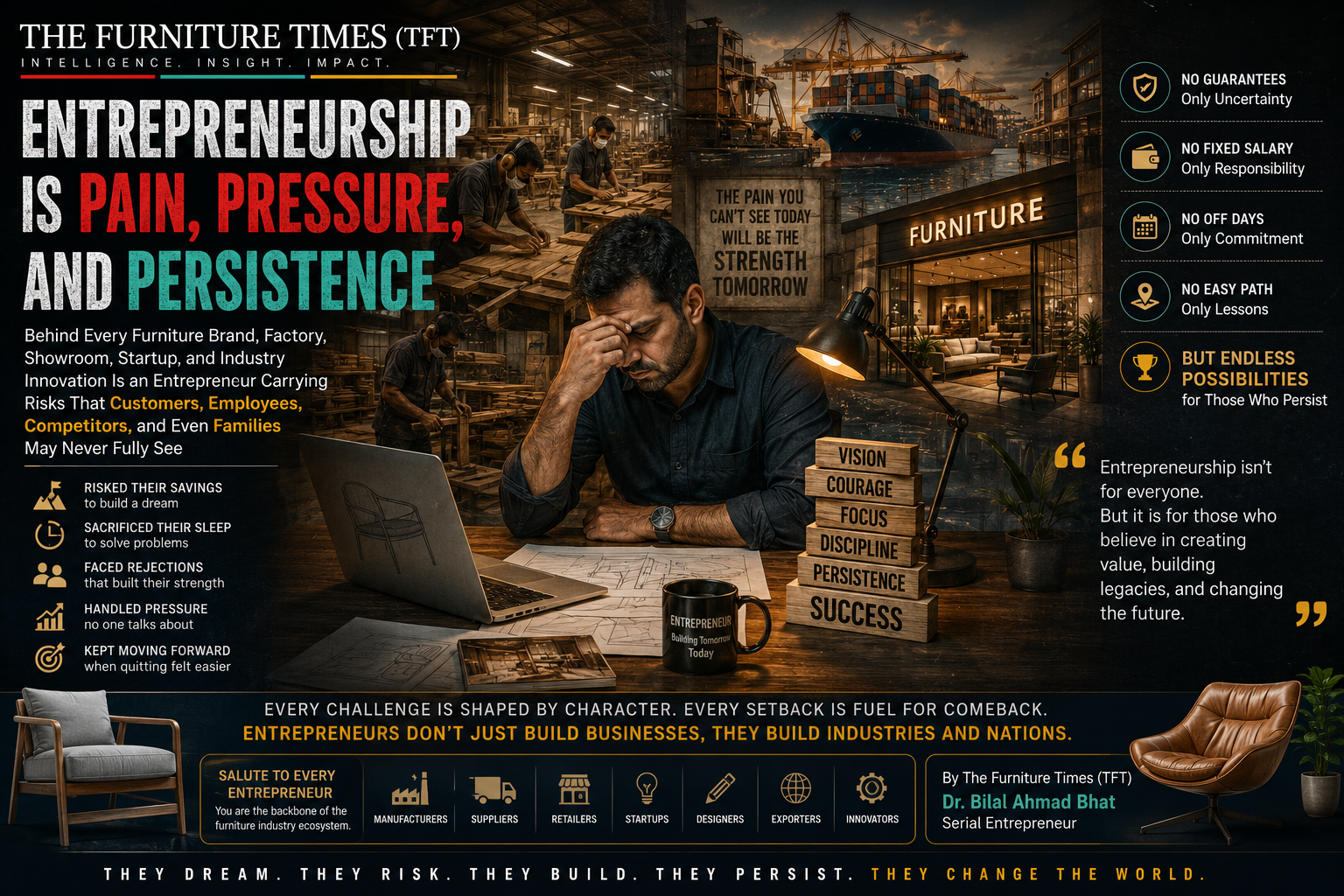
Entrepreneurship is pain, pressure, and persistence.
This is especially true within the global furniture industry ecosystem, where entrepreneurs operate in a complex environment involving materials, design, craftsmanship, manufacturing, machinery, logistics, retail, hospitality, construction, technology, finance, exports, and changing consumer behaviour.
A furniture business may appear simple from the outside.
A table is manufactured and sold.
A sofa is displayed in a showroom.
A chair is shipped to a customer.
A hotel places an order for furniture.
However, behind every product is a long chain of decisions, investments, risks, responsibilities, and uncertainties.
The entrepreneur stands at the centre of that chain.
The Furniture Industry Is Built by Entrepreneurs
The global furniture industry is not built only by large corporations.
It is built by millions of small and medium-sized businesses.
It is built by carpenters who opened their first workshops.
It is built by designers who transformed sketches into marketable products.
It is built by manufacturers who invested their savings in machinery.
It is built by retailers who took expensive showroom spaces without knowing whether customers would come.
It is built by exporters who entered unfamiliar markets.
It is built by logistics providers who developed specialised systems for handling bulky products.
It is built by interior designers, architects, upholsterers, timber suppliers, hardware companies, technology startups, installers, and independent craftspeople.
Many of these businesses began with little more than an idea, a skill, a small amount of capital, and the determination to create something valuable.
The furniture industry therefore represents one of the clearest examples of entrepreneurship in action.
Every factory began with a decision.
Every showroom began with a risk.
Every brand began before customers knew its name.
Every successful company passed through periods when survival was uncertain.
Entrepreneurship Begins with Uncertainty
An employee usually receives a defined role, a salary, a schedule, and a set of responsibilities.
An entrepreneur often begins with none of these certainties.
The entrepreneur must create the role.
Find the customers.
Raise the capital.
Build the team.
Develop the product.
Establish the supply chain.
Manage compliance.
Create demand.
Resolve complaints.
And take responsibility when things go wrong.
In the furniture ecosystem, uncertainty appears at almost every stage.
Will customers accept the design?
Will the timber arrive on time?
Will the machinery perform as promised?
Will the fabric colour remain available?
Will the project be completed before the hotel opening?
Will the retailer pay according to the agreed terms?
Will shipping costs rise?
Will currency fluctuations destroy the expected margin?
Will a competitor copy the product?
Will the customer cancel the order after production has started?
Entrepreneurs rarely receive guarantees.
They make decisions using incomplete information and then accept the consequences.
That is why entrepreneurship requires emotional strength in addition to business intelligence.
The Pain Behind Product Development
Furniture product development is rarely as simple as drawing an attractive design.
A new product must balance:
- Appearance
- Comfort
- Functionality
- Safety
- Durability
- Manufacturing feasibility
- Material availability
- Packaging
- Transportation
- Pricing
- Customer expectations
A designer may imagine a beautiful chair, but the manufacturer must determine whether it can be produced consistently and profitably.
The first prototype may fail.
The second may be uncomfortable.
The third may require too much material.
The fourth may be difficult to package.
The fifth may be rejected by buyers because the price is too high.
Every failed prototype costs money and time.
Yet the entrepreneur must continue.
Innovation requires the willingness to experience disappointment without abandoning the vision.
Customers usually see only the final product.
The entrepreneur remembers every failed version that made the final product possible.
Financial Pressure Never Sleeps
Cash flow is one of the greatest pressures faced by furniture entrepreneurs.
A company can appear profitable on paper and still struggle to survive because money does not always arrive when it is needed.
Manufacturers may have to pay for:
- Timber
- Boards
- Fabrics
- Foam
- Hardware
- Machinery
- Electricity
- Rent
- Salaries
- Packaging
- Transport
- Insurance
- Certifications
- Marketing
These costs may need to be paid weeks or months before the customer completes payment.
Retailers face similar pressures.
They must pay deposits, maintain inventory, rent showrooms, hire employees, advertise products, provide warranties, and manage delivery operations.
Commercial projects can create even greater pressure.
A hotel, office, hospital, school, or property developer may place a large order but require extended payment terms.
The furniture company must finance production while waiting for payment.
One delayed invoice can affect salaries.
Several delayed invoices can threaten the entire company.
This is why revenue does not always mean financial security.
Entrepreneurs must constantly balance growth with survival.
The Pressure of Responsibility
Employees may finish work at the end of the day.
Entrepreneurs often carry the company home in their minds.
They think about unfinished orders.
Customer complaints.
Production delays.
Supplier payments.
Employee concerns.
Upcoming salaries.
Marketing performance.
Competitor activity.
Future investment.
The responsibility does not end when the factory closes or the showroom lights are switched off.
For many entrepreneurs, the business becomes a continuous mental presence.
This pressure becomes heavier as the company grows.
A small workshop may support one family.
A larger factory may support hundreds of workers and their families.
Every business decision affects real lives.
When sales decline, the entrepreneur may be forced to choose between reducing costs, delaying expansion, borrowing money, or restructuring the workforce.
These are not easy decisions.
Leadership is painful because responsibility cannot always be shared equally.
Employees See the Salary; Entrepreneurs See the Entire System
A salary is received at a fixed time.
But before that salary can be paid, the entrepreneur must make sure that products are sold, customers pay, expenses are controlled, and sufficient cash remains available.
Employees naturally focus on their individual roles.
The entrepreneur must see the whole system.
The entrepreneur must ask:
- Is production efficient?
- Is quality improving?
- Are customers satisfied?
- Are prices sustainable?
- Are suppliers reliable?
- Are employees developing?
- Is the company visible?
- Are competitors moving faster?
- Is the business prepared for the future?
The entrepreneur cannot afford to focus only on today.
The entrepreneur must manage today while preparing for tomorrow.
The Furniture Industry Demands Patience
Furniture is not always a fast-moving business.
Product development takes time.
Manufacturing takes time.
Export documentation takes time.
Shipping takes time.
Commercial approvals take time.
Building trust takes time.
A retailer may invest in a showroom and wait months before customer traffic becomes stable.
A manufacturer may participate in several exhibitions before securing a serious buyer.
An exporter may send samples repeatedly before receiving a meaningful order.
A new furniture brand may publish content for years before achieving strong digital recognition.
This delay between effort and reward tests the entrepreneur’s patience.
Many businesses fail not because the idea was poor, but because the entrepreneur could not continue long enough for the strategy to work.
Persistence is therefore not passive waiting.
It is disciplined continuation.
It means improving while waiting.
Learning while struggling.
Adjusting without surrendering.
Rejection Is Part of Entrepreneurship
Furniture entrepreneurs face rejection from many directions.
Buyers reject prices.
Customers reject designs.
Investors reject proposals.
Banks reject financing applications.
Distributors reject new brands.
Landlords reject rental negotiations.
Skilled employees reject job offers.
International buyers reject samples.
Rejection can feel personal, especially when an entrepreneur has invested significant time, money, and emotion into a product or proposal.
However, rejection is information.
It may reveal that:
- The product needs improvement.
- The pricing is unsuitable.
- The presentation is weak.
- The market is not ready.
- The wrong customer was approached.
- The business value was not communicated clearly.
Strong entrepreneurs do not allow rejection to define them.
They study it.
They learn from it.
They return with a stronger offer.
The Pressure to Compete with Furniture Giants
Small and medium-sized furniture companies often compete with multinational brands that possess far greater resources.
Large companies may have:
- Strong purchasing power
- Global supply chains
- Large marketing budgets
- Advanced technology
- Dedicated design teams
- Established distribution
- Strong digital visibility
- Access to affordable finance
SMEs cannot always compete through scale.
They must compete through focus.
They can specialise in a particular material, market, customer group, style, or service.
They can provide flexibility that larger companies cannot easily offer.
They can respond faster.
Customise more deeply.
Build personal relationships.
Serve neglected market segments.
However, finding and defending this position requires persistence.
The small entrepreneur must work intelligently because outspending larger competitors is usually impossible.
Visibility Has Become a New Entrepreneurial Pressure
In the past, a furniture business could grow through location, personal relationships, exhibitions, agents, and word of mouth.
Today, customers often search before they contact a company.
They compare websites.
Read reviews.
Study photographs.
Ask artificial intelligence for recommendations.
A manufacturer may produce outstanding furniture but remain invisible because the company has poor digital information.
A retailer may operate a beautiful showroom but receive limited traffic because customers cannot find it online.
This creates a new pressure.
Entrepreneurs must now become publishers, storytellers, digital strategists, and brand builders in addition to managing their core businesses.
They must invest in:
- Websites
- Search optimisation
- Product content
- Social media
- Online reviews
- Digital catalogues
- Photography
- Press releases
- AI discoverability
Many SME owners were never trained in these areas.
Yet the market now expects them to understand them.
Entrepreneurship Requires Continuous Learning
The furniture industry is changing rapidly.
Materials are evolving.
Consumer tastes are shifting.
Technology is advancing.
Sustainability standards are becoming stricter.
Artificial intelligence is influencing search, design, manufacturing, and customer service.
Entrepreneurs who stop learning eventually become disconnected from the market.
Experience remains valuable, but experience must be updated.
A business model that worked ten years ago may not work today.
A showroom strategy that succeeded before e-commerce may no longer be sufficient.
An export approach built only around exhibitions may need digital support.
The persistent entrepreneur is not the person who refuses to change.
The persistent entrepreneur is the person who refuses to stop learning.
Failure Is Often the Tuition Fee of Entrepreneurship
Failure is painful, but it is also educational.
A failed store can teach location strategy.
A failed product can teach customer preference.
A failed partnership can teach due diligence.
A failed export shipment can teach documentation.
A failed campaign can teach market communication.
The cost of these lessons can be high.
Sometimes the entrepreneur loses money.
Sometimes reputation.
Sometimes relationships.
Sometimes years of effort.
However, failure becomes valuable when it produces better judgement.
The greatest loss occurs when pain produces no learning.
Entrepreneurs must examine failure honestly without allowing it to destroy their confidence.
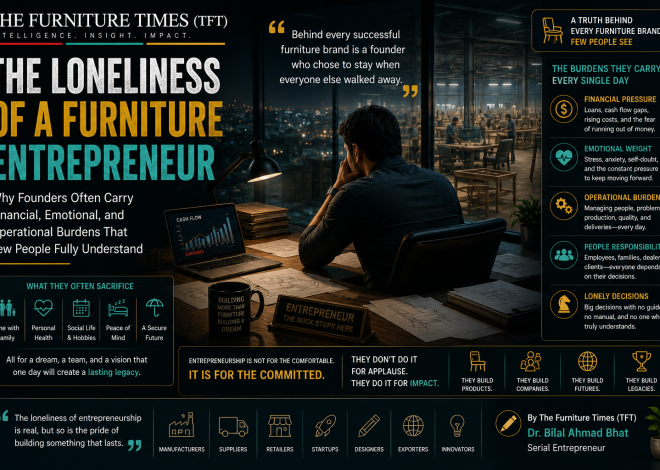
The Loneliness of Leadership
Entrepreneurship can be lonely.
Employees expect confidence.
Customers expect reliability.
Suppliers expect payment.
Banks expect performance.
Families expect stability.
Partners expect growth.
The entrepreneur may feel pressure from every direction while having few people with whom to share uncertainty.
Showing fear may weaken confidence.
Pretending that everything is fine can deepen emotional isolation.
This is why entrepreneurs need trusted networks.
Mentors.
Industry associations.
Peer groups.
Professional advisors.
Other entrepreneurs who understand the pressure.
Strong entrepreneurs do not carry everything alone.
They build relationships with people who can provide honest advice without judgement.
Persistence Does Not Mean Ignoring Reality
Persistence is often misunderstood.
It does not mean continuing the same failing strategy forever.
It does not mean refusing to accept evidence.
It does not mean borrowing endlessly to protect an unsustainable business.
True persistence combines determination with adaptability.
A persistent entrepreneur asks:
- What is working?
- What must change?
- Which costs are unnecessary?
- Which customers create value?
- Which products should be discontinued?
- Which markets offer greater potential?
- Which capabilities must be developed?
Persistence without reflection becomes stubbornness.
Persistence with intelligence becomes resilience.
Entrepreneurship Is Solving Problems Every Day
A business does not grow because problems disappear.
It grows because its ability to solve problems improves.
In the furniture industry, problems are constant.
A timber shipment arrives late.
A machine breaks down.
A customer changes the specification.
A product is damaged during delivery.
A designer leaves.
A buyer requests a lower price.
A fabric becomes unavailable.
An exhibition produces fewer leads than expected.
The entrepreneur’s role is not to expect a problem-free business.
The role is to build a company capable of responding quickly, responsibly, and creatively.
Every problem solved strengthens the organisation.
Every unresolved problem weakens trust.
The Customer Does Not Always Understand the Cost
Customers often compare furniture primarily by price.
They may not see the costs behind the product:
- Design development
- Prototyping
- Skilled labour
- Quality control
- Packaging
- Warehousing
- Delivery
- Warranty
- Customer service
- Compliance
- Marketing
When a customer asks for a lower price, the entrepreneur must decide what can be reduced without damaging quality or sustainability.
Excessive price competition can push companies toward weaker materials, underpaid labour, poor service, and short product lifecycles.
Responsible entrepreneurship requires protecting value, not merely chasing volume.
The cheapest sale is not always the best sale.
The Emotional Cost of Building a Brand
A brand is more than a logo.
It is years of promises, experiences, investments, and public perception.
One serious complaint can spread quickly.
One delivery failure can damage trust.
One poorly handled employee issue can affect reputation.
The entrepreneur must protect the brand continuously.
This creates emotional pressure because criticism of the business can feel like criticism of the entrepreneur personally.
Mature leadership requires separation.
The entrepreneur must listen to criticism without becoming defensive.
Protect the brand without hiding mistakes.
Respond professionally.
Correct what can be corrected.
Trust is strengthened when companies demonstrate accountability.
Furniture Startups Face a Difficult Path
The furniture sector is attractive to entrepreneurs because it combines design, lifestyle, craftsmanship, and commerce.
However, furniture startups face high operational barriers.
Unlike purely digital businesses, they may require:
- Physical materials
- Prototypes
- Production partners
- Warehousing
- Packaging
- Delivery systems
- Installation
- Returns management
- Working capital
A furniture startup can attract attention through beautiful designs but still fail because logistics are poorly managed.
Another may generate sales but struggle because margins were calculated incorrectly.
Another may receive strong interest but lack production capacity.
Entrepreneurs must understand that a furniture brand is not only a design business.
It is also an operational system.
Women and Young Entrepreneurs Need Stronger Ecosystem Support
The furniture industry benefits when more women and young people enter entrepreneurship.
They bring new ideas, digital skills, design perspectives, and understanding of emerging consumers.
However, many face barriers involving finance, industry networks, technical training, market access, and mentorship.
A stronger furniture ecosystem should provide:
- Incubation programmes
- Shared workshops
- Design laboratories
- Affordable machinery access
- Digital training
- Export guidance
- Business mentorship
- Industry networking
- Procurement opportunities
Entrepreneurship should not depend only on personal survival ability.
Institutions must create environments in which capable people can build businesses without facing unnecessary obstacles.
Governments Must Understand Entrepreneurial Reality
Governments frequently speak about supporting SMEs and entrepreneurship.
However, meaningful support must go beyond slogans.
Furniture entrepreneurs need practical assistance involving:
- Affordable financing
- Industrial land
- Energy costs
- Export promotion
- Skills development
- Technology adoption
- Certification
- Digital transformation
- Market intelligence
- Research and development
- Logistics infrastructure
Complex procedures and delayed approvals increase pressure on businesses that already operate with limited resources.
When governments support entrepreneurs effectively, they are not supporting one individual alone.
They are supporting employment, exports, innovation, tax revenue, local supply chains, and community development.
The Furniture Ecosystem Must Collaborate
Entrepreneurs cannot build the future of the furniture industry alone.
Manufacturers, retailers, designers, universities, government agencies, technology companies, logistics providers, financial institutions, and media organisations must work together.
The furniture industry is an ecosystem.
One weak link affects the entire chain.
Manufacturers need designers.
Designers need materials.
Retailers need reliable suppliers.
Exporters need logistics.
SMEs need visibility.
Students need industry access.
Customers need trusted information.
Collaboration reduces duplication and creates shared growth.
Entrepreneurship Is Also Service
Entrepreneurship is sometimes described only as wealth creation.
But strong entrepreneurship is also service.
A furniture entrepreneur serves customers by creating useful products.
Serves employees by creating jobs.
Serves suppliers by generating demand.
Serves communities through economic activity.
Serves the industry by introducing new ideas.
Serves the country through taxes, exports, and investment.
Profit is necessary because a business cannot survive without it.
But purpose gives entrepreneurship direction.
The most respected businesses create value beyond the transaction.
Pain Can Create Stronger Leaders
Pain alone does not create success.
But pain can produce awareness.
It can teach humility.
It can strengthen judgement.
It can reveal who is trustworthy.
It can clarify priorities.
It can show the entrepreneur which problems truly matter.
Many successful business leaders are shaped not by easy victories but by difficult periods they were forced to survive.
The entrepreneur who has faced crisis often becomes more disciplined.
More careful with cash.
More selective with partnerships.
More respectful of employees.
More prepared for uncertainty.
Pain becomes useful when it creates wisdom.
Pressure Reveals Character
Business pressure reveals how leaders behave when conditions are difficult.
Do they blame employees?
Mislead customers?
Delay payments without communication?
Compromise quality?
Or do they remain transparent, responsible, and solution-focused?
Leadership is not tested when everything is going well.
It is tested when money is limited, time is short, customers are angry, and the future is uncertain.
Values become visible under pressure.
The furniture industry needs entrepreneurs who protect ethics even when shortcuts appear attractive.
Persistence Builds Institutions
Many businesses begin as one person’s effort.
Over time, persistence transforms that effort into an institution.
The workshop becomes a factory.
The small store becomes a retail network.
The local supplier becomes an exporter.
The independent designer becomes a recognised brand.
The startup becomes an employer.
This transformation rarely happens quickly.
It is built through years of consistent work.
The entrepreneur continues when attention disappears.
Continues when early excitement fades.
Continues when results are slower than expected.
Persistence turns temporary effort into long-term value.
Success Is Not Only Measured by Size
Not every entrepreneur must build the largest company.
Success can mean:
- Building a profitable family business
- Preserving a traditional craft
- Creating stable employment
- Serving a local community
- Developing a respected niche brand
- Exporting to a new market
- Producing responsibly
- Creating products that last
The industry should celebrate different forms of entrepreneurship.
A small, well-managed furniture workshop can create more meaningful value than a larger company built on unstable debt and weak principles.
Sustainable success matters more than impressive appearances.
A Message to Furniture Entrepreneurs
To every furniture manufacturer struggling with orders:
Continue improving.
To every retailer facing slow showroom traffic:
Strengthen your visibility and customer experience.
To every designer whose ideas have been rejected:
Refine the concept and return stronger.
To every startup facing financial pressure:
Protect cash, test assumptions, and focus on real customer needs.
To every exporter waiting for the first major buyer:
Keep building trust and market knowledge.
To every craftsperson wondering whether traditional skills still matter:
Your knowledge has value, but it must be connected with modern design, technology, and markets.
To every entrepreneur who feels alone:
Your struggle is real, but it is not unique.
The furniture industry was built by people who continued despite uncertainty.
The Future Will Belong to Persistent Entrepreneurs
The future of the furniture industry will be shaped by entrepreneurs who can combine:
- Craftsmanship with technology
- Design with commercial understanding
- Sustainability with profitability
- Local identity with global ambition
- Manufacturing with digital visibility
- Persistence with adaptability
The next generation of furniture leaders will not succeed simply because they had the best idea.
They will succeed because they continued developing the idea through pain, pressure, rejection, uncertainty, and change.
Final Perspective
Entrepreneurship is not a comfortable journey.
It demands sacrifice.
It creates pressure.
It tests relationships.
It challenges confidence.
It forces people to make difficult decisions with incomplete information.
But entrepreneurship also creates.
It creates products.
Jobs.
Brands.
Markets.
Skills.
Innovation.
Hope.
Every strong furniture company standing today is evidence that someone persisted before success was visible.
Someone invested before customers arrived.
Someone continued when others doubted.
Someone carried the pressure.
Someone absorbed the pain.
Someone refused to abandon the mission.
The furniture industry ecosystem must recognise and support these individuals.
Entrepreneurs should not be romanticised as people who never struggle.
They should be respected as people who continue building despite struggle.
Entrepreneurship is pain because creation demands sacrifice.
Entrepreneurship is pressure because leadership carries responsibility.
Entrepreneurship is persistence because meaningful success takes time.
A business may begin with an idea, but it survives through discipline.
It grows through learning.
It strengthens through adversity.
And it becomes an institution through persistence.
The world sees the furniture.
The entrepreneur remembers the journey.
Closing Thought
“Entrepreneurship is not the absence of pain or pressure. It is the decision to keep building, learning, and moving forward until persistence transforms struggle into value.”
— Dr. Bilal Ahmad Bhat, Serial Entrepreneur