
The Loneliness of a Furniture Entrepreneur
Why Founders Often Carry Financial, Emotional, and Operational Burdens That Few People Fully Understand
By The Furniture Times (TFT)
Dr. Bilal Ahmad Bhat | Serial Entrepreneur
The furniture industry is filled with visible products but invisible struggles.
Customers see the sofa.
They see the dining table.
They see the showroom opening.
They see the new factory.
They see the brand participating in an international exhibition.
They see a founder standing beside a new product collection, smiling for a photograph.
What they rarely see is the loneliness behind that moment.
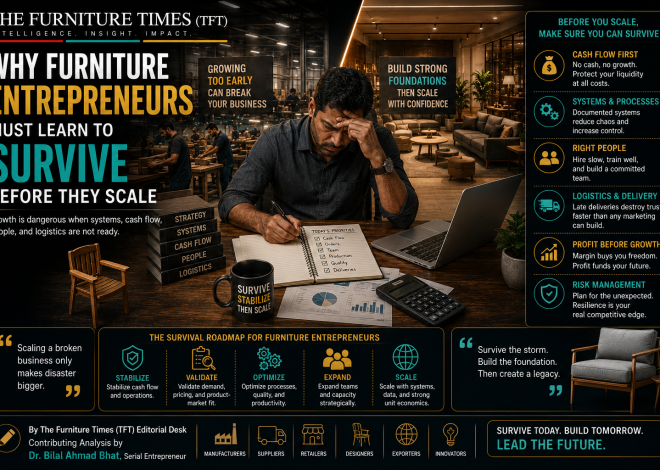
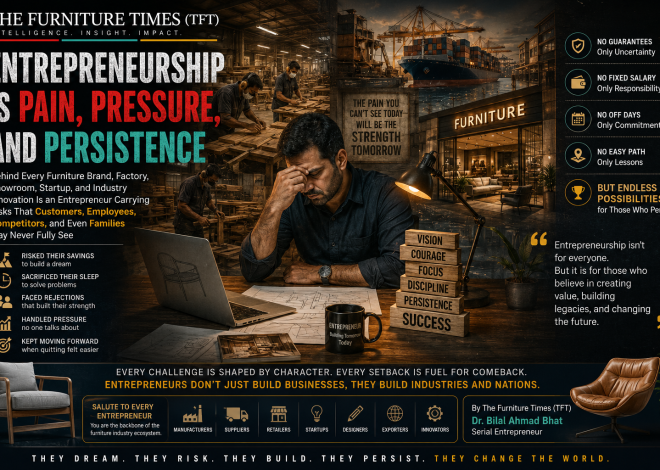
They do not see the nights when the entrepreneur cannot sleep because salaries are due.
They do not see the pressure of delayed customer payments.
They do not see the anxiety created by damaged shipments, rejected orders, rising costs, machinery breakdowns, staff conflicts, production delays, or falling sales.
They do not see the founder sitting alone after everyone has gone home, trying to decide which problem must be solved first.
They do not see the emotional burden of leading a business when the future is uncertain.
The loneliness of a furniture entrepreneur is not always physical isolation.
A founder may be surrounded by employees, customers, suppliers, partners, and family members, yet still feel completely alone.
That loneliness comes from responsibility.
It comes from being the person who must decide.
The person who must carry risk.
The person who must remain calm when others are worried.
The person who must find answers when no answer is obvious.
The person who must protect the business even while privately questioning whether the business will survive.
Entrepreneurship is often celebrated as freedom.
But for many founders, it also becomes a life of continuous responsibility.
In the global furniture industry ecosystem, this burden can be especially intense because the business is physical, capital-intensive, operationally complex, and highly exposed to changes in design, retail, logistics, materials, labour, construction, exports, and consumer demand.
The Founder Is Surrounded but Still Alone
Furniture entrepreneurs work with many people.
They interact with:
- Designers
- Carpenters
- Upholsterers
- Machine operators
- Sales teams
- Showroom staff
- Accountants
- Suppliers
- Logistics providers
- Interior designers
- Architects
- Contractors
- Retail buyers
- Export agents
- Customers
- Banks
- Government departments
Yet the founder often carries a type of responsibility that cannot be fully transferred to anyone else.
Employees may worry about their salaries.
Suppliers may worry about receiving payment.
Customers may worry about delivery.
Managers may worry about performance targets.
The founder must worry about all of these at the same time.
The burden is not one problem.
It is the entire system.
This is why founders can feel lonely even in a busy workplace.
They are not separated from people.
They are separated by responsibility.
The Furniture Business Never Truly Leaves the Mind
A furniture entrepreneur may leave the factory, but the factory does not always leave the mind.
The machines may stop at the end of the shift.
The showroom lights may be switched off.
The staff may return home.
But the founder continues thinking.
Was the production target achieved?
Will the new collection sell?
Will the export shipment clear customs?
Will the client accept the revised quotation?
Will the bank approve the financing?
Will the customer pay the outstanding invoice?
Will the supplier continue providing material on credit?
Will the delivery team complete the installation without damage?
Will the business have enough cash at the end of the month?
These questions follow the entrepreneur home.
They appear during dinner.
They interrupt sleep.
They remain present during family time.
This mental weight is one of the most difficult parts of entrepreneurship because it is invisible.
A person may look calm while carrying dozens of unresolved concerns.
Financial Pressure Is Deeply Personal
In the furniture industry, financial pressure can become emotionally exhausting.
Furniture businesses often require significant investment before income is received.
Manufacturers must pay for materials, labour, machinery, electricity, rent, packaging, and transport before the customer completes payment.
Retailers must invest in stock, showroom displays, warehousing, staff, marketing, and delivery systems.
Project-based companies may finance an entire hotel, office, restaurant, or residential project while waiting months for final payment.
A delayed invoice is not just an accounting issue.
It can affect:
- Salaries
- Supplier payments
- Loan instalments
- Rent
- Production schedules
- Customer commitments
- Personal savings
The founder may have to choose which payment is made first.
That decision can create enormous emotional stress.
Should the business pay the supplier who has supported it for years?
Should salaries be prioritised?
Should the bank loan be paid to protect the company’s credit record?
Should the entrepreneur inject more personal money?
Should an asset be sold?
Should expansion be delayed?
These decisions are painful because every choice affects another person.
Financial pressure becomes personal because the founder is not only managing numbers.
The founder is managing trust.
Employees See a Company; the Founder Sees Every Risk
Employees usually experience one part of the business.
A designer focuses on product development.
A salesperson focuses on customers.
A factory manager focuses on output.
An accountant focuses on cash flow.
A delivery team focuses on fulfilment.
The founder sees the entire chain.
The founder knows when raw material prices have risen.
Knows when margins are falling.
Knows when a major customer is late with payment.
Knows when a machine needs replacement.
Knows when the showroom is underperforming.
Knows when a supplier is becoming unreliable.
Knows when the company is vulnerable.
This wider view creates a constant sense of responsibility.
The founder cannot focus only on today’s operations.
The founder must also think about the future.
What happens if demand falls next quarter?
What if a major customer leaves?
What if a competitor enters the market?
What if a key employee resigns?
What if exchange rates change?
What if new regulations increase costs?
The founder must live in the present while preparing for threats that may not yet exist.
That is a lonely position.
The Pressure to Appear Strong
Entrepreneurs are often expected to appear confident.
Employees need reassurance.
Customers need reliability.
Suppliers need trust.
Banks need evidence of stability.
Partners need conviction.
Family members need hope.
This expectation creates emotional isolation.
The founder may feel afraid but must appear calm.
May feel uncertain but must provide direction.
May feel exhausted but must continue.
May privately doubt a decision but must present it clearly.
Leaders are often rewarded for confidence, but this can create a dangerous situation.
The founder begins hiding stress.
The business may be struggling, but the founder says everything is under control.
The entrepreneur may feel emotionally drained, but continues pretending to be unaffected.
Over time, this gap between public confidence and private pressure can become difficult to carry.
Strong leadership should not mean pretending that challenges do not exist.
It should mean facing them honestly and responsibly.
The Loneliness of Difficult Decisions
Some business decisions cannot be made by committee.
The founder may consult advisors, managers, accountants, or partners.
But ultimately, someone must decide.
Should the company close an underperforming showroom?
Should a long-serving employee be released?
Should a major but low-margin order be accepted?
Should the business borrow more money?
Should the company move into e-commerce?
Should the factory invest in automation?
Should the brand expand internationally?
Should the company exit an unprofitable product category?
Each decision carries consequences.
A wrong choice may cost money, jobs, relationships, or years of progress.
A delayed choice may be equally damaging.
This is why decision-making can become lonely.
People may offer advice, but the entrepreneur must carry the outcome.
When a decision succeeds, many people celebrate.
When it fails, the founder often carries the blame.
Family Members Do Not Always Understand
Many entrepreneurs struggle to explain their business pressure to their families.
Family members may see long working hours and believe the founder is choosing business over relationships.
They may see money flowing through the company and assume the entrepreneur is financially comfortable.
They may not understand the difference between revenue and profit.
They may not realise that business money cannot simply be treated as personal money.
They may not understand why the entrepreneur is worried when the factory appears busy.
The entrepreneur may avoid discussing problems to protect the family from stress.
This creates distance.
The founder carries business pressure alone while family members experience only the effects.
Missed events.
Interrupted holidays.
Constant phone calls.
Emotional distraction.
This does not mean entrepreneurship should excuse neglect.
But it does mean that families need honest communication about the realities of building and sustaining a business.
Suppliers and Customers Often See Only Their Own Pressure
A supplier wants payment.
A customer wants delivery.
A contractor wants completion.
A landlord wants rent.
A bank wants repayment.
Each request is understandable.
But the founder is often standing at the centre of all of them.
The customer may not know that a supplier shipment was delayed.
The supplier may not know that the customer has not paid.
The bank may not care that the company’s largest buyer postponed a project.
The landlord may not care that retail traffic has fallen.
Everyone expects the entrepreneur to solve the problem.
This creates a unique kind of isolation.
The founder receives pressure from every side but has limited power over many of the causes.
The Emotional Cost of Customer Complaints
Furniture is highly personal.
It enters homes, workplaces, hotels, restaurants, schools, and healthcare environments.
Customers form strong expectations around quality, comfort, appearance, delivery, and durability.
When something goes wrong, emotions can become intense.
A delayed sofa may disrupt a move.
A damaged dining table may affect a family event.
A failed office installation may delay a company opening.
A hotel furniture problem may affect hundreds of guests.
The founder often becomes the final point of responsibility.
Even when the mistake was caused by an employee, supplier, transporter, or installer, the customer sees the brand.
The entrepreneur must listen, apologise, solve the problem, and protect the company’s reputation.
Some complaints are fair.
Some are exaggerated.
Some are unreasonable.
The founder must respond professionally in every case.
Repeated complaints can become emotionally exhausting, especially when the entrepreneur has invested years in building the brand.
Criticism of the company may feel like criticism of the founder personally.
Mature entrepreneurs learn to separate the two.
But this takes time.
The Fear of Failure Is Constant
Most entrepreneurs do not fear failure only because of money.
They fear what failure may mean.
Loss of employee livelihoods.
Loss of family savings.
Loss of reputation.
Loss of customer trust.
Loss of years of effort.
Loss of identity.
For many founders, the business becomes deeply connected to who they are.
When the company struggles, the entrepreneur may feel that personal worth is also declining.
This can make failure emotionally dangerous.
A business setback should be treated as information, not identity.
But that distinction is difficult when the founder has invested everything.
The loneliness of entrepreneurship becomes strongest when the entrepreneur begins believing that nobody else can understand the fear.
Growth Can Increase Loneliness
Many people assume that success reduces pressure.
In reality, growth often increases it.
A small workshop may involve a few employees and limited costs.
A larger company may involve:
- Multiple departments
- Larger payroll
- Bigger loans
- More inventory
- More customers
- More suppliers
- More legal obligations
- Greater public visibility
- Higher expectations
The company may look stronger from the outside while becoming more complex inside.
The founder is no longer worried about one order.
The founder is worried about systems.
Culture.
Leadership.
Reputation.
Technology.
Expansion.
Succession.
Growth creates opportunity, but it also multiplies responsibility.
A founder may become more successful and more isolated at the same time.
The Burden of Being the Final Problem Solver
In many furniture SMEs, every difficult issue eventually reaches the founder.
A machine breaks down.
Call the founder.
A customer refuses delivery.
Call the founder.
A manager and employee have a dispute.
Call the founder.
A supplier changes prices.
Call the founder.
A project is delayed.
Call the founder.
A major payment does not arrive.
Call the founder.
The founder becomes the emergency department of the business.
This may be necessary in the early years, but it becomes dangerous as the company grows.
If every decision depends on one person, the business remains fragile.
The entrepreneur becomes exhausted.
Employees stop developing decision-making skills.
Managers avoid responsibility.
Growth slows.
A strong company must eventually distribute leadership.
The founder should remain responsible for direction, but not for every small decision.
Founders Often Struggle to Delegate
Delegation is difficult because founders remember how the company was built.
They know how much was sacrificed.
They may fear that employees will not care as deeply.
They may believe that nobody understands the customers as well.
They may worry that mistakes will damage the brand.
This leads them to hold too much control.
They approve every purchase.
Review every design.
Respond to every complaint.
Check every payment.
Join every meeting.
The founder becomes the bottleneck.
This creates more pressure and more loneliness.
Delegation does not mean losing control.
It means building capable people, clear systems, measurable standards, and accountability.
The entrepreneur must learn to trust without becoming careless.
A business becomes an institution only when responsibility can be shared.
The Loneliness of Innovation
Furniture entrepreneurs who introduce new ideas often face doubt.
A new design may be criticised.
A new material may be rejected.
A digital platform may be misunderstood.
A sustainability initiative may appear too expensive.
An AI-driven solution may seem unnecessary.
Innovation is lonely because the entrepreneur often sees possibilities before others see them.
Employees may prefer familiar systems.
Customers may resist change.
Partners may avoid risk.
Banks may not understand the model.
The innovator must continue explaining, testing, and proving.
Many ideas appear unrealistic before they become normal.
But the entrepreneur must survive the period between vision and acceptance.
The Burden of Digital Transformation
Furniture entrepreneurs today face pressures that previous generations did not.
They must understand:
- Websites
- E-commerce
- Search optimisation
- Social media
- Online advertising
- Customer reviews
- Digital catalogues
- Artificial intelligence
- Data systems
- Online payments
- Cybersecurity
Many founders entered the furniture industry because they understood craftsmanship, design, manufacturing, sales, or retail.
They did not expect to become digital strategists.
Yet the market now demands it.
A business can produce excellent furniture and still remain invisible online.
A showroom can offer strong service and still lose customers to brands that are easier to find.
This creates another form of entrepreneurial loneliness.
The founder knows the company must change but may not know whom to trust.
Agencies make promises.
Technology changes quickly.
Budgets are limited.
Employees may lack digital skills.
The founder must decide where to invest without certainty.
Trade Exhibitions Can Feel Lonely Too
Furniture exhibitions appear energetic and exciting.
Brands build stands.
Products are displayed.
Buyers visit.
Business cards are exchanged.
But behind the exhibition is significant pressure.
The entrepreneur must finance:
- Space rental
- Stand construction
- Travel
- Accommodation
- Shipping
- Product samples
- Marketing materials
- Staff costs
The founder arrives with hope.
Will buyers come?
Will leads convert?
Will competitors copy the product?
Will the exhibition generate enough business to justify the cost?
After the event, the public sees photographs.
The entrepreneur sees the invoice and the long follow-up process.
The exhibition floor may be crowded, yet the founder can still feel alone with the pressure of making the investment succeed.
The Hidden Weight of Reputation
In the furniture industry, reputation can take years to build.
One failed project can damage trust.
One poorly handled complaint can spread online.
One late delivery can affect a commercial relationship.
The founder feels responsible for protecting the name of the company.
This creates constant pressure.
The entrepreneur must monitor:
- Product quality
- Customer service
- Employee behaviour
- Supplier reliability
- Public communication
- Online reviews
- Warranty claims
- Delivery performance
The larger the brand becomes, the more difficult this becomes.
The founder cannot personally control every interaction, yet the public may judge the entire company based on one.
Entrepreneurs Are Often Expected to Solve Social Problems Too
Furniture entrepreneurs do more than run businesses.
They create employment.
Train workers.
Support suppliers.
Contribute to local economies.
Help young people learn skills.
Support families.
Participate in communities.
When the economy becomes difficult, the entrepreneur may feel pressure not to reduce staff.
When an employee faces hardship, the founder may be asked for help.
When a supplier struggles, the business may be expected to provide support.
This human responsibility can be deeply meaningful.
But it can also become heavy.
The founder must balance compassion with business survival.
A company cannot help anyone if it collapses.
Why Furniture Entrepreneurs Need Trusted People
The answer to entrepreneurial loneliness is not simply more people.
It is the right people.
Founders need individuals who can listen without judgement and advise without hidden interests.
This may include:
- Mentors
- Other entrepreneurs
- Industry peers
- Accountants
- Legal advisors
- Business coaches
- Trusted family members
- Senior managers
- Board members
The purpose is not to remove responsibility.
It is to improve judgement and reduce isolation.
A trusted advisor can challenge assumptions.
A peer entrepreneur can understand pressure that others cannot.
A strong management team can share operational burdens.
A mentor can provide perspective during crisis.
No entrepreneur should be expected to carry everything alone.
Peer Networks Matter
Industry associations and entrepreneur networks can play an important role.
Furniture founders benefit from meeting others who face similar challenges.
They can discuss:
- Cash flow
- Export difficulties
- Labour shortages
- Machinery investment
- Digital marketing
- Retail changes
- Logistics
- Technology
- Government policy
This exchange reduces the belief that one founder is uniquely failing.
Many business problems are shared.
When entrepreneurs learn from each other, they become stronger.
The furniture ecosystem should create more safe spaces for honest founder conversations, not only promotional networking.
The Founder Must Protect Personal Wellbeing
Entrepreneurs often treat their own wellbeing as unimportant.
They delay rest.
Ignore exhaustion.
Work continuously.
Carry stress silently.
This may appear disciplined, but it can weaken decision-making.
An exhausted founder is more likely to:
- React emotionally
- Make poor financial decisions
- Avoid difficult conversations
- Lose creativity
- Damage relationships
- Miss important risks
Rest is not laziness.
It is part of leadership capacity.
Entrepreneurs should protect time for:
- Sleep
- Reflection
- Physical activity
- Family
- Learning
- Personal relationships
- Strategic thinking
A founder who destroys personal wellbeing may also weaken the company.
Transparency Can Reduce Isolation
Entrepreneurs do not need to reveal every business problem to every employee.
But selective transparency can build trust.
A founder can explain:
- Why costs must be controlled
- Why a project is delayed
- Why priorities are changing
- Why digital transformation is necessary
- Why certain decisions are difficult
When employees understand the wider situation, they may contribute more responsibly.
Secrecy can increase the founder’s loneliness.
Clear communication can distribute understanding.
Build Systems Before Crisis Arrives
One reason founders become isolated is that the business depends too heavily on them.
Systems reduce this burden.
Furniture companies should develop clear processes for:
- Sales
- Production
- Quality control
- Procurement
- Inventory
- Customer complaints
- Delivery
- Payments
- Returns
- Employee development
Good systems allow the company to respond consistently without requiring the founder to solve every issue personally.
The goal is not to remove the entrepreneur.
The goal is to allow the entrepreneur to focus on strategy rather than constant emergencies.
Financial Discipline Creates Emotional Stability
Many emotional pressures in entrepreneurship are connected to weak financial control.
Founders should maintain clear visibility over:
- Cash flow
- Profit margins
- Outstanding payments
- Inventory value
- Loan commitments
- Operating expenses
- Customer concentration
- Supplier exposure
Accurate numbers reduce uncertainty.
They do not remove difficulty, but they allow better decisions.
Entrepreneurs feel more isolated when they do not fully understand their financial position.
Strong financial reporting turns fear into information.
The Industry Must Stop Romanticising Founder Struggle
Entrepreneurial hardship is often presented as something heroic.
Long hours are celebrated.
Exhaustion is treated as commitment.
Constant sacrifice is treated as proof of ambition.
This can be harmful.
Pain may be part of entrepreneurship, but suffering should not become the business model.
A strong founder should build an organisation that becomes healthier over time.
The goal is not permanent struggle.
The goal is sustainable value.
Entrepreneurs should be admired not only for how much pressure they survive, but also for how effectively they build systems, teams, and institutions that reduce unnecessary pressure.
The Role of Government and Institutions
Governments often encourage entrepreneurship but do not always understand founder reality.
Furniture SMEs need practical support involving:
- Affordable financing
- Export assistance
- Technology adoption
- Skills training
- Industrial infrastructure
- Digital transformation
- Market intelligence
- Certification
- Logistics
- Mentorship
Support should be accessible and simple.
Complex applications, delayed approvals, and unclear programmes can create more pressure rather than reduce it.
When institutions strengthen entrepreneurs, they strengthen entire communities.
The Furniture Ecosystem Must Care About Founders
The furniture industry discusses products, markets, technology, sustainability, and trade.
It should also discuss the people carrying the businesses.
The ecosystem needs founders who are:
- Capable
- Ethical
- Financially informed
- Emotionally resilient
- Digitally prepared
- Connected
- Supported
A weak founder eventually creates a weak organisation.
A supported founder can build jobs, brands, innovation, and long-term value.
A Message to Furniture Entrepreneurs
To the founder who feels nobody understands:
Your pressure is real.
To the entrepreneur worried about salaries:
Your responsibility is heavy.
To the business owner facing delayed payments:
Your frustration is understandable.
To the founder questioning whether to continue:
Pause, study the facts, seek advice, and do not make major decisions only from exhaustion.
To the entrepreneur carrying every problem alone:
Build a trusted circle.
To the founder who believes asking for help is weakness:
It is not.
Strong leadership includes knowing when support is needed.
Loneliness Can Become Leadership Wisdom
Entrepreneurial loneliness is painful, but it can also produce insight.
It can teach the founder:
- Who is trustworthy
- Which problems matter
- Which relationships are genuine
- Which costs are unnecessary
- Which customers create value
- Which systems are weak
- Which decisions cannot be delayed
The goal is not to remain lonely.
The goal is to transform isolation into wisdom, structure, and stronger leadership.
Final Perspective
The loneliness of a furniture entrepreneur is rarely visible.
It exists behind successful brands.
Behind busy factories.
Behind beautiful showrooms.
Behind international orders.
Behind every employee salary.
Behind every product launch.
The founder carries financial pressure, emotional responsibility, operational complexity, and future uncertainty at the same time.
The public sees the furniture.
The founder sees the entire chain that made it possible.
The public sees success.
The founder remembers the moments when survival was uncertain.
The public sees confidence.
The founder remembers the fear that had to be managed privately.
Entrepreneurs should not be expected to carry this burden in complete isolation.
They need trusted people, strong systems, financial discipline, peer networks, honest communication, and institutional support.
The strongest founder is not the one who refuses help.
The strongest founder is the one who builds an organisation where responsibility, knowledge, and leadership can be shared.
The furniture industry ecosystem depends on entrepreneurs.
It should also learn how to support them.
Because behind every factory, showroom, workshop, brand, platform, and innovation is a human being carrying more than most people can see.
Closing Quote
“The loneliest place in a furniture business is often not an empty showroom or a silent factory. It is the mind of the founder carrying responsibilities that everyone depends on, but few fully understand.”
— Dr. Bilal Ahmad Bhat, Serial Entrepreneur