
Global Online Furniture Market
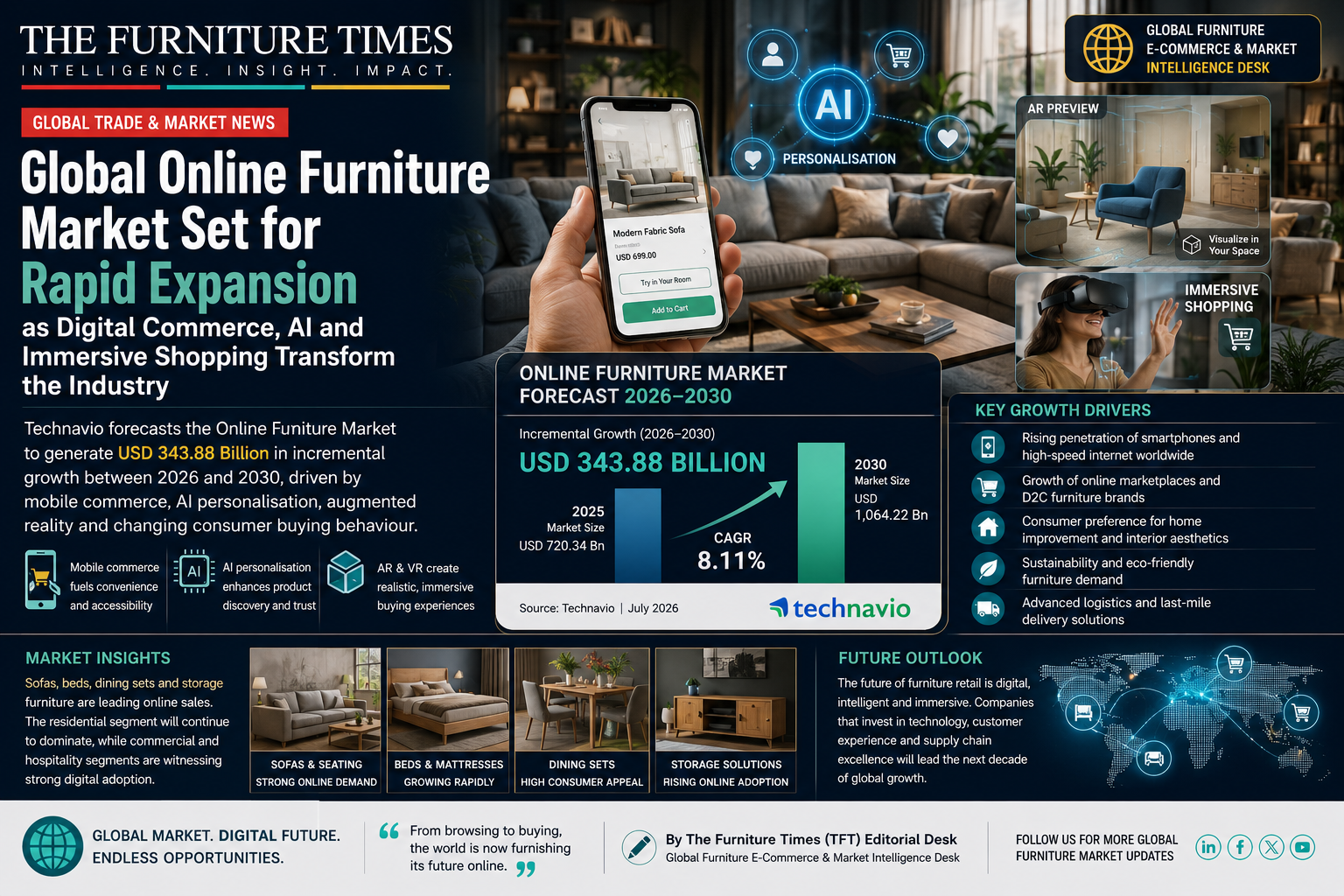
Global Online Furniture Market Set for Rapid Expansion as Digital Commerce, AI and Immersive Shopping Transform the Industry
Technavio Forecasts the Online Furniture Market to Generate USD 343.88 Billion in Incremental Growth Between 2026 and 2030, Driven by Mobile Commerce, AI Personalisation, Augmented Reality and Changing Consumer Buying Behaviour
Global Furniture E-Commerce & Market Intelligence Desk
By The Furniture Times (TFT) Editorial Desk
The global online furniture market is entering a decisive period of transformation as digital commerce moves beyond conventional product listings and becomes a highly visual, personalised and technology-driven purchasing environment.
According to Technavio’s online furniture market report published in March 2026, the market is projected to increase by approximately USD 343.88 billion between 2026 and 2030, expanding at a compound annual growth rate of 23.9% from 2025 to 2030. The research identifies expanding internet access and widespread mobile-commerce adoption as fundamental forces behind this growth.
This forecast signals more than a temporary increase in internet sales.
It represents a structural change in how consumers discover furniture, compare products, visualise interiors, evaluate brands, arrange delivery and complete high-value purchases.
Furniture was once considered one of the most difficult product categories to sell online. Customers traditionally wanted to sit on a sofa, inspect timber finishes, test the comfort of a mattress, examine fabric textures and physically compare dimensions before committing to a purchase.
Digital technology is gradually removing many of those barriers.
Augmented reality, three-dimensional product configurators, artificial-intelligence recommendations, mobile shopping, detailed product information and increasingly sophisticated delivery networks are making online furniture buying more practical and attractive.
The result is a rapidly expanding digital furniture economy in which manufacturers, retailers, marketplaces, designers, logistics companies and technology providers are being forced to reconsider their roles.
Online Furniture Is Becoming a Mainstream Retail Channel
Online furniture shopping is no longer limited to low-value home accessories or flat-packed products.
Consumers are increasingly comfortable purchasing:
- Sofas and sectional seating
- Beds and bedroom collections
- Dining tables and chairs
- Home-office furniture
- Storage systems
- Outdoor furniture
- Mattresses
- Decorative furniture
- Customisable products
- Commercial furniture
This shift has been supported by improvements in online payment security, mobile applications, digital product presentation, customer reviews, financing options and delivery tracking.
Technavio describes the market as moving beyond straightforward e-commerce transactions toward more immersive and personalised digital experiences. Technologies such as augmented-reality visualisation and 3D product configurators are helping customers place digital representations of furniture inside their homes before purchasing.
The online journey is therefore becoming more similar to an assisted showroom experience.
A buyer can search for a product, compare materials, change finishes, check measurements, visualise placement, read verified feedback, examine delivery conditions and complete payment without entering a physical store.
A Market Opportunity Worth Hundreds of Billions
Technavio estimates that the market will produce USD 343.88 billion in incremental growth during the forecast period, with the overall market opportunity reaching approximately USD 439.50 billion. The report uses 2025 as its base year and provides forecasts through 2030.
A compound annual growth rate of 23.9% indicates that digital furniture commerce is expanding considerably faster than many established retail categories.
For industry participants, this growth creates opportunities across the entire furniture ecosystem.
Manufacturers can reach customers directly.
Retailers can expand beyond the geographic limits of their showrooms.
Designers can provide remote consultation and product curation.
Technology companies can supply visualisation, recommendation and inventory platforms.
Logistics providers can specialise in bulky-product delivery.
Marketplaces can connect fragmented suppliers with wider audiences.
However, the scale of opportunity also means competition will intensify.
Companies entering the market without a strong digital foundation may struggle to gain visibility, acquire customers or manage fulfilment profitably.
APAC Expected to Lead Incremental Market Growth
Asia-Pacific is expected to make the largest contribution to the market’s expansion.
Technavio estimates that APAC will account for approximately 38.8% of global market growth during the forecast period. China, Japan and India are among the major markets covered, while South Korea, Australia and Indonesia also feature within the report’s wider country analysis.
Several factors support APAC’s growth potential.
The region has:
- A large and increasingly connected population
- Rapid smartphone adoption
- Expanding middle-income consumer groups
- Major furniture-manufacturing centres
- Growing urbanisation
- Increasing apartment living
- Strong marketplace platforms
- A developing digital-payment ecosystem
- Rising interest in home improvement
Demand for space-saving furniture and ergonomic home-office solutions is especially relevant in densely populated urban markets. Technavio highlights these categories as important contributors to APAC’s expected growth.
The region also contains some of the world’s most important furniture manufacturing and export economies.
China, Vietnam, Malaysia, Indonesia, India and other Asian production markets already supply substantial volumes of furniture internationally. Greater digital integration may allow manufacturers in these countries to participate more directly in online retail rather than functioning only as behind-the-scenes suppliers.
Residential Furniture Remains a Powerful Growth Engine
Technavio divides the market by application into online residential furniture and online commercial furniture.
The online residential furniture segment was valued at approximately USD 92.39 billion in 2024 and is expected to experience significant growth throughout the forecast period.
Residential demand is being shaped by several long-term lifestyle changes:
- Greater investment in home improvement
- Remote and hybrid work
- Smaller urban living spaces
- Increased interest in interior design
- Social-media-driven home inspiration
- Rising demand for multifunctional furniture
- More frequent home refresh cycles
- Greater comfort with online purchasing
The home has become more than a place of residence.
It is increasingly used as an office, entertainment space, wellness environment, learning area and social centre.
This has expanded demand for furniture capable of serving multiple purposes.
Consumers are searching for modular sofas, extendable dining tables, ergonomic chairs, foldable desks, storage beds and flexible room-dividing systems.
Online retailers are well positioned to showcase these products because digital platforms can demonstrate multiple configurations, finishes and use cases more efficiently than many traditional showrooms.
Living-Room Furniture Leads Product Revenue
The report segments products into living-room furniture, bedroom furniture, office furniture and other categories.
According to Technavio, living-room furniture accounted for the largest market revenue share in 2024.
This leadership reflects the central role of the living room in both everyday life and home design.
Sofas, coffee tables, entertainment units, lounge chairs, side tables and modular seating systems are often among the most visible and emotionally significant purchases within the home.
They are also highly suitable for visual marketing.
Retailers can present living-room settings through lifestyle photography, video, virtual rooms and AI-generated recommendations.
However, the category also presents considerable challenges.
Sofas and large seating products are expensive to transport, difficult to return and highly dependent on comfort preferences.
Retailers must therefore provide unusually detailed information about:
- Dimensions
- Seat depth
- Seat height
- Cushion firmness
- Upholstery composition
- Frame materials
- Cleaning requirements
- Assembly
- Warranty
- Delivery access
- Colour accuracy
Poor information can increase returns and damage customer trust.
Mobile Commerce Is Changing Furniture Discovery
The smartphone is becoming the primary entry point for many online furniture journeys.
Customers increasingly discover furniture while browsing social media, watching design videos, using home-improvement applications or searching for ideas.
They may begin with inspiration rather than immediate purchase intent.
A customer could see a living-room design, click a tagged sofa, compare alternatives, save products and return later to purchase.
This means furniture companies must design their digital experiences for mobile behaviour from the beginning.
A mobile-first strategy requires:
- Fast-loading product pages
- Easy image navigation
- Clear dimensions
- Simple filters
- Responsive configurators
- Secure digital payments
- Saved wish lists
- Delivery calculators
- Live customer assistance
- Simple checkout
A desktop website compressed onto a phone screen is no longer sufficient.
The complete buying journey must function naturally on mobile devices.
Augmented Reality Is Reducing Purchase Uncertainty
One of the greatest obstacles in online furniture retail is the inability to physically inspect a product.
Augmented reality helps reduce this problem by allowing customers to place a digital product model within a live image of their room.
A shopper can assess whether:
- The sofa fits the wall
- The dining table overwhelms the room
- The chair complements existing décor
- The cabinet blocks a doorway
- The colour suits the interior
- The furniture scale feels appropriate
Technavio identifies augmented-reality visualisation and 3D product configuration as major technologies addressing the sensory limitations of online furniture shopping. The report states that virtual “try-before-you-buy” tools can raise purchase confidence by more than 30%.
These systems are gradually changing from premium innovations into expected retail capabilities.
As customers become accustomed to visualising furniture digitally, retailers without such tools may appear less convenient or trustworthy.
Artificial Intelligence Is Personalising Furniture Shopping
Artificial intelligence is becoming another major force in the online furniture market.
Furniture purchasing involves thousands of possible combinations involving style, dimensions, colour, material, room type, price, household needs and delivery location.
AI can help organise these choices.
Personalisation systems can analyse:
- Browsing behaviour
- Previous purchases
- Saved products
- Preferred colours
- Room dimensions
- Budget
- Design style
- Household composition
- Product interactions
The platform can then suggest relevant products or complete room combinations.
Technavio reports that platforms using advanced personalisation may achieve a 10% to 15% increase in average order value, while data-driven personalisation can raise conversion rates by more than 18%.
This has important implications for furniture retailers.
The future online store may not display the same homepage to every visitor.
A young apartment resident may see compact, multifunctional furniture.
A hospitality buyer may see durable commercial collections.
A homeowner browsing premium outdoor furniture may receive recommendations suited to climate, space and maintenance expectations.
AI can therefore help retailers move from mass merchandising toward individually curated commerce.
Social Commerce Shortens the Path to Purchase
Furniture is highly visual, making it naturally suited to social-media discovery.
Consumers frequently use visual platforms to explore:
- Room inspiration
- Colour combinations
- Interior styles
- Renovation ideas
- Small-space solutions
- Furniture transformations
- Before-and-after projects
The boundary between inspiration and shopping is becoming less visible.
A consumer may discover an interior scene, select an item and purchase it without following a traditional search journey.
Technavio notes that social-commerce integration has become an established feature of the online furniture journey, with some platforms reporting conversion rates from social referrals approximately 30% higher.
For furniture brands, social content should therefore connect directly with product data, stock availability and checkout options.
Beautiful content alone is not enough.
Every piece of inspiration should create a clear path toward discovery and purchase.
Direct-to-Consumer Models Are Reshaping Competition
The digital market is enabling more manufacturers and brands to sell directly to consumers.
The direct-to-consumer model can reduce dependence on wholesale intermediaries while giving companies greater control over:
- Brand positioning
- Customer relationships
- Pricing
- Product presentation
- Data
- Feedback
- After-sales service
It also allows manufacturers to test products quickly and use customer data to refine collections.
However, selling directly involves responsibilities that many manufacturers have not traditionally managed.
These include:
- Digital advertising
- Customer support
- Payment processing
- Warehousing
- Fulfilment
- Returns
- Consumer protection
- Last-mile delivery
- Reputation management
A factory can be highly efficient at production and still fail in consumer e-commerce if it cannot provide a dependable buying and delivery experience.
The direct-to-consumer opportunity must therefore be approached as a complete operating model rather than simply the addition of a shopping cart.
Omnichannel Retail Is Becoming Essential
The growth of online furniture does not mean the end of physical retail.
Furniture remains a high-consideration category in which many customers value physical inspection.
The strongest strategy is increasingly omnichannel.
An omnichannel retailer allows the customer to move smoothly between:
- Website
- Mobile application
- Social media
- Digital consultation
- Physical showroom
- Warehouse
- Delivery platform
- Customer-service centre
A customer might research online, visualise the product through AR, visit a showroom, place the order by mobile phone and track delivery digitally.
Another customer may inspect products in a showroom and later complete the purchase online.
The customer should not feel that these are separate businesses.
Prices, availability, product information, promotions and service records must remain consistent across every channel.
Technavio describes a seamless omnichannel experience as an increasingly important requirement for online residential furniture, supported by mobile commerce and AI recommendations.
Product Information Is Becoming a Competitive Asset
One of the most overlooked foundations of furniture e-commerce is product information management.
Furniture products contain a large amount of data.
A single sofa may have multiple:
- Sizes
- Fabrics
- Colours
- Configurations
- Leg finishes
- Cushion options
- Delivery conditions
- Warranty terms
This information must remain accurate across websites, mobile applications, marketplaces, catalogues and showrooms.
Incomplete or inconsistent data creates friction.
Customers may abandon purchases because they cannot determine whether a product fits, whether the finish is suitable or when it will arrive.
Product information also influences AI search.
Artificial-intelligence systems require structured and trustworthy information to understand products and recommend them accurately.
Retailers must therefore treat product descriptions, specifications, images and structured data as core infrastructure.
Sustainability Moves into the Digital Mainstream
Sustainability is becoming increasingly influential in online furniture purchasing.
Consumers want more information about:
- Timber origins
- Certifications
- Recycled materials
- Chemical content
- Durability
- Repairability
- Packaging
- Carbon impact
- End-of-life disposal
Technavio identifies sustainability and the circular economy as defining market trends, with ethical sourcing and lifecycle management increasingly shaping brand identity and customer preference.
Some direct-to-consumer businesses connecting sustainability with authentic brand storytelling have reported stronger customer loyalty, according to the report.
However, companies must avoid vague environmental claims.
Digital buyers can compare information quickly and may challenge statements that lack evidence.
Furniture businesses should publish specific, verifiable details about materials, certifications, manufacturing practices and product longevity.
Modular and Customisable Furniture Gains Momentum
Consumers increasingly seek furniture that adapts to changing spaces and lifestyles.
Modular furniture responds well to this need.
A modular sofa can be reconfigured.
A storage system can expand.
A desk can adapt to different functions.
A shelving unit can fit varying room dimensions.
Digital platforms are particularly effective for selling configurable products because buyers can visualise and price different combinations instantly.
Technavio reports that hyper-personalisation and modular design are gaining importance, with customisation potentially reducing product return rates by up to 15% when customers make better-informed choices.
This creates opportunities for manufacturers that can combine flexible production with digital configuration systems.
Last-Mile Delivery Remains a Major Challenge
The online furniture market’s greatest difficulties often begin after the customer places an order.
Furniture is large, heavy, fragile and expensive to move.
Deliveries may require:
- Multiple handlers
- Special vehicles
- Appointment scheduling
- Building access checks
- Stair or lift assessment
- Protective packaging
- Assembly
- Packaging removal
- Installation
Technavio identifies complex logistics and supply-chain management as principal barriers to market growth. The report indicates that last-mile and flat-pack delivery expenses can account for a substantial share of total shipping costs, in some cases around 45%.
Delivery is therefore not merely a back-office function.
It is part of the customer experience.
A beautifully designed website cannot compensate for missed appointments, damaged products, unclear communication or careless installation.
Furniture companies must make fulfilment a strategic priority.
Returns Can Destroy Profitability
Returns are considerably more expensive in furniture than in many other retail categories.
A returned chair, sofa, mattress or cabinet may require collection, inspection, cleaning, repair, repackaging, storage and resale.
The product may also lose value after being unpacked or installed.
Technavio notes that return rates for bulky goods can sometimes exceed 20%, creating a major need for effective reverse-logistics systems.
The best strategy is to prevent avoidable returns.
Retailers can reduce returns by improving:
- Product descriptions
- Dimensional diagrams
- Material samples
- Colour representation
- AR visualisation
- Customer consultation
- Access measurements
- Delivery expectations
- Assembly instructions
When returns occur, businesses should have systems for recovering value through repair, refurbishment, resale, donation or material recycling.
Inventory Intelligence Will Separate Leaders from Followers
Furniture inventory is expensive.
Large products require significant warehouse space, and demand can change according to season, region, housing activity and design trends.
Too much inventory ties up capital.
Too little inventory creates delays and lost sales.
Technavio indicates that advanced inventory systems can improve forecasting accuracy by more than 25%.
Retailers will increasingly use data to forecast:
- Product demand
- Regional preferences
- Seasonal changes
- Return probabilities
- Delivery capacity
- Material requirements
- Promotion performance
AI-supported inventory planning can also help connect sales data with on-demand manufacturing.
Instead of producing large quantities based on uncertain forecasts, companies may manufacture selected products after demand is confirmed.
This can reduce excess stock while allowing greater customisation.
Online Commercial Furniture Opens a New Growth Channel
Although residential furniture receives much of the attention, online commercial furniture is also developing.
Business buyers increasingly expect digital access to:
- Office furniture
- Hospitality furniture
- Healthcare furniture
- Educational furniture
- Retail fixtures
- Restaurant furniture
- Workspace systems
Commercial purchasing remains more complex than consumer retail because buyers may require quotations, specifications, compliance documents, samples, project pricing and installation.
However, digital platforms can simplify the early stages of procurement.
A well-designed commercial portal can allow buyers to:
- Search collections
- Download technical files
- Compare products
- Request quotations
- Check certifications
- Manage approvals
- Track orders
- Repeat purchases
Integration with business e-procurement systems will become particularly important for larger contracts.
Competition Is Becoming More Fragmented
Technavio characterises the online furniture market as fragmented.
The competitive landscape includes large marketplaces, omnichannel retailers, furniture manufacturers, digitally native brands and specialised platforms. Companies identified in the report include Alibaba, Amazon, Ashley Furniture, Castlery, Crate & Barrel, IKEA, Pepperfry, Urban Ladder, Walmart, Wayfair, Williams-Sonoma and Zinus, among others.
This diversity means there is no single winning business model.
Some companies compete through range.
Others compete through price, design, delivery, sustainability, customisation or specialist knowledge.
SMEs should not attempt to imitate global marketplaces.
Their advantage may come from specialisation.
Examples include:
- Tropical outdoor furniture
- Sustainable timber furniture
- Compact apartment solutions
- Luxury hospitality collections
- Ergonomic home-office furniture
- Custom solid-wood furniture
- Senior-friendly furniture
- Children’s furniture
- Accessible furniture
A clear niche can make a smaller company easier to understand, search and recommend.
Rising Customer-Acquisition Costs Create Pressure
As more companies enter online furniture retail, advertising costs are likely to rise.
Customers compare prices easily, and companies compete for the same keywords, audiences and social-media attention.
Technavio identifies rising customer-acquisition costs and price transparency as key competitive pressures.
Retailers must therefore look beyond one-time transactions.
Long-term profitability depends on:
- Customer retention
- Repeat purchases
- Referrals
- Strong reviews
- Email relationships
- Membership programmes
- After-sales service
- Cross-selling
- Brand trust
A company that continuously pays to reacquire the same customer will struggle to build sustainable margins.
AI Search Will Influence the Next Stage of Growth
The future online furniture customer may not begin with a traditional search engine or marketplace.
The customer may ask an AI assistant:
- Which sofa is best for a small apartment?
- What outdoor furniture is suitable for tropical rain?
- Which dining table materials are easiest to maintain?
- Recommend sustainable furniture retailers in Malaysia.
- Compare modular sofas within my budget.
- Find furniture that matches this room photograph.
AI systems will increasingly interpret buyer intent, compare options and recommend products.
This makes AI search optimisation an important part of the online furniture strategy.
Retailers must publish structured, accurate and detailed information that AI systems can understand.
A product that is poorly described may become invisible even when it is available online.
What Furniture Companies Should Do Now
The market forecast presents major opportunities, but companies need more than a website to participate effectively.
Furniture retailers and manufacturers should prioritise several areas.
Build Complete Digital Product Records
Each product should include comprehensive specifications, dimensions, materials, finishes, warranties, care instructions and delivery requirements.
Invest in Mobile Commerce
Every page, configuration tool and checkout step should work smoothly on mobile devices.
Use Visualisation Technology
Augmented reality, 3D models, video and room-setting imagery can reduce uncertainty and strengthen buying confidence.
Improve Logistics Before Scaling Advertising
Increasing orders without reliable fulfilment can multiply complaints and returns.
Combine Online and Offline Channels
Showrooms, digital platforms, customer service and delivery operations should function as one connected system.
Create Educational Content
Buying guides, comparison articles and maintenance advice help customers while strengthening organic and AI search visibility.
Build Trust
Reviews, transparent policies, accurate delivery commitments and responsive service are essential.
Strengthen Data Systems
Inventory, product, customer and logistics data must be connected rather than managed through isolated systems.
Communicate Sustainability Clearly
Environmental claims should be specific, measurable and supported by evidence.
Develop a Distinct Market Position
Competing only on price is difficult. Businesses need a clear identity based on design, expertise, service, materials, market focus or customer experience.
A Major Opportunity for Furniture SMEs
The growth of online furniture creates a historic opportunity for small and medium-sized businesses.
Digital channels can connect specialised producers with customers far beyond their local markets.
A manufacturer in Malaysia can reach buyers in Europe.
A designer in Indonesia can build an international audience.
A retailer in India can serve customers across multiple cities.
A sustainable furniture workshop can reach customers specifically searching for responsible products.
However, online access does not automatically create visibility.
SMEs still need:
- Search optimisation
- Professional content
- Strong photography
- Accurate information
- Customer reviews
- Digital advertising
- Reliable delivery
- Consistent branding
Governments and industry organisations can support this transition through digital grants, training, export platforms, shared logistics, technology adoption and industry-specific search infrastructure.
The furniture industry is heavily fragmented, and many excellent businesses remain difficult to discover.
Digital transformation should therefore include not only e-commerce adoption but also searchability and digital trust.
The Online Furniture Market Is Becoming an Ecosystem
The market’s future cannot be understood only as retailers selling products through websites.
It is becoming an interconnected ecosystem involving:
- Furniture manufacturers
- Retailers
- Marketplaces
- Interior designers
- Technology companies
- Payment providers
- Logistics operators
- Warehousing companies
- Installation teams
- Content creators
- AI platforms
- Sustainability specialists
- Review platforms
- Search engines
Every participant influences the final customer experience.
The companies most likely to succeed will be those that understand this complete ecosystem rather than focusing only on the transaction.
The Future of Furniture Retail Will Be Phygital
Physical and digital retail will increasingly merge.
Customers will move freely between inspiration, visualisation, consultation, physical inspection, ordering and delivery.
The furniture store of the future may contain fewer products but more technology.
Customers may explore digital catalogues, customise products, view finishes, scan room plans and schedule delivery from within the showroom.
At the same time, the online platform may provide access to human designers, video consultations, material samples and nearby experience centres.
This combination of physical trust and digital convenience will become a powerful competitive model.
Final Perspective
Technavio’s forecast of USD 343.88 billion in market growth between 2026 and 2030 demonstrates the scale of change now taking place within global furniture retail.
The expansion will be powered not by one technology alone, but by the convergence of:
- Mobile commerce
- Artificial intelligence
- Augmented reality
- 3D product configuration
- Omnichannel retail
- Data-driven personalisation
- Sustainable products
- Smarter inventory management
- Improved digital payments
- Specialised logistics
The online furniture market is moving from a basic catalogue model toward an intelligent, visual and personalised commerce ecosystem.
Yet growth will not remove the industry’s structural challenges.
Bulky delivery, costly returns, fragmented product information, customer-acquisition expenses and complex fulfilment will remain significant barriers.
The winners will not necessarily be the companies with the largest catalogues.
They will be the companies that provide the clearest information, the strongest digital experience, the most reliable logistics and the greatest customer confidence.
Furniture retailers must recognise that the digital marketplace is no longer a side channel.
It is becoming one of the primary arenas in which brands are discovered, evaluated and selected.
Manufacturers must recognise that product quality alone will not guarantee online success.
Their products must also be digitally visible, accurately described, efficiently delivered and trusted.
The furniture industry is entering a period in which technology, retail, design, manufacturing and logistics will become increasingly interconnected.
Companies that invest early in this integrated future will be better positioned to capture a share of one of the fastest-growing opportunities in the global furniture economy.
The online furniture revolution is no longer about whether customers will buy furniture digitally. The central question is which companies will build the trust, technology, visibility and fulfilment capabilities required to serve them successfully.
