Adaptive Lighting That Responds to Human Behavior
By The Furniture Times (TFT) | Indoor & Outdoor Lighting | Smart Lighting & AI
The Future of Lighting Learns From People, Not Just Places
Walk into a room after sunset and the lights gently brighten. Sit down to read, and the illumination automatically adjusts to reduce eye strain. Leave the room, and the lights switch off without anyone touching a button. Wake up in the morning, and your bedroom gradually fills with soft daylight-like illumination instead of an abrupt flash of brightness.
This is no longer a vision of the distant future.
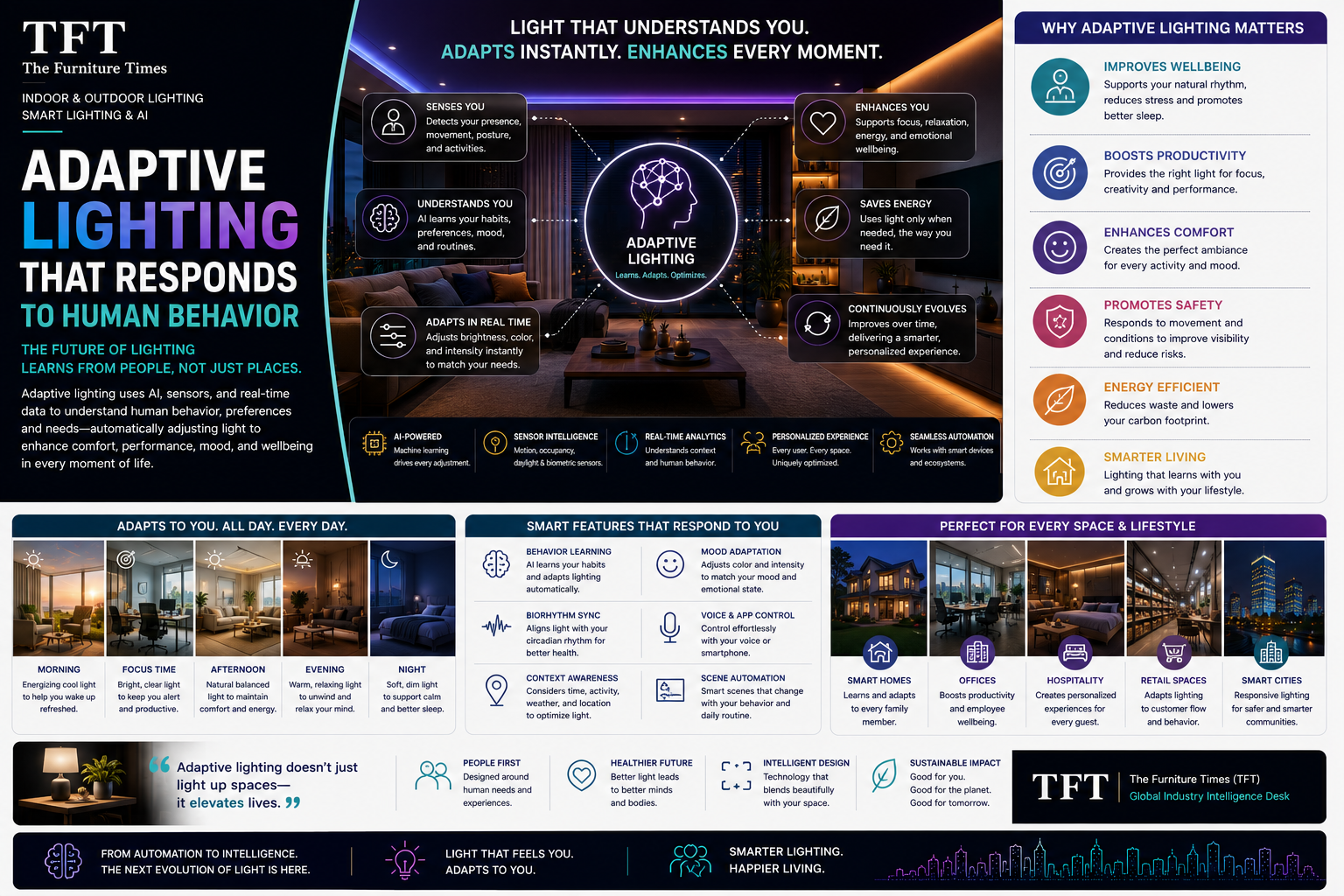
Adaptive lighting that responds to human behavior is rapidly becoming one of the most important innovations in the global lighting industry. Rather than treating every room the same, intelligent lighting systems are beginning to understand how spaces are used, who is using them, and what kind of lighting best supports the activity taking place.
Powered by Artificial Intelligence (AI), Internet of Things (IoT) connectivity, occupancy sensors, daylight harvesting, machine learning, and real-time data, adaptive lighting creates environments that evolve alongside the people within them.
For the furniture industry ecosystem, this marks an exciting transition. Lighting is no longer just an accessory added after furniture is installed. Instead, furniture, lighting, architecture, and digital technology are becoming part of one intelligent ecosystem designed to improve comfort, productivity, health, sustainability, and the overall living experience.
As homes, offices, hotels, healthcare facilities, educational institutions, and retail environments become smarter, adaptive lighting is emerging as a defining feature of modern interior design and connected living.
Lighting Is Beginning to Understand Human Behaviour
For decades, lighting operated on simple commands.
Someone entered a room, turned on the switch, and adjusted the brightness manually.
Today’s adaptive lighting systems work very differently.
Using sensors and intelligent software, they continuously observe environmental conditions and occupancy patterns. Instead of waiting for instructions, they respond automatically.
An adaptive lighting system can recognise whether a room is occupied, how much natural daylight is available, what time of day it is, and even the type of activity taking place.
This allows lighting to become proactive rather than reactive.
The experience feels natural because people no longer have to think about lighting—it simply works.
Every Room Has Different Needs
Not every activity requires the same lighting.
Preparing a meal, reading a book, working on a laptop, watching television, relaxing with family, or hosting guests all benefit from different light levels and colour temperatures.
Adaptive lighting understands these differences.
A connected home can automatically provide:
- Bright white lighting for cooking.
- Comfortable neutral lighting for work.
- Warm lighting for evening relaxation.
- Soft ambient lighting for entertaining.
- Gentle illumination for bedtime.
- Low-level pathway lighting during the night.
Instead of asking people to constantly adjust lighting, the environment adapts to their routines.
Artificial Intelligence Makes Every Day Smarter
Artificial Intelligence transforms adaptive lighting from automation into intelligence.
Rather than following fixed schedules, AI analyses patterns over time.
It begins to recognise:
- When family members wake up.
- Which rooms are most frequently used.
- Preferred lighting levels.
- Daily routines.
- Seasonal changes.
- Weather conditions.
- Occupancy behaviour.
- Energy usage patterns.
- Household preferences.
- Lifestyle habits.
As the system learns, it delivers increasingly personalised experiences without requiring manual adjustments.
Adaptive Lighting Creates Healthier Homes
People spend a significant portion of their lives indoors.
Lighting therefore plays an important role in everyday wellbeing.
Adaptive lighting supports healthier living by helping to:
- Reduce eye fatigue.
- Improve concentration.
- Encourage natural sleep cycles.
- Create calming evening environments.
- Enhance reading comfort.
- Support children’s study routines.
- Improve home office productivity.
- Reduce unnecessary brightness.
- Increase visual comfort.
- Promote overall wellbeing.
The goal is not simply to illuminate a space but to create an environment where people feel more comfortable throughout the day.
Furniture Is Becoming Part of an Intelligent Ecosystem
Furniture manufacturers are increasingly designing products that work together with adaptive lighting.
Examples include:
- Wardrobes that illuminate when opened.
- Kitchen cabinets that brighten work surfaces.
- Smart mirrors with automatic brightness adjustment.
- Reading chairs paired with adaptive task lighting.
- Home office desks with personalised lighting profiles.
- Bed frames that support healthy wake-up routines.
- Display cabinets with responsive accent lighting.
- Children’s furniture with safe nighttime illumination.
- Senior living furniture with fall-prevention lighting.
- Modular storage with integrated LED systems.
Furniture is no longer passive. It is becoming responsive.
Modern Offices Are Adapting to Employees
The workplace has changed dramatically.
Today’s offices prioritise employee wellbeing alongside productivity.
Adaptive lighting supports this transition by automatically responding to:
- Occupancy.
- Natural daylight.
- Meeting schedules.
- Collaborative work.
- Individual focus.
- Video conferencing.
- Break periods.
- Shared workspaces.
- Energy demand.
- Flexible office layouts.
Lighting becomes another tool that helps employees perform at their best.
Hospitals and Healthcare Are Seeing Real Benefits
Healthcare facilities require lighting that supports patients and medical professionals throughout the day and night.
Adaptive lighting helps create environments that:
- Improve patient comfort.
- Reduce nighttime disruption.
- Support recovery.
- Enhance staff visibility.
- Lower stress.
- Improve waiting areas.
- Assist elderly care.
- Increase safety.
- Reduce energy consumption.
- Create healthier healthcare environments.
Lighting is becoming part of the patient experience rather than simply building infrastructure.
Retailers Are Transforming Customer Experiences
Retail environments increasingly rely on adaptive lighting to create engaging shopping experiences.
Lighting can automatically respond to:
- Customer traffic.
- Product displays.
- Seasonal promotions.
- Window displays.
- Time of day.
- Special events.
- Store ambience.
- Product launches.
- Luxury collections.
- Energy management.
Retailers recognise that better lighting often leads to stronger customer engagement.
Sustainability Through Intelligence
Adaptive lighting contributes significantly to environmental sustainability.
Instead of operating continuously, systems deliver light only where and when it is needed.
This reduces:
- Electricity consumption.
- Carbon emissions.
- Operating costs.
- Equipment wear.
- Maintenance requirements.
- Energy waste.
- Peak electricity demand.
- Environmental impact.
- Long-term ownership costs.
- Resource consumption.
Smarter lighting supports smarter sustainability.
Opportunities Across the Furniture Industry Ecosystem
Adaptive lighting is creating new possibilities for:
- Furniture manufacturers.
- Lighting manufacturers.
- Interior designers.
- Architects.
- Smart home technology providers.
- Property developers.
- Hospitality operators.
- Healthcare designers.
- Retail businesses.
- Technology startups.
Companies that combine intelligent furniture with adaptive lighting will be well positioned as connected living becomes mainstream.
Challenges That Require Industry Collaboration
Despite rapid progress, several challenges remain.
The industry continues working on:
- Device compatibility.
- Consumer education.
- Installation complexity.
- Cybersecurity.
- Privacy protection.
- Technology standards.
- Integration costs.
- Software updates.
- Skilled workforce development.
- Long-term interoperability.
Addressing these issues will encourage broader global adoption.
The Future Is Predictive, Not Reactive
The next generation of adaptive lighting will move beyond responding to behaviour.
It will begin anticipating it.
Future systems may recognise when someone is preparing to work, exercise, relax, entertain guests, or sleep—and automatically create the ideal environment before any instruction is given.
Combined with AI, wearable technology, smart furniture, digital twins, and connected buildings, adaptive lighting will become one of the most valuable components of intelligent living.
A New Relationship Between People and Light
Adaptive lighting is changing our relationship with one of the oldest technologies in human history.
Instead of asking people to control lighting, modern systems are learning how to support people automatically.
For the global furniture industry ecosystem, this represents an opportunity to rethink how homes, workplaces, hotels, hospitals, schools, and retail spaces are designed.
Furniture is becoming smarter.
Lighting is becoming more intuitive.
Artificial Intelligence is becoming more personal.
Together, they are creating environments that respond to people with greater precision, efficiency, comfort, and care than ever before.
The future of lighting is not defined by brighter bulbs or more powerful fixtures.
It is defined by its ability to understand the people it serves.
The Furniture Times (TFT) & Furniture Industry Search Engine (FISE)
“TFT tells their story. FISE helps the world find them.”
“FurniReviewology helps the world trust them.”
The furniture industry ecosystem is a $1 trillion industry ecosystem.