How Urbanization Is Driving Demand for Modern Lighting Solutions
By The Furniture Times (TFT) | Indoor & Outdoor Lighting | Global Lighting Industry & Market
From Growing Cities to Smarter Communities: Why Urbanization Is Fueling the Next Generation of Lighting Innovation
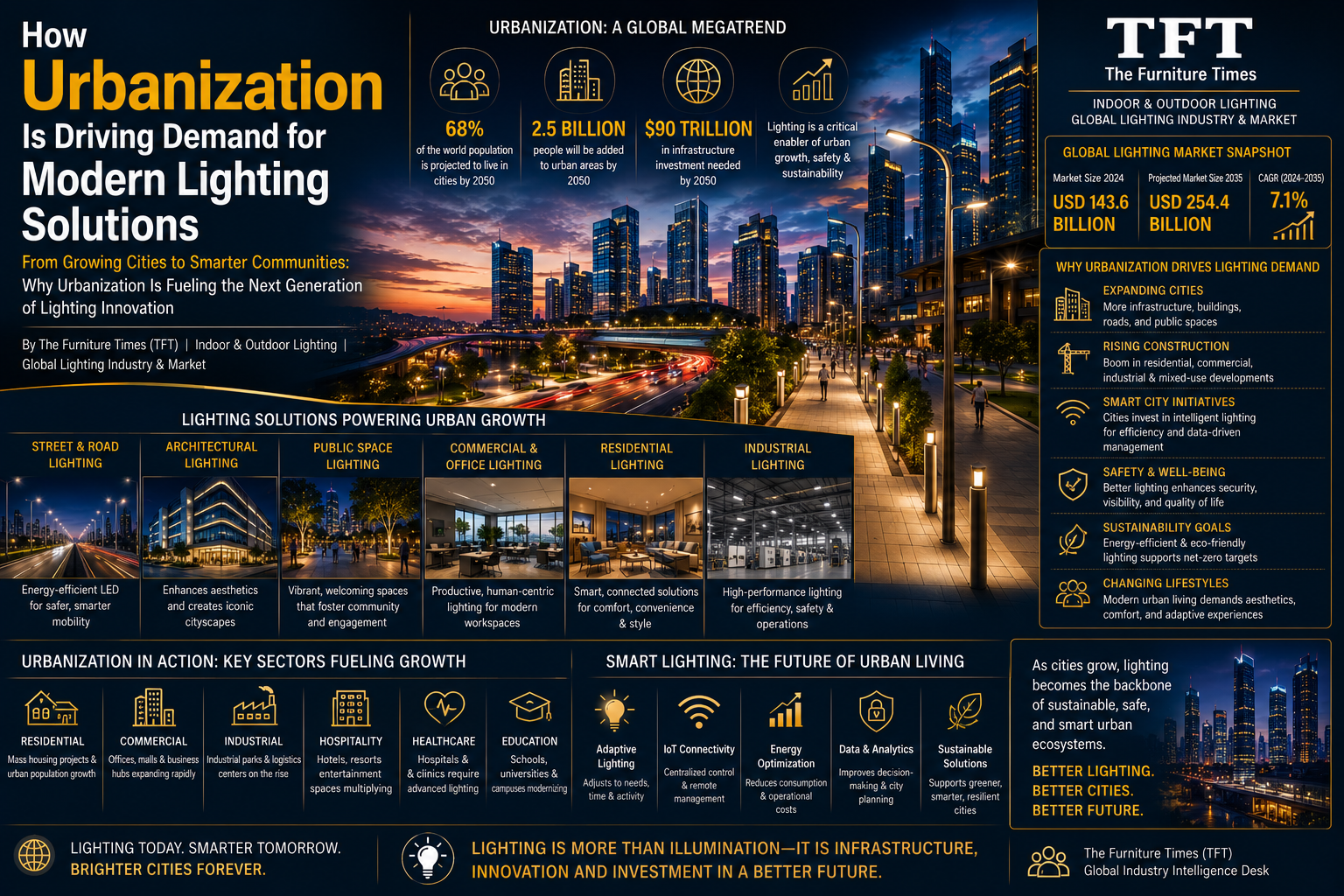
The world is urbanizing at an unprecedented pace. Every year, millions of people move from rural communities to towns and cities in search of better employment opportunities, education, healthcare, transportation, and improved standards of living. As urban populations continue to expand, governments, property developers, architects, infrastructure planners, and businesses face a growing responsibility to build cities that are not only larger but also safer, smarter, more energy-efficient, and environmentally sustainable.
At the center of this transformation is one often-overlooked yet indispensable industry—the global lighting industry.
Modern lighting is no longer just about illuminating streets, buildings, or homes. It has become a vital part of urban infrastructure that supports economic development, public safety, sustainable construction, digital connectivity, smart city technologies, and improved quality of life.
From residential apartments and commercial towers to airports, hospitals, industrial parks, shopping districts, transportation networks, parks, stadiums, and mixed-use developments, lighting has become one of the most critical investments shaping the cities of tomorrow.
For manufacturers, architects, interior designers, urban planners, furniture companies, governments, investors, and technology providers, urbanization represents one of the strongest long-term growth drivers for the global indoor and outdoor lighting market.
Urbanization Is Reshaping the Global Economy
Urbanization is transforming economies across every continent.
Growing cities create demand for:
- Residential housing
- Commercial office buildings
- Hotels and hospitality projects
- Healthcare facilities
- Educational institutions
- Retail developments
- Manufacturing facilities
- Logistics centers
- Transportation infrastructure
- Public recreational spaces
Every new development requires sophisticated lighting systems that combine functionality, aesthetics, energy efficiency, intelligence, and sustainability.
As cities become more complex, lighting evolves from a construction necessity into a strategic component of urban planning.
Residential Growth Drives Indoor Lighting Demand
One of the most immediate effects of urbanization is rapid residential construction.
Apartment towers, condominiums, gated communities, affordable housing developments, and luxury residences all require advanced indoor lighting systems that enhance comfort, safety, and energy efficiency.
Modern homeowners increasingly expect lighting solutions that offer:
- Smart home integration
- Voice control
- Energy-efficient LED technology
- Mood lighting
- Kitchen task lighting
- Home office lighting
- Security automation
- Circadian lighting
- Decorative architectural lighting
- Mobile application control
As cities grow vertically through high-rise developments, demand for innovative residential lighting continues expanding.
Commercial Construction Accelerates Market Growth
Urban economies depend on commercial buildings.
Modern cities require:
- Corporate headquarters
- Business parks
- Shopping malls
- Restaurants
- Hotels
- Convention centers
- Financial institutions
- Entertainment venues
- Co-working spaces
- Mixed-use developments
Lighting plays a critical role in improving employee productivity, customer experiences, operational efficiency, and building sustainability.
Developers increasingly recognize that intelligent lighting contributes directly to higher property values and long-term operational savings.
Smart Cities Depend on Intelligent Lighting
Urbanization has accelerated the development of smart cities around the world.
Smart cities integrate digital technologies to improve infrastructure, public services, environmental sustainability, and citizen experiences.
Modern lighting systems support numerous smart city functions, including:
- Traffic management
- Public safety
- Air quality monitoring
- Environmental sensing
- Weather observation
- Public Wi-Fi
- Emergency communication
- Security surveillance
- Electric vehicle charging
- Infrastructure monitoring
Streetlights are no longer passive infrastructure. They have become intelligent digital platforms capable of supporting multiple public services simultaneously.
Public Safety Begins with Better Lighting
Growing cities require safe public environments.
Well-designed outdoor lighting improves:
- Pedestrian safety
- Road visibility
- Crime prevention
- Public confidence
- Emergency response
- Nighttime transportation
- Urban accessibility
- Community engagement
- Tourism activities
- Commercial operations
Municipal governments increasingly prioritize high-performance LED lighting because it enhances both public safety and energy efficiency.
Smart lighting systems can automatically adjust brightness according to pedestrian movement, traffic volume, weather conditions, and emergency situations.
Transportation Infrastructure Expands Demand
Urbanization drives enormous investment in transportation infrastructure.
Major projects include:
- Airports
- Railway stations
- Metro systems
- Bus terminals
- Highways
- Bridges
- Tunnels
- Ports
- Logistics hubs
- Parking facilities
Each project depends on reliable, intelligent lighting systems capable of operating safely under demanding conditions while minimizing maintenance costs and energy consumption.
Advanced lighting also supports autonomous transportation technologies, intelligent traffic systems, and digital infrastructure.
Hospitality and Tourism Thrive in Urban Centers
Cities increasingly compete to attract tourists, conferences, international businesses, and cultural events.
Hotels, resorts, restaurants, entertainment districts, museums, shopping streets, and public landmarks rely heavily on lighting to create memorable visitor experiences.
Modern hospitality lighting contributes to:
- Luxury perception
- Customer comfort
- Brand identity
- Nighttime tourism
- Event experiences
- Architectural beauty
- Social media appeal
- Guest satisfaction
- Commercial activity
- Destination competitiveness
Cities investing in attractive nighttime environments often experience stronger tourism economies and longer visitor stays.
Sustainable Urban Development Requires Efficient Lighting
As urban populations expand, cities face increasing pressure to reduce environmental impact.
Lighting remains one of the largest consumers of electricity within urban infrastructure.
Governments increasingly promote:
- LED adoption
- Smart lighting controls
- Solar-powered lighting
- Renewable energy integration
- Motion sensors
- Adaptive brightness
- Daylight harvesting
- Carbon reduction
- Green building certification
- Circular economy manufacturing
Efficient lighting allows cities to reduce operational costs while meeting climate commitments.
Artificial Intelligence Is Transforming Urban Lighting
Artificial Intelligence is becoming a cornerstone of modern urban infrastructure.
AI-powered lighting systems can:
- Analyze traffic flow.
- Monitor pedestrian activity.
- Predict maintenance.
- Optimize energy usage.
- Improve emergency response.
- Detect unusual events.
- Integrate with security systems.
- Support disaster management.
- Enhance environmental monitoring.
- Improve municipal decision-making.
Lighting infrastructure increasingly generates valuable operational data that helps cities function more efficiently.
Furniture and Interior Design Benefit from Urbanization
Urban living has transformed interior design priorities.
Smaller apartments, flexible workspaces, and multifunctional homes require lighting solutions that maximize space while enhancing comfort and functionality.
Furniture manufacturers increasingly integrate lighting into:
- Kitchen cabinetry
- Wardrobes
- Office furniture
- Storage systems
- Display furniture
- Entertainment units
- Hospitality furniture
- Retail fixtures
- Bathroom cabinetry
- Smart home products
The collaboration between lighting manufacturers and furniture companies continues strengthening as urban lifestyles evolve.
Healthcare Facilities Require Advanced Lighting
Urban population growth increases demand for hospitals, clinics, rehabilitation centers, and senior living communities.
Healthcare lighting now supports:
- Patient recovery
- Medical accuracy
- Staff productivity
- Infection control
- Circadian health
- Emergency response
- Mental well-being
- Elderly care
- Surgical precision
- Energy efficiency
Human-centric lighting has become an important component of modern healthcare facility design.
Educational Campuses Continue Expanding
Growing cities require schools, colleges, universities, research centers, and innovation hubs.
Modern educational facilities increasingly adopt intelligent lighting that supports:
- Student concentration
- Visual comfort
- Energy efficiency
- Digital classrooms
- Campus safety
- Flexible learning environments
- Sustainability objectives
- Facility management
- Research laboratories
- Collaborative spaces
Lighting contributes directly to educational quality and campus operational performance.
Digital Infrastructure Creates New Business Opportunities
Urbanization accelerates digital transformation.
Architects, developers, contractors, facility managers, and homeowners increasingly rely on digital platforms to research, specify, purchase, and manage lighting systems.
Manufacturers investing in:
- AI-optimized websites
- BIM libraries
- Digital product catalogs
- Virtual showrooms
- Technical documentation
- Online configurators
- Cloud management platforms
- Predictive maintenance software
- Interactive visualization
- Educational content
gain stronger visibility and greater competitive advantage.
Investment Opportunities Continue Expanding
Urbanization creates opportunities across the entire lighting value chain.
Growth sectors include:
- LED manufacturing
- Smart lighting
- Building automation
- AI software
- IoT sensors
- Smart city infrastructure
- Renewable energy integration
- Hospitality lighting
- Healthcare lighting
- Human-centric lighting
Investors increasingly recognize lighting as one of the most resilient and future-ready sectors supporting urban development.
Challenges of Rapid Urban Growth
Despite tremendous opportunities, rapid urbanization presents several challenges.
The lighting industry must continue addressing:
- Rising electricity demand
- Infrastructure modernization
- Cybersecurity
- Data privacy
- Electronic waste
- Skilled workforce shortages
- Product standardization
- Supply chain resilience
- Climate adaptation
- Affordable housing requirements
Innovative technologies and strong collaboration between public and private sectors will be essential to overcome these challenges.
Lighting the Cities of Tomorrow
Urbanization is one of the most powerful forces shaping the future of the global lighting industry.
Every new neighborhood, apartment, office tower, transportation network, hospital, hotel, school, industrial park, and public space creates demand for lighting systems that are more intelligent, sustainable, connected, and efficient than ever before.
As cities evolve into smart, resilient, and digitally connected communities, lighting will play a central role in supporting economic growth, environmental responsibility, public safety, and human well-being.
For manufacturers, architects, interior designers, furniture companies, governments, developers, investors, and technology providers, urbanization is not simply increasing demand for lighting—it is redefining the entire purpose of illumination.
The cities of the future will not merely be brighter.
They will be illuminated by intelligent lighting ecosystems that power sustainable economies, healthier communities, and smarter ways of living for generations to come.