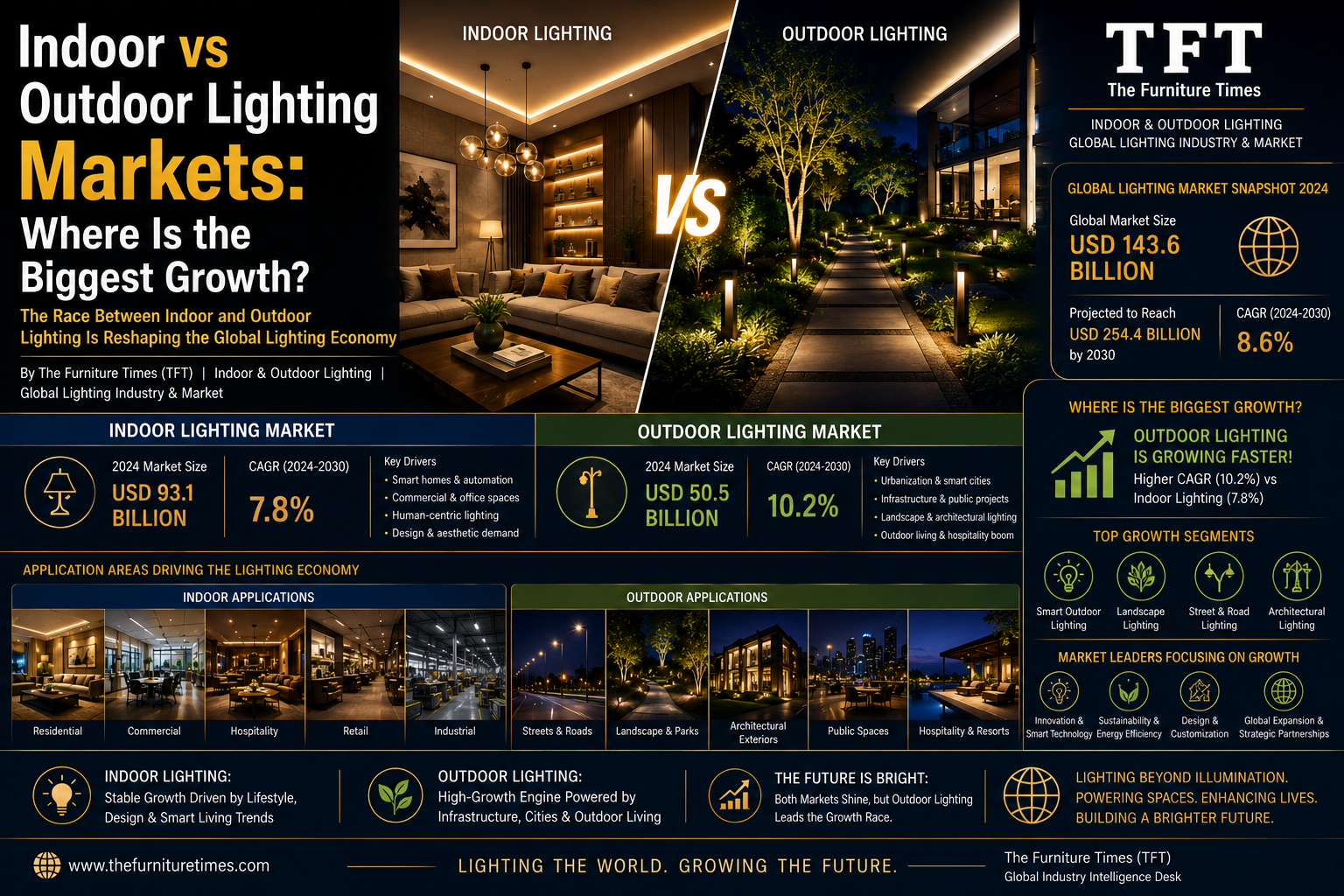
Indoor vs Outdoor Lighting Markets: Where Is the Biggest Growth?
By The Furniture Times (TFT) | Indoor & Outdoor Lighting | Global Lighting Industry & Market
The Race Between Indoor and Outdoor Lighting Is Reshaping the Global Lighting Economy
The global lighting industry is experiencing unprecedented transformation as technology, urbanization, sustainability, and changing lifestyles redefine how people illuminate homes, workplaces, public infrastructure, and outdoor environments. While both indoor and outdoor lighting markets continue to expand rapidly, investors, manufacturers, architects, property developers, governments, retailers, and designers are increasingly asking one important question:
Where is the biggest growth opportunity—indoor lighting or outdoor lighting?
The answer is not as simple as choosing one over the other.
Both sectors are growing for different reasons, serving different industries, and benefiting from unique technological innovations. Indoor lighting continues to evolve through smart homes, intelligent offices, hospitality, healthcare, retail, and human-centric lighting. Outdoor lighting, meanwhile, is accelerating due to smart city initiatives, infrastructure development, renewable energy, public safety, tourism, and urban expansion.
Rather than competing, these two markets complement each other, collectively shaping one of the world’s most dynamic industries.
The Global Lighting Industry Is Expanding Rapidly
The lighting industry today supports nearly every segment of the global economy.
Demand comes from:
- Residential housing
- Commercial buildings
- Industrial facilities
- Hotels and resorts
- Healthcare institutions
- Educational campuses
- Airports
- Warehouses
- Shopping centers
- Public infrastructure
- Parks and recreational facilities
- Smart cities
- Transportation networks
As governments invest in infrastructure and private developers construct increasingly sophisticated buildings, demand for innovative lighting solutions continues to rise across both indoor and outdoor environments.
The rapid adoption of LED technology, Artificial Intelligence (AI), Internet of Things (IoT), building automation, and energy-efficient systems is creating new opportunities throughout the entire lighting value chain.
Indoor Lighting: Driven by Lifestyle and Smart Buildings
Indoor lighting remains the largest segment of the global lighting market due to the sheer number of residential and commercial buildings worldwide.
Every home, office, school, hospital, hotel, retail store, restaurant, warehouse, and manufacturing facility depends on carefully designed lighting systems that balance functionality, aesthetics, and energy efficiency.
Modern indoor lighting extends far beyond basic illumination.
Today’s solutions include:
- Smart LED lighting
- Human-centric lighting
- Tunable white lighting
- Decorative architectural lighting
- AI-powered lighting controls
- Voice-controlled systems
- Motion sensing
- Circadian lighting
- Wireless automation
- Personalized lighting scenes
Consumers increasingly view lighting as part of interior design rather than simply electrical infrastructure.
Furniture manufacturers, architects, kitchen specialists, and interior designers now integrate lighting directly into cabinetry, wardrobes, shelving, entertainment units, office furniture, and hospitality installations.
This convergence continues expanding the indoor lighting market.
Residential Construction Supports Long-Term Growth
Global housing demand remains one of the strongest drivers of indoor lighting.
Population growth, urban migration, rising household incomes, and residential development create continuous opportunities for lighting manufacturers.
Homeowners increasingly prioritize:
- Energy-efficient LEDs
- Smart home integration
- Mood lighting
- Decorative fixtures
- Kitchen lighting
- Bedroom wellness lighting
- Home office lighting
- Security lighting
- Luxury interiors
- Sustainable products
As living standards improve globally, residential lighting becomes increasingly sophisticated.
Commercial Buildings Continue Investing
Office buildings, shopping malls, hospitals, hotels, universities, and industrial facilities require lighting systems capable of improving productivity, reducing energy costs, and supporting building automation.
Commercial customers increasingly demand:
- Occupancy-based controls
- AI-powered optimization
- Cloud monitoring
- Predictive maintenance
- Intelligent dimming
- Daylight harvesting
- ESG compliance
- Human-centric lighting
- Digital building integration
- Remote management
These requirements continue expanding the commercial indoor lighting market.
Outdoor Lighting Is Growing Faster Than Ever
Although indoor lighting currently represents a larger overall market, outdoor lighting is experiencing some of the fastest growth rates globally.
Several powerful trends are accelerating outdoor lighting demand.
Smart City Development
Governments worldwide are investing heavily in smart cities.
Modern outdoor lighting systems support:
- Traffic management
- Environmental monitoring
- Air quality sensors
- Security cameras
- Emergency response
- Public Wi-Fi
- Electric vehicle charging
- Digital communication
- Infrastructure monitoring
- Energy optimization
Streetlights are evolving into intelligent digital infrastructure.
Infrastructure Expansion
Developing economies continue investing in:
- Highways
- Airports
- Seaports
- Rail networks
- Public parks
- Stadiums
- Bridges
- Industrial zones
- Tourism destinations
- Urban redevelopment
Every infrastructure project requires sophisticated outdoor lighting systems.
Tourism Creates New Opportunities
Tourism has become one of the strongest drivers of decorative outdoor lighting.
Cities increasingly invest in attractive nighttime environments featuring:
- Waterfront lighting
- Heritage building illumination
- Landscape lighting
- Public art installations
- Outdoor entertainment districts
- Hotel landscapes
- Luxury resorts
- Shopping streets
- Cultural landmarks
- Event venues
Beautiful nighttime environments attract visitors, extend commercial activity, improve safety, and strengthen destination branding.
Landscape Lighting Is Becoming Mainstream
Residential outdoor living continues expanding.
Homeowners increasingly invest in:
- Garden lighting
- Patio illumination
- Swimming pool lighting
- Outdoor kitchens
- Rooftop terraces
- Walkway lighting
- Decorative landscapes
- Security lighting
- Architectural façade lighting
- Smart outdoor automation
Outdoor living spaces have become extensions of the modern home, creating significant opportunities for manufacturers and designers.
Sustainability Benefits Both Markets
Environmental sustainability supports growth across both indoor and outdoor lighting.
Governments continue promoting:
- LED adoption
- Solar-powered lighting
- Renewable energy integration
- Smart energy management
- Carbon reduction
- Green building standards
- Circular economy manufacturing
- Energy-efficient retrofits
Lighting upgrades often represent one of the fastest methods for reducing electricity consumption while improving environmental performance.
Artificial Intelligence Is Transforming Both Segments
AI represents one of the industry’s largest growth drivers.
Indoor AI applications include:
- Personalized lighting
- Occupancy detection
- Wellness optimization
- Energy management
- Workplace productivity
- Home automation
Outdoor AI applications include:
- Adaptive street lighting
- Traffic-responsive illumination
- Public safety monitoring
- Environmental sensing
- Infrastructure diagnostics
- Predictive maintenance
As AI capabilities continue advancing, both markets will experience accelerated innovation.
The Hospitality Industry Bridges Both Markets
Hotels, resorts, restaurants, and entertainment venues require seamless integration between indoor and outdoor lighting.
Guests experience lighting throughout their journey:
- Exterior arrival
- Parking facilities
- Landscape pathways
- Hotel lobby
- Guest rooms
- Restaurants
- Conference facilities
- Gardens
- Swimming pools
- Outdoor entertainment areas
Hospitality developers increasingly invest in unified lighting strategies that create memorable guest experiences while minimizing energy consumption.
Furniture and Interior Design Drive Indoor Demand
The furniture industry continues creating new opportunities for indoor lighting.
Integrated lighting enhances:
- Kitchen cabinetry
- Walk-in wardrobes
- Display furniture
- Office furniture
- Hotel furniture
- Bathroom cabinetry
- Retail fixtures
- Luxury storage
- Entertainment systems
- Smart home furniture
Lighting has become a premium design feature that adds functionality, elegance, and perceived value.
Outdoor Infrastructure Attracts Public Investment
Public investment increasingly favors outdoor lighting because municipalities recognize its broader economic benefits.
Modern outdoor lighting improves:
- Road safety
- Crime prevention
- Tourism
- Community well-being
- Nighttime commerce
- Transportation efficiency
- Environmental monitoring
- Infrastructure resilience
Many governments consider smart outdoor lighting an essential component of future urban development.
Digital Commerce Is Expanding Both Markets
Architects, contractors, developers, homeowners, and designers increasingly purchase lighting products through digital channels.
Manufacturers investing in:
- AI-friendly websites
- Product visualization
- BIM libraries
- Online configurators
- Technical documentation
- Virtual showrooms
- Interactive catalogs
gain competitive advantages in both indoor and outdoor markets.
Digital visibility increasingly influences purchasing decisions across every customer segment.
So, Where Is the Biggest Growth?
The answer depends on the market segment.
Indoor lighting continues generating the largest overall market value because every residential, commercial, industrial, healthcare, hospitality, and retail building depends on sophisticated lighting systems.
Outdoor lighting, however, is expected to experience some of the fastest growth rates due to:
- Smart city investments
- Infrastructure modernization
- Tourism development
- Renewable energy adoption
- Public safety initiatives
- Landscape architecture
- Urban redevelopment
- Digital infrastructure integration
Rather than replacing one another, both markets are expanding simultaneously through different economic drivers.
A Bright Future for the Entire Industry
The global lighting industry is entering an era where indoor and outdoor lighting are becoming increasingly intelligent, sustainable, connected, and data-driven.
Artificial Intelligence, LED innovation, renewable energy, smart buildings, digital infrastructure, and changing consumer lifestyles will continue driving demand across both sectors well into the next decade.
For manufacturers, architects, property developers, furniture companies, hospitality operators, investors, governments, and technology providers, the opportunity lies not in choosing between indoor and outdoor lighting—but in understanding how both markets intersect to create complete, integrated environments.
The future belongs to companies capable of delivering lighting solutions that seamlessly connect homes, workplaces, cities, landscapes, and communities into one intelligent ecosystem where light is no longer just illumination—it is infrastructure, experience, sustainability, and economic growth.