The Iran–USA–Israel Conflict and the Global Furniture Industry: Why SMEs Are Carrying the Heaviest Burden
Global Geopolitical Risk & Furniture Industry Intelligence Desk
By The Furniture Times (TFT) Editorial Desk
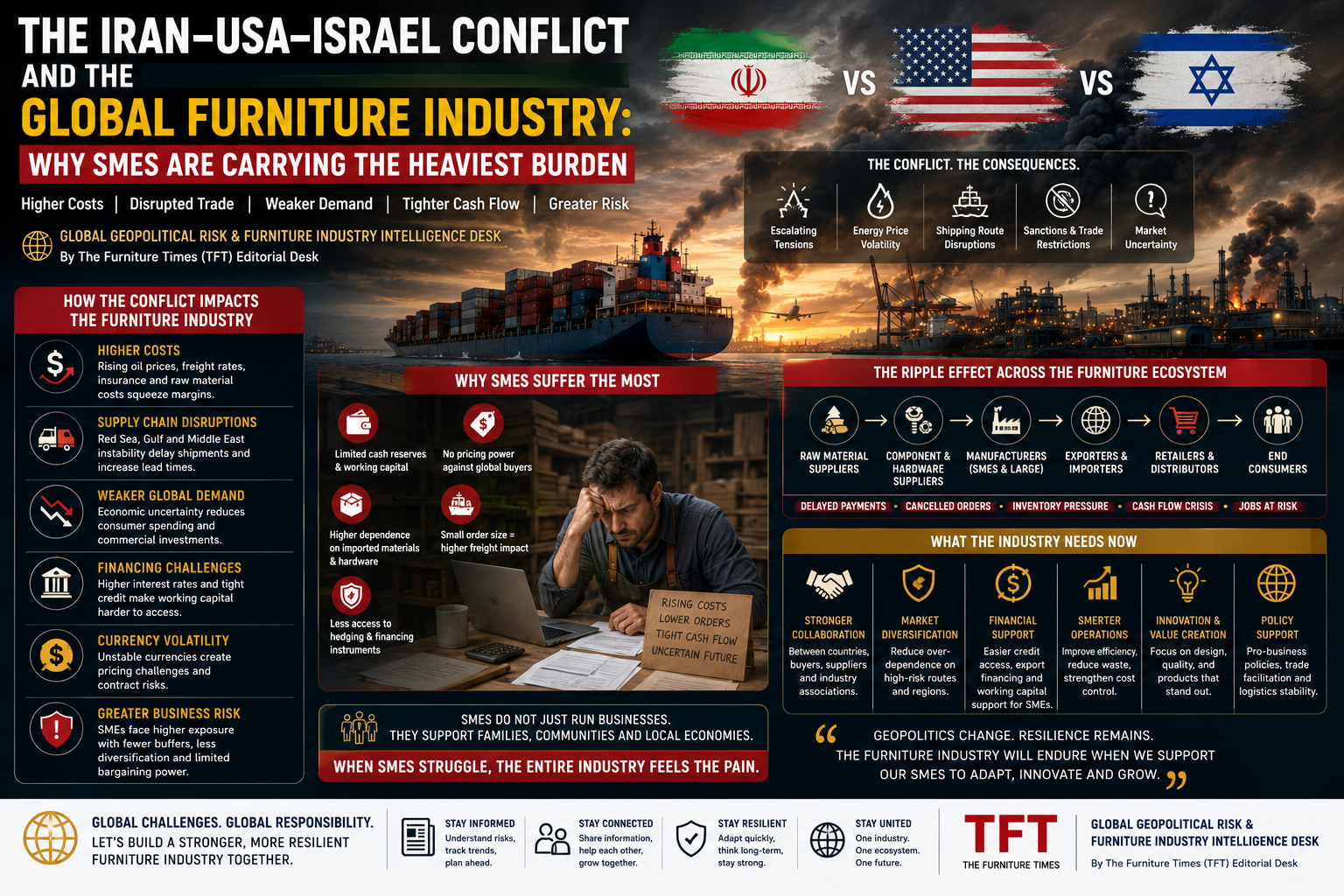
The ongoing conflict involving Iran, the United States and Israel has become more than a geopolitical and military crisis. It is increasingly affecting global trade, energy markets, shipping routes and manufacturing costs. Recent escalations have raised concerns about disruptions to the Strait of Hormuz, one of the world’s most important maritime trade corridors, with implications for shipping, fuel prices and international supply chains.
For the global furniture industry ecosystem, the consequences extend far beyond the Middle East.
Furniture manufacturers, exporters, retailers, logistics providers, raw material suppliers and, most importantly, small and medium-sized enterprises (SMEs) are facing rising uncertainty.
Unlike large multinational corporations, SMEs generally have limited financial reserves, less negotiating power and fewer options to absorb sudden increases in costs or delivery delays.
According to The Furniture Times (TFT), the greatest challenge is not only the conflict itself—it is the uncertainty it creates across the global furniture economy.
Why the Furniture Industry Is Being Affected
Furniture manufacturing depends on global supply chains.
Every furniture product relies on:
- Raw materials
- Energy
- Shipping
- Logistics
- International trade
- Warehousing
- Skilled labour
- Retail distribution
When geopolitical tensions disrupt any of these areas, the impact spreads throughout the entire furniture ecosystem.
Recent conflict has contributed to higher shipping risks, rising insurance costs, energy market volatility and concerns about maritime trade routes.
Rising Energy Costs Affect Every Furniture Factory
Furniture manufacturing is energy intensive.
Factories use electricity and fuel for:
- Cutting timber
- Drying wood
- CNC machinery
- Finishing processes
- Packaging
- Transportation
When oil and energy prices increase, manufacturing costs also rise.
These additional expenses often reduce already thin profit margins, particularly for SMEs. Analysts warn that prolonged conflict can contribute to higher energy prices and slower global growth.
Shipping Costs Continue to Rise
The furniture industry depends heavily on ocean freight.
Large furniture products occupy significant container space, making freight costs a major business expense.
Disruptions affecting key maritime routes have led to:
- Longer transit times
- Higher freight charges
- Increased insurance premiums
- Route diversions
- Delivery uncertainty
Industry reports describe major disruptions to merchant shipping and continued rerouting of vessels.
SMEs Face the Greatest Challenge
Large corporations often have:
- Multiple suppliers
- Larger inventories
- Better financing
- Global procurement networks
Most SMEs do not.
Instead, they frequently face:
- Cash flow pressure
- Delayed customer payments
- Higher import costs
- Reduced export competitiveness
- Difficulty absorbing freight increases
For many smaller businesses, even a modest increase in logistics costs can significantly affect profitability.
Export Markets Become Less Predictable
Furniture exporters depend on reliable shipping schedules.
Delays can affect:
- Hotel projects
- Commercial fit-outs
- Residential developments
- Retail inventory
- Contract manufacturing
Uncertain delivery schedules may cause buyers to postpone or diversify sourcing decisions.
Consumer Demand May Slow
Higher inflation and economic uncertainty can reduce spending on discretionary purchases such as furniture.
Consumers may:
- Delay home renovations
- Postpone furniture replacement
- Choose lower-priced products
- Reduce commercial investment
This affects manufacturers and retailers throughout the supply chain.
Malaysia’s Furniture Industry Must Stay Competitive
Malaysia remains one of the world’s recognised furniture exporting nations.
To strengthen resilience, the industry can continue investing in:
- Manufacturing efficiency
- Digital transformation
- Regional logistics
- Export diversification
- Market intelligence
- Product innovation
Expanding regional trade within ASEAN may also help reduce dependence on longer supply chains where appropriate.
The Need for Regional Supply Chains
The current environment highlights the value of stronger regional partnerships.
For Malaysia and Singapore, improved cooperation in:
- Cross-border logistics
- Warehousing
- Distribution
- Customs efficiency
- Digital documentation
could improve resilience for businesses serving Southeast Asia.
AI Can Help Businesses Respond
Artificial Intelligence cannot stop geopolitical conflict.
However, it can help businesses:
- Forecast demand
- Optimise inventory
- Improve logistics planning
- Analyse supply chain risks
- Reduce operational waste
Digital decision-making becomes increasingly valuable during periods of uncertainty.
Governments Have an Important Role
Governments can support furniture SMEs through:
- Export assistance
- SME financing
- Trade facilitation
- Skills development
- Innovation grants
- Logistics improvements
- Business advisory services
Targeted support can help businesses adapt to changing global conditions.
Opportunities Still Exist
Periods of disruption also encourage innovation.
Businesses that strengthen:
- Operational efficiency
- Product quality
- Customer service
- Digital visibility
- Regional partnerships
may be better positioned when market conditions stabilise.
The Furniture Times Analysis
Geopolitical conflicts rarely affect only one region.
They create ripple effects across global manufacturing, logistics, finance and consumer confidence.
For the furniture industry, SMEs remain the most vulnerable because they often have fewer financial and operational resources to absorb prolonged uncertainty.
At the same time, the current environment reinforces the importance of:
- Stronger regional supply chains
- Better logistics planning
- AI-driven operations
- Market diversification
- Government-industry collaboration
- Long-term resilience rather than short-term reaction
Final Verdict
The Iran–USA–Israel conflict is a reminder that the global furniture industry is deeply interconnected.
Events thousands of kilometres away can influence:
- Energy prices
- Freight costs
- Delivery schedules
- Manufacturing expenses
- Consumer confidence
- International trade
The businesses most likely to succeed will not necessarily be the largest.
They will be those that are most adaptable.
For governments, industry associations and business leaders, this is an opportunity to strengthen the furniture ecosystem through smarter policies, resilient logistics, digital transformation and closer international cooperation.
The future of the furniture industry will not be shaped only by how well it manufactures furniture.
It will also be shaped by how well it manages uncertainty.
By The Furniture Times (TFT) Editorial Desk
Global Geopolitical Risk & Furniture Industry Intelligence Desk | July 2026
“TFT tells their story. FISE helps the world find them.”