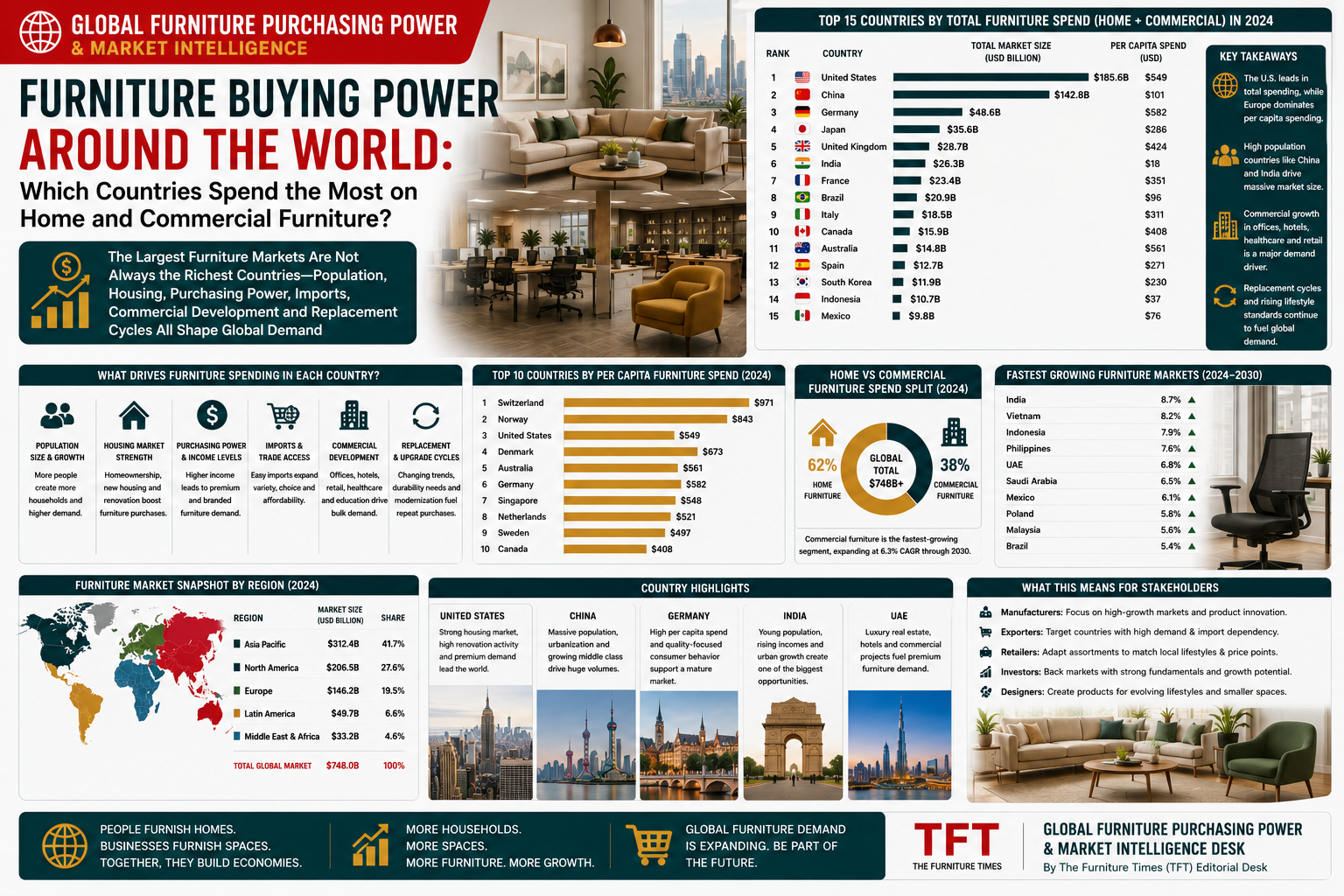
Furniture Buying Power Around the World: Which Countries Spend the Most on Home and Commercial Furniture?
The Largest Furniture Markets Are Not Always the Richest Countries—Population, Housing, Purchasing Power, Imports, Commercial Development and Replacement Cycles All Shape Global Demand
Global Furniture Purchasing Power & Market Intelligence Desk
By The Furniture Times (TFT) Editorial Desk
Which country spends the most on furniture?
The answer appears simple, but the global furniture economy cannot be understood through one number.
The United States may lead in the value of many furniture categories because of its large economy, high household consumption, substantial housing stock and strong import demand. China combines enormous domestic consumption with the world’s largest furniture-manufacturing ecosystem. Germany is one of Europe’s most important furniture markets and import destinations. India has lower spending per person but possesses extraordinary long-term potential because of its population, urbanisation and expanding middle class.
Smaller high-income markets such as Switzerland, Norway, Denmark, Singapore, the United Arab Emirates and Australia may not match the total purchasing volume of the United States or China, but they can generate high spending per household, strong premium demand or valuable commercial projects.
Furniture buying power must therefore be measured in several ways:
- Total national furniture consumption
- Residential furniture expenditure
- Commercial and institutional demand
- Furniture imports
- Spending per household
- Spending per person
- Property construction and renovation
- Replacement cycles
- Hospitality and tourism investment
- Office, healthcare and education development
- Access to consumer credit
- Currency strength
- Income distribution
- Local furniture prices
A country can rank highly in one measure and much lower in another.
The global furniture market itself was valued at approximately US$786.1 billion in 2025 under one broad market definition and is projected to increase from about US$831.6 billion in 2026 to US$1.33 trillion by 2033. Another major estimate places the 2025 market at US$597.7 billion and forecasts growth to approximately US$996.4 billion by 2034. These differences result from variations in product coverage, pricing levels and research methodology.
CSIL uses a narrower industry-focused definition and estimates that worldwide furniture consumption exceeded US$440 billion in 2025. It projected real global consumption growth of approximately 1.4% for that year.
Despite different market totals, the evidence consistently places the United States, China and major Western European economies among the most influential furniture-consuming markets.
What Does Furniture Buying Power Mean?
Furniture buying power is the ability and willingness of households, companies and institutions to purchase furniture at prevailing market prices.
It is not identical to national income.
A country can be wealthy but have:
- A small population
- Limited housing construction
- Small average homes
- Strong second-hand furniture habits
- High labour and furniture prices
- Cautious consumer spending
Another country can have lower income per person but generate enormous total demand through:
- A large population
- Millions of new households
- Rapid urbanisation
- Hotel and office construction
- Government infrastructure
- Expanding organised retail
- Strong local manufacturing
The most valuable furniture markets combine several demand drivers.
Household Purchasing Capacity
This includes disposable income, savings, employment security and access to financing.
Household Formation
Every new household requires at least basic sleeping, seating, dining and storage products.
Homeownership and Property Transactions
Home purchases and residential moves frequently trigger furniture buying.
Existing Housing Stock
Mature markets generate replacement and renovation demand even when new construction slows.
Commercial Development
Offices, hotels, hospitals, schools, restaurants and retail projects create contract-furniture demand.
Furniture Prices
The same income can purchase very different amounts of furniture in different countries.
Import Capacity
Strong furniture imports can indicate a large, diverse market that domestic manufacturing does not serve completely.
Cultural Spending Priorities
Some cultures invest heavily in dining, hospitality, bedrooms, wedding furniture or extended-family living spaces.
Why No Single Global Ranking Is Perfect
Furniture statistics are fragmented.
Some datasets include:
- Mattresses
- Kitchen cabinets
- Built-in furniture
- Outdoor furniture
- Furnishings and household equipment
- Office furniture
- Retail fixtures
- Hotel FF&E
Others exclude one or more of these categories.
Trade data also measures cross-border shipments rather than total consumption. A country with strong domestic manufacturing can have a large furniture market without importing as much as a country that depends heavily on foreign suppliers.
For this reason, a credible global comparison should use several indicators rather than relying on one commercial estimate.
The country rankings in this report are therefore organised into:
- Largest total furniture-spending markets
- Strongest import-driven markets
- High spending per household
- Largest commercial furniture opportunities
- Fastest-emerging future markets
The Global Leaders in Total Furniture Buying Power
1. United States: The World’s Most Valuable Furniture Demand Market
The United States is widely regarded as the largest or one of the two largest furniture-consuming countries.
It combines:
- A population exceeding 340 million
- High household consumption
- Large average residential spaces
- Strong homeownership and rental markets
- Extensive suburban housing
- High furniture replacement demand
- Large office, hotel, healthcare and education sectors
- Developed consumer-credit systems
- Mature e-commerce and retail infrastructure
The United States is also the world’s leading furniture importer. CSIL identified the United States, Germany, the United Kingdom, France and Canada as the five largest furniture importers, together accounting for almost half of global furniture imports.
For the broad category of “other wooden furniture,” World Bank WITS data based on UN Comtrade recorded US imports of approximately US$7.2 billion in 2024, far ahead of individual European countries in that product category.
One market forecast estimates that the total US furniture market could reach approximately US$130.24 billion by 2032. Exact values vary, but the scale of the market is undeniable.
Residential Demand
US households purchase large volumes of:
- Sofas and upholstered furniture
- Mattresses
- Bedroom collections
- Dining furniture
- Home-office furniture
- Outdoor furniture
- Storage and organisation products
- Kitchen and renovation furniture
Large houses enable consumers to own more pieces per household than residents of many densely populated urban markets.
Commercial Demand
The country contains major markets for:
- Corporate offices
- Hotels and resorts
- Hospitals and senior living
- Universities and schools
- Restaurants
- Retail stores
- Public facilities
Main Risks
Furniture demand is sensitive to:
- Mortgage rates
- Housing transactions
- Consumer confidence
- Tariffs
- Freight costs
- Inflation
- Property renovation activity
The United States depends heavily on imported furniture and components. Tariffs and supply-chain changes have encouraged companies to examine more local production, especially for bulky products where freight costs are high.
Strategic Position
Largest overall international opportunity for scale, imports, retail and commercial furniture.
2. China: Manufacturing Giant and Enormous Domestic Consumer Market
China is not only the world’s largest furniture manufacturing and export centre. It is also one of the largest domestic furniture-consuming markets.
The country’s strength comes from:
- A population of approximately 1.4 billion
- Extensive urban housing
- Large-scale apartment development
- A vast manufacturing ecosystem
- Strong digital commerce
- Growing middle-income demand
- Hotel, office and retail development
- Rapid product innovation
Asia-Pacific accounted for approximately 38.5% of global furniture revenue in 2025 under one market assessment and nearly 49.1% under another broader regional methodology. China represents a major share of that regional scale.
The United States and China together represent more than half of global upholstered-furniture demand, according to CSIL analysis of 70 major markets.
Residential Demand
China’s urban households generate demand for:
- Modular apartment furniture
- Bedroom furniture
- Mattresses
- Dining furniture
- Storage systems
- Children’s furniture
- Home offices
- Smart furniture
- Premium imported products
Commercial Demand
China has substantial demand from:
- Offices
- Hotels
- Healthcare
- Schools and universities
- Restaurants
- Shopping centres
- Public infrastructure
Changing Consumer Economy
China approved a five-year strategy in July 2026 aimed at increasing annual retail sales to about 60 trillion yuan by 2030 while strengthening household incomes and consumer services. The success of this policy could influence future home, lifestyle and furniture expenditure.
Main Risks
- Property-sector weakness
- Slower household formation
- Consumer caution
- Population ageing
- Intense domestic competition
- Price pressure
- Excess production capacity
Strategic Position
One of the world’s two largest total furniture markets and the most complete manufacturing-to-consumer ecosystem.
3. Germany: Europe’s Strongest All-Round Furniture Market
Germany is one of Europe’s largest furniture-consuming, importing and manufacturing markets.
Its position is supported by:
- A large high-income population
- Strong home-improvement culture
- Developed housing stock
- Major kitchen-furniture demand
- Significant office and commercial markets
- Strong furniture retail networks
- Central access to European trade
Germany is consistently identified among the world’s largest furniture importers. For “other wooden furniture,” Germany imported approximately US$2.26 billion in 2024, according to World Bank WITS data.
Residential Demand
German consumers frequently value:
- Durability
- Functional design
- Storage efficiency
- Kitchen systems
- Material quality
- Environmental performance
- Warranties
- Repairability
Commercial Demand
Germany offers major opportunities in:
- Office furniture
- Hospitality
- Education
- Healthcare
- Retail fixtures
- Public procurement
Main Risks
European furniture demand remained subdued through parts of 2024 and 2025 because of economic uncertainty, weaker construction and cautious consumers.
Strategic Position
Europe’s most important large-scale national furniture market, especially for kitchens, residential systems and technical commercial products.
4. United Kingdom: High Import Dependence and Strong Residential Demand
The United Kingdom remains one of the world’s leading furniture import markets.
Its demand is supported by:
- A population of roughly 70 million
- High urbanisation
- A large housing stock
- Strong home-improvement interest
- Developed e-commerce
- Significant hospitality and office sectors
- High import dependence
The UK imported approximately US$1.71 billion of other wooden furniture in 2024, placing it among the leading national import markets in that category.
Residential Opportunities
- Upholstered furniture
- Beds and mattresses
- Compact urban furniture
- Storage
- Kitchens
- Garden furniture
- Rental-housing packages
Commercial Opportunities
London and other major cities generate substantial demand for:
- Hotels
- Restaurants
- Offices
- Retail concepts
- Student accommodation
- Healthcare and senior living
Main Risks
- Housing affordability
- Weak consumer confidence
- Currency movements
- Import and freight costs
- Commercial-property uncertainty
Strategic Position
A highly developed, design-aware and import-dependent market with strong omnichannel retail demand.
5. France: Large Residential Market With Hospitality and Design Strength
France combines a major domestic furniture market with global influence in luxury, hospitality, interior design and lifestyle retail.
It is one of the world’s five largest furniture importers according to CSIL. Its imports of other wooden furniture reached approximately US$1.49 billion in 2024.
Residential Demand
French households purchase:
- Living-room furniture
- Bedroom products
- Kitchens
- Dining furniture
- Outdoor furniture
- Compact urban products
- Design and decorative furniture
Commercial Demand
France has strong demand from:
- Tourism and hospitality
- Luxury retail
- Offices
- Restaurants
- Healthcare
- Education
- Public projects
Strategic Position
One of Europe’s largest consumer markets, with particular strength in design, hospitality and mid-to-premium residential furniture.
6. Japan: High Spending, Compact Living and an Ageing Consumer Market
Japan remains one of Asia’s most valuable mature furniture markets.
It combines:
- High income per person
- Dense urban housing
- Strong consumer expectations
- A large ageing population
- Advanced retail and logistics
- Significant hospitality and office markets
Japan’s furniture demand differs from that of large-space markets such as the United States.
Consumers frequently require:
- Compact products
- Multifunctional furniture
- High-quality storage
- Low-profile designs
- Space-efficient dining
- Age-inclusive furniture
- Premium mattresses
- Refined materials
Commercial Opportunities
- Hotels and tourism
- Offices
- Healthcare
- Senior living
- Retail
- Restaurants
- Education
Main Risks
- Population decline
- Slow household formation
- Limited residential space
- Mature replacement market
Strategic Position
A high-value market for compact, refined, technically reliable and age-inclusive furniture.
7. Italy: Major Consumer, Design and Premium Furniture Market
Italy is globally recognised for furniture design and manufacturing, but it is also an important domestic consumer market.
The country’s demand is supported by:
- Strong interior-design culture
- Home renovation
- Kitchen and living furniture
- Luxury residential projects
- Hospitality
- Retail and restaurant development
Italy’s economic importance extends beyond domestic spending because its brands, designers and manufacturers influence premium purchasing worldwide.
Strategic Position
A leading design, premium residential, kitchen, hospitality and export-oriented furniture economy.
8. Canada: High Household Spending and Major Import Demand
Canada is one of the world’s five largest furniture importers.
Its furniture demand is supported by:
- High income
- Large homes in many regions
- Population growth through immigration
- Strong housing and rental markets
- Developed retail
- Office, hospitality and healthcare investment
Residential Opportunities
- Sofas and sectionals
- Mattresses
- Bedroom furniture
- Dining furniture
- Storage
- Outdoor living
- Furnished rental packages
Main Risks
- Housing affordability
- High household debt
- Property-market sensitivity
- Import dependence
- Long transport distances
Strategic Position
A wealthy, import-intensive North American market with strong residential and institutional demand.
9. South Korea: Urban, Digital and Design-Conscious Demand
South Korea is a high-income, highly urbanised and digitally advanced furniture market.
Demand is concentrated around:
- Apartments
- Compact storage
- Modular furniture
- Kitchens
- Mattresses
- Home offices
- Children’s products
- Design-led furniture
Its consumers are familiar with online research, rapid product comparison and sophisticated retail experiences.
Commercial Demand
South Korea offers opportunities in:
- Offices
- Hospitality
- Retail
- Healthcare
- Education
- Cafés and restaurants
Strategic Position
An advanced Asian market for modular, connected, visually refined and urban-space furniture.
10. Australia: High Per-Household Demand and Strong Outdoor Living
Australia has a smaller population than the largest furniture markets, but high income, large homes and a strong outdoor-living culture support substantial furniture spending per household.
Important categories include:
- Living-room furniture
- Mattresses
- Dining furniture
- Outdoor furniture
- Home offices
- Storage
- Hospitality furniture
Commercial Opportunities
- Hotels and resorts
- Restaurants
- Healthcare
- Education
- Offices
- Senior living
Strategic Position
A high-value residential and outdoor furniture market with strong import demand and premium potential.
Countries With the Highest Spending Per Household
The largest national markets are not necessarily the highest spenders per household.
High per-household expenditure is more likely in markets combining:
- High disposable income
- Expensive furniture
- Large or well-furnished homes
- Strong renovation culture
- High labour and delivery costs
- Premium material preferences
Countries and territories likely to rank strongly in this category include:
- Switzerland
- Norway
- Denmark
- Luxembourg
- Australia
- United States
- Canada
- Netherlands
- Sweden
- Singapore
- United Arab Emirates
- New Zealand
This is a directional grouping rather than a precise statistical ranking because comparable furniture-only household expenditure data are not consistently available worldwide.
GDP per person adjusted for purchasing power is one useful supporting indicator, but it cannot replace actual furniture-consumption data. High national income does not guarantee high furniture spending if the population is small, housing is compact or consumers replace products slowly.
Switzerland: Small Market, Strong Premium Capacity
Switzerland has:
- High income
- Strong currency
- Premium housing
- Significant design awareness
- Demand for quality and durability
The total market is small compared with Germany or France, but spending per buyer can be high.
The country is attractive for:
- Designer furniture
- Premium upholstery
- Solid wood
- Luxury kitchens
- Sustainable furniture
- High-end office products
Nordic Countries: Quality, Design and Sustainability
Sweden, Norway, Denmark and Finland have relatively small populations but strong furniture cultures.
Demand frequently favours:
- Functional design
- Natural materials
- Certified timber
- Durability
- Compact urban products
- Repairability
- Circular solutions
The Nordic region can be commercially valuable for brands capable of meeting demanding design and sustainability expectations.
Singapore: High Purchasing Power in Limited Space
Singapore has high income and expensive housing, but residential space is constrained.
This produces demand for:
- Premium compact furniture
- Custom storage
- Modular systems
- Multifunctional products
- High-quality mattresses
- Designer furniture
- Space-planning services
Commercial demand is also strong through:
- Hotels
- Offices
- Restaurants
- Retail
- Healthcare
- Education
Singapore demonstrates that high furniture value does not require large physical products. Sophisticated space efficiency can command premium pricing.
United Arab Emirates: Premium Residential and Commercial Purchasing Power
The UAE combines:
- High-income consumer segments
- Expatriate households
- Luxury residential development
- Hotels and resorts
- Restaurants
- Offices
- Retail projects
- Large property-development pipelines
The market supports both affordable rental packages and highly customised luxury interiors.
The UAE is also an important destination for European furniture exports outside the European Union.
Strategic Position
One of the strongest global markets for premium, hospitality, luxury residential and project furniture relative to population size.
The Strongest Commercial Furniture Markets
Commercial furniture buying power is driven less by household income and more by:
- Office construction and renovation
- Hotel pipelines
- Healthcare spending
- Education infrastructure
- Retail development
- Government procurement
- Tourism
- Corporate investment
United States
The largest diversified opportunity across offices, healthcare, senior living, education, hospitality and retail.
China
Large-scale offices, hotels, public facilities, schools, healthcare and retail projects.
Germany
Strong office, education, healthcare and public procurement markets.
Japan
Advanced healthcare, senior living, offices, hospitality and retail.
United Kingdom
Major office, hotel, restaurant, student-housing and retail demand.
France
Tourism, luxury hospitality, offices, public buildings and retail.
Saudi Arabia
Rapid expansion in tourism, offices, education, healthcare and urban development creates substantial project-furniture demand.
United Arab Emirates
High-value hotels, restaurants, offices, retail and premium property projects.
India
Fast-growing offices, hotels, hospitals, schools, universities and organised retail.
Australia
Strong healthcare, education, offices, hospitality and senior-living demand.
Saudi Arabia: One of the Most Important Emerging Commercial Markets
Saudi Arabia’s furniture opportunity is being driven by:
- Tourism development
- New hotels and resorts
- Offices
- Entertainment destinations
- Hospitals
- Universities
- Residential communities
- Restaurants and retail
The country may not yet rank alongside the United States or China in total furniture consumption, but its project sizes and development pipeline make it highly attractive to commercial suppliers.
Demand is particularly strong for:
- Hotel FF&E
- Outdoor furniture
- Office systems
- Healthcare furniture
- Education furniture
- Custom joinery
- Luxury residential furniture
India: The Largest Long-Term Furniture Growth Opportunity
India’s furniture spending per person remains lower than in developed markets, but its long-term potential is extraordinary.
Growth is supported by:
- A population exceeding 1.4 billion
- Urbanisation
- Apartment development
- Middle-class expansion
- Household formation
- Organised retail
- E-commerce
- Office growth
- Hotels
- Healthcare
- Education
India is also moving gradually from informal, custom carpentry toward more organised furniture manufacturing and branded retail. Industry leaders expect the country to become increasingly important for furniture components and fittings.
High-Growth Categories
- Affordable home furniture
- Modular kitchens
- Wardrobes
- Mattresses
- Office furniture
- Education furniture
- Hotel furniture
- Storage
- E-commerce furniture
Main Constraint
The market is highly price-sensitive and fragmented. Companies must understand regional differences, housing sizes, local materials and distribution.
Strategic Position
Potentially the most important long-term volume-growth market through the next decade.
Indonesia: Population Scale and Expanding Middle-Class Demand
Indonesia combines:
- A population exceeding 280 million
- Rapid urbanisation
- Household formation
- A strong timber and craft base
- Hotels and tourism
- Digital commerce
- Growing organised retail
Demand opportunities include:
- Affordable residential furniture
- Mattresses
- Modular storage
- Children’s furniture
- Hospitality furniture
- Rattan and teak products
- Office and education furniture
Indonesia’s domestic market can eventually become as strategically important as its export production.
Vietnam: From Export Powerhouse to Growing Consumer Market
Vietnam is best known as one of the world’s leading furniture exporters. Its role as a major supplier to the United States has expanded significantly; furniture shipments to the US approached US$8.2 billion during the first seven months of 2025 in one Reuters account.
Domestic demand is also increasing through:
- Urban households
- Apartments
- Rising income
- Hospitality
- Offices
- Retail
- Tourism
The market remains smaller than China or India but offers a valuable combination of manufacturing strength and rising consumption.
Brazil and Mexico: Latin America’s Largest Opportunities
Brazil
Brazil has:
- A large population
- Major cities
- Strong domestic manufacturing
- Housing demand
- Retail development
- Hospitality and tourism
Important categories include residential, mattresses, kitchens, office furniture and outdoor products.
Mexico
Mexico benefits from:
- Proximity to the United States
- Manufacturing integration
- Urban growth
- Tourism
- Hotels and restaurants
- Expanding middle-class demand
Mexico may gain further importance as companies seek regional manufacturing closer to North American consumers.
Furniture Buying Power in Europe
Europe’s furniture sector generated approximately €110 billion in consumption and €104 billion in production in 2025, according to recent CSIL figures. The ecosystem includes roughly 138,000 businesses and more than one million workers.
However, demand varies considerably.
Europe’s Largest Total Markets
- Germany
- United Kingdom
- France
- Italy
- Spain
- Poland
- Netherlands
High Per-Capita or Premium Markets
- Switzerland
- Norway
- Denmark
- Sweden
- Austria
- Belgium
- Netherlands
- Luxembourg
Strong Manufacturing and Value Markets
- Poland
- Romania
- Lithuania
- Czech Republic
- Portugal
- Türkiye
In 2024, furnishings, household equipment and routine household maintenance represented approximately 4.8% of total EU household expenditure. This category is broader than furniture alone, but it demonstrates the economic importance of equipping and maintaining homes.
Import Power Versus Domestic Production
Import data is a valuable indicator of market accessibility.
The largest furniture-importing countries include:
- United States
- Germany
- United Kingdom
- France
- Canada
Together, these markets accounted for almost half of global furniture imports in CSIL’s 2024 analysis.
However, import rankings do not equal consumption rankings.
China and Italy may consume substantial furniture while also producing large quantities domestically.
A high import ratio can indicate:
- Strong consumer demand
- Limited domestic capacity
- Desire for product variety
- Competitive retail markets
- Openness to foreign suppliers
It can also mean intense competition and price pressure.
Residential Buying Power Versus Commercial Buying Power
Some countries are stronger in household furniture, while others create disproportionate commercial opportunities.
Residential-Led Markets
- United States
- China
- Germany
- United Kingdom
- France
- Canada
- Australia
- Japan
- South Korea
Commercial-Project-Led Opportunities
- Saudi Arabia
- United Arab Emirates
- Qatar
- Singapore
- India
- China
- United States
- Indonesia
- Vietnam
- Türkiye
Hospitality-Led Markets
- United States
- China
- UAE
- Saudi Arabia
- Thailand
- Indonesia
- Mexico
- Spain
- France
- Türkiye
- Maldives
Why Rich Countries Do Not Always Buy More Furniture
Furniture demand can be reduced by several factors even when income is high.
Smaller Homes
Compact housing limits the number and size of products.
Mature Ownership
Consumers may already own high-quality furniture and replace it slowly.
Strong Second-Hand Culture
Resale and inheritance reduce new-product purchases.
High Prices
Furniture may cost more because of wages, property, logistics and regulatory requirements.
Population Size
A wealthy country with five million residents cannot match the total volume of a middle-income country with 200 million residents.
Lifestyle
Furnished rental housing or frequent relocation may reduce permanent furniture buying.
Furniture Affordability Is Different From Furniture Purchasing Power
A country can record high total furniture expenditure while consumers still struggle with affordability.
Furniture prices may rise because of:
- Timber and metal costs
- Energy
- Labour
- Freight
- Tariffs
- Currency depreciation
- Retail property costs
- Compliance
- Delivery
Lower-income households may respond by:
- Delaying purchases
- Buying second-hand
- Choosing lower specifications
- Using instalments
- Repairing old furniture
- Purchasing room by room
Manufacturers should therefore distinguish between national market size and the financial reality of individual households.
Search Behaviour in High-Spending Markets
In mature markets, customers increasingly search by:
- Material
- Quality
- Dimensions
- Reviews
- Sustainability
- Delivery
- Warranty
- Location
- Problem solved
Examples include:
- Best sofa for pets
- Solid wood dining table near me
- Sustainable office furniture
- Hotel furniture supplier
- Adjustable bed for seniors
- Commercial furniture with installation
- Furniture for small apartments
- Outdoor furniture for coastal homes
In emerging markets, searches may place greater emphasis on:
- Price
- Instalments
- Local availability
- Durability
- Delivery
- Custom manufacturing
Examples include:
- Affordable bedroom set
- Furniture on monthly payment
- Wardrobe manufacturer near me
- Hotel furniture factory
- Office chairs in bulk
- Best furniture for humid weather
Countries to Watch Through 2035
India
Scale, urbanisation, household formation and organised retail.
Saudi Arabia
Tourism, commercial projects and urban transformation.
Indonesia
Population, middle-class growth and hospitality.
Vietnam
Manufacturing strength and rising domestic demand.
Philippines
Urbanisation, housing, business-process offices and hospitality.
Mexico
Nearshoring, tourism and North American integration.
Türkiye
Manufacturing capacity, domestic demand and regional export access.
Nigeria
Population scale and long-term urban demand, although purchasing power remains constrained.
Egypt
Large population, housing and regional commercial opportunities.
Kenya
East African commercial, residential and hospitality growth.
These countries may not immediately overtake today’s largest furniture markets, but they can produce faster percentage growth from lower starting points.
A Practical Global Furniture Market Ranking
Based on total scale, income, imports, housing and commercial development, the world’s furniture markets can be grouped as follows.
Tier One: Global Furniture Supermarkets
- United States
- China
These countries combine extraordinary volume, multiple price segments and large residential and commercial demand.
Tier Two: Large Mature Furniture Markets
- Germany
- United Kingdom
- France
- Japan
- Italy
- Canada
These markets offer substantial scale, strong retail systems and recurring replacement demand.
Tier Three: High-Value Developed Markets
- Australia
- South Korea
- Netherlands
- Spain
- Switzerland
- Sweden
- Norway
- Denmark
- Belgium
- Austria
These markets offer premium, specialised or high per-household opportunities.
Tier Four: Rapidly Expanding Strategic Markets
- India
- Saudi Arabia
- United Arab Emirates
- Indonesia
- Vietnam
- Mexico
- Türkiye
- Brazil
- Poland
These markets combine population growth, construction, manufacturing or commercial investment.
Tier Five: Long-Term Frontier Opportunities
- Nigeria
- Egypt
- Kenya
- South Africa
- Philippines
- Bangladesh
- Morocco
- Ghana
- Tanzania
These markets require affordability, local partnerships, efficient logistics and long-term commitment.
Strategic Lessons for Furniture Manufacturers
Furniture companies should not enter a country simply because its GDP is large.
They should ask:
- How many households are being formed?
- What percentage of residents rent or own homes?
- What are the most common property sizes?
- Is furniture imported or locally produced?
- Which price segment is expanding?
- Are consumers comfortable buying online?
- Is financing widely available?
- What furniture materials are trusted?
- What commercial projects are underway?
- Are there strong hospitality, healthcare or education pipelines?
- What are the import duties and compliance rules?
- How expensive is last-mile delivery?
- Can products fit local lifts, doors and rooms?
- Is repair and replacement support available?
- Which search terms do local buyers use?
Market Strategies by Country Type
Large Mature Markets
Examples: United States, Germany, United Kingdom, France and Japan.
Winning strategies include:
- Brand differentiation
- Reviews
- Fast delivery
- Strong warranties
- Replacement services
- Sustainability evidence
- Omnichannel retail
- Specialised products
High-Income Small Markets
Examples: Switzerland, Norway, Singapore and UAE.
Winning strategies include:
- Premium positioning
- Customisation
- Compact luxury
- Professional installation
- Material transparency
- Strong service
High-Growth Emerging Markets
Examples: India, Indonesia, Vietnam and Mexico.
Winning strategies include:
- Affordable modular furniture
- Local manufacturing
- Instalment options
- Regional distribution
- Digital commerce
- Climate-appropriate materials
Commercial Project Markets
Examples: Saudi Arabia, UAE, Qatar and Singapore.
Winning strategies include:
- Technical specifications
- Project management
- Custom production
- Samples and mock-ups
- Installation
- Replacement components
- Reliable lead times
The Future of Global Furniture Buying Power
The countries that spend the most today will not necessarily record the fastest growth tomorrow.
The United States is likely to remain one of the world’s most valuable furniture markets because of its income, housing, consumption and commercial infrastructure.
China will remain central because it combines manufacturing, domestic consumption and digital commerce at extraordinary scale.
Germany, the United Kingdom, France, Japan, Italy and Canada will remain important mature markets supported by replacement, renovation and institutional demand.
Australia, Switzerland, the Nordic countries, Singapore and the UAE will continue offering high-value opportunities relative to their populations.
India, Saudi Arabia, Indonesia, Vietnam, Mexico and Türkiye are positioned to become increasingly influential.
Africa represents a major long-term demand frontier, but affordability, infrastructure, local manufacturing and financing will determine how quickly potential becomes actual sales.
The future global furniture map will be shaped by two simultaneous forces:
Purchasing power in developed economies and household formation in emerging economies.
Developed markets will spend more on replacement, premiumisation, accessibility, repairability and sustainability.
Emerging markets will spend more on first-time household furniture, affordable storage, mattresses, modular products and commercial infrastructure.
The Biggest Market Is Not Always the Best Market
Furniture companies often ask which country is largest.
The more important question is:
Which country is the right market for this product, price, material and business model?
A luxury stone dining table may find stronger opportunities in Dubai, Singapore or Switzerland than in a much larger but highly price-sensitive market.
An affordable modular wardrobe may find enormous volume in India, Indonesia or the Philippines.
A commercial healthcare chair may perform best in the United States, Germany, Japan or Australia.
A resort-furniture collection may find its strongest demand in Saudi Arabia, the UAE, Thailand, Indonesia or the Caribbean.
A compact multifunctional product may be suited to Tokyo, Seoul, Singapore, London or Hong Kong.
Global furniture buying power is therefore not one league table.
It is a collection of markets, segments, property types, institutions and household circumstances.
The companies that win will not chase population alone.
They will analyse income, imports, construction, culture, search behaviour, property size, customer risk and after-sales requirements.
The United States and China may lead the global furniture economy in total scale, but the next decade’s opportunities will be distributed across mature replacement markets, high-income premium markets and rapidly urbanising nations creating millions of new households.