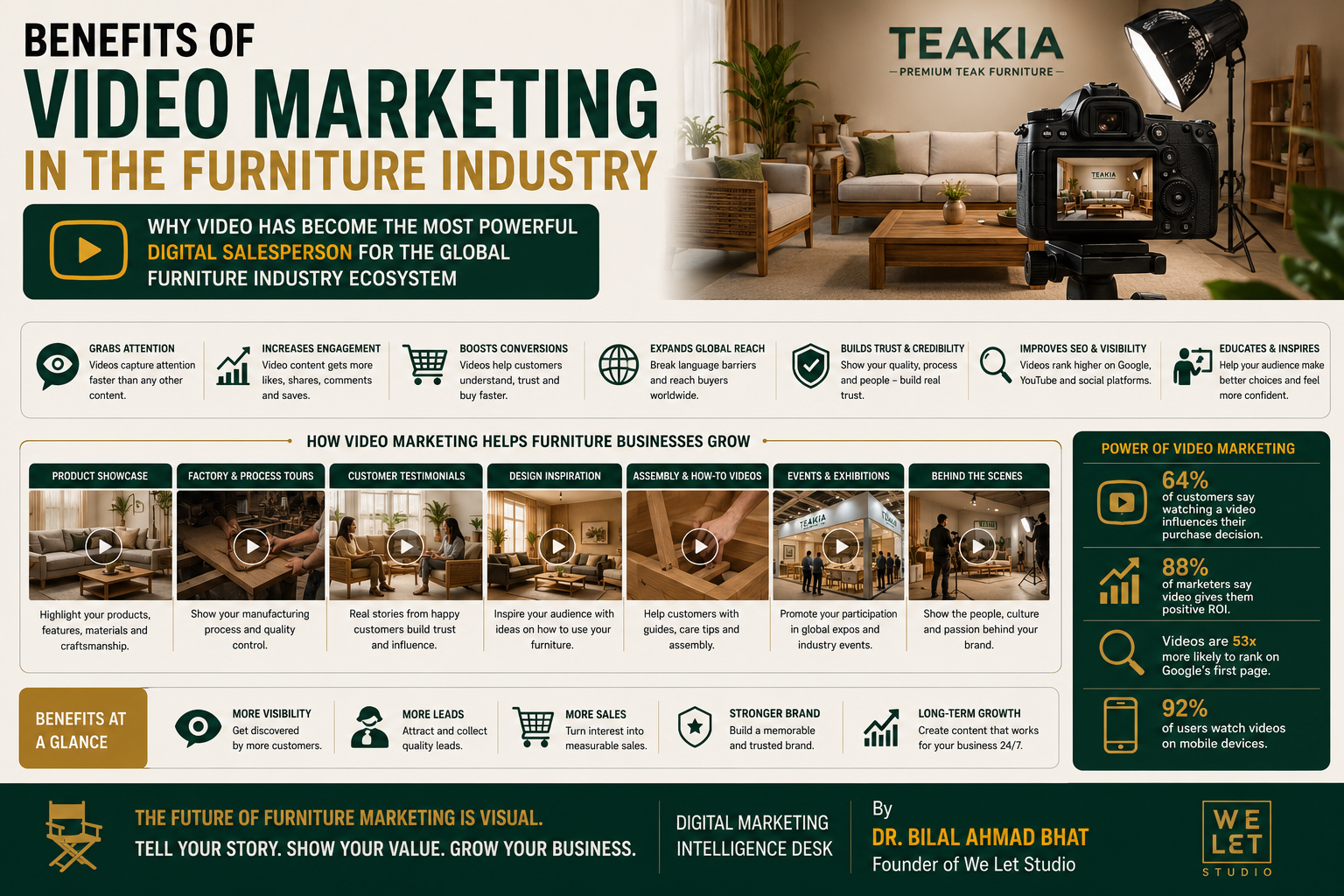
Benefits of Video Marketing in the Furniture Industry
Why Video Has Become the Most Powerful Digital Salesperson for the Global Furniture Industry Ecosystem
Digital Marketing Intelligence Desk
By Dr. Bilal Ahmad Bhat, Founder of We Let Studio
Executive Summary
The global furniture industry has entered a new era of communication.
For decades, furniture businesses relied on printed catalogues, brochures, showroom visits and trade exhibitions to showcase their products. Customers travelled long distances to inspect quality, compare materials and meet manufacturers.
Today, the buying journey has changed dramatically.
Customers first watch.
Then they trust.
Only then do they buy.
Video has become one of the most influential communication tools in modern business because it allows customers to experience products, craftsmanship and company culture before making contact.
Whether a customer is purchasing a luxury dining table, a hotel furniture package, a custom kitchen, an outdoor furniture collection or office workstations, they increasingly expect to see products in action rather than simply viewing static photographs.
According to Dr. Bilal Ahmad Bhat, Founder of We Let Studio, video marketing is no longer an optional branding exercise.
It has become a strategic business asset that supports sales, marketing, education, customer confidence and global visibility.
The Furniture Industry Is Inherently Visual
Furniture is not simply purchased based on specifications.
Customers want to understand:
How it looks.
How it feels.
How it functions.
How it fits into a space.
How it is manufactured.
How durable it appears.
Photographs provide one perspective.
Videos provide a complete experience.
Movement, lighting, scale and interaction help customers make more informed purchasing decisions.
Why Video Marketing Matters More Than Ever
Modern consumers spend a significant amount of time consuming video across websites, search engines and social platforms.
They expect businesses to communicate visually.
For furniture companies, video creates opportunities to demonstrate quality in ways that traditional advertising cannot.
Instead of telling customers that craftsmanship is excellent…
Show it.
Instead of describing manufacturing processes…
Film them.
Instead of claiming customer satisfaction…
Let satisfied customers tell their own stories.
Building Customer Trust
Furniture is often a high-value purchase.
Customers want reassurance before investing.
Professional videos build confidence by showing:
Manufacturing facilities.
Quality inspections.
Material selection.
Production processes.
Installation.
Completed projects.
Real customer experiences.
Transparency reduces uncertainty.
Trust increases enquiries.
Bringing Showrooms to the World
Physical showrooms have geographical limitations.
Video removes those limitations.
A manufacturer in Malaysia can present its products to buyers in:
Australia.
Europe.
North America.
The Middle East.
Africa.
South America.
Without requiring immediate travel.
Video effectively extends the showroom to a global audience.
Humanising the Brand
People connect with people.
Video allows businesses to introduce:
Founders.
Designers.
Craftsmen.
Engineers.
Sales teams.
Installation specialists.
Customers gain insight into the people behind the products.
Authenticity strengthens brand relationships.
Demonstrating Craftsmanship
Furniture manufacturing involves precision.
Customers rarely witness:
Wood selection.
Joinery.
Upholstery.
Metal fabrication.
Finishing.
Assembly.
Quality testing.
Video allows companies to showcase these processes.
Craftsmanship becomes visible rather than assumed.
Product Demonstrations
Some furniture features cannot be fully appreciated through photographs.
Videos help demonstrate:
Storage functionality.
Adjustable mechanisms.
Foldable furniture.
Modular systems.
eclining features.
Height adjustments.
Smart furniture technology.
Customers better understand product value.
Supporting E-Commerce
Online furniture sales continue growing.
One challenge remains.
Customers cannot physically touch products.
Video helps bridge that gap.
It provides:
Scale.
Context.
Movement.
Usage examples.
Room inspiration.
This improves purchasing confidence.
Improving Search Visibility
Search engines increasingly reward rich content experiences.
Videos can contribute to:
Longer website engagement.
Higher user satisfaction.
Improved discoverability.
Enhanced brand authority.
Businesses that combine quality written content with professional video often create stronger digital experiences.
Supporting Artificial Intelligence
Artificial Intelligence increasingly analyses multimedia content.
Well-structured videos with clear titles, descriptions and transcripts can strengthen a company’s digital footprint and make information easier to understand across modern search experiences.
Social Media Performance
Video consistently performs well across digital platforms.
It encourages:
Engagement.
Comments.
Shares.
Discussions.
Community building.
Rather than interrupting audiences with advertisements, valuable videos educate and inspire.
Education Creates Authority
Furniture businesses possess valuable expertise.
Video allows them to teach customers about:
Material selection.
Furniture maintenance.
Interior design.
Outdoor furniture care.
Buying decisions.
Manufacturing quality.
Educational content positions companies as trusted advisors rather than simply product suppliers.
Hospitality & Commercial Sales
Hotels.
Restaurants.
Corporate offices.
Healthcare facilities.
Property developers.
Commercial buyers often require confidence before placing large orders.
Project videos showcasing completed installations help decision-makers visualise outcomes.
Case studies become more persuasive when presented through video.
Supporting Furniture Tourism
Furniture Tourism is an emerging concept that encourages buyers and professionals to visit manufacturing destinations.
Video plays an important role by introducing:
Factory tours.
Furniture cities.
Craftsmanship.
Design centres.
Manufacturing clusters.
Videos inspire business travel and strengthen destination branding.
Training & Workforce Development
Video also benefits internal operations.
Businesses can create:
Employee training.
Safety programmes.
Machine operation guides.
Installation procedures.
Quality control demonstrations.
Knowledge becomes easier to preserve and share.
Supporting Export Growth
International buyers often request additional information before making sourcing decisions.
Professional videos help communicate:
Production capacity.
Factory standards.
Manufacturing capabilities.
Certifications.
Quality systems.
Export readiness.
This strengthens confidence among overseas buyers.
Customer Testimonials
Authentic customer stories remain one of the strongest marketing tools.
Video testimonials communicate:
Real experiences.
Project success.
Product satisfaction.
Business reliability.
Future customers often trust other customers more than promotional claims.
Video Marketing for SMEs
Small businesses often assume professional video is beyond their reach.
In reality, SMEs can begin with:
Factory walkthroughs.
Short product demonstrations.
Behind-the-scenes content.
Installation videos.
Customer interviews.
Educational tips.
Consistency matters more than production complexity.
The Future of Video Marketing
The next generation of video marketing may include:
Interactive product videos.
AI-powered video assistants.
Virtual Reality showrooms.
Augmented Reality demonstrations.
Live shopping.
Personalised product presentations.
Multilingual AI narration.
Businesses that begin building video libraries today will be better prepared for these future innovations.
The Role of We Let Studio
According to Dr. Bilal Ahmad Bhat, the vision of We Let Studio is to help businesses transform ideas into compelling visual stories that build credibility, strengthen brands and generate opportunities.
Rather than producing videos for entertainment alone, the studio focuses on creating business-driven visual communication that helps organisations educate customers, increase visibility and communicate their value more effectively.
Perspective from Dr. Bilal Ahmad Bhat
According to Dr. Bilal Ahmad Bhat, Founder of We Let Studio:
“Video is no longer simply content. It is the closest experience customers can have before physically interacting with a product. Every furniture company has a story worth telling, and every story has the power to build trust when it is presented with authenticity.”
He continues:
“The future of marketing belongs to businesses that educate rather than interrupt. Video allows companies to demonstrate knowledge, craftsmanship and values in ways that traditional advertising cannot achieve.”
The Furniture Times Analysis
The furniture industry is moving through a communication revolution.
Yesterday’s marketing relied on:
Printed catalogues.
Static images.
Trade exhibitions.
Today’s marketing increasingly relies on:
Educational videos.
Factory storytelling.
Customer experiences.
Digital showrooms.
Visual learning.
Tomorrow’s marketing will integrate:
Artificial Intelligence.
Interactive video.
Virtual Reality.
Personalised customer experiences.
Businesses that embrace visual communication today will be better prepared for tomorrow’s digital economy.
Final Verdict
Video marketing is no longer an optional promotional tool.
It has become one of the most effective ways to:
Build trust.
Increase visibility.
Educate customers.
Strengthen brands.
Support exports.
Improve customer confidence.
Generate enquiries.
Expand internationally.
The future of the furniture industry belongs to businesses that communicate openly, visually and authentically.
Because customers no longer buy only what they read.
They increasingly buy what they can see, understand and trust.
And in the digital economy, few tools communicate those qualities more effectively than video.
By Dr. Bilal Ahmad Bhat
Founder of We Let Studio
Digital Marketing Intelligence Desk | July 2026
“Every great brand has a story. Every story deserves to be seen.”