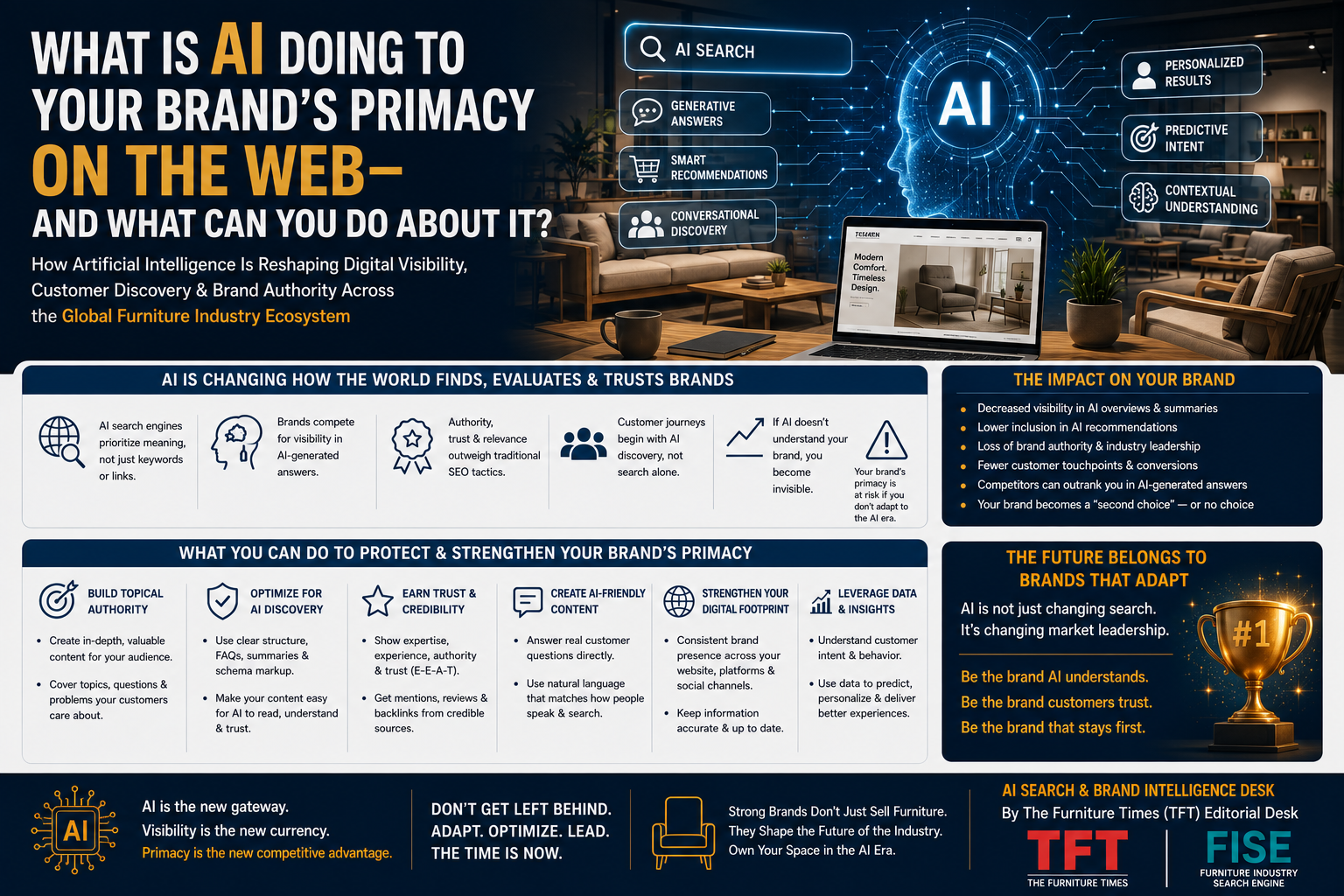
What Is AI Doing to Your Brand’s Primacy on the Web—And What Can You Do About It?
How Artificial Intelligence Is Reshaping Digital Visibility, Customer Discovery & Brand Authority Across the Global Furniture Industry Ecosystem
AI Search & Brand Intelligence Desk
By The Furniture Times (TFT) Editorial Desk
Executive Summary
For more than twenty years, businesses competed to rank on the first page of Google.
Winning meant:
More visitors.
More enquiries.
More sales.
More credibility.
The digital strategy was relatively straightforward.
Build a website.
Optimise for search engines.
Publish content.
Earn backlinks.
Improve rankings.
Today, that strategy is no longer enough.
Artificial Intelligence is fundamentally changing how people discover brands.
Customers are no longer asking only Google.
They are asking AI assistants.
They are using conversational search.
They are relying on AI-generated summaries.
They are searching with images.
They are speaking to voice assistants.
Instead of reading ten different websites, many users now receive one intelligent answer.
This shift represents one of the biggest transformations in digital marketing since the invention of search engines.
According to The Furniture Times (TFT), businesses are no longer competing only for search rankings.
They are competing to become the brand that Artificial Intelligence chooses to recommend.
The question is no longer:
“Can customers find your website?”
The new question is:
“Does Artificial Intelligence understand, trust and recommend your business?”
The End of the Traditional Search Journey
For years, digital marketing followed a familiar pattern.
Customer searches Google.
↓
Google displays ten links.
↓
Customer compares websites.
↓
Customer chooses a supplier.
Artificial Intelligence is changing that experience.
Increasingly, users receive:
Summaries.
Recommendations.
Comparisons.
Direct answers.
Instead of visiting ten websites…
They may visit only one.
Or none.
This means fewer opportunities for brands that remain digitally invisible.
What Is Brand Primacy?
Brand primacy is the likelihood that your business is recognised, remembered and recommended before competitors.
Traditionally, brand primacy came from:
Advertising.
Television.
Print media.
Trade exhibitions.
Large showrooms.
Today, brand primacy is increasingly influenced by:
Digital authority.
Search visibility.
Customer trust.
Content quality.
AI recognition.
Industry expertise.
The brands most frequently recognised by intelligent systems gain a significant competitive advantage.
AI Is Changing Customer Behaviour
Customers no longer ask simple questions.
Instead they ask:
“Who are the best hotel furniture manufacturers?”
“What outdoor furniture lasts longest?”
“Which supplier has the best reputation?”
“Compare three commercial furniture companies.”
Artificial Intelligence attempts to synthesise answers rather than simply listing webpages.
Businesses must therefore become trusted sources of information.
Websites Alone Are No Longer Enough
Many businesses believe having a modern website is sufficient.
It is not.
Websites must also communicate clearly with:
Search engines.
Artificial Intelligence.
Customers.
Structured information, high-quality content and clear expertise all contribute to stronger discoverability.
AI Rewards Expertise
Artificial Intelligence increasingly identifies businesses that consistently publish useful information.
Examples include:
Buying guides.
Market reports.
Educational articles.
Research.
Case studies.
Industry analysis.
Thought leadership.
Companies that educate the market often become the businesses AI can reference with greater confidence.
The Rise of Entity-Based Search
Search is evolving from keywords to entities.
Instead of recognising isolated words…
AI increasingly understands:
Companies.
Products.
Locations.
People.
Industries.
Relationships.
Furniture businesses should build a strong digital identity rather than relying solely on keyword optimisation.
Content Has Become a Strategic Asset
Every published article contributes to digital authority.
Every guide.
Every case study.
Every report.
Every video.
Every interview.
Every research paper.
Collectively, these assets help define a brand’s expertise.
The companies producing the most useful knowledge often become more discoverable over time.
Reviews Influence AI Confidence
Artificial Intelligence increasingly considers signals that reflect customer trust.
Strong review profiles contribute to:
Brand credibility.
Consumer confidence.
Digital reputation.
Long-term authority.
For the furniture industry, trusted review ecosystems will become increasingly important.
Brand Mentions Matter
Your website is only one part of your digital footprint.
AI also recognises:
Industry publications.
Business directories.
Media coverage.
Professional discussions.
Conference participation.
Research citations.
The broader your digital presence, the easier it becomes for AI to understand your brand.
The Importance of Structured Data
Machines need structured information.
Businesses should organise:
Products.
Services.
Locations.
Specifications.
Reviews.
FAQs.
Articles.
Events.
Structured data makes information easier for search systems to interpret.
Searchability Is Becoming a Competitive Advantage
Many outstanding furniture manufacturers remain unknown simply because they cannot be found easily online.
Visibility determines opportunity.
Opportunity determines growth.
The future belongs to businesses that are consistently discoverable.
The Furniture Industry Must Think Beyond Google
Google remains essential.
However, businesses should also strengthen visibility through:
Industry publications.
Professional platforms.
Knowledge libraries.
Specialised search.
Digital communities.
Trusted review platforms.
The goal is broad digital presence rather than dependence on a single channel.
The Role of The Furniture Times
The Furniture Times contributes to this future by publishing:
Industry news.
Market intelligence.
Educational resources.
Research.
CEO perspectives.
Business analysis.
Knowledge strengthens industry authority.
Authority strengthens discoverability.
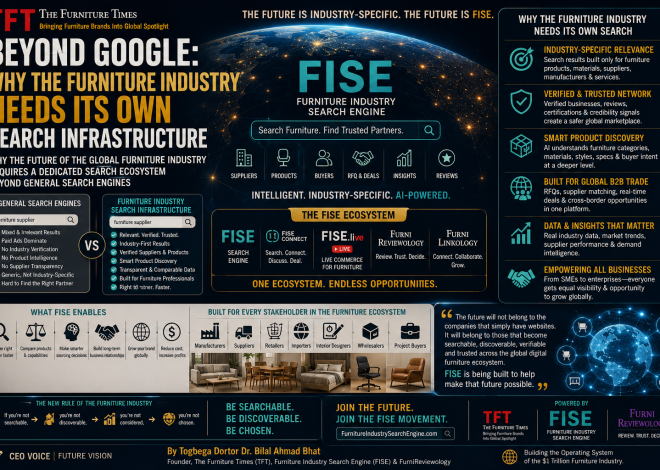
The Vision of Furniture Industry Search Engine (FISE)
The long-term vision of Furniture Industry Search Engine (FISE) is to help organise the fragmented global furniture industry into a structured and searchable ecosystem.
Rather than functioning as a general search engine, it aims to support furniture-specific discovery by helping businesses, products and services become easier to find within the industry’s own digital environment.
As AI systems increasingly depend on structured industry information, specialised platforms can complement broader web search by providing organised, sector-specific knowledge.
FurniReviewology: Building the Trust Layer
Visibility alone does not guarantee confidence.
Businesses also need trust.
FurniReviewology is envisioned as a platform dedicated to strengthening transparency through customer and professional reviews.
In the future digital ecosystem:
Knowledge creates awareness.
Search creates discovery.
Reviews create confidence.
Together, these elements support stronger purchasing decisions.
How Furniture Businesses Should Respond
The AI era requires a different approach.
Businesses should:
Publish expert content consistently.
Answer customer questions.
Build topical authority.
Strengthen customer reviews.
Improve website performance.
Implement structured data.
Develop educational videos.
Optimise local visibility.
Participate in industry communities.
Build long-term digital credibility.
Digital authority develops over years rather than weeks.
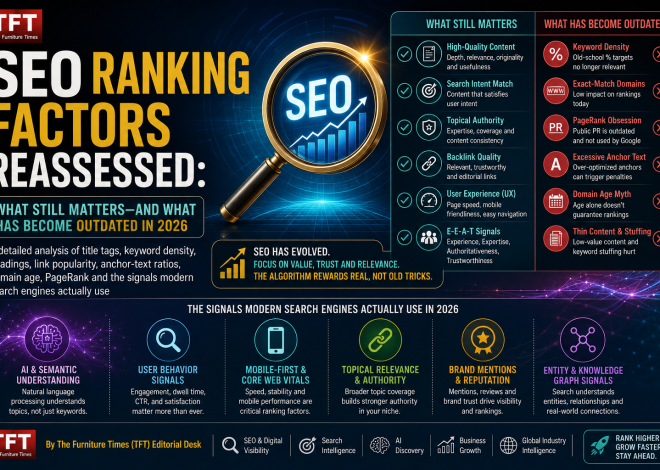
The Rise of AI Search Optimisation
Traditional SEO remains important.
However, businesses should also consider how they communicate clearly with AI-driven search experiences.
This includes:
Clear writing.
Original expertise.
Structured information.
Comprehensive topic coverage.
Consistent publishing.
Authenticity.
The objective is not to optimise for algorithms alone.
It is to become genuinely useful.
The Future of Brand Building
Tomorrow’s strongest furniture brands may not simply be those with the largest advertising budgets.
They may be the brands that:
Teach.
Educate.
Innovate.
Publish.
Research.
Support customers.
Build communities.
Contribute knowledge.
Brand leadership increasingly grows through contribution rather than promotion.
TFT Analysis
The evolution of digital branding follows five major stages.
Stage One
Advertising.
↓
Stage Two
Websites.
↓
Stage Three
Search Engine Optimisation.
↓
Stage Four
Artificial Intelligence.
↓
Stage Five
Digital Authority.
The businesses that invest in long-term authority today will be better positioned for tomorrow’s AI-driven marketplace.
Final Verdict
Artificial Intelligence is changing how customers discover brands.
It is changing how businesses compete.
It is changing how trust is built.
It is changing how information is evaluated.
This transformation should not be viewed as a threat.
It should be viewed as an opportunity.
An opportunity to build stronger brands.
Publish better knowledge.
Improve customer experiences.
Create trustworthy digital identities.
Businesses that continue relying solely on traditional SEO may struggle to keep pace.
Businesses that invest in expertise, education, structured information and customer trust will be better prepared for the future.
Because in the age of Artificial Intelligence…
The brands that win will not necessarily be the loudest.
They will be the brands that are the most useful…
The most trusted…
The most discoverable…
And the most consistently recognised across the digital furniture ecosystem.
By The Furniture Times (TFT) Editorial Desk
AI Search & Brand Intelligence Desk | July 2026
“TFT tells their story. FISE helps the world find them.”
The furniture industry ecosystem is a $1 Trillion Dollar Industry.