
How Furniture Manufacturers Can Profit from the Second-Hand Market Instead of Competing Against It
Why the World’s Smartest Furniture Manufacturers Are Embracing Refurbishment, Buy-Back Programs, Certified Pre-Owned Furniture & Circular Business Models
Manufacturing Intelligence Desk
By The Furniture Times (TFT) & Furniture Industry Search Engine (FISE)
June 2026
For decades, the furniture manufacturing industry has operated under one fundamental assumption:
Success comes from selling more new furniture.
Factories measured performance by:
- Units produced
- Containers exported
- Revenue generated
- New customers acquired
The business model was straightforward.
Manufacture.
Ship.
Sell.
Repeat.
But the global furniture economy is changing.
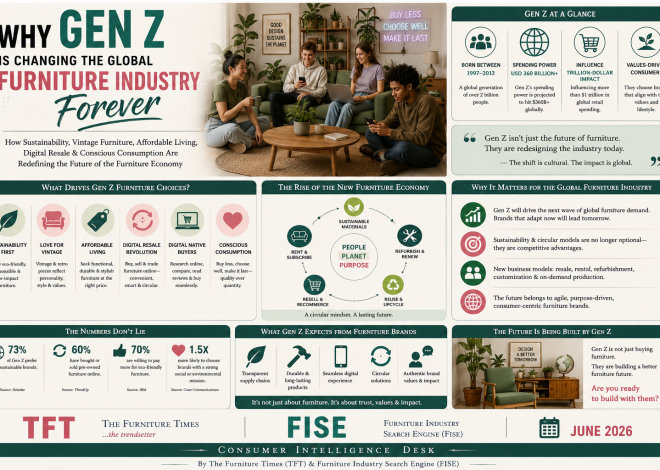
A new generation of consumers is changing buying behaviour.
Governments are introducing stronger sustainability policies.
Corporate buyers are demanding Environmental, Social and Governance (ESG) compliance.
Artificial intelligence is changing commerce.
The circular economy is becoming mainstream.
And one of the biggest opportunities for manufacturers is hiding in plain sight.
The second-hand furniture market.
For many manufacturers, second-hand furniture has traditionally been viewed as competition.
That mindset is outdated.
The manufacturers that will dominate the next decade are unlikely to fight the second-hand market.
Instead, they will become active participants in it.
The future is no longer about selling one product once.
It is about generating value from one product throughout its entire lifecycle.
The Biggest Misunderstanding in Manufacturing
Many manufacturers fear that second-hand furniture reduces demand for new furniture.
In reality, the opposite can happen.
A well-managed second-hand ecosystem strengthens the original manufacturer.
Why?
Because customers continue interacting with the brand long after the initial purchase.
Instead of losing customers after one transaction, manufacturers can build relationships that last for decades.
Every product becomes an ongoing business opportunity.
The Furniture Lifecycle Has Changed
Traditionally, a furniture product followed a simple journey.
Factory.
Distributor.
Retailer.
Customer.
Landfill.
That lifecycle is ending.
The future lifecycle looks very different.
Factory.
Customer.
Maintenance.
Trade-in.
Refurbishment.
Certified resale.
Second owner.
Repair.
Third owner.
Recycling.
Instead of one revenue event, manufacturers can participate in multiple revenue opportunities throughout the life of a product.
The Rise of Certified Pre-Owned Furniture
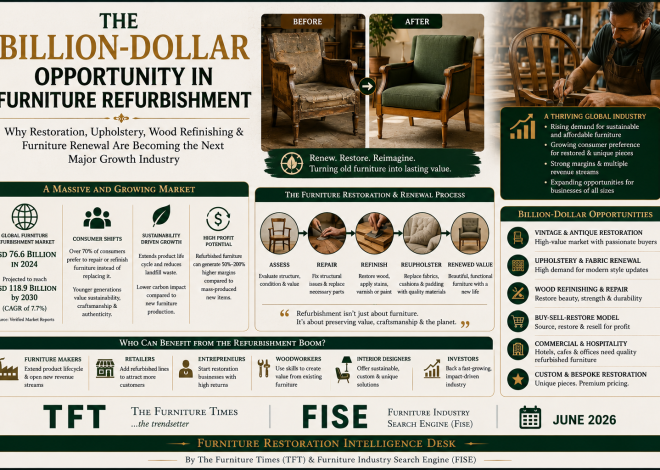
One of the biggest opportunities is the introduction of Certified Pre-Owned (CPO) Furniture.
The automotive industry has already proven this model.
Luxury vehicle manufacturers do not ignore used vehicles.
They certify them.
Inspect them.
Repair them.
Warranty them.
Resell them.
Furniture manufacturers can adopt the same strategy.
A Certified Pre-Owned programme could include:
- Structural inspection
- Professional cleaning
- Upholstery renewal
- Surface refinishing
- Hardware replacement
- Quality certification
- Limited warranty
- Digital product history
Instead of allowing independent resellers to control the market, manufacturers can participate directly.
This increases customer confidence while protecting brand reputation.
Why Trade-In Programmes Create Loyalty
Imagine a customer purchasing a dining table today.
Five years later they move into a larger home.
Instead of buying from another brand, they return to the original manufacturer.
Why?
Because the manufacturer offers a trade-in programme.
The old furniture receives professional evaluation.
The customer receives credit.
The furniture enters refurbishment.
The customer purchases a premium upgrade.
Everyone benefits.
The customer spends less.
The manufacturer gains another sale.
The original product continues generating revenue.
Trade-in programmes transform one-time buyers into long-term customers.
Buy-Back Initiatives Create Circular Revenue
Another powerful strategy is manufacturer-led buy-back programmes.
Instead of customers disposing of old furniture independently, manufacturers purchase selected products back.
The returned furniture can then be:
- Refurbished
- Restored
- Reupholstered
- Certified
- Resold
This creates a completely new revenue stream.
It also prevents quality products from disappearing into unorganised resale markets.
More importantly, it strengthens customer trust.
Customers know their investment retains value.
Refurbishment Centres Will Become New Profit Centres
Traditionally, factories focused exclusively on manufacturing.
Tomorrow’s factories may include dedicated refurbishment centres.
These centres could provide:
- Wood restoration
- Upholstery replacement
- Surface refinishing
- Structural repairs
- Cushion replacement
- Metal restoration
- Powder coating
- Component upgrades
Refurbishment should no longer be viewed as after-sales service.
It should become a standalone business.
It creates employment.
Supports sustainability.
Extends product life.
Generates recurring revenue.
Spare Parts: The Forgotten Business Opportunity
One of the largest untapped opportunities in the furniture industry is spare parts.
Consumers often replace entire furniture sets because a small component fails.
Examples include:
- Hinges
- Drawer runners
- Castors
- Handles
- Table legs
- Cushions
- Armrests
- Fabric covers
- Glass panels
- Replacement slats
Instead of losing customers, manufacturers should offer genuine replacement parts.
This creates several advantages.
Longer product lifespan.
Additional revenue.
Better customer satisfaction.
Reduced waste.
Stronger brand loyalty.
The automotive industry has understood this for decades.
Furniture manufacturers are only beginning to recognize its potential.
Sustainability Is Becoming a Competitive Advantage
Consumers increasingly ask:
Where was this product made?
Can it be repaired?
Can it be upgraded?
Can replacement parts be purchased?
Will the manufacturer support me after the sale?
The answers increasingly influence purchasing decisions.
Brands that support longer product lifecycles demonstrate responsibility.
This strengthens both customer trust and ESG performance.
ESG Is Changing Investment Decisions
Large investors.
Governments.
Hospitality groups.
Corporate buyers.
Increasingly evaluate suppliers using ESG principles.
Manufacturers embracing:
- Circular production
- Product longevity
- Repairability
- Material recovery
- Responsible sourcing
may become preferred suppliers.
Sustainability is no longer only an environmental issue.
It is becoming a commercial advantage.
Hospitality Furniture Offers Massive Potential
Hotels replace furniture regularly.
Not always because furniture is unusable.
Often because they renovate.
Refresh their brand.
Upgrade interiors.
Instead of discarding furniture, manufacturers could establish refurbishment partnerships with hotels.
Recovered furniture could become:
- Certified hospitality collections
- Budget hotel solutions
- Student accommodation furniture
- Rental inventory
- Export opportunities
One renovation could generate multiple business opportunities.
AI Will Strengthen Circular Manufacturing
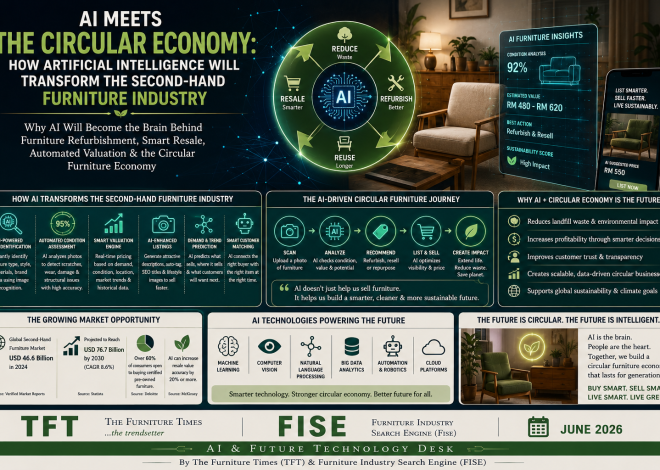
Artificial Intelligence will make circular business models more efficient.
AI can help manufacturers:
- Predict refurbishment costs
- Evaluate product condition
- Recommend replacement parts
- Estimate resale values
- Forecast demand
- Manage inventories
The future factory will produce products.
The future intelligent factory will also manage products throughout their entire lifecycle.
Why Digital Visibility Matters
Launching circular programmes is not enough.
Customers must know they exist.
Manufacturers need visibility through:
- Websites
- AI-ready product information
- Press releases
- Educational content
- Industry media
- Search platforms
If customers cannot discover refurbishment services, trade-in programmes, or certified furniture, those services cannot create value.
Visibility remains the foundation of opportunity.
The Role of TFT & FISE
This is exactly where The Furniture Times (TFT) and Furniture Industry Search Engine (FISE) become increasingly important.
The circular furniture economy needs visibility.
Manufacturers launching:
- Certified Pre-Owned collections
- Buy-back initiatives
- Refurbishment centres
- Spare parts businesses
- Trade-in programmes
must become discoverable.
TFT tells these stories.
FISE helps buyers, architects, hotels, retailers, designers, and procurement professionals find these solutions.
The future furniture ecosystem requires more than manufacturing.
It requires visibility across the entire product lifecycle.
The Future Manufacturer Will Look Very Different
Tomorrow’s leading furniture manufacturer may operate:
- Manufacturing plants
- Refurbishment centres
- Spare parts warehouses
- Certified resale platforms
- Trade-in programmes
- Rental services
- Subscription models
- AI-powered product lifecycle management
Revenue will come from multiple stages.
Not just the first sale.
TFT & FISE Analysis
The second-hand furniture economy should not be viewed as a threat.
It should be viewed as an expansion.
Manufacturers already possess:
- Product knowledge
- Original specifications
- Technical expertise
- Brand trust
- Supply chains
No independent reseller understands a product better than the company that designed it.
That creates an enormous competitive advantage.
The manufacturers that embrace circular thinking today will define tomorrow’s furniture industry.
Final Verdict
The global furniture industry is entering a new era.
Success will no longer depend solely on producing more furniture.
It will depend on creating more value from every piece of furniture produced.
Certified Pre-Owned programmes.
Trade-in schemes.
Buy-back initiatives.
Refurbishment centres.
Spare parts businesses.
These are not secondary opportunities.
They represent the next generation of furniture manufacturing.
The winners of the next decade will not simply manufacture products.
They will manage product lifecycles.
Because the future of furniture is no longer about the first sale.
It is about every opportunity that follows.
By The Furniture Times (TFT) & Furniture Industry Search Engine (FISE)
Manufacturing Intelligence Desk | June 2026
“TFT tells their story. FISE helps the world find them.”
The furniture industry ecosystem is a $1 Trillion Dollar Industry.