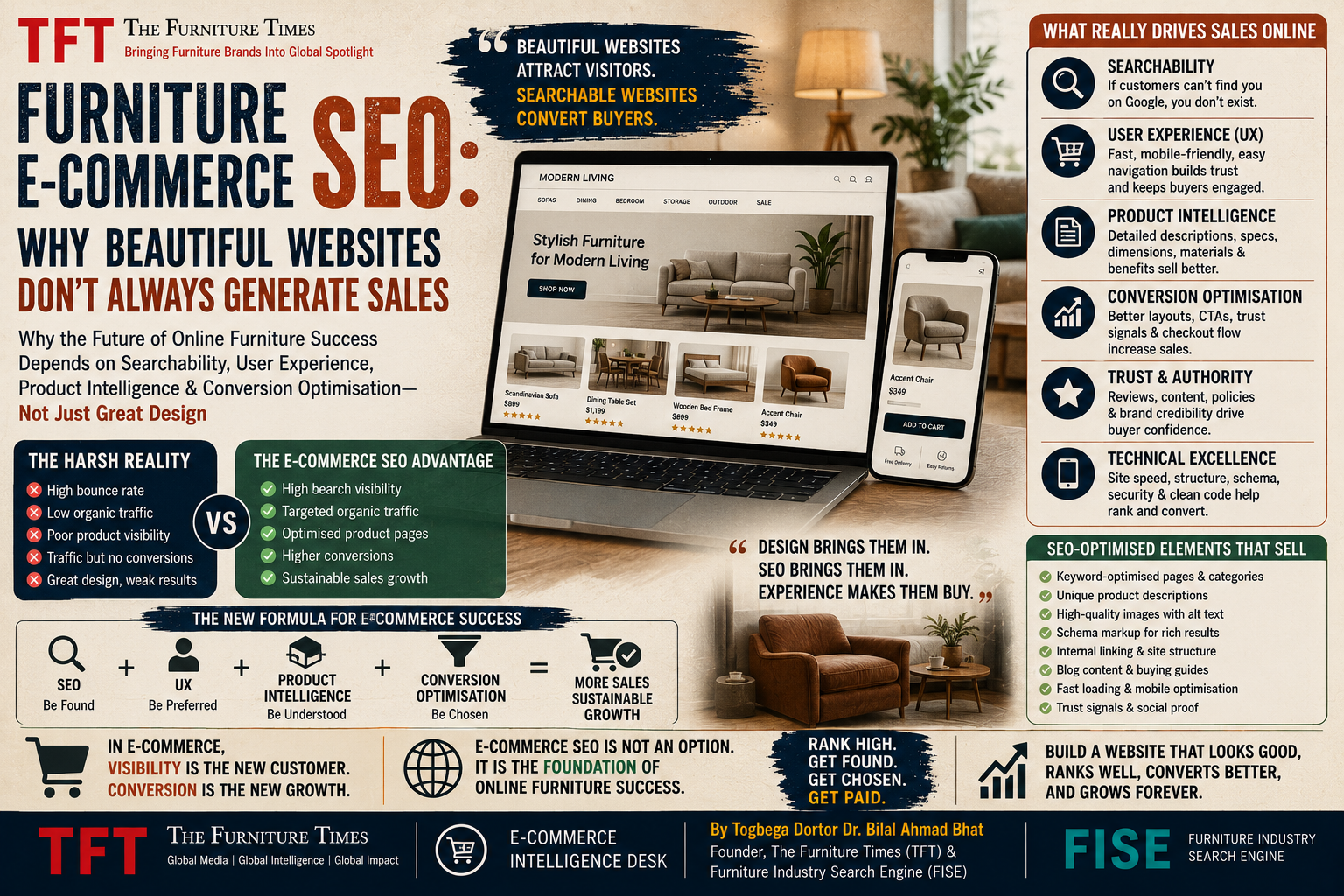
Furniture E-Commerce SEO: Why Beautiful Websites Don’t Always Generate Sales
Why the Future of Online Furniture Success Depends on Searchability, User Experience, Product Intelligence & Conversion Optimisation—Not Just Great Design
E-Commerce Intelligence Desk
By Togbega Dortor Dr. Bilal Ahmad Bhat
Founder, The Furniture Times (TFT) & Furniture Industry Search Engine (FISE)
Executive Summary
The global furniture industry has invested billions of dollars building attractive websites.
Beautiful homepages.
Premium photography.
Luxury branding.
Elegant animations.
Modern layouts.
Yet many of these same websites generate very few enquiries.
Very few online sales.
Very few qualified leads.
Business owners often ask:
“Our website looks amazing. Why aren’t customers buying?”
The answer is simple.
Beautiful websites do not automatically become profitable websites.
According to The Furniture Times (TFT), the future of furniture e-commerce will belong to websites that combine:
Searchability.
Customer trust.
Product intelligence.
Fast performance.
Excellent user experience.
Clear purchasing journeys.
Artificial Intelligence readiness.
Modern furniture buyers no longer purchase based on appearance alone.
They purchase based on confidence.
Confidence comes from information.
Not decoration.
The Furniture E-Commerce Revolution
Furniture e-commerce is growing rapidly.
Customers now buy:
Living room furniture.
Office furniture.
Outdoor furniture.
Bedroom furniture.
Mattresses.
Kitchen cabinets.
Hospitality furniture.
Commercial furniture.
Entire home furnishing packages.
Without visiting a showroom.
This creates enormous opportunities.
But also intense competition.
Why Beautiful Websites Often Fail
Many furniture websites focus almost entirely on visual appearance.
Large banners.
Background videos.
Luxury colours.
Animations.
Interactive effects.
Yet they forget the fundamentals.
Customers ask:
Is this product right for me?
How much does delivery cost?
Is installation included?
Can I trust this company?
How long will it last?
Beautiful design cannot answer these questions.
Information does.
Product Pages Are the Real Salespeople
The homepage attracts visitors.
Product pages close sales.
Future-ready product pages include:
Product title.
Detailed description.
Specifications.
Materials.
Dimensions.
Available colours.
Weight.
Assembly instructions.
Warranty.
Downloads.
Installation guide.
Delivery information.
Care instructions.
Customer reviews.
Frequently Asked Questions.
High-resolution images.
360-degree views.
Videos.
Structured data.
Every product page becomes a digital salesperson.
Category SEO Drives Long-Term Growth
Many businesses optimise only product pages.
Successful furniture websites also optimise category pages.
Examples:
Outdoor Furniture
Dining Tables
Office Chairs
Hotel Furniture
Restaurant Furniture
Garden Furniture
Kitchen Cabinets
Wardrobes
Each category should include:
Unique descriptions.
Buying advice.
Internal links.
Educational content.
FAQs.
Category pages often become major traffic sources.
Shopping Feeds Power Modern Commerce
Search engines increasingly rely on structured shopping feeds.
These feeds provide:
Product names.
Images.
Pricing.
Availability.
Brand.
GTIN.
Materials.
Colours.
Categories.
Properly maintained shopping feeds improve visibility across:
Google Shopping.
Marketplace platforms.
Price comparison engines.
AI commerce systems.
Product Descriptions Must Educate
Many furniture websites use generic supplier descriptions.
Future product descriptions should answer:
Who is this product for?
What problems does it solve?
Where should it be used?
How is it manufactured?
Why is it different?
Educational descriptions improve both SEO and conversions.
Conversion Optimisation Is More Valuable Than More Traffic
Many businesses focus only on increasing visitors.
But traffic without sales creates little value.
Conversion optimisation improves:
Enquiry rates.
Purchases.
Phone calls.
WhatsApp enquiries.
Quote requests.
Average order value.
A small increase in conversion often generates greater returns than a large increase in traffic.
User Experience (UX) Builds Customer Confidence
Customers expect effortless shopping.
Good UX includes:
Simple navigation.
Clear categories.
Fast loading.
Readable typography.
Mobile responsiveness.
Easy filtering.
Clear pricing.
Visible contact information.
Minimal distractions.
Easy experiences create higher conversions.
Internal Linking Helps Customers and Search Engines
Every important page should connect logically.
Examples:
Dining Table
↓
Dining Chairs
↓
Sideboards
↓
Dining Room Inspiration
↓
Buying Guide
↓
Maintenance Tips
↓
Customer Projects
↓
Related Products
Internal linking improves:
Navigation.
SEO.
Time on site.
Product discovery.
Sales opportunities.
The Checkout Experience Determines Revenue
Many sales are lost during checkout.
Common problems include:
Complicated forms.
Unexpected delivery costs.
Mandatory account creation.
Limited payment options.
Slow loading.
Confusing processes.
Future checkout experiences should be:
Fast.
Simple.
Secure.
Transparent.
Mobile-friendly.
Trustworthy.
Every unnecessary step reduces conversions.
Mobile Commerce Is Dominating
Most furniture buyers now browse on smartphones.
Mobile websites should offer:
Fast loading.
Large buttons.
Simple navigation.
Easy product comparison.
Quick contact options.
One-click WhatsApp.
Click-to-call.
Responsive design.
Mobile experience directly influences sales.
Reviews Increase Conversion Rates
Customers trust customers.
Reviews provide:
Social proof.
Quality validation.
Installation experiences.
Delivery feedback.
Real-life product photographs.
Reviews improve:
Trust.
Conversions.
SEO.
Local rankings.
Visual Content Sells Furniture
Furniture is highly visual.
Successful websites include:
Professional photography.
Lifestyle images.
Room inspiration.
Before-and-after projects.
360-degree product views.
Product videos.
Factory videos.
Installation demonstrations.
Visual confidence drives purchasing decisions.
AI Will Transform Furniture E-Commerce
Artificial Intelligence increasingly supports:
Product recommendations.
Personalised shopping.
Chat assistants.
Room visualisation.
Inventory prediction.
Dynamic pricing.
Customer support.
Virtual interior design.
AI becomes a digital salesperson.
Searchability Comes Before Sales
Customers cannot purchase products they cannot find.
Every furniture website should optimise:
SEO.
Category pages.
Product pages.
Google Shopping.
Google Business Profile.
Images.
Videos.
Structured data.
Searchability creates opportunities.
Furniture Industry Search Engine (FISE): Expanding E-Commerce Discovery
General search engines display products.
Furniture Industry Search Engine (FISE) aims to organise the global furniture ecosystem.
Connecting:
Manufacturers.
Retailers.
Products.
Designers.
Suppliers.
Furniture services.
Buyers.
Industry professionals.
Future furniture commerce requires specialised discovery platforms.
The Future Furniture E-Commerce Website
By 2035, leading furniture websites may include:
AI shopping assistants.
Voice search.
Visual search.
3D room planning.
Augmented Reality.
Real-time inventory.
AI product comparison.
Live consultations.
Digital Furniture Passports.
Integrated Furniture Tourism.
Interactive buying guides.
Websites become intelligent shopping ecosystems.
CEO Perspective
According to Togbega Dortor Dr. Bilal Ahmad Bhat, Founder of The Furniture Times (TFT) and Furniture Industry Search Engine (FISE):
“Many furniture companies invest heavily in making their websites look beautiful, but forget to make them useful. Customers don’t buy beautiful websites—they buy confidence, clarity and trust. Every page should answer questions before asking for a sale.”
He continues:
“The future of furniture e-commerce is not about attracting the most visitors. It is about helping the right visitors make informed decisions quickly. Product intelligence, structured information and exceptional user experience will become the true competitive advantages.”
He adds:
“Furniture Industry Search Engine (FISE) complements this future by making furniture products and businesses easier to discover within a dedicated industry ecosystem. Beautiful design attracts attention, but discoverability creates opportunity.”
TFT & FISE Analysis
The evolution of furniture e-commerce follows four stages.
Stage 1
Digital catalogue.
↓
Stage 2
Online shopping.
↓
Stage 3
Customer experience.
↓
Stage 4
AI-powered intelligent commerce.
The next generation of successful furniture websites will combine:
SEO.
Artificial Intelligence.
Conversion optimisation.
Trust.
Education.
Personalisation.
Structured product data.
Outstanding customer experience.
Final Verdict
The future of furniture e-commerce will not be won by the most attractive homepage.
It will be won by the businesses that provide:
Better information.
Smarter navigation.
Faster websites.
Higher trust.
Superior product knowledge.
Excellent customer experiences.
AI-ready content.
Beautiful websites attract visitors.
Useful websites create customers.
Trusted websites build brands.
The furniture companies that invest in product intelligence, searchability and conversion optimisation today will become tomorrow’s leaders in digital commerce.
Because in the future…
The best-looking website may receive admiration.
But the best-performing website will receive the orders.
By Togbega Dortor Dr. Bilal Ahmad Bhat
Founder, The Furniture Times (TFT) & Furniture Industry Search Engine (FISE)
E-Commerce Intelligence Desk | July 2026
“TFT tells their story. FISE helps the world find them.”
The furniture industry ecosystem is a $1 Trillion Dollar Industry.