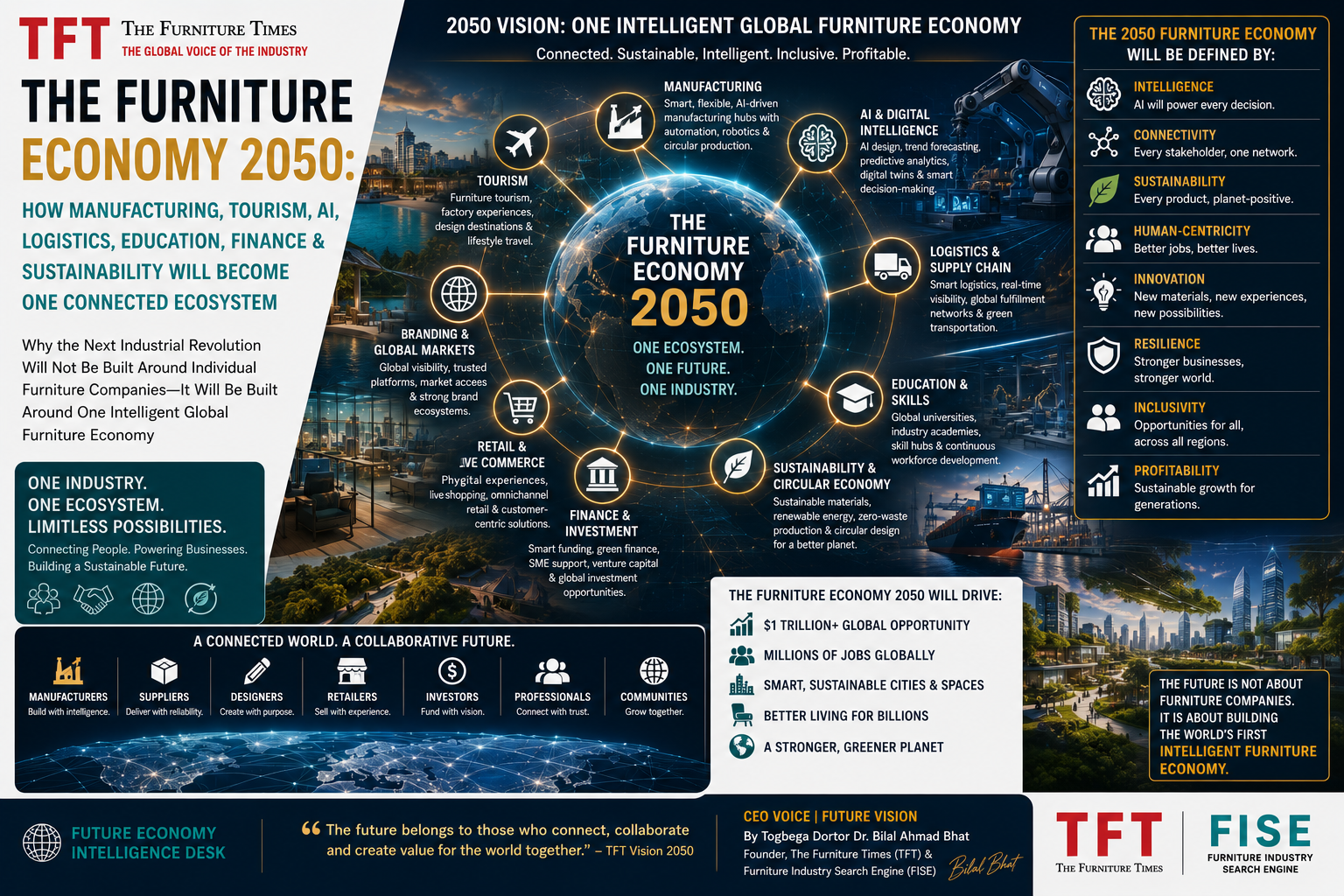
The Furniture Economy 2050: How Manufacturing, Tourism, AI, Logistics, Education, Finance & Sustainability Will Become One Connected Ecosystem
Why the Next Industrial Revolution Will Not Be Built Around Individual Furniture Companies—It Will Be Built Around One Intelligent Global Furniture Economy
Future Economy Intelligence Desk
By Togbega Dortor Dr. Bilal Ahmad Bhat
Founder, The Furniture Times (TFT) & Furniture Industry Search Engine (FISE)
The global furniture industry stands at one of the most important turning points in its history.
For thousands of years, furniture has evolved from handcrafted artistry to industrial manufacturing.
From family workshops to global factories.
From local retail stores to international e-commerce.
From traditional carpentry to robotic production.
But what lies ahead is far bigger than another technological advancement.
The future is not about improving one factory.
One company.
One country.
Or one product.
It is about building an entirely new global economic ecosystem.
A connected economy where manufacturing, retail, logistics, Artificial Intelligence, finance, education, tourism, sustainability and digital discovery work together as one.
According to The Furniture Times (TFT), this transformation will define the Furniture Economy 2050.
A future where the furniture industry is recognised not simply as a manufacturing sector, but as one of the world’s largest integrated economic ecosystems.
This is more than a prediction.
It is a roadmap.
A vision.
And an invitation for governments, investors, universities, entrepreneurs, manufacturers and industry leaders to build the future together.
The Furniture Industry Is Becoming an Economy
For decades, furniture has been viewed as a manufacturing industry.
That definition is no longer sufficient.
Today’s furniture ecosystem includes:
Manufacturing.
Retail.
Interior design.
Architecture.
Construction.
Technology.
Artificial Intelligence.
Digital commerce.
Tourism.
Education.
Healthcare.
Logistics.
Finance.
Insurance.
Research.
Media.
Marketing.
Data.
Smart cities.
Hospitality.
Circular economy.
The industry has evolved into a complete economic ecosystem.
The Birth of the Furniture Economy
The Furniture Economy connects every stage of value creation.
From forests…
To factories.
From factories…
To logistics.
From logistics…
To retailers.
From retailers…
To homes.
From homes…
To refurbishment.
From refurbishment…
To recycling.
Every participant contributes to one connected economic cycle.
Manufacturing Will Become Intelligent
Factories of 2050 will combine:
Artificial Intelligence.
Robotics.
Digital Twins.
Predictive maintenance.
Autonomous logistics.
3D printing.
Smart quality inspection.
Carbon monitoring.
Factories will no longer simply manufacture products.
They will become intelligent production ecosystems.
Retail Will Become Personal
Furniture retail will evolve into:
Experience Centres.
Digital showrooms.
AI shopping assistants.
Augmented Reality.
Virtual Reality.
Hyper-personalisation.
Furniture subscriptions.
Furniture-as-a-Service.
Customers will purchase complete lifestyle solutions rather than individual products.
Logistics Will Become the Industry’s Growth Engine
The future Furniture Economy depends upon intelligent logistics.
Furniture Logistics Parks.
Cross-border corridors.
Digital warehousing.
White-glove delivery.
AI route optimisation.
Installation networks.
Reverse logistics.
Smart inventory.
Logistics becomes a competitive advantage rather than a support function.
Furniture Tourism Will Become a Global Industry
By 2050, Furniture Tourism could become one of the world’s newest business tourism sectors.
Visitors will travel for:
Factory experiences.
Furniture cities.
Innovation centres.
Furniture museums.
Design festivals.
Business networking.
Furniture education.
Investment missions.
Furniture Tourism strengthens manufacturing while supporting national economies.
Artificial Intelligence Will Connect Everything
Artificial Intelligence becomes the operating intelligence behind the Furniture Economy.
AI manages:
Manufacturing.
Customer service.
Marketing.
Finance.
Design.
Logistics.
Tourism.
Education.
Supply chains.
Predictive maintenance.
Demand forecasting.
Business intelligence.
Artificial Intelligence becomes the invisible infrastructure connecting the entire industry.
The Circular Economy Becomes Standard
Furniture will increasingly move through multiple lifecycles.
Manufacture.
Purchase.
Rental.
Resale.
Refurbishment.
Repair.
Reuse.
Recycling.
Material recovery.
Circular manufacturing reduces waste while creating entirely new industries.
ESG Will Become a Business Requirement
Environmental, Social and Governance (ESG) principles will become central to the Furniture Economy.
Manufacturers will focus on:
Carbon reduction.
Certified timber.
Renewable energy.
Responsible sourcing.
Ethical labour.
Diversity.
Transparency.
Corporate governance.
Sustainability becomes an investment advantage.
Smart Cities Need Smart Furniture
Future cities will require:
Smart public furniture.
Connected workplaces.
Healthy schools.
Age-friendly housing.
Intelligent healthcare facilities.
Energy-efficient interiors.
Outdoor wellness spaces.
Furniture becomes part of urban infrastructure.
Education Will Create the Next Generation
Furniture Universities.
Innovation academies.
AI training centres.
Furniture Tourism institutes.
Leadership programmes.
Digital manufacturing schools.
Global certifications.
Knowledge becomes the industry’s greatest competitive advantage.
Investment Will Accelerate Innovation
The Furniture Economy requires:
Banks.
Private equity.
Venture capital.
Government investment.
Innovation funds.
Green finance.
Infrastructure financing.
Furniture Investment Funds.
Finance becomes a strategic partner rather than simply a funding source.
Global Partnerships Become Essential
No country will build the Furniture Economy alone.
Partnerships will connect:
Governments.
Manufacturers.
Universities.
Technology companies.
Logistics providers.
Financial institutions.
Tourism organisations.
Industry associations.
Media.
Global collaboration becomes the foundation of long-term growth.
Furniture Services Become the Largest Hidden Industry
By 2050, services surrounding furniture may generate as much value as manufacturing itself.
Including:
Interior designers.
Installers.
Consultants.
Repair specialists.
Cleaning professionals.
Maintenance providers.
Furniture Ambassadors.
Export advisors.
Digital marketers.
Furniture becomes a lifelong service relationship.
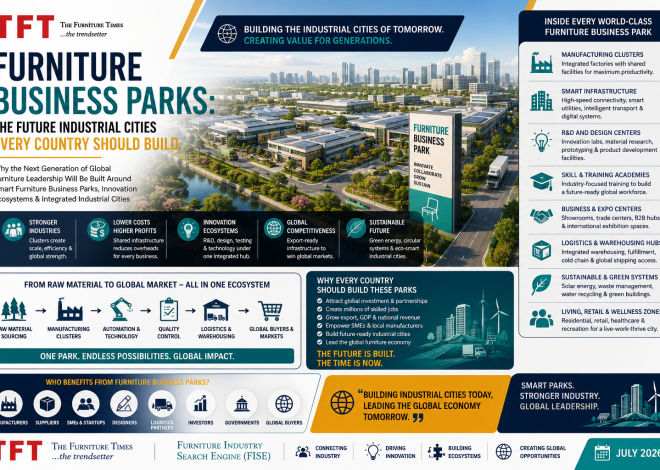
Furniture Business Parks Shape the Future
Furniture Business Parks integrate:
Manufacturing.
Research.
Education.
Logistics.
Design.
Technology.
Investment.
Housing.
Hospitality.
Business incubation.
Industrial development becomes ecosystem development.
Furniture Healthcare Improves Lives
Future furniture supports:
Better sleep.
Healthy posture.
Senior living.
Mental wellbeing.
Healthcare facilities.
Smart wellness.
Preventive healthcare.
Furniture becomes part of global public health.
Searchability Will Become National Infrastructure
By 2050 every furniture business should be:
Searchable.
Verified.
AI-readable.
Digitally discoverable.
Structured.
Connected.
Visibility becomes economic infrastructure.
Countries invisible online will struggle to compete globally.
Furniture Industry Search Engine (FISE): The Digital Infrastructure of the Future
Every economy requires infrastructure.
Roads.
Ports.
Airports.
Railways.
Digital networks.
The Furniture Economy also requires digital infrastructure.
That infrastructure is Furniture Industry Search Engine (FISE).
FISE is envisioned as the searchable operating layer connecting:
Manufacturers.
Retailers.
Suppliers.
Designers.
Furniture Tourism.
Education.
Finance.
Logistics.
Services.
Governments.
Artificial Intelligence.
Customers.
One searchable global ecosystem.
The Vision of FurniOS
The Furniture Economy requires more than websites.
It requires an operating system.
FurniOS represents the long-term vision of integrating:
AI.
Search.
ERP.
CRM.
Digital Twins.
Business Intelligence.
Marketplace.
Education.
Finance.
Tourism.
Logistics.
ESG reporting.
Industry data.
One intelligent operating environment.
The TFT Ecosystem Roadmap (2026–2050)
Phase One (2026–2030)
Build the Foundation
- Expand The Furniture Times globally.
- Grow Furniture Industry Search Engine (FISE).
- Launch TFT Business Tour.
- Promote Furniture Tourism.
- Introduce Furniture Ambassadors.
- Expand industry intelligence reports.
- Strengthen global furniture visibility.
Phase Two (2031–2035)
Connect the Ecosystem
- Develop Furniture Business Parks.
- Launch Global Furniture Services Network.
- Introduce Digital Furniture Passports.
- Expand Furniture Education programmes.
- Establish Furniture Logistics Corridors.
- Build AI-powered furniture discovery.
Phase Three (2036–2040)
Accelerate Global Integration
- Create international Furniture Investment Networks.
- Expand Furniture Tourism worldwide.
- Launch Furniture Innovation Centres.
- Connect Smart Furniture Cities.
- Strengthen circular manufacturing systems.
Phase Four (2041–2050)
Build the Global Furniture Economy
- One searchable industry.
- One connected services network.
- One Furniture Tourism ecosystem.
- One education network.
- One digital infrastructure.
- One global industry intelligence platform.
- One worldwide Furniture Economy.
Why The Furniture Times Created This Vision
According to Togbega Dortor Dr. Bilal Ahmad Bhat, Founder of The Furniture Times (TFT) and Furniture Industry Search Engine (FISE):
“The furniture industry has reached a historic moment. We should stop thinking in terms of factories and begin thinking in terms of ecosystems. The future will belong to industries that connect manufacturing, technology, logistics, education, tourism, finance and sustainability into one intelligent economy.”
He continues:
“My vision has never been to build another media platform or another search engine. My vision is to help build the operating ecosystem for the global furniture industry—an ecosystem where every manufacturer, every SME, every designer, every student, every investor and every country can participate and grow together.”
He adds:
“Furniture Economy 2050 is not only about the future of business. It is about creating employment, supporting SMEs, strengthening communities, improving sustainability and building a legacy that benefits future generations.”
The Role of TFT & FISE
The Furniture Times provides:
Global leadership.
Industry intelligence.
Research.
Thought leadership.
Policy discussions.
Future vision.
Furniture Industry Search Engine (FISE) provides:
Searchability.
Digital infrastructure.
Business discoverability.
AI integration.
Global connectivity.
Together they create the foundation for the next generation of the global Furniture Economy.
TFT & FISE Analysis
The next industrial revolution will not be measured by how many factories are built.
It will be measured by how well industries connect.
The Furniture Economy 2050 combines:
Manufacturing.
Technology.
Education.
Finance.
Tourism.
Healthcare.
Sustainability.
Artificial Intelligence.
Logistics.
Services.
Digital search.
Global partnerships.
Into one connected ecosystem.
This transformation has the potential to redefine how the world views the furniture industry.
Final Verdict
The future of the furniture industry is not one innovation.
It is thousands of innovations working together.
It is not one company.
It is millions of businesses connected.
It is not one country.
It is every furniture-producing nation collaborating.
The Furniture Economy 2050 represents one of the boldest opportunities in modern industrial development.
Manufacturers will become technology companies.
Retailers will become experience providers.
Logistics companies will become strategic partners.
Universities will become innovation engines.
Investors will become ecosystem builders.
Governments will become facilitators.
Artificial Intelligence will become the operating intelligence.
Searchability will become the industry’s digital infrastructure.
And people will remain at the centre of everything.
The future will not belong to those who simply manufacture furniture.
It will belong to those who help build the world’s first truly connected Furniture Economy.
That is the vision of The Furniture Times (TFT).
That is the mission of Furniture Industry Search Engine (FISE).
And that is the roadmap toward Furniture Economy 2050.
By Togbega Dortor Dr. Bilal Ahmad Bhat
Founder, The Furniture Times (TFT) & Furniture Industry Search Engine (FISE)
Future Economy Intelligence Desk | July 2026
“TFT tells their story. FISE helps the world find them.”
The furniture industry ecosystem is a $1 Trillion Dollar Industry.

Related Posts
Global Drivers Analysis: How the Furniture Logistics Market Is Rapidly Evolving
The Digital Furniture Economy: How AI, Search, Data & Automation Will Build the Next Generation of Furniture Businesses