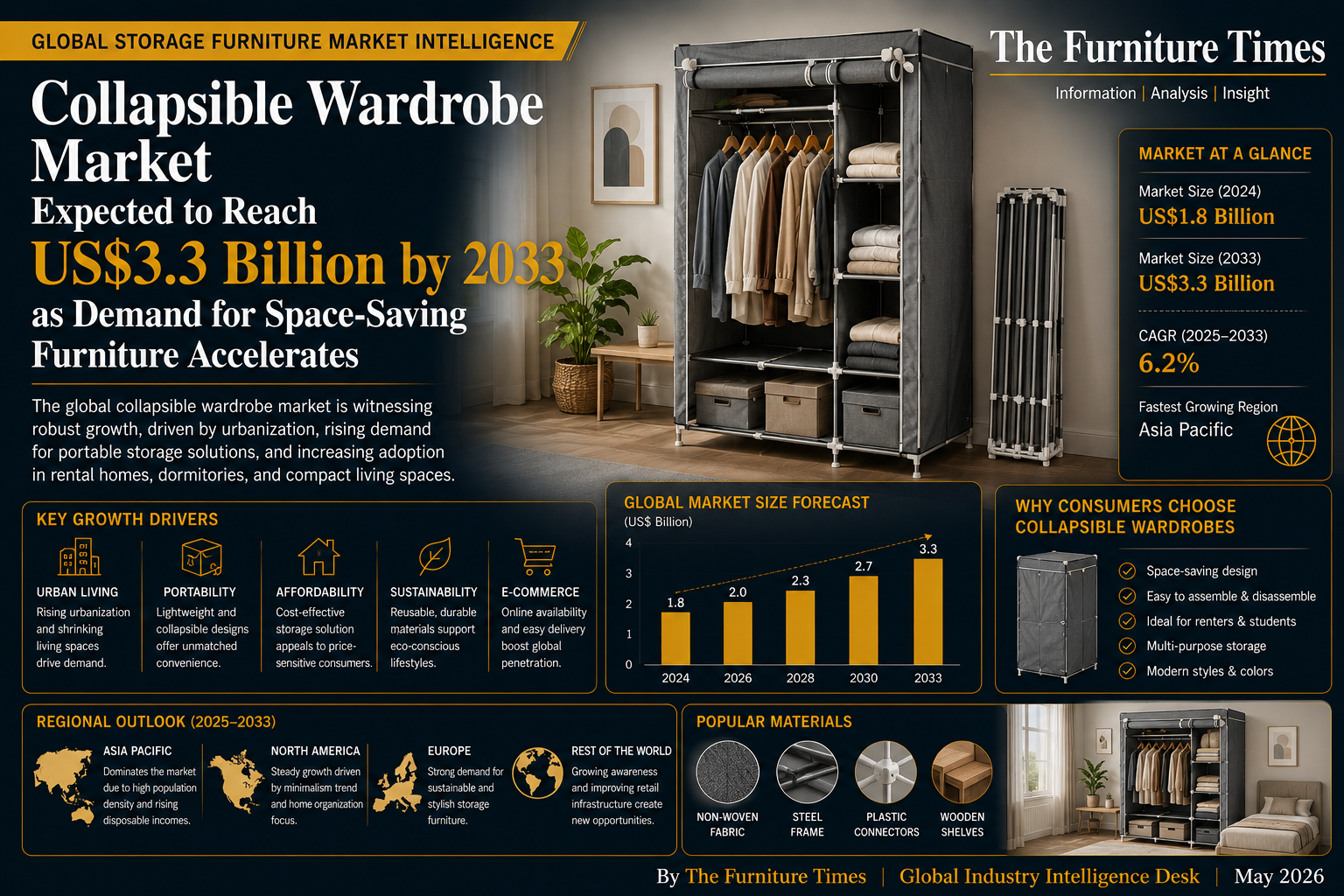
Collapsible Wardrobe Market Expected to Reach US$3.3 Billion by 2033 as Demand for Space-Saving Furniture Accelerates
Global Storage Furniture Market Intelligence | The Furniture Times
By The Furniture Times | Global Industry Intelligence Desk | May 2026
The global collapsible wardrobe market is projected to reach approximately US$3.34 billion by 2033, driven by rising demand for space-saving furniture, urban living solutions, and affordable modular storage systems across global residential markets.
The market’s projected expansion reflects a much larger transformation taking place across the global furniture ecosystem, where consumers are increasingly prioritizing:
- flexibility
- portability
- compact living
- multifunctional furniture
- affordability
- convenience-driven home solutions
Urban Living Is Reshaping Furniture Demand
Rapid urbanization and shrinking residential spaces are becoming major drivers behind the growth of collapsible and modular furniture categories globally.
Consumers living in:
- apartments
- rental homes
- student housing
- compact urban residences
are increasingly seeking furniture solutions that:
- maximize space
- reduce clutter
- remain portable
- support flexible lifestyles
Collapsible wardrobes are emerging as one of the most practical storage solutions within this growing segment.
Space-Saving Furniture Becoming a Major Industry Trend
The furniture industry is witnessing a broader shift toward:
- foldable furniture
- modular systems
- multifunctional interiors
- portable home solutions
Consumers increasingly value products that combine:
- functionality
- mobility
- affordability
- easy assembly
- lightweight design
This trend is especially strong among:
- younger consumers
- urban renters
- students
- first-time homeowners
- temporary housing users
Asia-Pacific Driving Market Growth
The Asia-Pacific region is expected to remain one of the strongest growth markets for collapsible wardrobes and compact furniture systems.
Countries including:
- India
- China
- Indonesia
- Vietnam
- Malaysia
continue experiencing:
- rapid urban expansion
- rising apartment living
- growing middle-class populations
- changing housing patterns
These trends are increasing demand for:
- affordable storage systems
- portable furniture
- compact interior solutions
E-Commerce Accelerating Furniture Accessibility
The rise of online furniture retail has also accelerated the popularity of collapsible wardrobes.
Unlike heavy traditional furniture, collapsible storage systems offer:
- easier shipping
- lower logistics costs
- simpler packaging
- faster delivery
This makes them highly suitable for:
- e-commerce platforms
- direct-to-consumer sales
- online marketplaces
The category is benefiting significantly from digital furniture retail expansion globally.
Affordability & Convenience Driving Consumer Preference
One of the strongest advantages of collapsible wardrobes is affordability.
Consumers increasingly prefer products that:
- require lower upfront investment
- can be assembled easily
- are movable
- adapt to changing living arrangements
The category is becoming especially popular among:
- students
- young professionals
- temporary residents
- small families
where mobility and flexibility matter more than permanent furniture systems.
Manufacturers Expanding Modular & Portable Product Lines
Furniture manufacturers globally are increasingly expanding into:
- modular furniture
- lightweight storage
- DIY furniture systems
- foldable product categories
The shift reflects changing consumer lifestyles where furniture is expected to:
- adapt quickly
- move easily
- serve multiple functions
- fit smaller spaces
Manufacturers that can combine:
- affordability
- durability
- modern aesthetics
- efficient logistics
may benefit significantly from future market demand.
Sustainability & Minimalist Living Influencing Design
Minimalist living trends are also contributing to the rise of collapsible furniture categories.
Consumers increasingly seek:
- clutter-free interiors
- efficient storage
- multifunctional spaces
- sustainable consumption habits
Compact furniture solutions align closely with:
- urban sustainability
- smaller housing footprints
- efficient space utilization
inside modern living environments.
Digital Furniture Discovery Changing Consumer Behavior
Social media platforms, online furniture marketplaces, and interior design content are also influencing consumer preferences toward:
- modular interiors
- compact storage
- smart space planning
Consumers increasingly discover products through:
- digital inspiration
- online reviews
- interior influencers
- furniture content ecosystems
before making purchasing decisions.
TFT Industry Insight
The growth of the collapsible wardrobe market reflects a much larger transformation happening across the global furniture ecosystem:
Consumers are no longer buying furniture only for permanence.
They are increasingly buying furniture for flexibility, mobility, adaptability, and modern urban living.
The future furniture market may increasingly favor:
- modular systems
- compact furniture
- lightweight structures
- multifunctional products
- digitally discoverable furniture ecosystems
Final Thought
The future of furniture is not only about larger homes and heavier products.
It is increasingly about intelligent space optimization, flexible lifestyles, and furniture systems designed for modern urban realities.
As global housing patterns continue evolving, collapsible and multifunctional furniture categories may become one of the fastest-growing segments within the global furniture industry.

Related Posts
Global Furniture Industry Shows Signs of Strategic Transformation Amid Economic Uncertainty

Why Core Values Will Become the New Competitive Advantage in the Furniture Industry