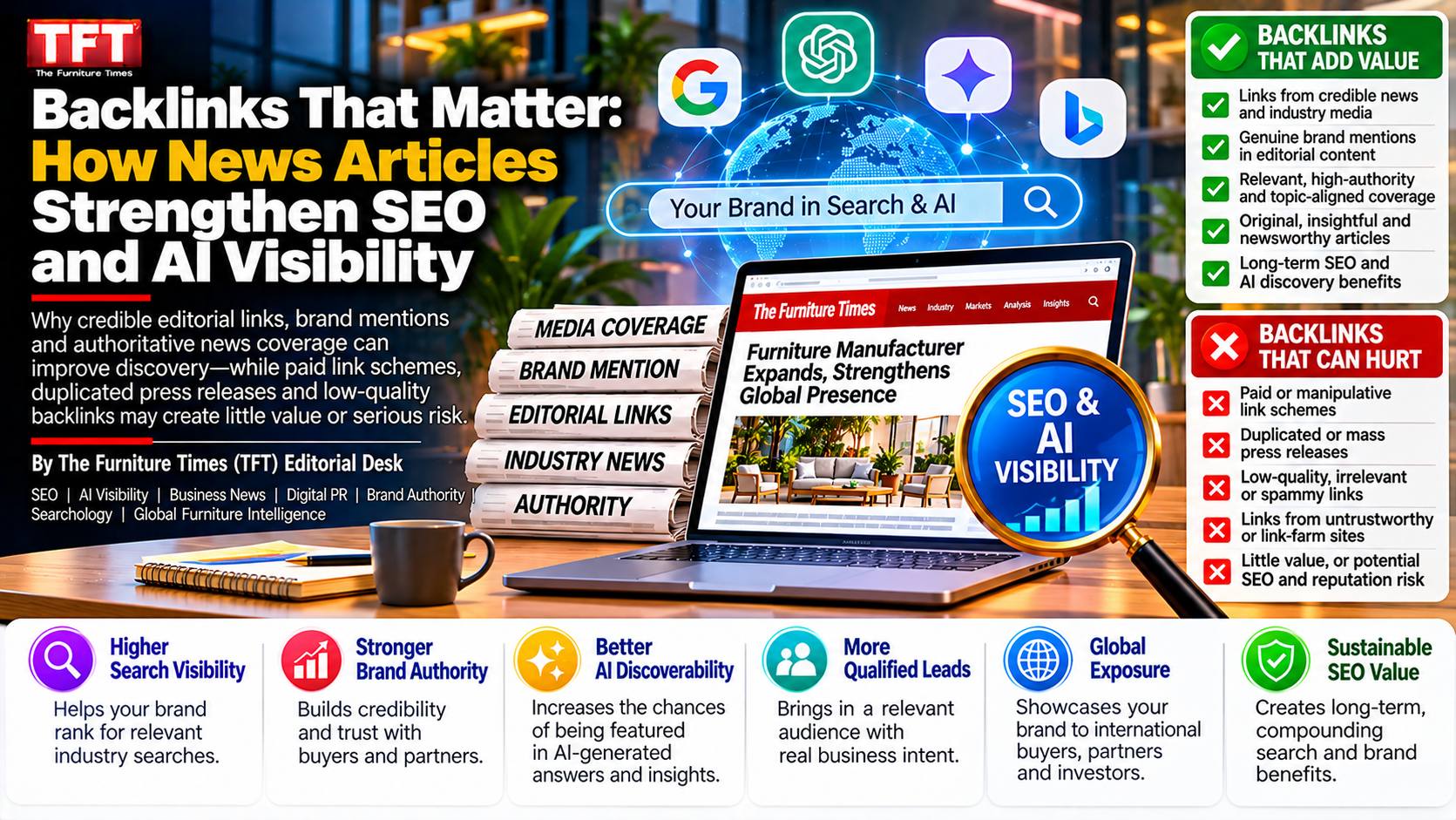
Backlinks That Matter: How News Articles Strengthen SEO and AI Visibility
Why credible editorial links, brand mentions and authoritative news coverage can improve discovery—while paid link schemes, duplicated press releases and low-quality backlinks may create little value or serious risk
By The Furniture Times (TFT) Editorial Desk
SEO | AI Visibility | Business News | Digital PR | Brand Authority | Searchology | Global Furniture Intelligence
For years, businesses have been told that backlinks are essential for search engine optimisation.
That advice is broadly correct—but dangerously incomplete.
Not every backlink has equal value. Some links help search engines discover useful pages, clarify relationships and understand why a source may be relevant. Others generate referral traffic, strengthen brand recognition and place a company inside a credible industry context.
But thousands of artificial, irrelevant or purchased links may deliver little commercial value. Manipulative link-building can also violate search-engine policies and place a website’s visibility at risk.
The more important question is no longer:
“How many backlinks does our website have?”
It is:
“Which credible sources mention our business, why are they linking to us, what evidence surrounds that link and does the destination genuinely help the reader?”
This distinction has become even more important as business discovery moves beyond conventional search results into AI Overviews, AI Mode, Microsoft Copilot, conversational assistants and other answer-driven systems.
In this environment, a good news article can produce much more than a hyperlink.
It can create:
- A searchable company reference
- A credible brand mention
- A contextual relationship
- A source page for customers
- Referral traffic
- Evidence of business activity
- Public information about products and expertise
- A discoverable page that AI systems may retrieve
- A permanent record of company development
News coverage does not guarantee a higher ranking or an AI citation. But credible, crawlable and useful editorial coverage can strengthen the information environment through which both people and machines discover a business.
What is a backlink?
A backlink is a link from one website to another.
For example, if a news article about a furniture manufacturer links to the manufacturer’s website, the manufacturer has received a backlink from that publication.
In basic HTML, a conventional link may look like this:
<a href="https://examplefurniturecompany.com">
  Example Furniture Company
</a>
Search engines use links for several purposes. Google states that it uses links to discover new pages and as a signal when determining page relevance. It also advises publishers to use crawlable HTML links and meaningful, natural anchor text. developers.google.com
However, the existence of a link alone does not prove:
- The destination is trustworthy
- The source is authoritative
- The article is useful
- The business deserves to rank
- The link will transfer ranking value
- The page will be indexed
- The company will appear in an AI answer
- The link will generate customers
A backlink is one signal inside a much larger discovery and evaluation system.
Why news backlinks can be different
A naturally included link within a genuine news article usually has a reason for existing.
The article may be reporting:
- A factory expansion
- A product launch
- A new showroom
- An export partnership
- A completed hospitality project
- A certification
- A management appointment
- An investment
- A technology upgrade
- An industry initiative
- A research report
- A sustainability programme
The link helps readers verify the business, obtain more information or visit the relevant source.
This gives the backlink context.
A furniture manufacturer mentioned in an article about hotel procurement is connected to a clear subject. A component supplier featured in a report about furniture durability is connected to a relevant area of expertise. A Malaysian outdoor-furniture company covered for completing a resort project is linked to a real business activity.
Context is important because a link from an unrelated page containing no useful information may tell readers very little.
The anatomy of a backlink that matters
A valuable editorial backlink generally combines several qualities.
| Quality | Why it matters |
|---|---|
| Editorial relevance | The link has a genuine reason to appear |
| Topical context | Surrounding content explains the relationship |
| Credible source | The publication has a real identity and audience |
| Crawlability | Search engines can technically discover the link |
| Useful destination | The linked page satisfies the reader’s next need |
| Natural anchor text | The clickable wording accurately describes the destination |
| Original reporting | The article adds information rather than duplicating promotional text |
| Audience alignment | Readers may reasonably care about the linked business |
| Longevity | The page can remain accessible and useful |
| Transparency | Sponsored relationships are appropriately disclosed and qualified |
No single item guarantees SEO success. Together, they create a much stronger link than an artificial placement on an irrelevant website.
1. Relevance matters more than random volume
A furniture manufacturer does not necessarily benefit from obtaining hundreds of links from unrelated websites.
A smaller number of relevant references may be commercially more useful.
Strong potential sources might include:
- Furniture-industry publications
- Architecture and design media
- Hospitality publications
- Construction media
- Retail publications
- Trade associations
- Exhibition websites
- Certification organisations
- Universities
- Government programmes
- Project partners
- Reputable local and business news outlets
The value is not merely that these sites can link. It is that their subject matter and audience align with the company’s market.
A resort-furniture supplier featured in hospitality media may be discovered by hotel owners, architects and procurement managers. That commercial alignment can matter more than an impressive-looking metric from an unrelated website.
2. The reason for the link matters
A strong editorial link answers a simple question:
Why should the reader visit this website?
Good reasons include:
- To view the product
- To verify the company
- To read the original research
- To examine the completed project
- To access technical information
- To understand a service
- To contact the organisation
- To review the source document
Weak reasons include:
- The link was inserted solely to manipulate ranking
- The anchor text was sold as an SEO package
- The article exists only to host backlinks
- The destination is unrelated to the surrounding discussion
- The same keyword-rich link appears across hundreds of sites
Links created for readers usually have a clearer editorial purpose than links manufactured only for search engines.
3. The source page must have substance
A link from a thin, duplicated or automatically generated article may carry little practical value.
A stronger news page contains:
- An accurate headline
- Original information
- A clear date
- Named organisations
- Identified people
- Relevant context
- Supporting evidence
- Original quotations
- Useful images
- An editorial purpose
- A functional destination link
A credible article should still be valuable even if every external link were removed.
If the page exists only because someone purchased a backlink, it is not strong journalism and may not be a sustainable SEO asset.
4. The destination page must deserve the link
Businesses frequently pursue backlinks before improving the page receiving those links.
This reverses the correct order.
The destination should provide:
- Clear company information
- Accurate product or service details
- Fast mobile performance
- Secure HTTPS delivery
- A logical page title
- Useful text
- Working contact information
- Relevant photographs
- Clear next steps
- Updated information
- No misleading claims
If a news story links to a broken, outdated or confusing page, the referral opportunity is wasted.
The backlink may generate attention, but the destination fails to convert it into trust or action.
5. Anchor text should be natural
Anchor text is the clickable wording used in a link.
Examples include:
- The Furniture Times
- FurnitureIndustrySearchEngine.com
- Malaysia furniture-industry report
- View the company’s outdoor-furniture collection
- Read the original research
- Company website
Natural anchor text helps readers understand where the link leads.
Google advises that anchor text should be descriptive, concise and written naturally. It warns against forcing excessive keywords into links. developers.google.com
A news article does not need to repeatedly use anchors such as:
- Best furniture manufacturer Malaysia
- Cheap outdoor furniture supplier Kuala Lumpur
- Number one sofa company
- Buy furniture online Malaysia
Aggressive exact-match anchors can make an article appear artificial.
Brand names, article titles, source descriptions and naturally descriptive phrases are usually more editorially appropriate.
Backlinks are not the only value of news coverage
Businesses often judge a news article only by whether it contains a followed backlink.
That approach ignores several other benefits.
Brand mention
The article may mention the company’s name even when the link is qualified or absent.
A clear mention can still help people:
- Recognise the brand
- Search for it later
- Understand its category
- Connect it to a person, place or product
- Verify that it has real business activity
Referral traffic
Readers may click the link and visit the business directly.
A smaller number of relevant visitors can be more valuable than thousands of unqualified website visits.
Search-result coverage
The news article itself may appear when someone searches for:
- The company
- Its founder
- Its product
- Its location
- Its project
- Its announcement
This expands the company’s searchable footprint.
Sales credibility
A salesperson can use the article in proposals, presentations and follow-ups.
Reputation evidence
Customers may interpret independent coverage as another point of verification.
Entity clarity
Consistent references to the business name, leadership, location, products and website can help create a clearer public identity.
These benefits can exist even when the link does not pass conventional ranking credit.
What link attributes mean
Not every hyperlink is treated identically.
Publishers can use link attributes that communicate the relationship between the page and the destination.
Standard editorial link
<a href="https://example.com">Example Company</a>This is commonly used when a publisher independently chooses to reference a relevant source.
Sponsored link
<a href="https://example.com" rel="sponsored">
  Example Company
</a>
This is appropriate when the link is connected to advertising, sponsorship or another commercial arrangement.
Nofollow link
<a href="https://example.com" rel="nofollow">
  Example Company
</a>
This tells search systems that the publisher does not want to associate the link in the conventional way.
User-generated-content link
<a href="https://example.com" rel="ugc">
  Example Company
</a>
This may be used for links in user-created areas such as comments or forums.
A sponsored or nofollow link should not automatically be dismissed as worthless. It can still generate:
- Referral traffic
- Brand discovery
- Customer enquiries
- Searchable coverage
- Reputation value
The mistake is promising clients that every paid placement will transfer ranking authority.
Google’s position on paid links and press releases
Google’s spam policies classify links created primarily to manipulate search rankings as link spam.
Examples include:
- Buying or selling links for ranking purposes
- Excessive link exchanges
- Automated link creation
- Low-quality directory links
- Keyword-rich links in widgets
- Large-scale article campaigns
- Paid advertorials that pass ranking credit
- Optimised anchor text in widely distributed press releases
Google recognises that purchasing advertising and sponsored placement is a normal part of the web economy, but commercial links should be appropriately qualified. developers.google.com
This distinction matters.
Paying for legitimate media production, distribution or advertising is not inherently prohibited. The problem arises when the arrangement attempts to disguise paid links as independent ranking endorsements.
A professional media campaign should sell:
- Editorial production
- Audience access
- Storytelling
- Brand visibility
- Referral opportunity
- Searchable coverage
- Distribution
It should not guarantee that purchased links will manipulate Google rankings.
Why duplicated press releases underperform
Some businesses distribute the same press release word for word across dozens or hundreds of websites.
This can create the appearance of broad coverage without producing meaningful editorial authority.
Problems include:
- Duplicate content
- Low reader value
- Identical headlines
- No local or industry context
- No independent analysis
- Weak publication quality
- Repetitive anchor text
- Short-lived or unindexed pages
- Confusing canonicalisation
- Little audience engagement
Press releases remain useful for communicating facts to media and stakeholders.
But a press release is an input to journalism—not automatically the final editorial product.
A stronger approach is to adapt the story for different relevant audiences.
For example:
- Furniture-industry publication: manufacturing impact
- Hospitality publication: hotel procurement relevance
- Local business media: jobs and regional investment
- Sustainability media: material and waste implications
- Technology media: automation and digital production
The facts remain consistent, but each article provides distinct value.
How news backlinks support traditional SEO
Page discovery
Search-engine crawlers follow links to discover pages.
A link from an accessible news article can help expose a company page that might otherwise receive little external attention.
Google explicitly identifies crawlable links as an important mechanism through which it finds pages. developers.google.com
Relevance
The article’s subject, anchor text and surrounding language can help explain why the destination is relevant.
Authority and recognition
Independent editorial references may contribute to the broader evidence that a business, organisation or page is recognised by others.
However, no third-party SEO score should be confused with Google’s internal ranking systems. Google uses many page-level and site-wide signals, and a strong site-wide reputation does not guarantee that every page will rank highly. developers.google.com
Referral behaviour
Relevant referral traffic can produce:
- Product enquiries
- Newsletter sign-ups
- Downloads
- Calls
- RFQs
- Distributor interest
- Brand searches
These are business outcomes, even if ranking movements are difficult to attribute.
Search-result diversification
A company’s own website may occupy one result, while news coverage, interviews, reviews and profiles can create additional search visibility around its brand.
How news coverage supports AI visibility
AI visibility requires careful explanation.
There is no universal formula stating that a specific number of backlinks will make a company appear in AI-generated answers.
Different AI platforms use different retrieval systems, indexes, models and citation methods.
Nevertheless, credible news coverage can support AI-era discovery in several ways.
1. It creates retrievable public information
AI-powered search systems often retrieve information from indexed web pages.
Google states that its AI Overviews and AI Mode rely on core search systems, may perform multiple related searches and display supporting links. Pages must be indexed and eligible for conventional Search to appear as supporting sources. developers.google.com
A news article can provide a crawlable page containing:
- Company name
- Product category
- Location
- Founder
- Project
- Market served
- Business development
- Supporting evidence
2. It creates multiple contextual associations
If reliable pages consistently connect a company with a legitimate specialisation, systems have more public material from which to understand that relationship.
For example:
- Company + outdoor furniture
- Company + Malaysia
- Company + hotel projects
- Company + aluminium manufacturing
- Company + founder
- Company + sustainability programme
This does not guarantee recommendation, but it creates clearer context than a company name appearing alone.
3. It provides potential source material
AI systems may retrieve news pages when answering current, specific or research-intensive questions.
Google’s official guidance says the same foundational SEO principles remain relevant for generative search. It emphasises original, useful, non-commodity content, crawlability, technical accessibility and high-quality supporting media. developers.google.com
4. It supports source diversity
AI answers may draw on several sources rather than only the business’s own website.
Independent reporting can provide another perspective that owned content cannot reproduce.
5. It creates citation opportunities
Microsoft introduced AI Performance reporting in Bing Webmaster Tools in 2026, allowing publishers to examine how their pages are cited across Microsoft Copilot, Bing AI summaries and selected partner experiences.
Microsoft explicitly distinguishes citation frequency from page importance or ranking. blogs.bing.com
This reinforces an important point:
AI citation visibility is measurable, but it should not be treated as identical to conventional ranking or backlink authority.
Backlinks, mentions and citations are not the same
| Signal | Meaning | Possible benefit |
|---|---|---|
| Backlink | One page links to another | Discovery, context, referral traffic |
| Brand mention | A company is named, with or without a link | Recognition and entity clarity |
| Source citation | A page is referenced in an AI or editorial answer | Authority, visibility and referral opportunity |
| Search ranking | A page’s position for a query | Organic discoverability |
| Referral visit | A reader clicks through from another site | Direct audience and conversion opportunity |
A complete visibility strategy should monitor all five.
Focusing only on followed backlinks can cause a business to undervalue meaningful coverage that creates recognition, referrals or AI citations.
Which news backlinks matter most?
High-value editorial situations
- Original reporting by a relevant publication
- Expert commentary included in a genuine industry article
- A case study containing measurable results
- Coverage of a verified company development
- Citation of original research
- A founder interview containing real insight
- A trade-association or institutional reference
- A project partner crediting the business
- A university or government resource linking to useful material
- A respected event linking to an exhibitor’s relevant profile
Moderate but useful situations
- Local news coverage
- Niche blogs with genuine audiences
- Relevant directories with editorial controls
- Event listings
- Supplier and partner profiles
- Qualified sponsored articles
- Professional-association membership pages
Low-value or risky situations
- Thousands of automated directory links
- Links from unrelated websites
- Expired-domain networks
- Private blog networks
- Hidden links
- Comment spam
- Keyword-rich footer links
- Mass reciprocal-link pages
- Duplicated press-release farms
- Paid links presented as independent endorsements
- Articles created solely to manipulate search results
A news-link quality scorecard
Before pursuing or accepting a media placement, score it against the following questions.
| Question | Strong sign |
|---|---|
| Is the publication relevant? | It covers the business’s market, location or industry |
| Is there a real audience? | Readers, subscribers or stakeholders engage with it |
| Is the site identifiable? | It has editors, contact details and publication information |
| Is the story original? | It contains reporting, analysis or unique evidence |
| Is the link natural? | It helps the reader obtain useful information |
| Is the destination strong? | The linked page is accurate, current and valuable |
| Is sponsorship disclosed? | Commercial relationships are transparent |
| Is the page crawlable? | It is technically accessible to search engines |
| Is the story durable? | It is likely to remain accessible |
| Can the company reuse it? | It supports sales, proposals and brand communication |
If the only attractive feature is a third-party “domain authority” score, the placement deserves further scrutiny.
What should a news article link to?
The homepage is not always the best destination.
A news article should link to the page most relevant to the story.
Product launch
Link to:
- Product page
- Collection page
- Specification sheet
- Launch information
Factory expansion
Link to:
- Manufacturing capabilities
- Company profile
- Investment announcement
- Facility information
Completed project
Link to:
- Case study
- Project portfolio
- Relevant service page
Research report
Link to:
- Original report
- Data page
- Downloadable methodology
Founder interview
Link to:
- Leadership profile
- Company story
- Relevant initiative
Recruitment announcement
Link to:
- Careers page
- Job listing
- Internship programme
Deep links can provide a better user journey than sending every reader to a generic homepage.
News publishers also need internal linking
The value of a news article is strengthened when it connects naturally to related content on the same publication.
For example, a furniture-compliance article can link internally to:
- BIS certification guides
- Mechanical-testing reports
- Sample-selection guidance
- Documentation checklists
- Variant-declaration articles
This creates a topical content cluster.
Internal links help:
- Readers continue learning
- Search engines discover related pages
- Publications organise topic authority
- Older articles remain accessible
- Important pages receive contextual support
External backlinks attract the reader into the ecosystem. Internal links help the reader navigate it.
Technical requirements cannot be ignored
Media coverage cannot compensate for a technically inaccessible website.
Businesses should confirm that:
- The linked page returns a successful HTTP status
- Crawling is permitted
- The page is indexable
- Canonical tags are correct
- Mobile rendering works
- Important information appears as text
- The page loads securely
- Internal links reach the destination
- Structured data matches visible content
- XML sitemaps are current
- Redirects are functioning
- The page is not accidentally marked
noindex
Google states that pages must be indexed and eligible for Search with a snippet before they can appear as supporting links in its AI search features. developers.google.com
Bing also recommends accurate XML sitemaps and genuine lastmod dates to support crawling and freshness in conventional and AI-powered search. blogs.bing.com
A backlink leading to a blocked or broken page cannot perform its full discovery function.
Measuring the real impact of news backlinks
A backlink programme should be evaluated through business and visibility outcomes—not raw link quantity.
Search measurements
Track:
- Indexed coverage pages
- Search impressions
- Search clicks
- Ranking changes
- Branded searches
- Referring domains
- Linked destination performance
- New and lost links
- Crawl activity
Referral measurements
Track:
- Visits from the article
- Engaged sessions
- Time on page
- Product views
- Contact-form submissions
- Calls
- RFQs
- Newsletter registrations
- Downloads
Reputation measurements
Track:
- Media mentions
- Sales use of coverage
- Customer references to the article
- Partnership enquiries
- Distributor interest
- Recruitment interest
- Speaking invitations
AI visibility measurements
Where platforms provide information, monitor:
- Referenced URLs
- AI citations
- Grounding queries
- Branded prompts
- Category prompts
- Share of relevant AI answers
- Accuracy of company descriptions
These measures should be interpreted carefully. Correlation does not prove that one article caused a ranking increase or AI mention.
A practical news-backlink strategy for SMEs
Step 1: Repair the destination
Ensure the website accurately explains:
- Who the company is
- What it provides
- Where it operates
- Who it serves
- Why it is different
- How customers can contact it
Step 2: Identify real news
Create a list of genuine developments:
- Products
- Projects
- Investments
- Partnerships
- Certifications
- Research
- Appointments
- Market expansion
- Community impact
Step 3: Match the story to the audience
Do not distribute every story to every publication.
Choose outlets serving the relevant:
- Industry
- Geography
- Profession
- Buyer group
- Investment community
Step 4: Prepare evidence
Provide:
- Accurate facts
- Original photographs
- Named quotations
- Supporting documents
- Relevant statistics
- Working URLs
Step 5: Request useful, natural links
A link should take the reader to an appropriate source or next step. Do not demand unnatural exact-match anchors.
Step 6: Disclose commercial relationships
Sponsored coverage should be identified and links qualified where appropriate.
Step 7: Amplify the coverage
Use the article in:
- Sales emails
- Proposals
- Newsletters
- Social posts
- Presentations
- Dealer communications
- Investor updates
Step 8: Measure outcomes
Review performance after 30, 90 and 180 days.
A strong article may continue producing value long after publication.
The furniture industry needs more credible references
The global furniture industry contains thousands of manufacturers, retailers, suppliers, designers, installers, logistics companies, repairers and artisans that remain difficult to discover.
Many have:
- No independent media coverage
- Few meaningful backlinks
- Incomplete business profiles
- Outdated websites
- Limited customer reviews
- No searchable project history
- Poor AI visibility
This creates a serious disadvantage.
A buyer searching for a hotel-furniture manufacturer, component supplier or installation specialist may encounter only the companies with the strongest digital footprints—not necessarily the companies with the greatest capability.
The industry must close the gap between operational expertise and digital discoverability.
The TFT visibility infrastructure
The Furniture Times ecosystem addresses three connected layers of business discovery.
The Furniture Times (TFT) publishes industry news, company developments, analysis and intelligence—helping furniture businesses build credible public stories and relevant editorial references.
Furniture Industry Search Engine—FurnitureIndustrySearchEngine.com creates structured industry discovery, helping buyers search for manufacturers, retailers, suppliers, designers and service providers.
FurniReviewology—Review. Trust. Decide. supports the reputation layer through reviews and customer-experience intelligence.
TFT tells their story.
FISE helps the world find them.
FurniReviewology helps the world trust them.
News coverage, search profiles and reviews perform different functions. Together, they can create a stronger information ecosystem than isolated backlink campaigns.
From link building to authority building
The phrase “link building” often encourages the wrong behaviour.
It can lead businesses to pursue quantity, shortcuts and artificial placements.
A more sustainable objective is authority building.
Authority building means:
- Doing work worth reporting
- Producing original knowledge
- Publishing useful research
- Solving genuine problems
- Earning customer recognition
- Creating verifiable business developments
- Becoming a credible source
- Maintaining accurate public information
- Building relationships with relevant media
The backlink becomes a result of substance—not the entire purpose.
Final verdict
Backlinks still matter, but the old approach of acquiring as many links as possible is no longer a responsible strategy.
The backlinks that matter are:
- Relevant
- Editorially justified
- Contextual
- Crawlable
- Audience-aligned
- Connected to useful pages
- Supported by genuine information
- Transparent when commercially arranged
News articles can strengthen SEO by helping search engines discover pages, understand context and connect businesses with relevant subjects.
They can support AI visibility by creating accessible, structured and potentially retrievable information that AI-powered search systems may use when grounding answers.
But no article, backlink package or press-release campaign can guarantee ranking or AI citation.
The strongest strategy remains:
- Build a real business.
- Create useful information.
- Document genuine developments.
- Earn relevant coverage.
- Link readers to valuable pages.
- Remain technically accessible.
- Measure commercial outcomes.
- Build trust consistently.
Do not chase backlinks that merely exist. Build editorial references that mean something.
Visibility is the new currency.
If you are not searchable, you do not exist.