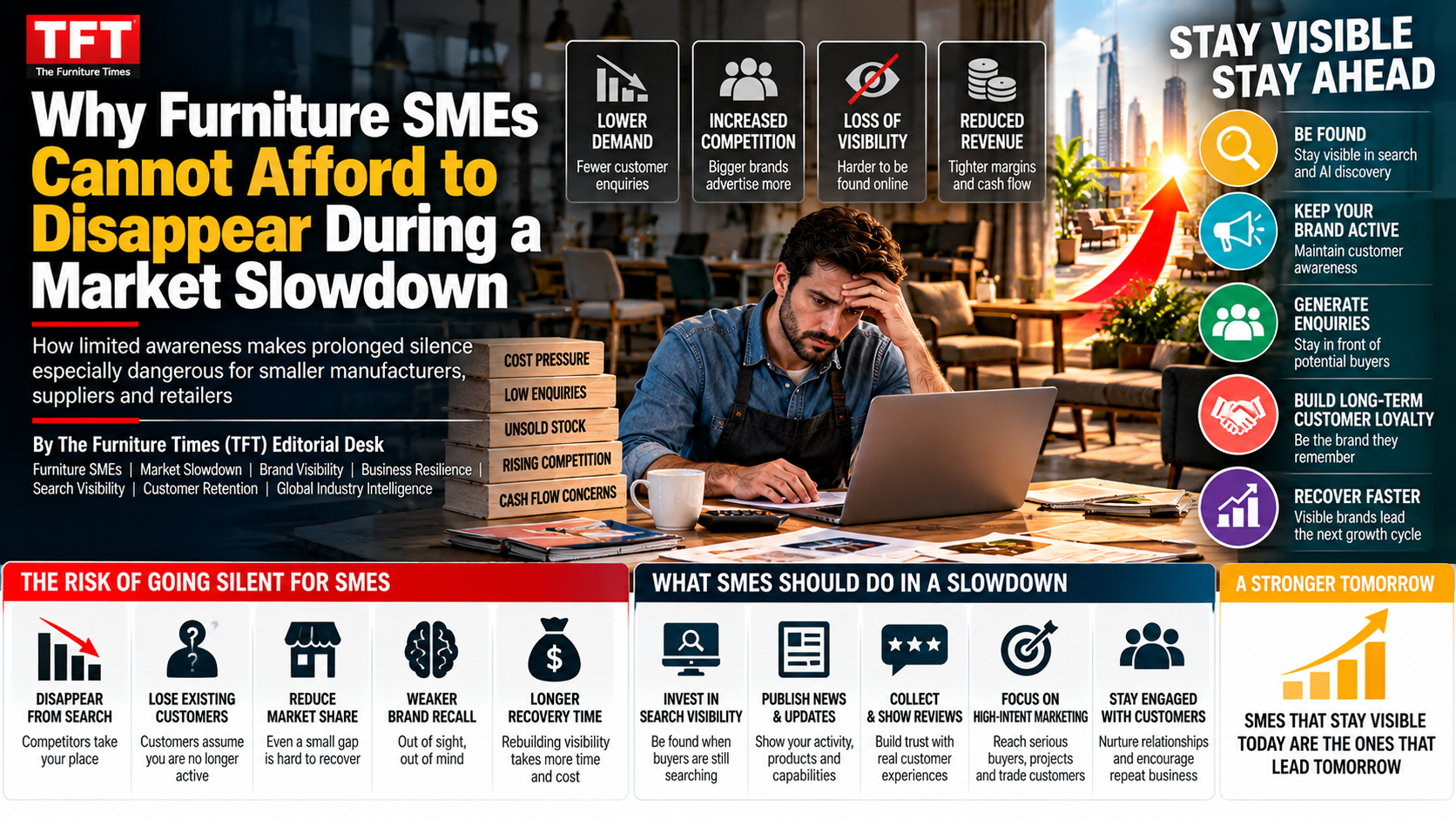
Why Furniture SMEs Cannot Afford to Disappear During a Market Slowdown
How limited awareness makes prolonged silence especially dangerous for smaller manufacturers, suppliers and retailers
By The Furniture Times (TFT) Editorial Desk | Furniture SMEs | Market Slowdown | Brand Visibility | Business Resilience | Search Visibility | Customer Retention | Global Industry Intelligence
When furniture demand slows, small and medium-sized enterprises often respond by reducing every expense that does not appear immediately essential.
Advertising is paused. News publication stops. Product photography is delayed. Search optimisation is neglected. Customer communication becomes irregular. Social channels fall silent. Trade-event participation is cancelled. Business listings remain outdated.
From a cash-flow perspective, these decisions may appear sensible. A business experiencing fewer orders naturally wants to conserve working capital.
But complete silence carries its own cost.
Large furniture brands may survive a temporary reduction in visibility because they already possess:
- Strong name recognition
- Established dealer networks
- Significant search demand
- Large customer databases
- Showroom presence
- Media coverage
- Distribution relationships
- Historical trust
Most SMEs do not have the same protection.
Their potential customers may know the product category but not the company. A buyer may search for an outdoor-furniture supplier, office-chair manufacturer, hotel-furniture specialist or local furniture retailer without knowing which SME can fulfil the requirement.
If the smaller company disappears from search, media, customer communication and industry platforms, it does not merely become quieter.
It becomes easier to forget.
During a slowdown, silence does not protect an unknown brand. It makes the brand more unknown.
For furniture SMEs, preserving a minimum level of visibility is not vanity. It is part of protecting the future sales pipeline.
A slowdown reduces demand—it does not eliminate demand
Market slowdowns do not mean that every customer stops buying furniture.
Demand becomes more selective.
Customers may:
- Delay non-essential purchases
- Compare more suppliers
- Negotiate harder
- Seek greater value
- Repair rather than replace
- Reduce order quantities
- Extend approval cycles
- Prioritise essential projects
- Request stronger warranties
- Demand better delivery commitments
At the same time, purchases continue because:
- Homes are completed
- Hotels open
- Offices relocate
- Restaurants renovate
- Furniture breaks
- Families move
- Businesses expand
- Schools need equipment
- Developers furnish units
- Landlords prepare properties
- Customers replace damaged items
- Hospitality operators refurbish spaces
The commercial opportunity becomes smaller or slower, but it does not disappear.
The danger is that an SME may withdraw precisely when customers become more careful about which supplier they choose.
In uncertain markets, buyers often favour businesses that appear:
- Active
- Stable
- Reachable
- Informative
- Reviewed
- Professional
- Capable of supporting the purchase
Silence can create the opposite impression.
Smaller companies suffer faster from declining awareness
Awareness is not permanent.
Customers forget. Employees change companies. Procurement databases are updated. New competitors enter the market. Search results move. Social-media feeds refresh continuously. AI systems gather newer information.
A large brand may remain mentally available because customers have encountered it repeatedly over many years.
An SME may depend on recent visibility.
Consider two businesses:
| Established national brand | Local furniture SME |
|---|---|
| Widely recognised name | Known within a limited audience |
| Large customer database | Smaller contact list |
| Multiple showrooms | One showroom or online presence |
| Strong branded search demand | Mostly category-based discovery |
| Regular media mentions | Limited independent coverage |
| Dealer distribution | Direct local sales |
| Large review volume | Fewer customer reviews |
| Can rely partly on memory | Must remain visible to be considered |
If both businesses become silent for six months, the SME is likely to lose a larger proportion of its effective market presence.
It does not have enough accumulated awareness to remain automatically included in the customer’s shortlist.
Silence creates five types of commercial loss
1. Discovery loss
Customers cannot choose a business they cannot find.
If the SME is absent from:
- Search results
- Maps
- Industry directories
- Marketplaces
- News platforms
- Review sites
- Social channels
- AI-generated recommendations
high-intent customers may never encounter it.
2. Memory loss
Past customers and prospects gradually forget the company, its products and its capabilities.
3. Confidence loss
An inactive digital presence can make buyers wonder whether the company is still operating, carrying stock or honouring warranties.
4. Data loss
Paused campaigns, neglected customer databases and broken tracking systems reduce the information available for future decisions.
5. Recovery loss
When demand improves, silent businesses must rebuild awareness before they can fully benefit from the recovery.
These losses are rarely visible on the day the marketing budget is cut. They appear gradually through fewer enquiries, weaker search performance and reduced customer recall.
The hidden recovery debt
Stopping marketing may save money today, but rebuilding lost visibility later can require more time and money than maintaining a basic presence.
This creates recovery debt.
Recovery debt may include the cost of:
- Rebuilding search rankings
- Restarting advertising from limited data
- Re-engaging an inactive customer database
- Updating an outdated website
- Replacing old product content
- Repairing inconsistent business listings
- Collecting new reviews
- Re-establishing media relationships
- Rebuilding customer confidence
- Recovering lost dealer attention
- Reintroducing the brand to the market
A company that remains visible during the slowdown can respond more quickly when demand returns.
A company that disappears must first prove that it still exists.
Competitors do not stop because you become silent
An SME’s absence creates space.
Competitors may occupy that space through:
- Search advertising
- New product pages
- Customer reviews
- News articles
- Trade-platform listings
- Social content
- Dealer outreach
- Project case studies
- Email campaigns
- Local-search optimisation
A business may pause its communications for six months and assume that it can return to the same market position.
But the market does not remain still.
Competitors may have:
- Collected new reviews
- Improved their websites
- Published technical guides
- Added product catalogues
- Expanded local listings
- Entered new categories
- Built new industry relationships
- Acquired the absent company’s customers
Visibility surrendered is not always easily recovered.
Search visibility deteriorates quietly
Furniture customers increasingly discover suppliers through search.
They may look for:
- Furniture manufacturer near me
- Outdoor furniture supplier Malaysia
- Hotel furniture manufacturer
- Office chairs in bulk
- Custom wardrobe company
- Restaurant table supplier
- Sofa repair service
- Furniture showroom nearby
- Furniture exporter
- Commercial parasol supplier
- Ready-stock dining furniture
- Bedroom furniture delivery
Search visibility depends on a combination of:
- Useful website content
- Accurate business information
- Product pages
- Location information
- Technical accessibility
- Reviews
- External references
- Business activity
- Relevant links and mentions
A website does not need daily changes merely to exist, but prolonged neglect creates risks:
- Product information becomes outdated.
- Broken pages remain unresolved.
- Opening hours become inaccurate.
- Enquiries go unanswered.
- Competitors publish more useful content.
- Reviews receive no response.
- Important pages disappear from search results.
- Search engines have less evidence that the business remains relevant.
Search decline often goes unnoticed because it happens gradually.
By the time management recognises the loss, the enquiry pipeline may already be weaker.
AI discovery creates another reason to remain visible
Customers increasingly ask AI systems to recommend:
- Furniture manufacturers
- Local retailers
- Project suppliers
- Sustainable brands
- Repair specialists
- Hospitality-furniture companies
- Outdoor-furniture providers
AI systems require accessible information to understand:
- Who the company is
- Where it operates
- What it sells
- Which customers it serves
- What evidence supports its claims
- Whether other sources recognise it
- Whether business information is consistent
A silent SME may not provide enough current information for confident inclusion.
More visible competitors may be recommended not because their products are better, but because their digital identities are clearer.
For the modern furniture SME, discoverability is no longer limited to traditional search rankings. It increasingly includes whether machines can accurately understand and describe the business.
A quiet showroom cannot replace a visible market presence
Furniture retailers have traditionally depended on:
- Showrooms
- Passing traffic
- Local reputation
- Printed catalogues
- Salespeople
- Referrals
These remain valuable, but customer behaviour has changed.
Before visiting a showroom, buyers may check:
- Maps
- Opening hours
- Photographs
- Product categories
- Prices
- Reviews
- Delivery options
- Stock availability
- Social activity
- Company legitimacy
If the showroom appears inactive online, some customers will not visit.
Physical presence without digital visibility can leave an SME commercially invisible beyond its immediate neighbourhood.
Manufacturers face an even greater invisibility risk
Many furniture manufacturers believe marketing is primarily a retailer’s responsibility.
They rely on:
- Existing distributors
- A few major buyers
- Trade fairs
- Sales agents
- Personal relationships
- Repeat orders
This model becomes vulnerable during a slowdown.
A distributor may reduce purchases. A major buyer may delay orders. A sales agent may focus on other brands. A trade fair may produce fewer leads.
If the manufacturer has no independent digital presence, it may struggle to reach:
- New retailers
- Importers
- Designers
- Property developers
- Hospitality buyers
- Architects
- E-commerce brands
- Private-label partners
- International agents
A manufacturer should publish:
- Product categories
- Materials
- Production capacity
- Customisation capabilities
- Minimum order quantities
- Certifications
- Export markets
- Factory photographs
- Quality-control systems
- Lead times
- Packaging capabilities
- Contact information
A factory with strong production but weak discoverability remains dependent on whoever already knows it.
Silence weakens existing customer relationships
A slowdown should increase the importance of customer retention.
Instead, many SMEs stop communicating with previous buyers because they associate marketing only with new-customer advertising.
Existing customers may represent opportunities for:
- Repeat purchases
- Referrals
- Repairs
- Replacements
- Upgrades
- Maintenance
- Accessories
- New projects
- Additional branches
- Property furnishing
Customers should receive useful, proportionate communication such as:
- Product-care guidance
- Warranty reminders
- New collection information
- Maintenance services
- Replacement-part availability
- Relevant seasonal products
- Project updates
- Business news
- Review invitations
The objective is not to bombard customers with promotions. It is to remain useful and remembered.
Furniture’s long purchase cycle makes memory more important
Furniture is not purchased as frequently as food, clothing or everyday household products.
A customer may buy a sofa today and not need another for several years.
This long cycle makes continued brand memory essential.
The same customer may eventually need:
- A dining set
- Outdoor furniture
- Bedroom furniture
- Office furniture
- Furniture for another property
- Replacement cushions
- Repair
- Reupholstery
- A recommendation for a friend
If the company disappears from communication between purchases, it may not be remembered when the next need arises.
Furniture businesses should therefore think beyond immediate transactions.
Visibility maintains the relationship during the long interval between purchases.
SMEs must distinguish cost reduction from disappearance
Financial discipline is necessary during a slowdown.
The objective should be to remove waste while protecting essential visibility.
Costs that should be reviewed
- Advertising with no measurable outcome
- Duplicate software
- Unused subscriptions
- Poor-quality directory listings
- Vanity sponsorships
- Repetitive content
- Agencies without clear deliverables
- Broad campaigns reaching irrelevant audiences
- Discounts that destroy margin
- Unqualified lead providers
- Paid traffic directed to weak landing pages
Visibility assets that should be protected
- Website availability
- Accurate contact information
- Local-search profiles
- Core product pages
- Customer follow-up
- Review responses
- High-intent advertising
- Product photography
- Industry listings
- News publication
- Basic analytics
- Enquiry handling
The correct response is not “stop marketing.”
It is:
Protect the parts of marketing that keep the business discoverable, credible and commercially reachable.
The minimum visibility system for a furniture SME
Even under severe budget pressure, an SME should protect six functions.
| Function | Minimum action |
|---|---|
| Search visibility | Maintain website, maps and priority category pages |
| Product information | Keep specifications, photographs and availability accurate |
| Customer retention | Communicate selectively with past customers and prospects |
| Reviews | Request genuine feedback and respond professionally |
| News and authority | Publish meaningful updates and expert content |
| High-intent advertising | Maintain targeted visibility for the most valuable searches |
This minimum system does not require a large campaign.
It requires consistency.
1. Maintain searchable business information
At minimum, customers should be able to find:
- Correct company name
- Address
- Telephone number
- Website
- Opening hours
- Product categories
- Service area
- Delivery coverage
- Enquiry method
This information should be consistent across the website, search listings, industry directories and social profiles.
An unanswered telephone number or inaccurate address can waste every other marketing effort.
2. Protect the most valuable product pages
An SME may not have the budget to update hundreds of products.
It should prioritise the pages most closely connected to profitable demand.
Each priority page should include:
- Clear product name
- Strong photographs
- Dimensions
- Materials
- Colours and finishes
- Intended use
- Availability
- Lead time
- Delivery information
- Warranty
- Enquiry button
If products are unavailable, pages should be updated promptly.
Outdated availability damages trust.
3. Continue requesting reviews
A market slowdown is not a reason to stop collecting customer feedback.
Reviews provide:
- Current evidence of activity
- Information about service
- Search visibility support
- Customer confidence
- Operational intelligence
SMEs should request genuine reviews after:
- Delivery
- Installation
- Project completion
- Repair
- Successful complaint resolution
The company should respond to positive and negative feedback professionally.
Silence in response to complaints can be more damaging than the original complaint.
4. Publish useful news—not only promotions
During difficult markets, businesses often communicate only discounts.
This can make the company appear desperate and weaken perceived value.
A healthier editorial mix includes:
- Project stories
- Material guidance
- Maintenance advice
- Factory developments
- Product education
- Customer case studies
- Founder perspectives
- Industry commentary
- Sustainability initiatives
- New capabilities
- Team achievements
- Certifications
News keeps the brand visible without relying entirely on price cuts.
It also gives customers more reasons to understand and trust the business.
5. Protect high-intent advertising
If budget must be reduced, SMEs should prioritise audiences demonstrating a clear need.
Examples include:
- “Buy outdoor furniture near me”
- “Hotel furniture supplier”
- “Office chair bulk order”
- “Ready-stock sofa delivery”
- “Furniture repair service”
- “Custom dining table manufacturer”
These searches are closer to commercial action than broad, untargeted awareness campaigns.
High-intent advertising should direct customers to relevant pages—not a generic homepage.
Campaigns should be monitored for:
- Enquiries
- Qualified leads
- Sales
- Gross profit
- Search terms
- Geographic relevance
- Wasted clicks
A smaller, well-targeted campaign can be more valuable than broad exposure without commercial purpose.
6. Keep responding quickly
Marketing visibility is wasted when enquiries receive no response.
During slow periods, every qualified enquiry deserves disciplined handling.
Furniture SMEs should establish:
- Response-time targets
- Lead assignment
- Quotation follow-up
- Stock confirmation
- Delivery estimates
- Appointment booking
- Lost-lead analysis
A customer who submits an enquiry to three suppliers may select the first credible business that responds clearly.
Slow markets make response quality more—not less—important.
Visibility should shift from volume to precision
An SME does not need to publish constantly on every platform.
It should concentrate on the channels where its customers actually make decisions.
A local retailer might prioritise
- Google Maps
- Local search
- Product pages
- Reviews
- WhatsApp enquiries
- Retargeting
- Customer database
A manufacturer might prioritise
- Technical catalogue
- Searchable company profile
- Industry news
- Case studies
- Export directories
- RFQ channels
A hospitality supplier might prioritise
- Project portfolio
- Architect and designer outreach
- Hotel case studies
- Specifications
- Trade media
- High-intent search
- Direct business development
Precision allows limited budgets to remain productive.
Discounting cannot replace visibility
During a slowdown, SMEs may replace marketing with repeated price reductions.
This is risky.
Discounts may:
- Reduce gross margin
- Train customers to wait
- Damage perceived quality
- Attract low-loyalty buyers
- Create price competition
- Limit future pricing power
A promotion can create a transaction, but it does not necessarily build awareness or preference.
Customers need to understand:
- Why the product is valuable
- How it differs
- Whether it will last
- Whether delivery is dependable
- Whether the business supports the purchase
Reducing price does not answer these questions.
How silence affects different furniture SMEs
Furniture retailers
Risks include declining showroom traffic, reduced local-search visibility and loss of customer recall.
Manufacturers
Risks include dependence on fewer buyers, limited export discovery and invisibility to designers or project purchasers.
Component suppliers
Risks include being excluded from specification conversations and supplier shortlists.
Designers
Risks include losing visibility to professionals who publish more case studies and thought leadership.
Installers
Risks include disappearing from local search and losing referral networks.
Repairers and restorers
Risks include being overlooked by customers who choose replacement because repair services are difficult to find.
Artisans
Risks include exceptional skills remaining commercially invisible outside personal networks.
Every category faces the same fundamental problem:
Capability has limited commercial value when the market cannot discover it.
The 90-day SME visibility plan
A furniture SME can maintain market presence through a focused quarterly programme.
Month 1: Repair the foundation
- Update company information
- Fix broken website pages
- Review local-search listings
- Refresh top product pages
- Verify enquiry forms
- Organise the customer database
- Respond to outstanding reviews
Month 2: Rebuild evidence
- Publish a project case study
- Request reviews from recent customers
- Add new product photographs
- Publish one educational article
- Update warranty and delivery information
- Create a clear company-capability profile
Month 3: Capture demand
- Launch a targeted search campaign
- Contact appropriate previous customers
- Publish a genuine company news story
- Approach dealers or project buyers
- Measure lead quality
- Reallocate spending toward productive channels
This programme protects visibility without requiring indiscriminate expenditure.
A practical slowdown dashboard
Furniture SMEs should track leading indicators—not only completed sales.
| Indicator | What it reveals |
|---|---|
| Search impressions | Whether the market is still encountering the business |
| Website enquiries | Active customer interest |
| Calls and WhatsApp messages | Direct response |
| Qualified leads | Commercial relevance |
| Quotation volume | Pipeline activity |
| Quote-to-sale rate | Sales effectiveness |
| Repeat-customer enquiries | Retention strength |
| New reviews | Current customer activity |
| Branded searches | Brand awareness |
| Gross profit by campaign | Marketing quality |
| Response time | Enquiry-handling performance |
| Lost-sale reasons | Barriers to conversion |
Sales are a lagging indicator. By the time sales fall severely, visibility and enquiry signals may have been deteriorating for months.
Leadership must protect the future pipeline
During a slowdown, management attention naturally turns to:
- Cash
- Stock
- Payroll
- Rent
- Supplier payments
- Debt
- Operational efficiency
These priorities are necessary.
But leadership must also ask:
- Where will orders come from three months from now?
- Are customers still finding us?
- Are we remaining visible to previous buyers?
- Are competitors gaining our search space?
- Does our website reflect current capabilities?
- Are we still building trust?
- Will we be ready when demand improves?
Marketing is not separate from survival.
The sales pipeline is a future cash-flow system.
Allowing it to disappear may solve one month’s expenses while weakening the next year’s revenue.
Visibility does not require pretending everything is perfect
Businesses should not respond to a difficult market by publishing unrealistic optimism.
Credible communication can acknowledge:
- Changing demand
- Cost pressures
- Longer decision cycles
- Supply-chain challenges
- Customer affordability concerns
The company can then explain how it is responding through:
- Better value
- Flexible options
- Improved service
- Stronger warranties
- Faster delivery
- Repair programmes
- Smaller order quantities
- More efficient products
- Financing
- Better product information
Honest communication can strengthen trust.
Customers do not expect every business to be unaffected. They expect it to remain reliable.
The opportunity hidden inside a slowdown
A slowdown can create space for disciplined SMEs to improve assets neglected during busy periods.
They can:
- Reorganise catalogues
- Photograph products
- Improve specifications
- Collect reviews
- Publish case studies
- Train sales teams
- Strengthen local search
- Repair the website
- Develop new partnerships
- Analyse customer feedback
- Clarify brand positioning
- Create new services
- Prepare export material
These investments can position the business more strongly for recovery.
The objective is not simply to endure the slowdown.
It is to emerge more visible, searchable and trusted than before.
The role of TFT, FISE and FurniReviewology
Furniture SMEs often possess valuable capabilities but lack the infrastructure required to present them globally.
A connected system can support them across three critical stages.
The Furniture Times—visibility through industry storytelling
TFT helps manufacturers, retailers, suppliers, designers, artisans and service providers communicate their news, expertise, projects and market relevance.
Furniture Industry Search Engine—structured discovery
FISE helps the world search for furniture businesses according to their location, category, products and capabilities.
FurniReviewology—reputation and customer experience
FurniReviewology helps companies build trust through reviews, feedback and visible customer experience.
The Furniture Times tells their story.
Furniture Industry Search Engine helps the world find them.
FurniReviewology helps the world trust them.
For an SME, these three layers—story, discovery and trust—can reduce dependence on expensive advertising alone.
The Global Furniture Ecosystem
The Furniture Industry is a $1 Trillion USD Ecosystem in the world.
Furniture Industry Search Engine – FISE helps the world find them.
The Furniture Times – TFT tells their story.
FurniReviewology helps the world trust them.
The TFT conclusion
Furniture SMEs do not need to spend carelessly during a slowdown.
They need to remain intelligently visible.
The essential actions are clear:
- Keep business information accurate.
- Protect local and category search presence.
- Maintain strong product pages.
- Communicate with previous customers.
- Continue collecting and responding to reviews.
- Publish useful news and expertise.
- Preserve high-intent advertising.
- Respond quickly to every qualified enquiry.
- Measure profitability—not vanity metrics.
- Prepare for recovery before it arrives.
Large brands may survive periods of silence because millions of customers already know them.
Most SMEs do not have that luxury.
Their next customer may be searching today without knowing their name. If the business has disappeared, the customer will find someone else.
A slowdown is not the moment to become invisible.
It is the moment to become more precise, more useful and more credible.
Cut waste. Control costs. Protect cash. But never abandon discoverability.
Because when the market begins moving again, the businesses customers can find, remember and trust will recover first.