Now or Never: The Businesses That Act Today Will Own Tomorrow’s Market
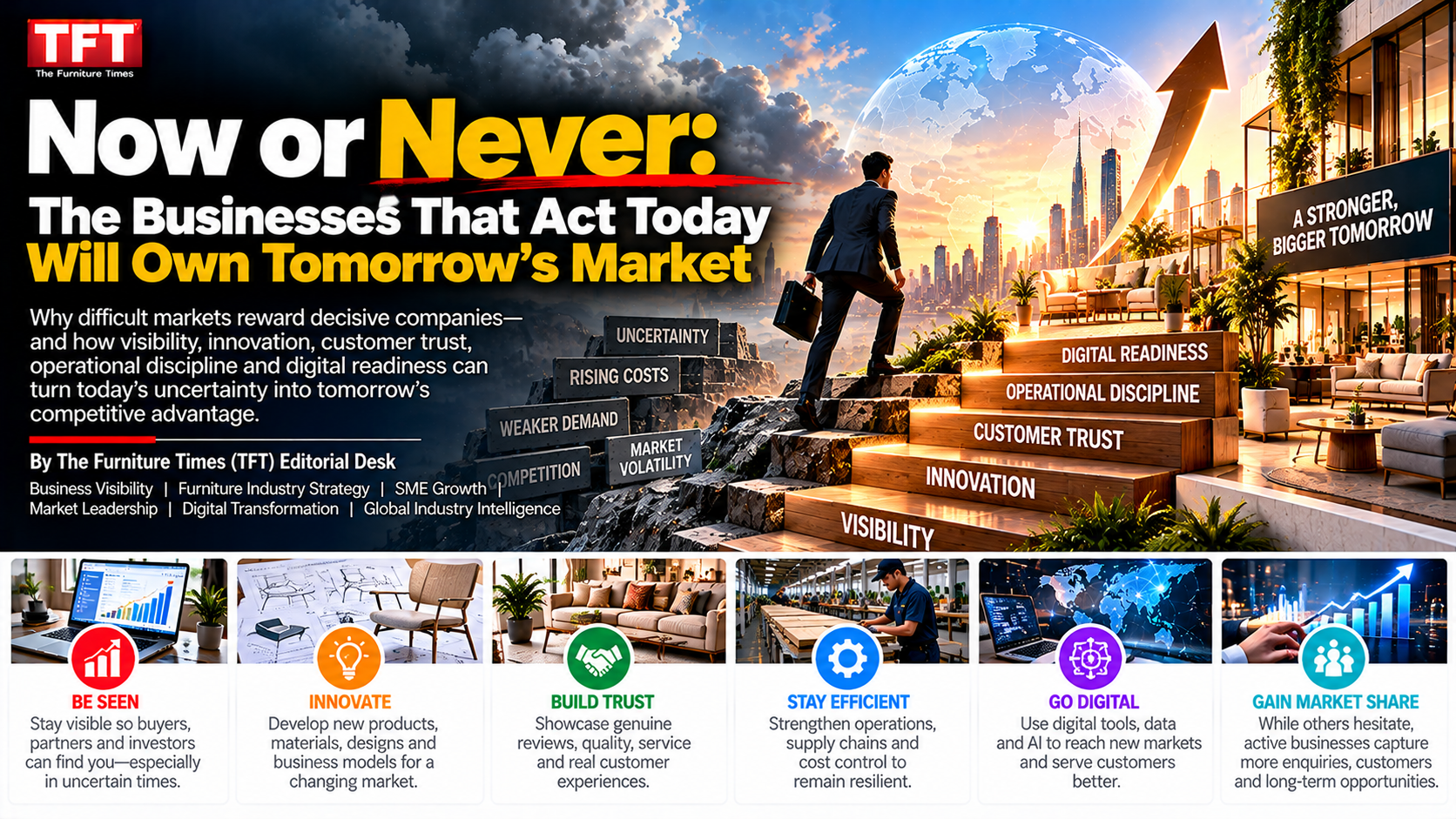
Now or Never: The Businesses That Act Today Will Own Tomorrow’s Market
Why difficult markets reward decisive companies—and how visibility, innovation, customer trust, operational discipline and digital readiness can turn today’s uncertainty into tomorrow’s competitive advantage
By The Furniture Times (TFT) Editorial Desk
Business Visibility | Furniture Industry Strategy | SME Growth | Market Leadership | Digital Transformation | Global Industry Intelligence
Every difficult market produces two kinds of businesses.
The first becomes paralysed by uncertainty. It postpones investment, reduces communication, avoids innovation and waits for conditions to improve. Management remains busy protecting yesterday’s model while customers, competitors and technology move in new directions.
The second recognises that uncertainty changes the competitive landscape.
It protects cash but continues improving. It listens to customers, strengthens its digital identity, develops better products, trains its workforce, repairs operational weaknesses and remains visible. It uses the slowdown to prepare for demand that may not yet have fully returned.
When the market eventually improves, these two businesses will not restart from the same position.
One will be attempting to recover lost attention, weakened relationships and outdated capabilities.
The other will already be visible, trusted and prepared.
That is why the present moment should be understood as a now-or-never period for furniture manufacturers, retailers, suppliers, designers, logistics companies, installers, repairers, artisans and technology providers.
This is not a demand for reckless spending. It is a call for decisive action.
The businesses that act intelligently today will have the strongest chance of owning tomorrow’s market.
Waiting Is Also a Business Decision
Management teams often believe that postponing action preserves their position.
It does not.
Markets continue changing while a company waits.
Customers search for alternatives. Competitors publish new information. New manufacturers enter the market. Technology reduces operating costs. Search platforms reorganise discovery. Regulations evolve. Distribution relationships change. Employees acquire new expectations.
A company may believe it is standing still, but relative to an advancing market, it is moving backwards.
Delay creates hidden costs:
- Lost search visibility
- Weakening brand recall
- Outdated product information
- Declining customer confidence
- Missed distributor relationships
- Slower adoption of technology
- Growing skills gaps
- Reduced employee morale
- Dependence on existing customers
- Higher future recovery costs
Strategic patience can be valuable. Strategic inactivity is different.
A business does not need to launch every project immediately, but it must decide what future it is preparing to enter.
Difficult Markets Reallocate Opportunity
A downturn does not eliminate demand. It changes where demand goes.
Consumers may delay premium purchases but prioritise durability and value. Hotels may postpone major renovations but replace damaged furniture. Offices may reduce expansion while investing in flexible workplaces. Households may move toward multifunctional furniture. Developers may seek more efficient suppliers. Retailers may reduce inventory and demand quicker replenishment.
Even when total demand contracts, buyers continue making choices.
They may shift from:
- Expensive products to better-value products
- Imported products to local alternatives
- Long lead times to readily available stock
- Unverified suppliers to trusted businesses
- Disposable furniture to repairable products
- Generic products to space-efficient designs
- Large minimum orders to flexible purchasing
- Traditional suppliers to digitally responsive companies
The opportunity therefore belongs to businesses capable of understanding changing priorities.
A difficult market does not ask only, “Who has the lowest price?”
It also asks:
- Who can deliver reliably?
- Who communicates clearly?
- Who provides evidence of quality?
- Who responds quickly?
- Who can adapt quantities and specifications?
- Who supports the product after purchase?
- Who can be independently verified?
- Who appears ready for the future?
Businesses that answer these questions now can capture demand that weaker competitors leave behind.
The First Advantage: Visibility While Others Disappear
When markets become difficult, many businesses stop communicating.
They reduce advertising, stop publishing news, neglect their websites and become inactive on professional platforms. Their last visible update may be months or years old.
This creates an opening.
A company that continues publishing useful, credible and current information can become more prominent even without dramatically increasing spending.
Visibility does not mean making noise for its own sake. It means giving customers reliable reasons to discover, understand and remember the business.
Businesses should remain visible through
- Updated product information
- Genuine company news
- Completed-project stories
- Customer case studies
- Educational content
- Factory and capability information
- Certification announcements
- New-service updates
- Reviews and customer experiences
- Leadership commentary
- Accurate business listings
- Responsive social channels
- Searchable company profiles
A silent company creates uncertainty.
An active company communicates continuity.
During unstable periods, continuity itself becomes a competitive signal.
Searchability Is Becoming Commercial Infrastructure
Tomorrow’s market will not be won only in showrooms, exhibitions and sales meetings.
It will also be won inside:
- Search engines
- Online marketplaces
- Industry directories
- Mapping platforms
- Review platforms
- Social networks
- AI assistants
- Conversational search systems
- Procurement databases
- Product-comparison tools
Buyers increasingly begin with a question rather than a supplier name.
They may search for:
- Contract furniture manufacturers in Malaysia
- Sustainable bedroom furniture suppliers in India
- Hotel furniture exporters in Vietnam
- Office-chair manufacturers with certification
- Outdoor furniture for coastal resorts
- Furniture repair specialists near me
- Custom joinery companies for hospitality projects
- Manufacturers offering small minimum orders
- Furniture logistics and installation companies
If a business’s products, capabilities, location and reputation cannot be found, it may never enter the buyer’s consideration set.
A company can have decades of experience and still remain digitally invisible.
That is why the statement remains urgent:
If you are not searchable, you do not exist.
Searchability is no longer an optional marketing improvement. It is part of basic market access.
AI Discovery Raises the Stakes
The next phase of business discovery will not depend entirely on customers scrolling through conventional search results.
Buyers will increasingly ask AI-supported systems to identify, compare and recommend businesses.
A procurement professional may ask:
Which furniture manufacturers can supply durable hospitality furniture within Southeast Asia?
An architect may ask:
Which companies produce custom outdoor furniture suitable for tropical climates?
A retailer may ask:
Which suppliers offer certified ready-to-assemble furniture with export experience?
AI systems require understandable information.
A company with only an image-based catalogue and a telephone number is difficult to interpret. A business with conflicting addresses, inconsistent names and no recent activity is difficult to trust. A manufacturer whose capabilities exist only inside a sales manager’s memory is difficult to recommend.
Businesses should begin organising their digital identities around clear facts:
- Official name
- Location
- Product categories
- Materials
- Manufacturing capabilities
- Certifications
- Markets served
- Minimum-order requirements
- Customisation options
- Delivery coverage
- Warranty support
- Leadership
- Projects
- Reviews
- Contact details
AI discovery does not remove the need for branding. It increases the importance of clarity, credibility and structured information.
The Second Advantage: Fixing the Business Before Demand Returns
Busy markets can hide operational weaknesses.
When orders are strong, management may tolerate:
- Inaccurate inventory
- Slow quotations
- Poor product photography
- Weak quality-control records
- Inconsistent model numbers
- High warranty costs
- Outdated websites
- Manual processes
- Supplier dependence
- Unprofitable product lines
- Inadequate customer follow-up
A slowdown exposes these weaknesses—but also provides time to fix them.
This is the moment to examine the business from order to after-sales service.
Review the complete customer journey
- How does the customer find the company?
- Can the customer understand the product?
- Is pricing or quotation clear?
- How quickly does the company respond?
- Is stock information accurate?
- Is the delivery promise realistic?
- Does the product match its description?
- Is installation professional?
- Are complaints recorded and resolved?
- Does the company request feedback?
- Can the customer obtain spare parts?
- Is there a reason to buy again?
Every unnecessary delay is an opportunity for a competitor.
Tomorrow’s market leaders will not merely attract more customers. They will lose fewer customers through poor processes.
The Third Advantage: Customer Trust
During prosperous periods, customers may take more risks. During uncertain periods, they become cautious.
They examine:
- Product quality
- Company history
- Delivery reliability
- Warranty conditions
- Customer reviews
- Return policies
- Business registration
- Physical location
- Project evidence
- Financial stability
- After-sales support
Trust therefore becomes a commercial asset.
Furniture is particularly sensitive because products may be:
- Expensive
- Large
- Difficult to return
- Made to order
- Delivered weeks later
- Installed inside a home or business
- Expected to last for years
- Purchased from another city or country
A buyer is not only purchasing a product. The buyer is accepting a chain of promises.
The product must arrive. The dimensions must be correct. The colour must match. The furniture must remain stable. The warranty must be meaningful. The supplier must remain contactable.
Businesses that make these promises visible and verifiable will have an advantage.
Reviews Are Becoming Part of Business Infrastructure
Reviews should not be treated as a decorative collection of five-star ratings.
They are a form of market intelligence.
A detailed review can reveal:
- Whether the product matched its description
- How comfortable it was
- Whether dimensions were accurate
- How delivery was handled
- Whether installation was professional
- How complaints were resolved
- Whether the product remained durable
- Whether the buyer would purchase again
Businesses should not fear every critical review. They should fear repeated problems that remain unresolved.
A responsible review strategy includes:
- Requesting genuine feedback
- Avoiding purchased or fabricated reviews
- Responding professionally
- Investigating recurring complaints
- Connecting feedback with product improvement
- Showing how problems were resolved
- Monitoring patterns across locations and product categories
The companies that learn from customer experience today will build better products tomorrow.
The Fourth Advantage: Innovation That Solves Real Problems
Innovation does not always require a revolutionary product or expensive technology.
In furniture, practical innovation may include:
- Easier assembly
- Replaceable components
- Improved packaging
- Smaller shipping volume
- Faster production
- Modular construction
- Better moisture resistance
- Stronger joints
- More efficient material use
- Space-saving functions
- Repair services
- Digital product information
- Improved delivery scheduling
- Customisation at lower quantities
- More accurate visualisation
The strongest innovations solve measurable customer or operational problems.
A company should ask:
- What causes the most returns?
- What damages products in transit?
- What slows manufacturing?
- Which customer questions occur repeatedly?
- Which parts fail first?
- What prevents repeat orders?
- Which products consume space but generate little margin?
- What can be standardised without reducing customer value?
- What can be repaired instead of replaced?
Innovation begins with observation.
The business that solves today’s most expensive problems will be better positioned when demand accelerates.
The Fifth Advantage: Better Information
Many furniture companies possess valuable knowledge but fail to record it.
Specifications may exist in the minds of employees. Product dimensions may differ between catalogues. Material descriptions may be vague. Photographs may show discontinued models. Salespeople may provide different warranty information.
This weakens sales, quality control, certification and digital discovery.
Every important product should have
- A unique model number
- Product name
- Accurate dimensions
- Material specifications
- Colour and finish options
- Weight
- Assembly status
- Intended use
- Care instructions
- Warranty information
- Packaging dimensions
- Lead time
- Replacement-part information
- Current photographs
- Technical drawings, where relevant
- Certification or testing information
Product information is not an administrative burden. It is infrastructure for:
- Sales
- E-commerce
- Search
- AI discovery
- Exporting
- Certification
- Customer service
- Manufacturing
- Warranty management
- Future digital product passports
Businesses that organise their information today will move faster tomorrow.
The Sixth Advantage: Workforce Capability
Technology will change the furniture industry, but people will determine whether companies benefit.
Tomorrow’s businesses will require combinations of traditional and emerging skills:
- Carpentry
- Upholstery
- Welding
- Finishing
- Product design
- Computer-aided design
- CNC operation
- Automation maintenance
- Quality assurance
- Digital marketing
- E-commerce
- Data management
- Customer experience
- Sustainability reporting
- Certification management
- International sales
A slowdown can provide an opportunity to train employees before order volumes recover.
Training should address real performance gaps:
- Reducing production defects
- Improving measurement accuracy
- Strengthening finishing consistency
- Managing technical documentation
- Responding to digital enquiries
- Handling customer complaints
- Capturing product data
- Maintaining machinery
- Understanding applicable standards
- Improving installation quality
When demand returns, companies will compete not only for customers but also for skilled people.
The businesses that develop talent now will be less dependent on an increasingly competitive labour market.
The Seventh Advantage: Financial Discipline Without Strategic Paralysis
Decisive action does not mean unlimited spending.
A company can be bold and financially disciplined at the same time.
Protect cash by removing
- Unprofitable product lines
- Excessive inventory
- Duplicate subscriptions
- Unmeasured advertising
- Unnecessary approvals
- Inefficient logistics routes
- Repeated production errors
- Preventable warranty claims
- Underused showroom space
- Low-value administrative work
Protect growth by maintaining
- Customer communication
- Product visibility
- Searchable information
- Sales follow-up
- Quality control
- Workforce capability
- Essential technology
- Reviews and reputation
- Industry relationships
- Product development
The objective is not to cut everything.
It is to transfer resources from activities that preserve the past to activities that create the future.
Small Businesses Can Move Faster Than Large Competitors
SMEs often view size as a disadvantage.
Large companies may have bigger budgets, more employees and wider distribution. But scale can also create complexity.
Smaller businesses can often:
- Approve changes quickly
- Speak directly with customers
- Modify products faster
- Serve narrow market segments
- Offer flexible quantities
- Build local relationships
- Personalise service
- Experiment at lower cost
- Communicate authentically
- Resolve problems without bureaucracy
Speed is an asset only when it is used.
A small furniture company that delays every decision loses its natural advantage. A decisive SME can identify a specific customer problem, develop an offer, publish the information and begin selling before a large competitor completes its internal approvals.
The future does not belong only to the biggest company.
It belongs to the company that learns and acts fastest without losing discipline.
From Price Competition to Value Competition
Businesses that remain passive during a downturn often become dependent on discounts.
When customers are unfamiliar with a company, price becomes the easiest comparison.
Strong businesses give buyers other reasons to choose them:
- Better durability
- Faster delivery
- More reliable installation
- Clearer specifications
- Genuine customisation
- Better reviews
- Responsive after-sales support
- Spare-part availability
- Repairability
- Local knowledge
- Certified quality
- Lower lifecycle cost
- Stronger project coordination
A table is not merely a tabletop and four legs.
Its value may include accurate sizing, reliable delivery, stable construction, stain resistance, replacement components, installation and support.
Businesses must communicate the complete value—not merely the purchase price.
The Cost of Acting Too Late
When the market begins recovering, many businesses will attempt to restart simultaneously.
They will compete for:
- Advertising inventory
- Search visibility
- Skilled employees
- Distributor attention
- Raw materials
- Factory capacity
- Logistics availability
- Customer consideration
- Investment capital
By then, preparation will be more expensive.
A company trying to rebuild its website, catalogue, sales pipeline, workforce and supplier network during a demand surge will be competing with organisations that completed those tasks earlier.
Late action creates what may be called recovery debt.
Recovery debt includes:
- The cost of restoring brand awareness
- The cost of rebuilding search rankings
- The cost of rehiring employees
- The cost of repairing dealer relationships
- The cost of updating years of neglected information
- The cost of regaining customer confidence
- The cost of hurried technology adoption
- The cost of correcting delayed compliance work
Saving money by doing nothing today can create a larger bill tomorrow.
Twelve Actions Furniture Businesses Can Take Now
1. Audit the company’s digital footprint
Search for the business name, products, leaders, locations and services. Record what buyers can and cannot find.
2. Update every priority product
Correct descriptions, dimensions, materials, images, availability and enquiry information.
3. Strengthen local and industry listings
Make the company discoverable by location, category and capability.
4. Publish genuine company news
Document investments, certifications, projects, partnerships, new employees and product developments.
5. Contact existing customers
Ask what they need, what has changed and how the company can support them.
6. Request authentic reviews
Build a searchable record of customer experience.
7. Analyse margins by product
Revenue without contribution can weaken the company.
8. Remove operational bottlenecks
Improve quotations, order confirmation, production planning, delivery and complaint handling.
9. Train employees
Focus on capabilities the future business will require.
10. Evaluate every product variant
Simplify unnecessary complexity while protecting meaningful customer choice.
11. Build a 12-month opportunity map
Identify target categories, locations, customer groups, distributors and partnerships.
12. Assign responsibility and deadlines
A strategy without ownership becomes another postponed document.
A 30–60–90-Day Action Programme
First 30 days: Become clear
- Define the company’s strongest market position
- Identify profitable customers and products
- Correct website and directory information
- Review cash flow
- Contact key customers
- Resolve outstanding complaints
- Remove outdated product content
- Select three immediate growth priorities
Days 31–60: Become visible
- Publish company news
- Create useful product and buying information
- Improve photography
- Request reviews
- Launch focused search and customer-retention activity
- Update distributor materials
- Build case studies
- Make leadership visible
Days 61–90: Become scalable
- Improve production controls
- Standardise model data
- Train employees
- Automate repetitive tasks
- Develop new partnerships
- Measure marketing and sales conversion
- Prepare for certification or export requirements
- Increase investment in proven activities
Action should be progressive. A company does not need to transform everything in one week.
It needs to stop postponing the first meaningful step.
TFT, FISE and FurniReviewology: Infrastructure for Tomorrow’s Market
The furniture industry ecosystem is a $1 trillion industry ecosystem, yet it remains fragmented.
Thousands of capable businesses remain difficult to discover. Their stories are undocumented, their product information is incomplete and their reputations are scattered across unrelated platforms.
Tomorrow’s furniture market needs connected layers of intelligence, discovery and trust.
The Furniture Times tells their story.
Furniture Industry Search Engine helps the world find them.
FurniReviewology helps the world trust them.
Furniture companies should not wait until the market fully recovers to build their presence.
Manufacturers, suppliers, retailers, designers, installers, logistics providers, repairers, artisans and technology companies should prepare their:
- Company profiles
- Product information
- Service categories
- Locations
- Certifications
- Project records
- Leadership information
- Customer reviews
- Contact details
Search is the new marketplace.
Listings are the new storefronts.
Visibility is not vanity. It is commercial infrastructure.
The Market Will Not Wait
The future furniture market will reward businesses that are:
- Searchable
- Verifiable
- Responsive
- Efficient
- Technically prepared
- Customer-focused
- Digitally organised
- Operationally reliable
- Financially disciplined
- Willing to innovate
Businesses do not need perfect certainty before acting.
They need clear priorities, responsible investment and the courage to move while others hesitate.
Some companies will spend the next year explaining why the market prevented them from growing.
Others will use the same conditions to improve systems, strengthen relationships, build credibility and capture attention.
When tomorrow arrives, the market will not be divided simply between large and small companies.
It will be divided between those that prepared and those that waited.
This is the moment to become visible.
This is the moment to strengthen trust.
This is the moment to organise, innovate and act.
Now or never.
The businesses that act today will own tomorrow’s market.
If you are not searchable, you do not exist.