
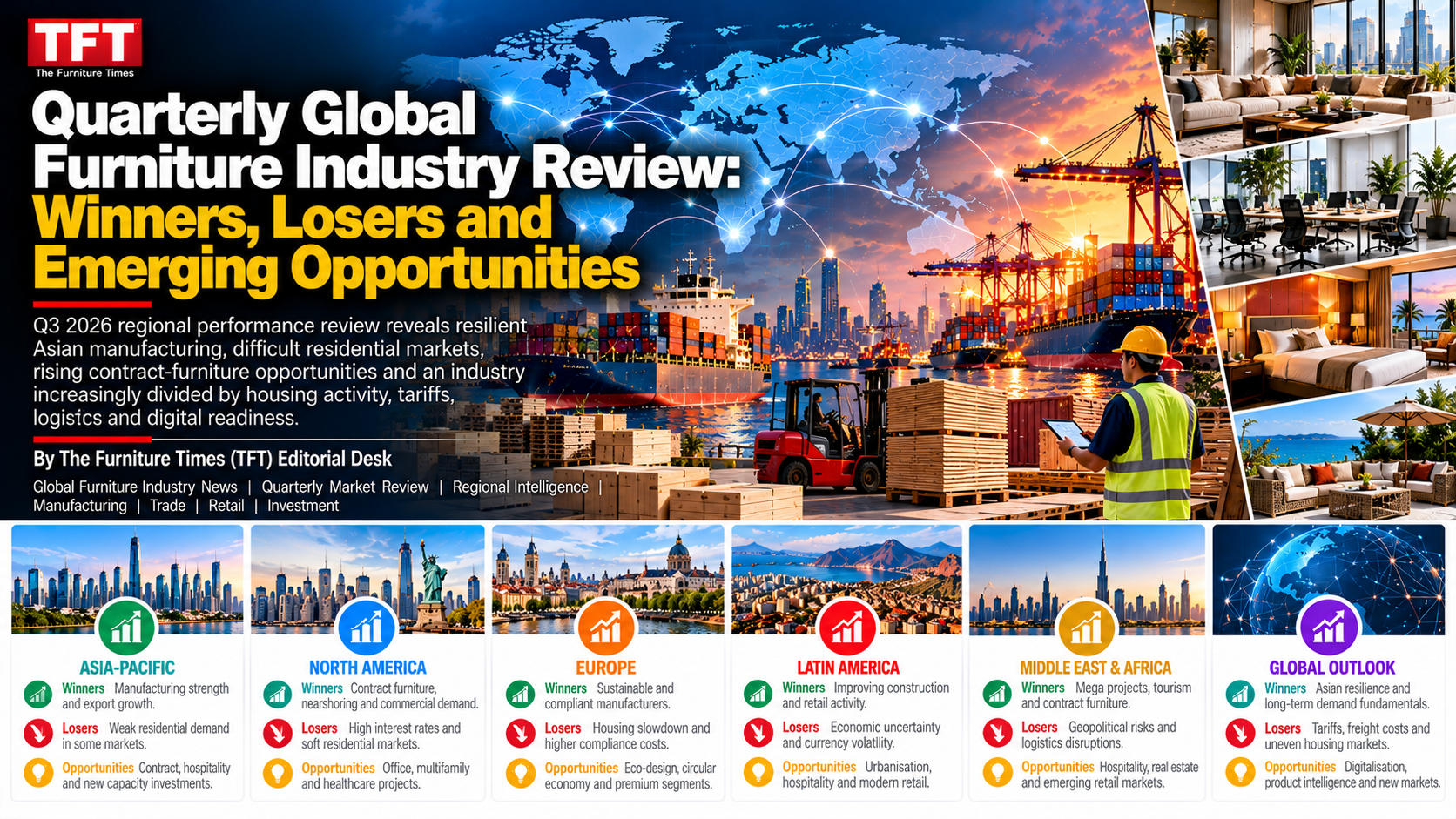
Quarterly Global Furniture Industry Review
Quarterly Global Furniture Industry Review: Winners, Losers and Emerging Opportunities
Q3 2026 regional performance review reveals resilient Asian manufacturing, difficult residential markets, rising contract-furniture opportunities and an industry increasingly divided by housing activity, tariffs, logistics and digital readiness
By The Furniture Times (TFT) Editorial Desk | Global Furniture Industry News | Quarterly Market Review | Regional Intelligence | Manufacturing | Trade | Retail | Investment
Reporting period: July–September 2026
The global furniture industry completed the third quarter of 2026 without producing a single, uniform direction.
Some markets benefited from manufacturing investment, export diversification, tourism, workplace modernisation and institutional construction. Others struggled with weak housing turnover, high mortgage rates, subdued consumer confidence, volatile freight and mounting regulatory costs.
China maintained formidable manufacturing and export capabilities, but its domestic property sector remained weak. Vietnam continued to rank among the world’s most important furniture-production centres, although export momentum slowed. India emerged as one of the clearest long-term opportunities, combining domestic consumption with new manufacturing capacity. The Middle East retained major hospitality and development potential while facing extraordinary geopolitical and logistics risks.
In North America, tariff protection created opportunities for regional production but increased costs for importers and consumers. Europe remained influential in design, machinery and sustainability, yet its manufacturers continued confronting weak demand, expensive production and rising import penetration. Australia demonstrated how falling housing transactions can quickly damage furniture and home-related retail.
The winners of Q3 were therefore not simply the countries with the largest markets.
They were the businesses and regions aligned with the quarter’s strongest demand patterns:
- Contract and hospitality furniture
- Modular and space-efficient products
- Ergonomic workplace furniture
- Regional and diversified manufacturing
- Traceable timber supply chains
- Repairable and replacement-ready products
- Digitally visible businesses
- Logistics-efficient furniture engineering
The losers were not necessarily poor-quality companies. Many were businesses trapped in vulnerable operating models: excessive dependence on housing transactions, one export destination, one shipping route, one supplier or permanent discounting.
This Quarterly Global Furniture Industry Review examines the regional winners, pressured markets and emerging opportunities shaping the transition into Q4 2026 and 2027.
Executive Scorecard: Q3 2026
| Region or segment | Q3 direction | TFT assessment |
|---|---|---|
| China manufacturing and exports | Strong overall trade capacity | Relative winner, but furniture demand remains pressured domestically |
| India furniture ecosystem | Expanding opportunity | Structural winner with execution risks |
| Southeast Asian manufacturing | Strategically important but uneven | Long-term winner; short-term export pressure |
| Middle East projects | Strong potential, extreme risk | Opportunity market requiring caution |
| North American regional manufacturing | Improving strategic relevance | Selective winner |
| US import-dependent furniture retail | Higher cost and policy exposure | Pressured |
| European premium and contract furniture | Resilient niches | Selective winner |
| European mass-market manufacturing | Cost and import pressure | Challenged |
| Australian furniture retail | Housing-linked weakness | Q3 loser |
| Hospitality furniture | Tourism and refurbishment support | Winner |
| Office and collaborative furniture | Workplace modernisation | Emerging winner |
| Generic middle-market residential furniture | Weak differentiation | Loser |
| Modular and multifunctional furniture | Smaller homes and urbanisation | Winner |
| Traceable and documented furniture | Regulation and procurement support | Winner |
| High-volume, inventory-heavy businesses | Demand volatility | Vulnerable |
“Winner” and “loser” in this report refer to relative quarterly commercial positioning—not a permanent judgment on any country, business or product category.
The global background: better trade, difficult furniture economics
The World Trade Organization’s October 2026 outlook projects merchandise-trade volume growth of 3.9% in 2026 and 4.1% in 2027, a considerable improvement from its earlier forecast. Stronger first-half activity and AI-related investment contributed to the revision.
However, furniture companies have not benefited equally.
Technology products, semiconductors and infrastructure equipment have been important drivers of the trade improvement. Furniture remains exposed to housing activity, discretionary expenditure, freight costs and import policy.
Meanwhile, the International Monetary Fund projects global economic growth of approximately 3.1% in 2026 and 3.4% in 2027, describing the global economy as resilient but increasingly uneven.
This produces a difficult commercial combination:
- International trade is expanding.
- Some investment categories remain strong.
- Housing-related consumer demand is weak in important markets.
- Energy and freight costs remain vulnerable to conflict.
- Regulatory obligations are increasing.
- Consumers are highly selective.
The global furniture market is therefore growing in some directions while restructuring in others.
Q3 Winner One: China’s industrial and export capability
China entered Q4 with exceptionally strong overall export performance.
Official customs data reported that Chinese merchandise exports increased by 36.3% year over year in September, while imports rose by 31%. Technology, semiconductors and automobiles were leading drivers rather than furniture specifically, but the results demonstrate the continuing depth and adaptability of China’s industrial system.
China remains indispensable to the global furniture ecosystem because it offers:
- Large-scale furniture manufacturing
- Extensive panel and metal-processing capacity
- Furniture hardware and mechanisms
- Upholstery fabrics and synthetic materials
- Woodworking machinery
- Packaging
- Lighting and home accessories
- Rapid product development
- Integrated port and logistics infrastructure
Why China remains a relative winner
Even where buyers diversify into Vietnam, Malaysia, India, Indonesia or Mexico, many factories continue sourcing Chinese components, machinery or materials.
China is therefore not merely a finished-furniture exporter. It is an infrastructure layer supporting furniture manufacturing in other countries.
Where China remains under pressure
The domestic property downturn continues to weaken household confidence and residential demand.
This places pressure on manufacturers previously dependent on Chinese property development and domestic retail. Some factories are pursuing overseas customers more aggressively, intensifying price competition in international markets.
The trade-policy risk
China’s large export surplus could lead to additional trade restrictions from major partners. Furniture may be affected indirectly by wider customs enforcement, origin investigations, anti-dumping action or measures targeting particular materials and products.
TFT judgment
China was a Q3 winner in manufacturing resilience and export capability, but not necessarily in domestic residential furniture demand.
Q3 Winner Two: India’s expanding furniture opportunity
India continues to emerge as one of the most important long-term furniture markets.
Its opportunity is not based on one factor. It combines:
- A large domestic population
- Urbanisation
- Rising demand for modular interiors
- Smaller residential spaces
- Office development
- Hospitality construction
- Institutional purchasing
- Traditional craft skills
- Expanding organised manufacturing
- Export diversification
India’s overall merchandise exports increased slightly in September to US$44.4 billion, although faster import growth widened the trade deficit. High oil prices remain a concern because India is a major energy importer.
Manufacturing investment
Premium furniture manufacturer Fabience announced a greenfield facility near Hyderabad as part of its production expansion and export-development strategy. The project is one example of growing confidence in India’s furniture-manufacturing potential.
Engineered wood opportunity
Smaller urban homes are supporting demand for:
- Modular kitchens
- Wardrobe systems
- Compact storage
- Multifunctional furniture
- MDF and particleboard
- Pre-laminated panels
- Space-saving furniture hardware
Indian panel producers and plywood companies are expanding toward engineered wood and furniture components to serve this transition.
India’s greatest challenge
The country must close the gap between capability and consistency.
International buyers require:
- Repeatable tolerances
- Accurate product drawings
- Reliable bills of materials
- Tested samples
- Controlled variants
- Traceable raw materials
- Export-ready packaging
- On-time delivery
- Professional claims management
TFT judgment
India was one of Q3’s strongest structural winners, although energy costs, interest rates, fragmented production and quality consistency remain risks.
Q3 Mixed Performer: Vietnam remains powerful, but export momentum slows
Vietnam remains one of the world’s leading furniture and wood-product exporters.
Its industry has grown from approximately US$200 million in exports in 2000 to around US$17.3 billion in 2025, demonstrating an extraordinary transformation into a major global production centre.
However, more recent analysis indicates that Vietnam’s furniture exports weakened during the first seven months of 2026, falling by approximately 10% compared with the corresponding 2025 period.
Why Vietnam still matters
Vietnam offers:
- Established export factories
- Wood-furniture capabilities
- Experience with US and European buyers
- International compliance knowledge
- Developed manufacturing clusters
- Access to Asian supply networks
Why Q3 was more difficult
The industry faced:
- Weak residential demand in major markets
- US tariff uncertainty
- Buyer inventory control
- Rising freight costs
- Currency movements
- Timber-traceability requirements
- Competition from other manufacturing countries
Emerging opportunity
Vietnam can strengthen its position through:
- Original design manufacturing
- Online and direct-to-consumer exports
- Certified and traceable timber
- Higher-value contract furniture
- More efficient packaging
- Stronger domestic brands
- Digital product documentation
TFT judgment
Vietnam remained a long-term winner in furniture sourcing, but Q3 export performance showed that its growth is no longer automatic.
Q3 Mixed Performer: Malaysia needs differentiation, not only production
Malaysia possesses an established furniture-manufacturing ecosystem supported by rubberwood, manufacturing clusters, international trade fairs and export experience.
It remains strategically valuable to buyers seeking alternatives within Asia. Malaysia can supply bedroom, dining, living-room, upholstery and OEM or ODM collections, while China provides unmatched scale and Vietnam remains particularly strong in wood-furniture exports.
However, available trade indicators suggest weakness in parts of Malaysia’s furniture-export performance during 2026.
Malaysia’s advantages
- Established export factories
- Rubberwood knowledge
- Multilingual business environment
- Major ports
- Familiarity with international buyers
- Regional location
- Furniture exhibitions and industry networks
Malaysia’s vulnerabilities
- Dependence on external demand
- Labour availability
- Currency movements
- Competition from Vietnam, China, India and Indonesia
- Limited global visibility for smaller manufacturers
- Excessive reliance on OEM production
- Weak brand recognition in destination markets
The strategic opportunity
Malaysia must move further from anonymous manufacturing into:
- Original design
- Brand development
- Contract furniture
- Hospitality procurement
- Verified sustainability
- Small-batch customisation
- Fast product development
- International media visibility
TFT judgment
Malaysia was neither a clear winner nor loser in Q3. Its future position depends on whether it competes through differentiation rather than price alone.
Q3 Winner Under Pressure: Southeast Asia’s diversified sourcing role
The broader Southeast Asian region remains one of the strongest beneficiaries of global sourcing diversification.
Indonesia offers solid wood, rattan and craft capabilities. Thailand has a developed manufacturing base and material expertise. Malaysia and Vietnam remain established exporters. Cambodia is attracting interest in furniture and agro-processing investment.
Why the region continues to win
Buyers want alternatives to concentration in one country.
Southeast Asia benefits from:
- Manufacturing experience
- Material availability
- Competitive labour structures
- Proximity to Chinese component supply
- Port connectivity
- Existing export relationships
- Regional trade arrangements
The qualification
Adding a country does not automatically create supply-chain resilience.
Buyers must assess:
- Factory ownership
- Actual production location
- Component origin
- Capacity
- Quality systems
- Labour practices
- Timber legality
- Export documentation
- Financial stability
Some apparently diversified suppliers may still depend on the same upstream component manufacturers or shipping routes.
TFT judgment
Southeast Asia remained a Q3 sourcing winner, but buyers must measure real—not superficial—diversification.
Q3 Selective Winner: North American furniture manufacturing
Furniture tariffs have increased the strategic importance of domestic and regional manufacturing in North America.
US measures affecting imported upholstered furniture, kitchen cabinets and vanities create potential advantages for businesses with meaningful production in the United States, Canada or Mexico. However, tariffs also raise input costs, and North American capacity cannot expand immediately.
Potential beneficiaries
- Existing domestic upholstery factories
- North American cabinet manufacturers
- Regional component suppliers
- Automation providers
- Contract manufacturers
- Repair and refurbishment companies
- Mexican nearshoring operations
- Domestic logistics providers
Why the opportunity has limits
Furniture factories require:
- Skilled labour
- Industrial space
- Machinery
- Foam, fabric and hardware suppliers
- Timber and panel access
- Working capital
- Reliable order commitments
Tariffs do not create these assets overnight.
North American manufacturers can also face higher prices for imported lumber, hardware, mechanisms and other inputs. Analysis of US reshoring efforts has shown that domestic companies may receive tariff protection on finished goods while simultaneously paying more for essential materials.
TFT judgment
North American manufacturing was a selective Q3 winner, particularly for established producers. New entrants face difficult cost and capacity barriers.
Q3 Loser: Import-dependent US furniture businesses
Import-dependent companies were among the most exposed participants during the quarter.
Previously announced US measures included tariffs of 30% on imported upholstered furniture and 50% on imported kitchen cabinets and vanities. The uncertainty affected retailers and suppliers dependent on production in China, Vietnam, India and other markets.
Commercial consequences
Importers may face:
- Higher landed costs
- Lower gross margins
- Consumer price resistance
- Supplier renegotiations
- Delayed product launches
- Reduced assortment
- Increased customs complexity
- Inventory valuation risk
Consumer problem
Furniture consumers were already dealing with housing affordability and high financing costs.
US existing-home sales reached an annualised 3.99 million in September after a modest monthly increase, but remained subdued. Mortgage rates were approximately 7.4%, while the median home price reached a September record of US$417,500.
Higher furniture prices therefore arrive when many households are least able to absorb them.
TFT judgment
Import-dependent US furniture companies were clear Q3 losers unless they possessed strong pricing power, diversified sourcing or protected inventory.
Q3 Selective Winner: The US premium consumer
The US market should not be treated as uniformly weak.
While entry- and middle-income households face affordability pressure, higher-value housing transactions and affluent consumers have remained comparatively resilient. This supports selected demand for:
- Designer furniture
- Custom upholstery
- Luxury outdoor collections
- Bespoke cabinetry
- Artisanal products
- Premium mattresses
- Home offices
- Interior-design services
The widening difference between consumer groups is reshaping product strategy.
A retailer serving financially constrained households must offer affordability and durability. A premium retailer must offer exclusivity, material credibility and excellent service.
The undifferentiated middle is increasingly vulnerable.
Q3 Loser: Australia’s housing-connected furniture economy
Australia was one of the clearest examples of housing weakness flowing into furniture retail.
Housing transactions declined significantly, affecting furniture retailers, stylists, moving companies, tradespeople and other property-related businesses. Reuters estimated that reduced turnover was removing between A$355 million and A$710 million each month from the wider property-linked economy.
Furniture retailer Nick Scali experienced declining traffic and weaker sales momentum, while other discretionary retailers also faced market pressure.
Why transaction volume matters
Furniture purchases are commonly triggered by moving home.
When fewer properties change hands, fewer consumers need:
- New sofas
- Dining sets
- Beds
- Storage
- Outdoor furniture
- Home-office products
- Property-staging furniture
A market can retain high house prices while producing weak furniture demand if transactions remain low.
TFT judgment
Australian housing-linked furniture retail was a Q3 loser, although replacement, value and premium niches remain available.
Q3 Challenged Market: European mass-market furniture
Europe remains one of the world’s most important furniture regions, but its mass-market manufacturing segment is under pressure.
The industry faces:
- High labour costs
- Expensive energy
- Weak household confidence
- Import competition
- Regulatory investment
- Housing-market uncertainty
- Retail price sensitivity
European furniture-industry performance declined slightly in 2025, although stabilisation became more visible during the second half of that year.
The 2026 picture remains selective rather than broadly positive.
Import penetration
Imports have increased their role in European furniture consumption, placing pressure on local factories operating in standardised, price-sensitive categories.
Regulation
The EU Deforestation Regulation and future Digital Product Passport requirements create additional systems costs. Organised manufacturers may eventually gain a competitive advantage, but implementation requires immediate investment.
TFT judgment
European mass-market manufacturing remained challenged in Q3, particularly where products lacked design or delivery differentiation.
Q3 Winner: European premium, design and contract furniture
Europe’s difficulties do not eliminate its competitive strengths.
European companies retain global influence in:
- Premium furniture
- Office systems
- Kitchen furniture
- Lighting
- Design
- Woodworking machinery
- Surface materials
- Contract projects
- Sustainability systems
- Luxury interiors
The region’s strongest companies are not competing only on production cost. They compete through:
- Design authorship
- Brand heritage
- Product engineering
- Customisation
- Material knowledge
- Architect relationships
- Project delivery
- After-sales service
Contract opportunity
Salone del Mobile’s greater emphasis on contract furniture reflects the industry’s shift toward integrated project markets.
Hotels, workplaces, healthcare facilities and branded residential developments require more than individual products. They require coordinated design, documentation, logistics and installation.
TFT judgment
European premium and contract furniture were selective Q3 winners despite weakness in the wider consumer market.
Q3 Highest-Risk Opportunity: The Middle East
The Middle East presents one of the industry’s most difficult combinations of opportunity and risk.
The region continues to generate demand from:
- Luxury residential projects
- Hotels and resorts
- Tourism infrastructure
- Offices
- Restaurants
- Retail developments
- Public facilities
- Branded residences
- Entertainment projects
However, conflict involving Iran and the Gulf has affected energy, insurance, shipping and economic confidence.
UN Trade and Development documented major disruption around the Strait of Hormuz, including sharp falls in ship transits during the crisis, increases in tanker rates and higher war-risk insurance and marine-fuel costs. Even after routes reopen, the economic effects can take time to normalise.
Furniture-industry implications
Projects may experience:
- Material delays
- Higher freight charges
- Insurance exclusions
- Revised delivery schedules
- Contractor cash-flow pressure
- Investment postponements
- Difficulty obtaining imported components
Who can still win
Suppliers with:
- Regional inventory
- Local installation teams
- Multiple shipping routes
- Strong project documentation
- Financial capacity
- Reliable replacement services
will be better positioned than distant suppliers quoting only an ex-factory price.
TFT judgment
The Middle East was Q3’s highest-risk opportunity: commercially important, but impossible to approach without contingency planning.
Q3 Emerging Winner: Office and collaborative furniture
Office furniture is regaining strategic importance—but not because workplaces are returning to their previous layouts.
Hybrid work has changed the purpose of the office. Companies increasingly need spaces that support:
- Collaboration
- Meetings
- Video calls
- Focused work
- Employee wellbeing
- Flexible teams
- Training
- Social interaction
Current market analysis estimates the global office-furniture market at approximately US$86.5 billion in 2026, with chairs remaining the largest category. The same research identifies ergonomic seating, flexible partitions and technology-integrated workstations as important growth areas.
Regional opportunity
Asia-Pacific office real estate performed selectively well, with Japan leading early-2026 performance and office assets in Australia and Singapore remaining comparatively strong over the rolling annual period.
Winning products
- Ergonomic task chairs
- Height-adjustable desks
- Acoustic furniture
- Mobile partitions
- Modular meeting systems
- Lounge-work furniture
- Technology-integrated tables
- Phone booths and privacy pods
Losing products
Rows of fixed workstations designed for permanently assigned seating may face weaker long-term demand.
TFT judgment
Flexible, ergonomic and collaborative office furniture was an emerging Q3 winner.
Q3 Winner: Hospitality and tourism-linked furniture
Hospitality remains an attractive opportunity where tourism and development pipelines are active.
Demand comes from:
- New hotels
- Resort development
- Renovation cycles
- Restaurants
- Serviced apartments
- Short-term rentals
- Wellness retreats
- Branded residences
Hospitality furniture benefits from the recovery in international travel and the continuing need to refresh rooms and public areas.
What hospitality buyers require
- Commercial durability
- Fire and safety compliance
- Custom dimensions
- Approved finishes
- Mock-up rooms
- Replacement continuity
- Installation coordination
- Stain-resistant surfaces
- Repairable components
The category includes much more than bedroom furniture. It supports upholstery, lighting, outdoor furniture, mattresses, window coverings, decorative accessories, logistics and installation.
TFT judgment
Hospitality furniture was one of Q3’s clearest demand winners, although regional conflict and financing can delay projects.
Q3 Loser: Generic middle-market residential furniture
The most vulnerable category is not necessarily low-priced furniture.
It is generic furniture with an unclear value proposition.
These products frequently suffer from:
- No distinctive design
- Unclear material quality
- Weak brand recognition
- Limited warranty
- Poor product information
- Long delivery times
- No spare parts
- Few independent reviews
- Constant discounting
Consumers either trade down to a lower price or trade up to a more meaningful product.
The middle-market business must prove why it deserves the difference.
Possible answers include:
- Better durability
- Faster delivery
- Local manufacturing
- Customisation
- Sustainable materials
- Superior installation
- Repair services
- Strong reviews
- Extended warranty
Without a defensible advantage, the segment will remain under pressure.
Q3 Winner: Modular and multifunctional furniture
Urban homes are becoming smaller in many high-growth markets.
This supports furniture that provides multiple functions:
- Sofa beds
- Storage beds
- Extendable dining tables
- Folding desks
- Stackable seating
- Modular wardrobes
- Mobile storage
- Convertible guest furniture
- Wall-mounted workstations
The opportunity is particularly strong in:
- India
- China’s major cities
- Southeast Asian urban centres
- European apartments
- Middle Eastern serviced residences
- Student housing
- Short-term rentals
However, moving mechanisms and connectors must withstand repeated use. Multifunctionality that fails quickly creates warranty and reputation costs.
Q3 Winner: Documented and traceable furniture
Regulatory change is creating a new category of competitive advantage: documentation readiness.
The EU Deforestation Regulation is scheduled to apply from 30 December 2026 to large and medium operators, with later application for many smaller businesses.
Furniture companies that can connect finished products with timber-origin and supplier information will be better positioned than factories dependent on informal or inconsistent records.
The EU’s Digital Product Passport infrastructure is also advancing. Furniture is among the product groups identified for future implementation work.
Documentation winners will have
- Stable model numbers
- Controlled variants
- Accurate drawings
- Bills of materials
- Supplier declarations
- Test reports
- Batch traceability
- Repair information
- Product-care instructions
- Consistent digital records
Documentation losers will rely on
- Verbal supplier assurances
- Uncontrolled substitutions
- Conflicting model codes
- Outdated laboratory reports
- Missing component origins
- Undeclared product variants
In 2027, the ability to prove product information may become as important as the ability to manufacture the product.
Emerging Opportunities for Q4 2026 and 2027
1. Regional furniture manufacturing
Tariffs, freight volatility and delivery risk are increasing interest in production closer to consumers.
2. Furniture repair and refurbishment
High replacement costs and sustainability targets support professional repair, reupholstery and remanufacturing.
3. Hospitality and short-term-rental furniture
Hotels, serviced apartments, Airbnb properties and homestays require durable, replacement-ready products.
4. Healthcare and senior-living furniture
Ageing populations and healthcare investment create specialised demand for safe, cleanable and accessible furniture.
5. Educational furniture
Schools, universities, training centres and childcare facilities require adaptable learning environments.
6. Modular urban furniture
Smaller residences require compact, flexible and multifunctional solutions.
7. Product-data and compliance technology
Manufacturers need systems connecting models, materials, testing, origin, warranty and repairs.
8. Furniture logistics specialisation
Bulky-goods warehousing, installation and reverse logistics remain underserved.
9. Verified industry search
Buyers need reliable ways to identify manufacturers, suppliers and service providers across countries.
10. Independent furniture reviews
Customers and procurement teams need credible information about quality, delivery, durability and after-sales performance.
Regional Opportunity Matrix
| Region | Strongest opportunity | Principal risk |
|---|---|---|
| China | Components, machinery, export manufacturing | Trade restrictions and domestic property weakness |
| India | Modular, hospitality and organised manufacturing | Energy costs and execution consistency |
| Vietnam | Export furniture and international sourcing | Slowing orders and tariff exposure |
| Malaysia | OEM/ODM, contract and wood furniture | Limited differentiation and export weakness |
| Indonesia | Solid wood, rattan and craft furniture | Scale, documentation and logistics |
| North America | Regional production and nearshoring | High costs and weak housing affordability |
| Europe | Premium, contract and sustainable furniture | Costs, regulation and import competition |
| Middle East | Hospitality, luxury and project furniture | Conflict and logistics disruption |
| Australia | Premium and replacement niches | Weak housing turnover |
| Africa | Local production and urban development | Finance, infrastructure and currency pressure |
| Latin America | Regional production and nearshoring | Uneven growth and currency volatility |
Who Really Won Q3 2026?
The strongest performers were businesses that possessed several of the following advantages:
- More than one export market
- Multiple supplier countries
- Strong contract capabilities
- Efficient packaging
- Shorter lead times
- Accurate product records
- Timber traceability
- Original designs
- Repair and replacement support
- Clear digital visibility
- Independent customer trust
The quarter’s weakest performers commonly suffered from:
- Dependence on housing transactions
- Undifferentiated products
- Excess inventory
- Permanent discounting
- One-country sourcing
- Poor documentation
- High freight exposure
- Weak online product information
- Limited brand recognition
- No after-sales infrastructure
The fundamental division was not simply between East and West, or developed and emerging economies.
It was between adaptable and inflexible businesses.
TFT Strategic Recommendations for Q4
Manufacturers
- Calculate profitability by country and customer.
- Map tariff and freight exposure.
- Standardise product models and variants.
- Prepare timber-origin documentation.
- Develop contract-market capabilities.
- Reduce packaging volume.
- Build spare-parts programmes.
- Publish verified factory information.
Exporters
- Avoid dependence on one market.
- Review country-of-origin rules.
- Confirm quotation validity periods.
- Separate freight from product pricing.
- Strengthen compliance records.
- Monitor buyer creditworthiness.
Retailers
- Identify slow inventory early.
- Reduce reliance on blanket discounting.
- Improve product data and reviews.
- Measure delivery performance.
- Offer repair and replacement services.
- Match assortment to local housing conditions.
Designers
- Design for smaller spaces.
- Reduce shipping volume.
- specify replaceable mechanisms.
- Document materials correctly.
- consider commercial durability.
Investors
- Look beyond product manufacturing.
- Assess components, logistics, installation, repair, data and technology.
- Examine factory utilisation—not only announced capacity.
- Verify whether growth depends on temporary tariff advantages.
The Global Furniture Ecosystem Needs Better Intelligence
The furniture industry ecosystem is a $1 trillion industry ecosystem, yet its information remains fragmented across government data, trade associations, private reports, exhibitions, company announcements and disconnected digital platforms.
The industry needs a permanent intelligence infrastructure connecting:
- Markets
- Manufacturers
- Materials
- Components
- Retailers
- Service providers
- Regulations
- Reviews
- Investment
- Technology
This is the strategic role of TFT, FISE and FurniReviewology.
The Furniture Times tells their story.
Furniture Industry Search Engine helps the world find them.
FurniReviewology helps the world trust them.
Quarterly reporting creates context.
Structured search creates commercial discovery.
Independent reviews create confidence.
Together, these layers can make the global furniture ecosystem more searchable, transparent and measurable.
Editorial Conclusion
Q3 2026 did not produce one global furniture-industry winner.
China won through industrial scale and export adaptability, but its domestic furniture market remained exposed to property weakness.
India gained strategic momentum, but must improve consistency and formalisation.
Vietnam retained its importance while experiencing slower export growth.
Malaysia preserved strong manufacturing potential but needs greater differentiation.
North American producers gained strategic relevance from tariffs, while import-dependent businesses faced higher costs.
Europe’s premium and contract companies remained influential, while mass-market manufacturers faced pressure.
The Middle East offered major projects under exceptional geopolitical risk.
Australia demonstrated the damage caused when housing transactions decline.
Across every region, the same principle emerged:
The future belongs to furniture businesses that can adapt their products, supply chains, documentation, visibility and customer relationships faster than market conditions change.
The next quarter will reward preparedness, not assumptions.
If you are not searchable, you do not exist.
Be the next one. Be part of the movement.
Sources:
World Trade Organization—Global Trade Outlook, International Monetary Fund—World Economic Outlook, European Commission—Deforestation Regulation, European Commission—Digital Product Passport, UN Trade and Development—Transport and Trade Logistics