
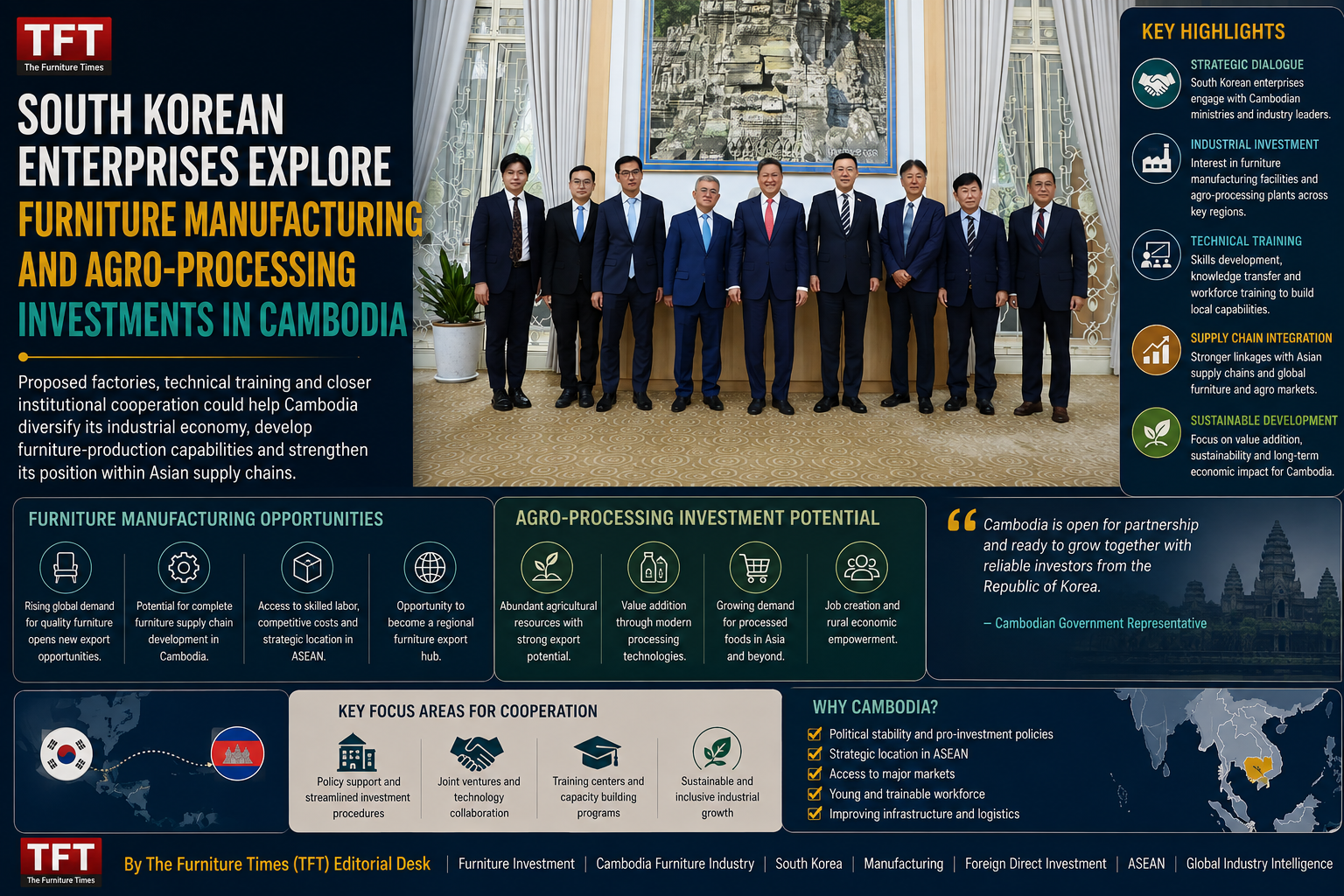
South Korean Enterprises Explore Furniture Manufacturing and Agro-Processing Investments in Cambodia
Proposed factories, technical training and closer institutional cooperation could help Cambodia diversify its industrial economy, develop furniture-production capabilities and strengthen its position within Asian supply chains
By The Furniture Times (TFT) Editorial Desk | Furniture Investment | Cambodia Furniture Industry | South Korea | Manufacturing | Foreign Direct Investment | ASEAN | Global Industry Intelligence
Cambodia’s ambition to diversify beyond its traditional manufacturing base could receive an important boost as South Korean enterprises explore new investments in furniture manufacturing and agricultural processing.
The emerging investment interest was discussed during a bilateral meeting held on 17 August 2026 between Cambodia’s Deputy Prime Minister and First Vice President of the Council for the Development of Cambodia, Sun Chanthol, and a delegation from the Incheon Chamber of Commerce and Industry led by its president, Park Joo-bong.
According to a report published by Construction & Property News, South Korean businesses are examining the possibility of establishing furniture-manufacturing and agro-processing operations in Cambodia. The Cambodian government has indicated that it is prepared to facilitate the proposed projects and support the development of the technical workforce required by incoming investors. Construction & Property News
The discussions do not yet represent a final announcement of specific factories, investment values, production capacities or locations. Nevertheless, the stated interest is strategically significant.
Furniture manufacturing could help Cambodia move further into value-added production while creating demand across timber processing, panels, upholstery, hardware, foam, packaging, logistics, design, testing, installation and vocational training.
For South Korean enterprises, Cambodia may offer access to a young workforce, an emerging industrial base, investment incentives and regional trade connections. For Cambodia, the investment could provide employment, technical knowledge, supplier development and a path towards greater participation in the Asian furniture economy.
The opportunity, however, will depend on execution.
Investment proposals must be converted into viable factories, trained employees, responsible material supply chains, market-ready products and sustainable commercial relationships.
Bilateral Meeting Brings Furniture Manufacturing Into Focus
The August meeting brought together Cambodia’s principal investment-development institution and representatives of an important South Korean commercial organisation.
The Incheon Chamber of Commerce and Industry represents enterprises connected to one of South Korea’s most important industrial and logistics regions. Incheon’s proximity to Seoul, its international airport, major port facilities and established manufacturing base give its business community strong connections to regional and international markets.
According to the original report, Park Joo-bong said previous Cambodian investment-promotion activities in South Korea had attracted considerable interest from the country’s business community.
The report also stated that 38 South Korean media organisations had covered Cambodia’s economic potential and investment environment. This increased visibility reportedly encouraged prominent businesses to investigate industrial and agricultural opportunities in the Kingdom.
This is an important reminder that investment attraction does not begin when a company submits a factory proposal.
It begins much earlier through:
- International visibility
- Government outreach
- Business delegations
- Media coverage
- Investment forums
- Industry intelligence
- Site visits
- Trade agreements
- Local partnership development
- Confidence in regulatory institutions
Countries competing for foreign direct investment must first become visible and understandable to decision-makers.
Cambodia appears to be using investment promotion, government-to-business dialogue and institutional partnerships to present itself as an alternative manufacturing location in Southeast Asia.
What Has Been Announced—and What Remains Undetermined
The reported development should be understood as an expression of investment interest rather than confirmation that named factories are already under construction.
At the time of the report, important details had not been publicly specified, including:
- Names of the participating corporations
- Total proposed investment value
- Number of furniture factories
- Factory locations
- Special Economic Zones under consideration
- Production capacity
- Intended furniture categories
- Export destinations
- Construction timetable
- Expected employment
- Material-sourcing strategy
- Ownership or joint-venture structure
- Environmental approvals
- Final investment-registration status
These details will determine the eventual economic importance of the proposals.
A furniture plant producing components for export would create a different industrial impact from a complete furniture factory serving domestic and international customers. A large automated operation would also require a different workforce and supplier base from a labour-intensive upholstery facility.
Investors and industry observers should therefore distinguish between three stages:
- Investment interest – businesses examine market conditions and possible projects.
- Investment approval – authorities formally register or approve a defined project.
- Operational investment – land, capital, machinery, employment and production are placed into active use.
The latest discussion is important because it may initiate this journey, but the full outcome will become clear only after individual projects advance through those stages.
Why Cambodia Is Seeking More Industrial Investment
Cambodia’s modern export economy has historically depended heavily on garments, footwear and travel goods.
Those sectors created employment and integrated the country into international supply chains. However, reliance on a limited number of industries can expose an economy to changes in consumer demand, trade preferences, labour costs and sourcing strategies.
Industrial diversification can reduce that concentration.
Furniture manufacturing could become part of a broader Cambodian effort to attract investment in:
- Furniture and wood-based products
- Electronics
- Automotive components
- Machinery
- Food processing
- Packaging
- Construction materials
- Household products
- Renewable-energy components
- Logistics and distribution
The objective is not necessarily to replace existing industries. It is to build a wider manufacturing economy with more products, capabilities and levels of technical sophistication.
Furniture is particularly relevant because it connects industrial and consumer markets.
A furniture factory may serve:
- Residential retailers
- Hotels and resorts
- Restaurants
- Offices
- Schools
- Healthcare facilities
- Property developers
- Construction projects
- Export wholesalers
- Online marketplaces
- Government procurement
- Short-term rental operators
Cambodia’s construction, urban development, hospitality and tourism sectors can generate domestic demand, while regional agreements may help manufacturers reach external markets.
Why Furniture Manufacturing Matters for Industrial Diversification
Furniture manufacturing is sometimes misunderstood as a single production activity.
In reality, it is an industrial ecosystem.
A complete furniture supply chain can involve:
- Timber and engineered panels
- Veneers and laminates
- Metal tubing and fabrication
- Aluminium components
- Foam and cushioning
- Textiles and leather
- Sewing and upholstery
- Adhesives and coatings
- Hinges and drawer slides
- Fasteners and connectors
- Castors and mechanisms
- Glass, stone and ceramics
- Electrical components
- Packaging materials
- Machinery maintenance
- Product photography
- Warehousing
- Freight forwarding
- Quality testing
- Product design
- Installation and after-sales service
A successful foreign investment can therefore stimulate activity beyond the factory gate.
Local businesses may begin by providing simple inputs, transport or packaging. Over time, some can progress into specialised components, tooling, maintenance, testing, design and logistics.
This is how foreign direct investment can contribute to economic upgrading: not only by employing workers but by creating capabilities that spread into the wider economy.
The strongest outcome for Cambodia would be the development of a domestic supplier network able to serve South Korean investors and eventually compete for other international customers.
What South Korean Furniture Investors Could Bring
South Korea has a sophisticated consumer economy, advanced manufacturing expertise and a strong design culture.
South Korean companies have experience in combining manufacturing with:
- Automation
- Digital production management
- Quality assurance
- Product engineering
- Compact-space design
- Modular furniture
- Smart-home integration
- E-commerce
- Export packaging
- Brand development
- Contemporary lifestyle marketing
If investors transfer part of these capabilities into Cambodia, the impact could extend beyond low-cost assembly.
Cambodian facilities could potentially develop expertise in:
- Panel furniture
- Ready-to-assemble furniture
- Upholstered seating
- Beds and bedroom furniture
- Dining furniture
- Office furniture
- Hotel and project furniture
- Kitchen systems
- Storage products
- Wooden components
- Furniture accessories
- Smart or electrically enabled furniture
The exact categories have not been announced. However, South Korean investment could bring production systems, technical supervision, buyer relationships and access to established supply networks.
The long-term value will depend on how much activity remains local.
If a factory imports nearly every component and performs only basic assembly, the domestic value created may be limited. If it trains workers, purchases local inputs, develops Cambodian suppliers and establishes product-development functions, the economic benefits could be considerably larger.
Cambodia’s Potential Advantages as a Furniture-Manufacturing Location
Cambodia may appeal to international furniture investors for several interconnected reasons.
Strategic position in Southeast Asia
Cambodia is located between major regional production and consumer markets. It shares borders with Thailand, Vietnam and Laos and has access to maritime trade through its ports.
This position can support regional sourcing and distribution, although actual competitiveness depends on transport costs, border efficiency and logistics reliability.
Participation in regional trade frameworks
Cambodia and South Korea are connected through the Cambodia–Korea Free Trade Agreement, the ASEAN–Korea Free Trade Area and the Regional Comprehensive Economic Partnership.
The Cambodia–Korea Free Trade Agreement entered into force on 1 December 2022. The wider ASEAN–Korea framework covers trade in goods, services and investment, while RCEP connects Cambodia and South Korea with other major Asia-Pacific economies.
ASEAN describes South Korea as one of the region’s important economic partners. In 2024, South Korea was ASEAN’s fifth-largest trading partner and seventh-largest source of foreign direct investment, with two-way trade of approximately US$208 billion and Korean FDI inflows into ASEAN of around US$7.5 billion. ASEAN–Korea Economic Relations
Trade agreements do not automatically make every product tariff-free. Manufacturers must still comply with applicable tariff schedules, rules of origin and customs requirements. Nevertheless, these frameworks create an important institutional foundation.
Growing industrial zones
Cambodia has continued to expand its Special Economic Zone network, creating locations intended to support manufacturing investment through industrial land, infrastructure, administrative services and links to transport corridors.
For furniture investors, a suitable zone may offer:
- Reliable electricity
- Road access
- Water and wastewater systems
- Customs support
- Worker access
- Warehousing
- Container handling
- Investment facilitation
However, individual zones differ considerably. Investors must assess actual infrastructure rather than relying only on general promotional claims.
Young labour force
Cambodia has a relatively young population capable of supporting labour-intensive and increasingly technical manufacturing.
The challenge is to match the workforce with the precise skills furniture factories require.
Competitive operating environment
Labour and operating costs may be lower than in more mature Northeast Asian manufacturing locations. Yet cost alone will not be enough.
Furniture buyers increasingly require reliability, compliance, traceability, safety and consistent quality. Cambodia must compete through a complete production proposition, not only wages.
Domestic development and hospitality demand
Cambodia’s hotels, resorts, housing developments, restaurants, offices and public infrastructure generate potential demand for furniture.
A manufacturer serving both domestic projects and export customers may be able to diversify its sales base, although local project markets can be price-sensitive and cyclical.
The Technical Training Centre Could Be the Most Important Part of the Proposal
One of the most consequential elements of the discussion is the proposed establishment of a technical training centre in Cambodia.
According to the source report, the Incheon Chamber of Commerce and Industry plans to create the centre through cooperation involving Cambodia’s Ministry of Labour and Vocational Training and the National Polytechnic Institute of Cambodia. The parties are expected to formalise the initiative through a memorandum of understanding. Construction & Property News
This proposal addresses a central challenge facing emerging manufacturing destinations: investors may find workers, but not always workers with the required technical preparation.
Furniture production needs much more than general labour.
A training centre supporting the sector may need programmes in:
- Furniture-machine operation
- CNC machining
- Cutting optimisation
- Panel processing
- Joinery
- Welding and metal fabrication
- Upholstery cutting and sewing
- Foam preparation
- Spray finishing
- Coating safety
- Electrical-mechanism assembly
- Quality inspection
- Technical drawing
- Computer-aided design
- Production planning
- Machine maintenance
- Packaging engineering
- Workplace safety
- Lean manufacturing
- Export documentation
- Supervisory management
Without trained technicians, investors may depend heavily on expatriate staff or limit local employees to lower-skilled roles.
A well-designed training centre could help Cambodia build a progression from operator to technician, supervisor, production manager, engineer and product developer.
That progression is essential if the country wants industrial investment to create long-term human capital rather than only short-term employment.
Training Must Be Connected to Actual Factory Requirements
Creating a training facility is not enough.
The curriculum must be designed around confirmed industry needs.
Furniture companies should help define:
- Machinery used in proposed plants
- Required technical competencies
- Production tolerances
- Quality-control methods
- Safety procedures
- Digital systems
- Maintenance needs
- Language requirements
- Supervisory capabilities
- Certification expectations
Training should include practical equipment, industry placements and measurable competency standards.
A programme that teaches general theory without exposure to factory machinery will not solve the investor’s labour problem.
A stronger model could include:
- Classroom instruction at the polytechnic institution.
- Practical training using industry-standard machinery.
- Factory-based apprenticeships.
- Assessment by educational and industry representatives.
- Recognised competency certification.
- Continuing training after employment.
- Progression into supervisory and specialist roles.
The centre could initially serve South Korean investors but should ultimately build skills transferable across Cambodia’s wider manufacturing economy.
The Opportunity to Build a Cambodian Furniture Supplier Base
Foreign factories often begin with imported materials because established suppliers already meet their standards.
Cambodia’s long-term objective should be gradual localisation where commercially and environmentally viable.
Potential local supply opportunities could include:
- Cartons and protective packaging
- Wooden pallets
- Labels and printed materials
- Foam conversion
- Basic sewn upholstery components
- Metal brackets
- Simple hardware
- Timber components from verified sources
- Warehousing
- Domestic transport
- Installation
- Maintenance services
- Photography and digital catalogues
As quality improves, Cambodian suppliers may move into more demanding categories.
This process will require:
- Clear specifications
- Supplier-development programmes
- Access to finance
- Testing facilities
- Production equipment
- Quality-management systems
- Reliable delivery
- Material traceability
- Technical mentorship
South Korean lead firms could support local suppliers by sharing specifications, conducting audits and providing improvement plans.
The government could complement this through industrial-extension services, testing infrastructure and financing support for small and medium-sized enterprises.
A furniture factory should not remain an isolated foreign-owned production island. It should become an anchor around which a broader Cambodian furniture economy can grow.
Raw-Material Sourcing Will Require Careful Management
Furniture manufacturing raises an unavoidable question: where will the materials come from?
Wood-based furniture requires a lawful, traceable and commercially dependable timber supply. Upholstered and metal furniture require different inputs, many of which may initially be imported.
Investors must develop sourcing strategies covering:
- Legal timber origin
- Chain of custody
- Species identification
- Moisture content
- Engineered-panel emissions
- Chemical compliance
- Textile performance
- Foam safety
- Metal quality
- Coating restrictions
- Packaging requirements
- Customer sustainability policies
Cambodia must avoid positioning furniture investment as an opportunity for uncontrolled timber extraction.
The country will gain more sustainable value through efficient material use, verified legal sourcing, plantation resources, engineered materials and responsible supply-chain management.
Factories targeting regulated markets may encounter requirements concerning:
- Timber legality
- Deforestation risk
- Formaldehyde emissions
- Restricted chemicals
- Product safety
- Packaging waste
- Carbon reporting
- Labour conditions
- Environmental management
Supply-chain traceability should therefore be designed before production begins.
It should not be treated as an administrative exercise added after buyers raise concerns.
Product Quality Will Determine Whether Cambodia Can Move Beyond Contract Assembly
New manufacturing destinations can attract initial orders through price, but repeat business depends on quality.
Furniture quality involves many variables:
- Dimensional accuracy
- Structural stability
- Joint strength
- Surface consistency
- Colour matching
- Upholstery alignment
- Stitch quality
- Foam density
- Drawer and door movement
- Hardware performance
- Load capacity
- Moisture control
- Packaging protection
- Assembly accuracy
A product may look acceptable at the end of the factory line but fail during transport, installation or use.
Factories will therefore need quality systems covering:
- Incoming-material inspection
- In-process checks
- Final product inspection
- Batch identification
- Testing schedules
- Calibration
- Non-conformance management
- Corrective action
- Complaint analysis
- Supplier quality control
- Production traceability
South Korean investors may introduce established systems, but Cambodian employees must be trained to operate and improve them.
The country’s reputation will be shaped not by one factory’s opening ceremony but by the reliability of the products shipped over many years.
Furniture Testing and Certification Infrastructure Will Be Essential
Furniture exported to international markets must often comply with buyer specifications and destination-country standards.
Depending on the product and market, testing may cover:
- Chair strength and durability
- Table stability
- Storage-unit safety
- Bed performance
- Bunk-bed hazards
- Upholstery flammability
- Mattress requirements
- Formaldehyde emissions
- Surface resistance
- Corrosion resistance
- Electrical safety
- Children’s furniture safety
- Tip-over prevention
- Chemical restrictions
If Cambodia lacks recognised local testing capacity, samples may need to be sent abroad. That increases cost and delays product development.
A growing furniture industry would benefit from:
- Accredited testing laboratories
- Trained quality engineers
- Standardised testing equipment
- Certification advisory services
- Calibration providers
- Material-analysis capability
- Regulatory intelligence
Testing infrastructure can serve both foreign investors and domestic manufacturers.
It also helps shift competition from “lowest price” towards measurable product performance.
South Korean Design and Cambodian Production Could Create New Market Opportunities
The most valuable cooperation may emerge when South Korean design capability combines with Cambodian manufacturing development.
South Korean lifestyle products have gained international recognition through the wider influence of Korean culture, media, beauty, fashion, technology and design.
Furniture brands may be able to translate this influence into products characterised by:
- Clean contemporary styling
- Compact urban dimensions
- Multifunctional use
- Neutral colour palettes
- Modular arrangements
- Digital-lifestyle compatibility
- Efficient storage
- Younger consumer positioning
Cambodia could provide the production platform, while South Korean companies contribute design, engineering, quality systems and market access.
Over time, collaboration should also include Cambodian designers.
A sustainable industrial relationship should not position Cambodia permanently as a silent manufacturing location. It should help the country develop its own design capabilities, brands and cultural expressions.
Joint collections could explore:
- Cambodian materials
- Khmer craft traditions
- Korean production engineering
- Contemporary Asian lifestyles
- Hospitality design
- Tropical-climate requirements
- Compact urban housing
- Sustainable materials
This could produce furniture with a more distinctive identity than generic contract manufacturing.
Hospitality and Property Development Could Create a Domestic Market
Cambodia’s tourism and property sectors create a natural connection to furniture manufacturing.
Hotels, resorts, serviced apartments, restaurants, cafés, offices and residential developments all require furniture. Local production could potentially reduce lead times, simplify customisation and improve replacement support.
Possible domestic market categories include:
- Hotel guest-room furniture
- Restaurant seating
- Resort outdoor furniture
- Apartment furniture packages
- Office desks and seating
- Retail fixtures
- School furniture
- Healthcare furniture
- Public-space furniture
- Short-term rental furniture
South Korean companies entering Cambodia may initially focus on exports, but domestic project demand could provide additional opportunities.
Local production can be particularly valuable for hospitality properties because project furniture often requires:
- Custom dimensions
- Coordinated finishes
- Installation
- Replacement units
- Fast defect correction
- Small repeat orders
- On-site measurement
- Local after-sales service
The investment could therefore connect manufacturing with Cambodia’s construction and tourism economy.
Agro-Processing and Furniture Manufacturing May Share Industrial Infrastructure
Furniture and agricultural processing appear to be separate industries, but the two can share parts of an industrial-development strategy.
Both require:
- Reliable power
- Water and waste management
- Transport infrastructure
- Packaging
- Warehousing
- Quality control
- Technical training
- Export logistics
- Industrial machinery
- Maintenance services
- International certification
Agriculture may also produce materials with potential furniture or interior applications.
Examples could include:
- Bamboo
- Rattan
- Agricultural fibres
- Rice husk composites
- Coconut-based materials
- Natural woven materials
- Biomass-derived board products
- Plant-based packaging
Not every agricultural residue is immediately suitable for furniture production. Material development requires testing for strength, moisture resistance, emissions, durability and manufacturability.
Nevertheless, the simultaneous interest in furniture and agro-processing opens an opportunity for research into bio-based materials and circular manufacturing.
Cambodia could investigate whether agricultural by-products can be converted into panels, fillers, composites, packaging or energy for industrial use.
This would require collaboration among factories, research institutions, universities and material-technology companies.
Logistics Could Strengthen—or Undermine—the Investment Case
Furniture is expensive to transport relative to its value because many products occupy considerable space.
A sofa may not be extremely heavy, but it consumes substantial container volume. Dining tables and cabinets can also be vulnerable to scratches, impact and moisture.
Cambodia’s competitiveness will depend partly on:
- Factory distance from ports and borders
- Road reliability
- Container availability
- Customs efficiency
- Port performance
- Freight rates
- Consolidation services
- Packaging expertise
- Export-document accuracy
- Transit times
Manufacturers can reduce logistics costs through product and packaging design.
Potential strategies include:
- Knock-down construction
- Flat-pack formats
- Stackable products
- Detachable arms and legs
- Modular upholstery
- Efficient carton dimensions
- Protective corner systems
- Container-loading optimisation
- Packaging tests
Furniture should be engineered for the entire journey—not only for the showroom.
If a product reaches its customer damaged, the manufacturing effort has failed regardless of how well it left the production line.
Special Economic Zones Must Match Furniture’s Operational Needs
Special Economic Zones can simplify investment, but furniture factories have specific requirements.
Before selecting a location, investors should examine:
- Land and building costs
- Electricity price and stability
- Fire-protection infrastructure
- Ventilation requirements
- Wastewater treatment
- Dust collection
- Chemical storage
- Worker transport
- Distance to suppliers
- Port and border access
- Expansion capacity
- Customs services
- Local labour availability
Woodworking facilities generate dust and combustible waste. Finishing operations may involve chemicals, emissions and fire risks. Upholstery plants need material storage and efficient internal movement. Metal production requires different machinery and safety controls.
A zone suitable for garment production is not automatically suitable for every type of furniture manufacturing.
Project assessment should therefore be based on the actual manufacturing process.
Environmental and Social Responsibility Must Be Designed Into New Factories
New investment creates employment, but responsible industrial development requires protection for workers, communities and natural resources.
Furniture factories may face environmental issues involving:
- Wood dust
- Solvents
- Coatings
- Adhesives
- Wastewater
- Offcuts
- Foam waste
- Textile waste
- Packaging
- Noise
- Energy use
- Fire safety
They also face social responsibilities concerning:
- Fair recruitment
- Working hours
- Occupational safety
- Chemical exposure
- Protective equipment
- Worker accommodation
- Freedom from harassment
- Skills progression
- Grievance systems
- Equal opportunity
Investors should implement environmental and social management systems from the start.
Factories can also improve material efficiency through:
- Cutting optimisation
- Offcut reuse
- Foam recycling
- Textile segregation
- Solvent recovery
- Water-based coatings
- Reusable transport packaging
- Energy-efficient machinery
- Dust collection and biomass management
- Repair and refurbishment systems
Cambodia has an opportunity to build newer facilities around modern expectations instead of repeating outdated industrial practices.
What the Cambodian Government Must Deliver
Cambodia’s willingness to facilitate foreign investors is important, but facilitation must be transparent and effective.
Government priorities should include:
- Predictable investment procedures
- Timely project approvals
- Clear land documentation
- Reliable infrastructure
- Transparent taxation
- Customs efficiency
- Skills-development coordination
- Labour-law clarity
- Environmental enforcement
- Intellectual-property protection
- Commercial dispute resolution
- Protection against unofficial costs
- Consistent communication
Investors often compare multiple countries before making a final decision.
Cambodia may be assessed against Vietnam, Thailand, Indonesia, Malaysia and other emerging manufacturing locations. Each offers different combinations of costs, infrastructure, skills, supplier depth and market access.
A promotional campaign may attract an initial delegation. The quality of institutions determines whether the delegation returns with capital.
What South Korean Investors Must Commit To
The responsibilities do not rest only with Cambodia.
South Korean investors should bring more than orders and machinery.
A high-quality investment should commit to:
- Formal employment
- Safe working conditions
- Technical training
- Local management development
- Environmental responsibility
- Supplier development
- Transparent material sourcing
- Product safety
- Technology transfer
- Long-term commercial engagement
Short-term investment based only on temporary cost advantages can leave limited benefits when market conditions change.
The strongest investment partnerships create shared capacity.
Cambodian workers should be able to acquire skills that remain valuable beyond one employer. Local suppliers should become more competitive. Educational institutions should gain updated curricula. Managers and engineers should develop capabilities that support the wider economy.
That is how foreign direct investment becomes industrial development.
The Role of Media Visibility in Attracting Investment
The report’s reference to coverage by 38 South Korean media organisations deserves attention.
Investment decisions are influenced by visibility.
A country may offer competitive costs and incentives, but if investors cannot find credible information about its industries, workforce, infrastructure and institutions, it may never enter the shortlist.
Media coverage can help explain:
- Investment opportunities
- Policy reforms
- Industrial zones
- Workforce programmes
- Existing investor experiences
- Infrastructure development
- Trade advantages
- Sector potential
- Government commitments
However, publicity must remain credible.
Investors require more than promotional claims. They need evidence, data, site access and direct engagement with existing businesses.
The furniture industry has the same visibility challenge.
Many capable manufacturers remain absent from international consideration because they are difficult to discover online, poorly documented or unable to communicate their capabilities.
Cambodia’s future furniture sector will need strong visibility through trade media, search platforms, directories, exhibitions and verified company profiles.
Cambodia Could Become a New Furniture-Sourcing Destination
If the proposed South Korean investments advance, Cambodia could gradually become a more visible furniture-sourcing destination.
This will not happen immediately.
Established furniture hubs have decades of supplier development, machinery investment, specialist labour, design knowledge, logistics networks and buyer relationships.
Cambodia must build its reputation step by step.
The country could initially focus on categories aligned with available skills and investment:
- Standardised furniture components
- Upholstery operations
- Contract manufacturing
- Ready-to-assemble furniture
- Hospitality furniture
- Selected wood-based products
- Export packaging and assembly
As technical capacity develops, it could move towards:
- Original design
- Smart furniture
- Complex project furniture
- Branded collections
- Advanced materials
- Product development
- Regional distribution
Industrial destinations become credible when buyers can visit multiple suppliers, inspect production, access professional services and complete orders efficiently.
Furniture manufacturing investment could therefore contribute to Cambodia’s future potential as a furniture-tourism and sourcing destination, particularly for South Korean and ASEAN buyers.
Key Risks That Could Delay the Opportunity
The proposed investment direction is promising, but several risks must be addressed.
Skills mismatch
Factories may struggle to recruit technicians, machine operators, supervisors and quality professionals.
Limited supplier depth
Dependence on imported components can increase lead times and production costs.
Logistics costs
Furniture’s volume makes transport efficiency critical.
Material traceability
Wood and panel sourcing must comply with buyer and destination-market requirements.
Energy reliability
Production interruptions can affect machinery, schedules and product quality.
Regulatory uncertainty
Unexpected procedural or cost changes can discourage long-term investment.
Quality inconsistency
Early export failures could damage Cambodia’s reputation as a sourcing location.
Environmental compliance
Poor dust, chemical, waste or wastewater management could create serious operational and reputational problems.
Overdependence on one investor group
Cambodia should welcome South Korean investment while developing a diversified international and domestic industrial base.
Failure to convert interest into projects
Business delegations and memoranda create momentum, but they do not themselves create factories or jobs.
Success should be measured through operating projects, trained workers, export performance and local supplier participation.
A Practical Roadmap for Turning Interest Into Industry
The investment dialogue could be advanced through a structured roadmap.
Stage One: Define the projects
Participating businesses should identify product categories, investment values, sites, machinery, workforce requirements and target markets.
Stage Two: Complete feasibility studies
Studies should examine logistics, electricity, land, materials, labour, taxation, market access and environmental requirements.
Stage Three: Build the skills partnership
The proposed training centre should develop curricula around confirmed factory needs and begin instructor preparation.
Stage Four: Develop suppliers
Cambodian companies should be mapped and assessed for packaging, components, transport, maintenance and other services.
Stage Five: Establish compliance systems
Product standards, material traceability, environmental management and occupational safety should be integrated into factory design.
Stage Six: Launch pilot production
Initial lines can validate employee skills, supplier quality, logistics performance and buyer requirements.
Stage Seven: Expand localisation
Successful operations can gradually increase domestic sourcing and management participation.
Stage Eight: Build Cambodia’s furniture identity
The country should promote verified manufacturers, capabilities, investment success stories and sourcing opportunities internationally.
This progression would allow the partnership to move from diplomatic discussion to a measurable industrial programme.
A Strategic Opening for Cambodia’s Furniture Economy
The reported South Korean interest arrives at an important moment.
Furniture companies worldwide are reassessing supply chains, production costs, market access and concentration risk. Many are searching for additional manufacturing locations capable of supporting cost competitiveness without sacrificing quality or compliance.
Cambodia is not yet one of Asia’s largest furniture-production centres. That may be precisely why the opportunity deserves attention.
The country can build new capacity around emerging requirements rather than relying entirely on legacy systems. It can connect investment with vocational education, digital production, responsible sourcing, testing and modern logistics.
South Korean enterprises could act as early anchors.
Their investments may help Cambodia develop technical employees, local suppliers and new export capabilities. But these benefits are not guaranteed. They depend on the design of the projects, the quality of training, the depth of localisation and the commitment of both public and private institutions.
Furniture manufacturing should not be treated simply as another factory category.
It is a gateway into a broad industrial ecosystem connecting materials, engineering, design, construction, property development, hospitality, retail, logistics and international trade.
For Cambodia, the opportunity is larger than producing furniture at a competitive cost.
It is an opportunity to build furniture knowledge, manufacturing credibility and a recognisable position within the global furniture industry ecosystem.
TFT Analysis
The discussions between the Council for the Development of Cambodia and the Incheon Chamber of Commerce and Industry represent a promising step, but the furniture industry should watch what happens next.
The decisive indicators will include:
- Named investors
- Approved projects
- Committed capital
- Factory locations
- Employment targets
- Product categories
- Training-centre implementation
- Export markets
- Local supplier participation
- Production commencement
If these elements materialise, the partnership could mark an important stage in Cambodia’s movement towards more diversified and technically capable manufacturing.
It could also demonstrate a wider principle for emerging economies: foreign direct investment becomes most valuable when it is connected to education, local enterprise development and industrial capability.
Cambodia has the workforce potential. South Korea has manufacturing experience, technology and market connections. The proposed technical training centre could help connect the two.
The opportunity now is to convert interest into infrastructure, skills, products and sustainable employment.
The furniture industry ecosystem is a $1 trillion industry ecosystem. Cambodia has an opportunity to claim a larger place within it.
