The Middle East’s Growing Holiday-Home Furniture Opportunity
Examining Premium Apartments, Villas, Tourism Projects and Professionally Managed Rentals
By The Furniture Times (TFT) Editorial Desk | Airbnb & Homestay Furniture | Middle East | Holiday Homes | Hospitality Furniture | Property Development | Global Market Intelligence
The Middle East is developing one of the world’s most ambitious tourism, hospitality and furnished-residential economies.
Across the United Arab Emirates, Saudi Arabia, Qatar, Oman, Bahrain, Türkiye, Egypt and Jordan, governments and private investors are building destinations designed to attract international visitors, domestic travellers, business guests, families, religious tourists, sports audiences and affluent long-stay residents.
This expansion is creating demand for much more than conventional hotel furniture.
Premium apartments, branded residences, serviced apartments, resort villas, licensed holiday homes, desert retreats, coastal properties and professionally managed short-term rentals all require complete furnishing packages. Beds, mattresses, sofas, dining tables, workstations, outdoor lounges, pool furniture, storage, lighting and decorative products form the physical infrastructure of these properties.
The market is particularly attractive because many Middle Eastern destinations compete through quality, space, design and experience rather than accommodation volume alone. Guests paying premium nightly rates expect furniture that appears sophisticated in photographs, feels comfortable in person and remains in excellent condition.
For manufacturers and suppliers, however, the opportunity is demanding. Products must withstand heat, sunlight, dust, humidity, air-conditioning and intensive use. They must meet licensing and safety expectations, support large family groups and remain serviceable after installation.
The Middle East’s holiday-home furniture opportunity is therefore not simply a luxury-furniture story. It is an emerging contract-furnishing, property-development and operational-services market.
Tourism Diversification Is Creating Furniture Demand
Tourism has become a central part of economic-diversification strategies across the Middle East.
UN Tourism describes the Middle East as one of the world’s fastest-growing tourism regions, with investment helping countries diversify their economies, generate employment and build new destinations. UN Tourism
The region’s accommodation expansion involves:
- Hotels
- Serviced apartments
- Holiday homes
- Resort residences
- Branded residences
- Luxury villas
- Rural and heritage stays
- Religious-tourism accommodation
- Desert camps
- Coastal resorts
- Wellness retreats
- Event-related rentals
Furniture demand follows every stage of that development.
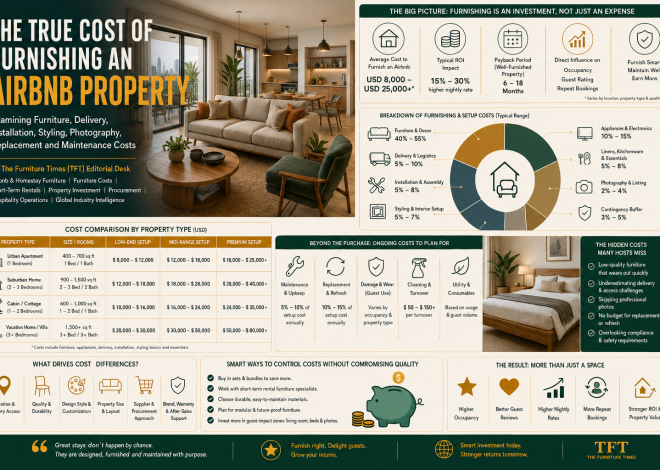
New projects require initial furnishing. Existing properties need maintenance and refurbishment. Professionally managed portfolios require standardisation and rapid replacement. Luxury accommodation needs periodic design updates to remain competitive.
The overall opportunity therefore includes both new construction and the recurring furniture lifecycle.
Why Holiday-Home Furniture Is a Distinct Category
Middle Eastern holiday-home furniture sits between residential and hotel furnishing.
It must look residential because guests expect privacy, warmth and a sense of home. It must perform commercially because many different people will use it throughout the year.
The category requires:
- Premium visual presentation
- Hospitality-level durability
- Climate-resistant materials
- Efficient cleaning
- Strong structural performance
- Large-family functionality
- Flexible sleeping capacity
- Fast replacement
- Reliable installation
- Consistent quality
- Clear warranties
- Locally available support
A sofa intended for a private household may not tolerate continuous guest turnover. A conventional hotel desk may not suit a premium villa. Highly delicate luxury furniture may look impressive but become expensive to maintain.
The design opportunity lies in combining residential elegance with commercial practicality.
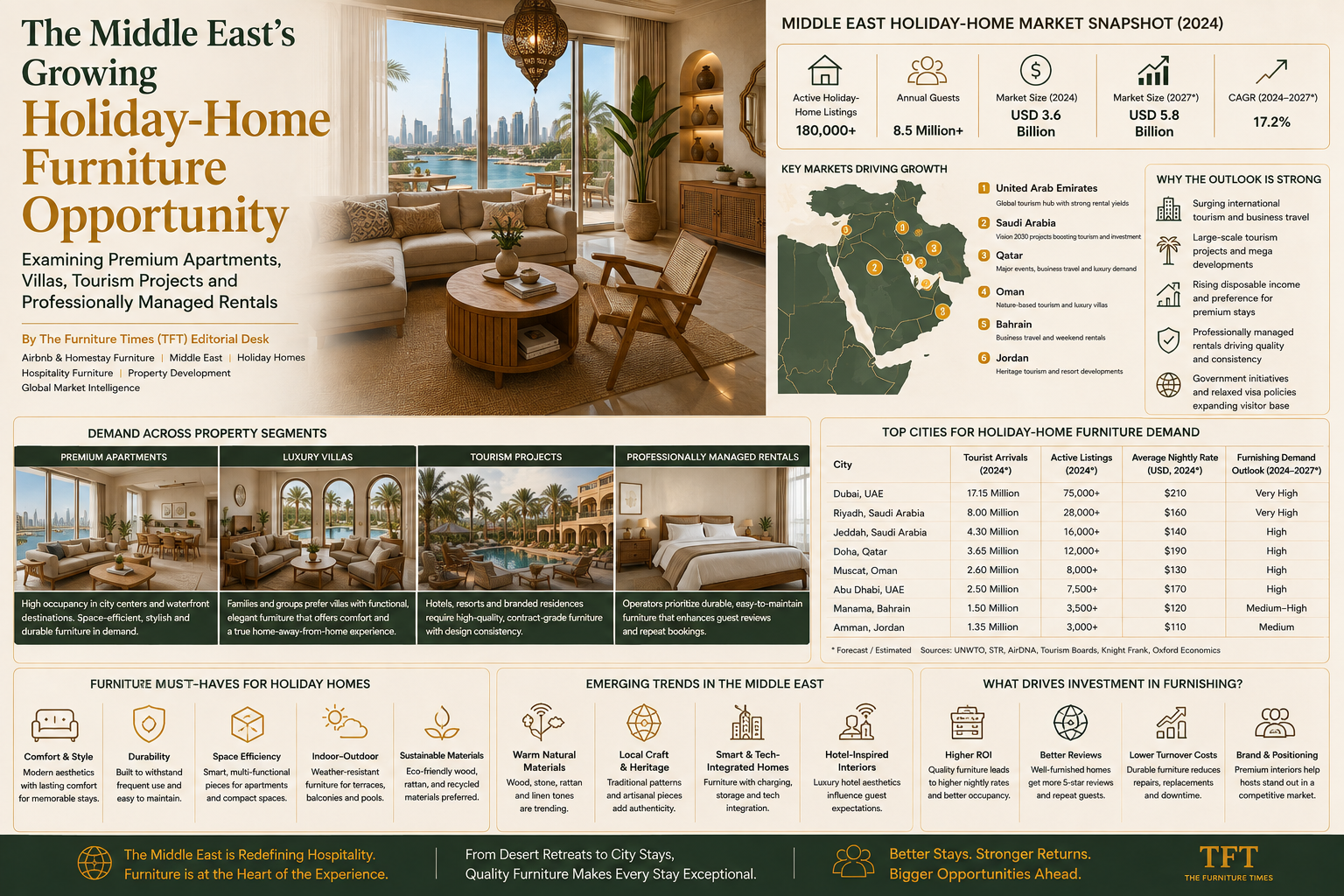
The Regional Opportunity Map
| Market | Accommodation Profile | Main Furniture Opportunity |
|---|---|---|
| United Arab Emirates | Premium apartments, villas, branded residences and licensed holiday homes | Turnkey packages, luxury interiors and rapid replacement |
| Saudi Arabia | Tourism projects, religious travel, urban apartments and new destinations | Large-volume project furnishing and locally relevant design |
| Qatar | Serviced residences, business travel and premium apartments | High-quality apartment packages and portfolio standardisation |
| Oman | Coastal resorts, villas, mountain retreats and heritage stays | Outdoor furniture and locally inspired hospitality design |
| Bahrain | Business travel, weekend tourism and serviced apartments | Compact premium furnishing and flexible rental packages |
| Kuwait | Furnished apartments and regional business travel | Extended-stay furniture and premium residential durability |
| Egypt | Red Sea resorts, Mediterranean homes, Cairo apartments and heritage travel | Cost-efficient packages, outdoor furniture and refurbishment |
| Jordan | Amman apartments, Petra tourism and desert accommodation | Boutique furnishing, local craft and durable guest furniture |
| Türkiye | Coastal villas, city apartments and heritage properties | Large-scale manufacturing, outdoor products and refurbishment |
These markets should not be approached with one standard regional collection. Guest profile, climate, regulation, property type and purchasing power differ substantially.
United Arab Emirates: The Region’s Most Developed Holiday-Home Market
The United Arab Emirates—particularly Dubai—has one of the Middle East’s most mature professionally managed holiday-home economies.
Dubai’s market includes:
- Downtown apartments
- Marina residences
- Palm Jumeirah villas
- Beachfront condominiums
- Serviced residences
- Family holiday homes
- Business-travel apartments
- Luxury penthouses
- Desert properties
- Golf-community villas
Holiday-home operators in Dubai must register and obtain the appropriate approvals from the Department of Economy and Tourism. DET provides a formal process for licensing businesses that manage vacation rentals, helping distinguish the regulated sector from informal hosting. Dubai Department of Economy and Tourism
This regulatory structure creates a more professional furniture-buying environment.
Operators need complete, booking-ready interiors that meet presentation, safety and operational expectations.
Dubai’s Premium Apartment Opportunity
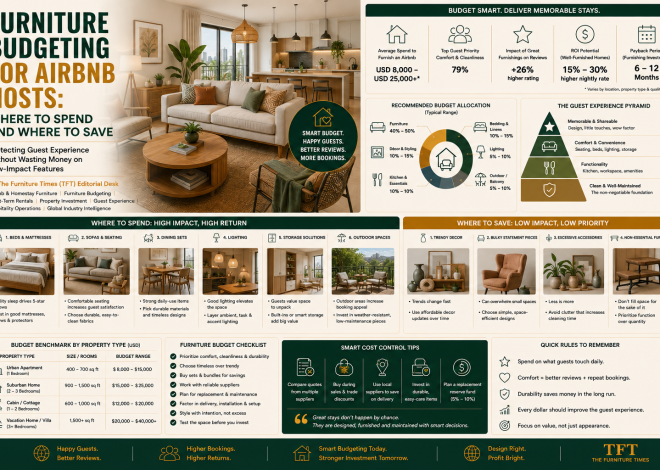
Dubai’s high-rise residential market creates strong demand for apartment furniture packages.
These properties often compete through views, location, building amenities and interior presentation. Furniture must strengthen the perceived value of the accommodation without overcrowding the apartment.
Product Requirements
- Compact sectional sofas
- Durable sofa beds
- Dining tables
- Upholstered dining chairs
- Premium mattresses
- Storage beds
- Work desks
- Luggage benches
- Balcony furniture
- Integrated charging
- Modular wardrobes
- Statement chairs
- Decorative lighting
The strongest furniture packages are visually distinctive enough to improve listing photographs but neutral enough to appeal to international guests.
A property serving travellers from Europe, Asia, Africa and the wider Middle East cannot depend too heavily on one narrow personal style.
Dubai Villas Create a Larger Furnishing Opportunity
Villa rentals require substantially more furniture than apartments.
A complete villa may need:
- Several bedroom packages
- Multiple living areas
- Large dining furniture
- Outdoor dining
- Poolside loungers
- Parasols
- Daybeds
- Bar furniture
- Children’s rooms
- Workspaces
- Entrance consoles
- Luggage furniture
- Staff-area furniture
Large villas are frequently booked by families and groups, making capacity planning essential.
A villa advertised for twelve guests must provide adequate seating, dining, storage and outdoor facilities for that number. Adding beds without supporting communal furniture creates an incomplete guest experience.
Climate Considerations
Dubai’s outdoor furniture must tolerate:
- Extreme UV exposure
- High surface temperatures
- Dust and sand
- Humidity
- Pool chemicals
- Occasional heavy rain
- Frequent cleaning
Heat-resistant surfaces, UV-stable fabrics, corrosion-resistant frames and quick-drying cushions are commercially important.
Abu Dhabi and the Wider UAE
Abu Dhabi’s opportunities include:
- Business accommodation
- Cultural tourism
- Saadiyat Island residences
- Yas Island properties
- Premium apartments
- Family villas
- Event-related stays
Ras Al Khaimah, Fujairah and other emirates add coastal, mountain and resort-style demand.
These markets require:
- Villa furnishing
- Outdoor living
- Resort-residence packages
- Family accommodation
- Durable coastal furniture
- Premium bedroom systems
Regional warehousing and installation capability can help suppliers serve multiple emirates efficiently.
Saudi Arabia: The Region’s Largest Development Opportunity
Saudi Arabia represents one of the Middle East’s most important long-term furniture opportunities because of the scale of its tourism and hospitality ambitions.
Tourism investment is connected to:
- Riyadh’s business and events economy
- Jeddah’s urban and coastal market
- Makkah and Madinah’s religious tourism
- AlUla’s cultural tourism
- Red Sea resorts
- NEOM
- Diriyah
- Entertainment destinations
- Domestic travel
- Serviced apartments
- Holiday homes
Saudi Arabia’s broader hospitality pipeline is enormous. Industry estimates have suggested the Kingdom could add hundreds of thousands of hotel rooms by 2030. Although hotel rooms are not equivalent to holiday homes, such expansion strengthens the surrounding procurement, manufacturing, logistics, design and workforce ecosystem from which short-term rentals will also benefit.
Red Sea Global’s official Vision 2030 project profile states that the completed destination is expected to include 50 hotels with approximately 8,000 rooms and 1,000 residential properties by 2030. Saudi Vision 2030
Those residential properties are especially relevant to the furniture industry because some may require villa-scale and premium residential furnishing rather than standard guestrooms.
Riyadh: Business Travel, Events and Furnished Apartments
Riyadh’s growth as a corporate, government, entertainment and events destination creates demand for professionally furnished apartments and villas.
Relevant furniture categories include:
- Premium bedroom packages
- Ergonomic workspaces
- Living-room furniture
- Dining sets
- Storage
- Sofa beds
- Luggage benches
- Longer-stay furniture
- Technology-integrated desks and nightstands
Guests may include consultants, executives, project teams, relocating families and event visitors. Their needs differ from short leisure stays.
Longer stays require more storage, better workspaces and comfortable daily-use furniture.
Jeddah: Coastal Living and Religious-Tourism Connections
Jeddah combines business travel, Red Sea tourism and its role as a gateway for religious visitors.
Furniture opportunities include:
- Serviced-apartment packages
- Family accommodation
- Coastal outdoor furniture
- Long-stay products
- Larger dining furniture
- Durable mattresses
- Moisture-resistant finishes
High humidity and coastal air require careful material selection, particularly for balconies, terraces and outdoor environments.
Makkah and Madinah: High-Volume Family Accommodation
Religious tourism creates accommodation demand with distinctive requirements.
Properties may host:
- Extended families
- Elderly travellers
- Multi-generational groups
- Longer stays
- Groups with substantial luggage
Furniture should prioritise:
- Strong beds
- High-quality mattresses
- Accessible layouts
- Sufficient dining
- Luggage storage
- Stable seating
- Easy-clean surfaces
- Flexible sleeping capacity
Accessibility and circulation are especially important. Furniture should not obstruct movement, and seating heights should support older guests.
The strongest opportunity is not necessarily decorative luxury. It is reliable, dignified and operationally efficient furniture capable of supporting high occupancy.
AlUla and Heritage Tourism
AlUla demonstrates how Saudi tourism can combine heritage with contemporary hospitality.
Accommodation projects in historic settings need furniture that reflects local architecture and materials without sacrificing modern comfort. Dar Tantora, for example, was created within historic mudbrick houses and combines traditional character with modern hospitality requirements. TIME
This creates opportunities for:
- Locally inspired furniture
- Artisan products
- Natural materials
- Custom joinery
- Woven elements
- Low-profile lounge furniture
- Heritage-sensitive lighting
- Premium mattresses
- Furniture designed for irregular spaces
The challenge is to avoid making cultural identity purely decorative. Local design should be supported by durable construction, material documentation and maintenance planning.
Qatar: Premium Residences and Business Accommodation
Qatar’s tourism and accommodation market expanded significantly around major global events and continues to develop through business travel, sports, exhibitions and stopover tourism.
The short-term and furnished-accommodation opportunity includes:
- Doha apartments
- Serviced residences
- Premium towers
- Waterfront properties
- Family villas
- Corporate accommodation
Furniture Priorities
- High-quality compact furniture
- Durable upholstery
- Premium mattresses
- Workstations
- Modular storage
- Dining furniture
- Balcony sets
- Consistent multi-unit packages
Qatar’s market is likely to favour professional operators, serviced accommodation and portfolio-level procurement rather than highly fragmented informal hosting.
Suppliers with contract experience, documentation and reliable after-sales service may be better positioned than general residential retailers.
Oman: Villas, Nature and Heritage Hospitality
Oman offers a different market proposition from the region’s high-rise urban centres.
Its opportunities include:
- Muscat apartments and villas
- Salalah holiday homes
- Coastal properties
- Mountain retreats
- Desert camps
- Heritage accommodation
- Nature-based tourism
Oman’s accommodation can communicate local identity through:
- Timber
- Woven materials
- Regional textiles
- Traditional patterns
- Natural colours
- Locally inspired furniture forms
Product Opportunities
- Outdoor dining
- Resort loungers
- Villa furniture
- Durable bedroom packages
- Desert-camp furniture
- Mountain-retreat furniture
- Locally crafted accent products
- Terrace and courtyard seating
Products must tolerate heat, dust and sometimes coastal humidity.
Furniture for remote destinations should also be repairable with locally available tools and components. Complex imported mechanisms may create long-term operational problems.
Bahrain: Business, Weekend and Serviced-Apartment Demand
Bahrain’s smaller geographic size does not eliminate its furnishing potential.
Its accommodation market benefits from:
- Business travel
- Regional weekend visitors
- Events
- Waterfront development
- Serviced apartments
- Furnished residences
Furniture opportunities include:
- Compact apartment packages
- Premium bedroom furniture
- Sofa beds
- Workstations
- Dining sets
- Balcony furniture
- Multi-unit standardisation
Because of the market’s size, fast delivery and dependable local stock may be more important than extensive customisation.
Kuwait: Extended-Stay and Furnished Residential Demand
Kuwait’s opportunity is more closely connected to business travel, expatriate accommodation, family visits and furnished residences than conventional leisure tourism.
This creates demand for furniture suited to longer stays:
- Larger wardrobes
- Comfortable sofas
- Durable dining furniture
- Ergonomic desks
- Premium mattresses
- Bedroom storage
- Family living-room packages
Suppliers should treat the market as an intersection of serviced apartments, corporate housing and premium residential furniture.
Durability and daily comfort may matter more than highly theatrical vacation styling.
Egypt: Scale, Heritage and Red Sea Tourism
Egypt combines one of the world’s most important cultural-tourism markets with major coastal destinations.
Important accommodation markets include:
- Cairo
- Giza
- Alexandria
- Sharm El-Sheikh
- Hurghada
- North Coast
- Luxor
- Aswan
- Red Sea resorts
The furniture opportunity ranges from budget homestays and urban apartments to premium resort villas.
Product Categories
- Cost-efficient bedroom packages
- Durable mattresses
- Sofa beds
- Family dining
- Outdoor furniture
- Poolside loungers
- Coastal materials
- Locally inspired furniture
- Heritage-property furniture
- Refurbishment
Egypt also has local furniture-manufacturing capabilities that can support domestic demand and reduce dependence on imports.
The market requires a wide price range. Suppliers should not assume that all Middle Eastern accommodation demand is luxury demand.
Jordan: Boutique Accommodation and Cultural Identity
Jordan’s tourism market includes:
- Amman apartments
- Petra accommodation
- Wadi Rum desert camps
- Dead Sea properties
- Aqaba coastal stays
- Rural and community tourism
Jordan offers strong opportunities for smaller-scale, locally distinctive accommodation.
Furniture can communicate identity through:
- Regional weaving
- Natural stone colours
- Timber
- Metalwork
- Traditional textiles
- Handcrafted tables
- Low lounge seating
Operational Requirements
- Durability
- Easy cleaning
- Repairability
- Compact transport
- Suitability for remote installation
- Climate resistance
- Stable bed construction
Furniture for desert accommodation must tolerate dust, temperature changes and limited access to specialist repair services.
Türkiye: Manufacturing Scale Meets Tourism Demand
Türkiye is both a major tourism destination and a significant furniture-manufacturing country.
Its accommodation markets include:
- Istanbul apartments
- Antalya villas
- Bodrum
- İzmir
- Cappadocia
- Mediterranean coastal homes
- Black Sea tourism
- Ski destinations
- Heritage towns
Product Opportunities
- Apartment packages
- Villa furniture
- Coastal outdoor collections
- Heritage-sensitive furniture
- Sofa beds
- Family dining
- Premium mattresses
- Refurbishment
- Regional export
Türkiye’s manufacturing strength allows it to serve domestic properties while exporting to the Gulf, Europe and neighbouring regions.
Its suppliers can compete through:
- Customisation
- Upholstery
- Shorter regional lead times
- Contract manufacturing
- Diverse design styles
- Complete project furnishing
Currency volatility and tourism fluctuations can affect pricing, but Türkiye remains strategically important to the wider regional supply chain.
Premium Apartments Are Becoming a Separate Furnishing Market
Premium apartments in Dubai, Riyadh, Doha, Abu Dhabi and other business centres require a furnishing model distinct from hotels and private homes.
These properties may serve:
- Business travellers
- Digital professionals
- Medical visitors
- Relocating executives
- Families
- Event attendees
- Longer-stay tourists
The interiors must support:
- Sleeping
- Working
- Dining
- Entertaining
- Storage
- Relaxation
- Listing photography
High-Value Product Categories
- Premium mattresses
- Ergonomic task chairs
- Desks with charging
- Modular sofas
- Durable dining chairs
- Storage beds
- Luggage benches
- Balcony seating
- Acoustic window furnishings
- Integrated lighting
The operator may need residential warmth, but the procurement system should function like commercial hospitality.
Villas Generate High Furniture Value Per Property
Villas are among the most attractive furnishing opportunities because of the number and variety of spaces involved.
A large villa may require:
- Five or more bedroom packages
- Formal living furniture
- Family lounge furniture
- Indoor dining
- Outdoor dining
- Pool furniture
- Daybeds
- Parasols
- Bar furniture
- Children’s furniture
- Staff-area furniture
- Workspaces
- Entrance furniture
- Decorative accessories
The value of the complete furnishing package can be substantial.
However, villa furniture must be planned around the advertised occupancy. If a property accommodates fourteen guests, communal areas must function for fourteen.
This makes space planning and complete-property packages especially valuable.
Branded Residences Expand the Quality Benchmark
Branded residences are becoming increasingly visible in Middle Eastern development.
These projects connect residential ownership with hotel-style services, recognised brands and professionally managed rental programmes.
Furniture must support:
- Premium branding
- Owner expectations
- Rental operations
- Maintenance
- Standardisation
- Replacement
- Long-term asset value
Branded-residence furniture may require customised specifications, exclusive finishes, regional installation and long-term product continuity.
This creates opportunities for contract manufacturers with strong project-management capabilities.
Professionally Managed Rentals Are Changing Procurement
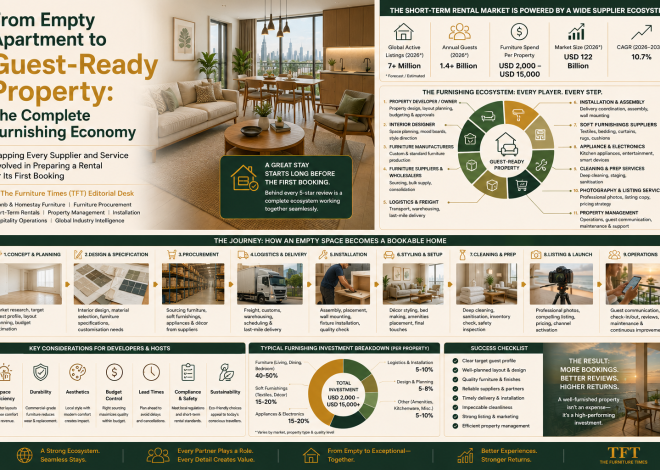
The regional holiday-home market is moving away from individual purchasing toward professional management.
A portfolio operator requires:
- Standard product specifications
- Multi-unit pricing
- Regional stock
- Rapid replacement
- Warranty management
- Repair services
- Digital furniture inventories
- Consistent installation
- Reliable project schedules
Furniture is no longer purchased only when a new unit launches. It is managed continuously across the portfolio.
This creates a long-term commercial relationship between suppliers and operators.
Climate Performance Is Non-Negotiable
Middle Eastern furniture faces environmental conditions that can accelerate wear.
Heat
Extreme temperatures can affect adhesives, coatings, plastics, foam and timber movement.
UV Exposure
Sunlight can fade fabrics, discolour surfaces and weaken some synthetic materials.
Dust and Sand
Fine particles enter mechanisms, upholstery, tracks and joints.
Humidity
Coastal cities can create corrosion, mould and timber movement.
Air-Conditioning
Frequent transitions between cooled interiors and outdoor heat can stress materials.
Pool Chemicals
Chlorine and cleaning products can affect outdoor frames and fabrics.
Manufacturers should test and specify products according to these conditions rather than rely on generic “outdoor” claims.
Family and Group Travel Affect Furniture Design
Middle Eastern holiday homes often serve larger and multi-generational family groups.
Furniture planning should therefore consider:
- Large dining tables
- Sufficient living-room seating
- Flexible sleeping capacity
- Children’s furniture
- Elder-friendly seating
- Luggage storage
- Privacy
- Multiple lounge areas
- Accessible circulation
Furniture should remain stable and safe under high occupancy.
Dining, sleeping and seating capacity must correspond to the number of guests advertised. A property cannot deliver a premium experience if half the group cannot sit together.
Privacy and Cultural Expectations Matter
Furniture layouts in the Middle East may need to support different levels of family and social privacy.
Some properties benefit from:
- Separate formal and family lounges
- Flexible screens
- Multiple seating areas
- Gender-sensitive spatial arrangements where appropriate
- Private outdoor spaces
- Larger dining areas
- Concealed storage
- Family-oriented bedroom configurations
International suppliers should understand these expectations rather than copy European or North American layouts without adaptation.
Regional relevance is not limited to colour and decoration. It includes how people use the space.
Local Identity Can Differentiate Holiday Homes
The most memorable Middle Eastern properties can draw from regional materials, craft and architecture.
Potential elements include:
- Mashrabiya-inspired screens
- Woven textiles
- Regional geometric patterns
- Carved timber
- Brass and metalwork
- Stone surfaces
- Natural desert colours
- Contemporary majlis-inspired seating
- Locally produced artwork
- Handcrafted accessories
However, local identity must not become visual imitation without substance.
Products should be authentically sourced where possible, credited appropriately and designed to withstand commercial use.
Artisans and manufacturers can collaborate to translate traditional skills into repeatable hospitality products.
Sustainability Will Become More Important
The Middle East’s major tourism developments are increasingly discussing sustainability, environmental responsibility and resource efficiency.
Furniture strategies should include:
- Durable products
- Repairable construction
- Replaceable covers
- Modular components
- Responsible timber sourcing
- Low-waste manufacturing
- Regional production
- Furniture refurbishment
- Take-back programmes
- Reusable packaging
- Product traceability
- End-of-life recovery
Extreme climate conditions make premature failure a significant risk. Selecting inappropriate products creates both financial and environmental waste.
Lifecycle durability should be treated as a sustainability measure.
The Circular Opportunity
The expansion of premium rental portfolios will eventually create a large secondary furniture economy.
When a property is refreshed, its furniture may be:
- Reupholstered
- Refinished
- Transferred to another unit
- Sold to smaller operators
- Used in staff accommodation
- Donated
- Dismantled for components
- Recycled
Furniture liquidators, refurbishers and asset-recovery specialists can help operators avoid unnecessary disposal.
Digital furniture inventories would make this process more efficient by recording product age, location, condition and residual value.
Geopolitical Risk Cannot Be Ignored
The Middle East’s tourism opportunity exists alongside significant geopolitical uncertainty.
Conflict, airspace disruption, travel warnings and changes in traveller confidence can reduce bookings rapidly. Events during 2026 demonstrated how regional instability can affect airlines, tour operators and neighbouring destinations even when individual tourism centres remain operational.
Furniture companies should therefore manage risk through:
- Diversified national markets
- Phased project delivery
- Clear payment terms
- Local inventory
- Flexible production
- Insurance
- Multiple transport routes
- Strong contractual protections
- Realistic demand assumptions
Long-term tourism and property development can remain attractive while short-term operating conditions fluctuate.
Suppliers should separate the region’s structural opportunity from temporary booking cycles.
What Manufacturers Should Prepare For
Companies entering the Middle Eastern holiday-home sector should develop:
- Premium apartment collections
- Complete villa packages
- Climate-resistant outdoor furniture
- Large-family dining systems
- Durable bedroom furniture
- High-quality sofa beds
- Extended-stay workspaces
- Contemporary regional designs
- Luxury outdoor lounges
- Modular storage
- Replaceable upholstery
They should also offer:
- Technical specifications
- UV and corrosion information
- Commercial warranties
- Spare parts
- Installation
- Regional warehousing
- Fast replacement
- Multi-unit pricing
- Furniture asset records
- Repair and refurbishment support
The most successful suppliers will sell operating performance alongside design.
Opportunities for Regional Furniture Manufacturers
The Middle East’s development pipeline creates opportunities for manufacturers in:
- Türkiye
- Egypt
- Jordan
- United Arab Emirates
- Saudi Arabia
- India
- China
- Vietnam
- Malaysia
- Indonesia
- Italy
- Eastern Europe
Malaysia and Indonesia can offer tropical outdoor and rattan expertise. Türkiye can provide regional contract manufacturing. Italy can serve premium design projects. India can supply timber, metal, upholstery and customised packages. China and Vietnam offer scale, while local Gulf production can reduce lead times and support national industrial-development goals.
The market will reward manufacturers capable of balancing quality, customisation, volume and reliable delivery.
The Searchability Challenge
Holiday-home operators need to find suppliers capable of serving specific property types and regional conditions.
They may search for:
- Villa furniture in Dubai
- Apartment packages in Riyadh
- Outdoor loungers in Oman
- Heritage furniture in AlUla
- Serviced-apartment furniture in Doha
- Coastal furniture in Egypt
- Repair services in Bahrain
- Turnkey installation in Abu Dhabi
Many suitable manufacturers remain difficult to find because their digital presence does not clearly show their project capabilities, service areas or hospitality experience.
Furniture Industry Search Engine (FISE) can help make these companies more visible within the global furniture ecosystem.
If you are not searchable, you do not exist in the moment the buyer needs you.
TFT tells their story. FISE helps the world find them. FurniReviewology helps the world trust them.
Where the Strongest Opportunities Are Emerging
Dubai and the UAE
Premium apartments, villas, licensed holiday homes and branded residences.
Saudi Arabia
Tourism megaprojects, new destinations, religious accommodation and urban furnished apartments.
Qatar
Professionally managed residences, business travel and premium multi-unit supply.
Oman
Coastal villas, heritage stays, mountain retreats and nature-based accommodation.
Egypt
Red Sea properties, urban apartments, cost-efficient packages and refurbishment.
Jordan
Boutique accommodation, desert tourism and culturally distinctive furnishing.
Türkiye
Domestic tourism supply, coastal villas, manufacturing and regional exports.
Portfolio Services
Installation, furniture asset management, rapid replacement, repair and refurbishment throughout the region.
Conclusion
The Middle East’s holiday-home furniture market is becoming a strategically important part of the global hospitality and furniture economy.
Premium apartments, villas, serviced residences, branded developments and professionally managed rentals are creating demand for complete furnishing systems rather than isolated furniture products.
The opportunity is being driven by:
- Tourism diversification
- Major property development
- Business and events travel
- Religious tourism
- Domestic travel
- Luxury residences
- Platform adoption
- Professional property management
Yet success requires more than luxury styling.
Furniture must withstand extreme climate conditions, support large family groups, meet operational requirements and remain available for repair or replacement. It must appear attractive in listing photographs while delivering comfort and durability in person.
The United Arab Emirates offers a mature and regulated holiday-home economy. Saudi Arabia presents extraordinary development potential. Qatar, Oman and Bahrain offer premium and professionally managed opportunities. Egypt, Jordan and Türkiye add cultural tourism, coastal demand and regional manufacturing capacity.
For furniture manufacturers, designers, distributors and service providers, the strongest opportunity lies in becoming part of the property’s long-term operating infrastructure.
The Middle East does not simply need more furniture. It needs regionally appropriate, commercially durable and operationally supported furniture capable of matching the scale of its tourism ambitions.