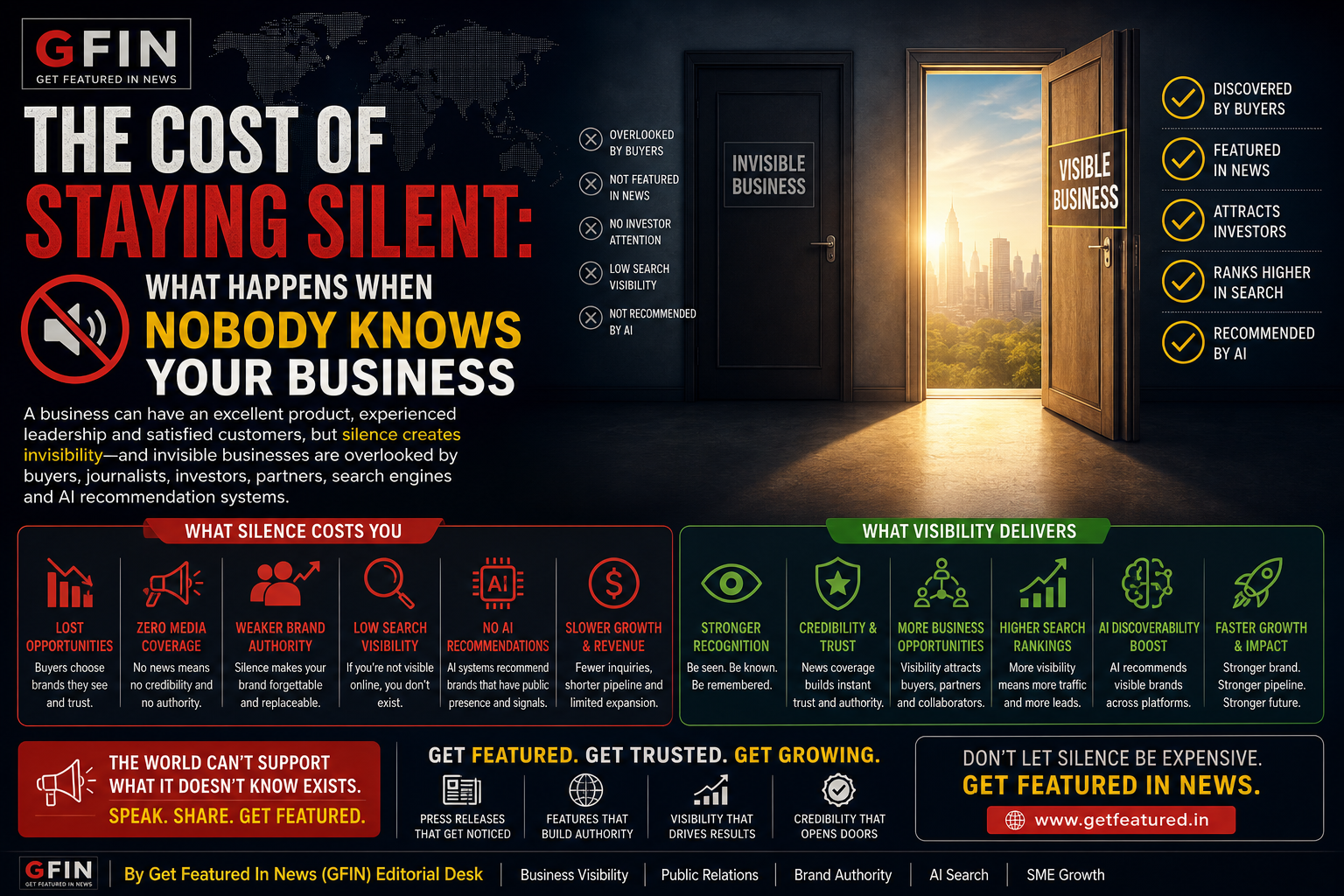
The Cost of Staying Silent: What Happens When Nobody Knows Your Business
A business can have an excellent product, experienced leadership and satisfied customers, but silence creates invisibility—and invisible businesses are overlooked by buyers, journalists, investors, partners, search engines and AI recommendation systems
By Get Featured In News (GFIN) Editorial Desk | Business Visibility | Public Relations | Brand Authority | AI Search | SME Growth
Many businesses believe silence is safe.
They avoid publishing news because they are waiting for a major announcement. They hesitate to promote their achievements because they do not want to appear boastful. They postpone public relations because budgets are tight, markets are uncertain or the leadership team believes that a good product will eventually speak for itself.
But products do not speak for themselves.
Factories do not explain their capabilities. Certifications do not announce themselves. Customer successes do not automatically reach the market. Years of experience do not become visible unless somebody documents them.
A business may be doing meaningful work every day and still remain unknown beyond a small circle of existing customers, suppliers and employees.
That silence has a cost.
It can weaken brand recognition, reduce search visibility, limit customer confidence, discourage potential partners and allow competitors to control the industry conversation. In the age of AI-powered discovery, prolonged silence can also make it difficult for search engines and recommendation systems to understand what the business does, where it operates or why it should be considered.
The greatest threat facing many businesses is not poor quality.
It is invisibility.
Silence does not protect a business—it removes it from consideration
Every customer begins with a limited set of options.
A buyer searching for a manufacturer, consultant, retailer, technology provider or professional service cannot evaluate every business in the market. The buyer creates a shortlist using the information that is easiest to find and verify.
That information may come from:
- AI assistants
- News publications
- Industry directories
- Social media
- Customer reviews
- Business profiles
- Trade associations
- Referrals
- Events
- Press releases
- Comparison articles
If a company is absent from these sources, it may never enter the shortlist.
The customer cannot choose a business they do not know exists.
Silence therefore has a direct commercial consequence: the business is excluded before it receives an opportunity to compete.
Nobody can remember a company they never encounter
Brand recognition is not created by one advertisement or one social-media post. It develops through consistent exposure.
A potential customer may encounter a business through an article, see its name again in a search result, notice a founder’s commentary, read a customer review and later visit its website.
Each interaction creates familiarity.
Familiarity matters because customers often feel more comfortable choosing a name they recognise. A company that appears consistently can seem more established, active and relevant than one that remains quiet.
This does not mean visibility should replace quality. It means quality must be communicated before it can influence a decision.
A silent business may be excellent. But an excellent business that nobody remembers can lose to an average competitor that has built stronger recognition.
Competitors fill the silence
Every industry has a public conversation.
Customers ask questions. Journalists look for experts. Search engines organise information. AI systems generate recommendations. Buyers compare suppliers. Investors evaluate opportunities.
If your business does not contribute, competitors will.
They may become the companies quoted in articles, invited to events and mentioned in market discussions. Their founders may become recognised as industry authorities. Their product launches may define how customers understand the category.
Over time, their visibility can create the impression that they are leading the market—even when your business has greater experience or better capabilities.
The market cannot recognise leadership that remains undocumented.
Silence does not create an empty space. It creates an opportunity for somebody else to occupy that space.
Your website cannot do everything alone
A professional website is essential, but it is not the complete visibility strategy.
A website is a business speaking about itself. Customers expect companies to present themselves positively, so self-published claims carry limitations.
People often look for external confirmation:
- Has the company appeared in the news?
- Has an industry publication discussed its work?
- Are its leaders quoted as experts?
- Can its achievements be verified elsewhere?
- Do customers review it positively?
- Is its information consistent across platforms?
- Does it have an active public history?
News coverage helps create this external context.
A company website may say, “We are an experienced manufacturer.” A published feature can document when the business was established, which markets it serves, how its factory operates and what problems it solves.
The second form of information is more detailed, searchable and potentially more persuasive.
Search engines cannot understand an empty public record
Modern search visibility depends partly on information consistency.
Search engines attempt to determine:
- The company’s name
- Its location
- Its leadership
- Its services
- Its products
- Its industry
- Its areas of expertise
- Its relationship with other organisations
- Whether the information is current
- Whether other sources recognise it
A business with one limited website and little external information gives search systems fewer signals to work with.
The problem becomes more serious when the available information is inconsistent. Different platforms may show different company descriptions, addresses, services or leadership details.
Regular, factual publication can help establish a clearer digital identity.
News articles, interviews, profiles, announcements and expert commentaries can create multiple points of evidence explaining who the business is and what it does.
AI cannot recommend what it cannot understand
Customers increasingly use conversational AI to discover businesses.
Instead of typing short keywords, they may ask:
- Which companies provide this service?
- Who are the trusted manufacturers in this region?
- What suppliers should I compare?
- Which consultant has experience in this area?
- What businesses can deliver this type of project?
- Which brands are known for this product?
- Who are the leading experts on this subject?
AI systems generate answers using information available across the digital environment.
If a business has little accessible information, the system may struggle to identify it. If its capabilities are poorly documented, AI may not associate the company with the relevant category. If competitors have stronger news coverage, clearer profiles and more structured content, they may be more likely to appear.
No ethical publication platform can guarantee inclusion in AI-generated answers. However, one principle remains clear:
A business with no public evidence gives search and AI systems almost nothing to understand, verify or recommend.
Silence weakens customer confidence
Before making a purchase, customers often investigate the business.
They want reassurance that it is:
- Legitimate
- Active
- Experienced
- Responsive
- Knowledgeable
- Reliable
- Relevant
- Trusted by others
A weak digital footprint can create doubts.
The customer may wonder:
- Is this company still operating?
- Why is there so little information?
- Has it completed any recent work?
- Does it have real industry experience?
- Can it be trusted with a deposit?
- Will it provide after-sales support?
- Why do competitors appear more frequently?
These questions may never be sent to the company. The customer may simply leave.
That makes silent lost opportunities difficult to measure. Businesses see no enquiry and therefore assume there was no demand. In reality, the potential customer investigated the company, found insufficient evidence and selected someone else.
Silence makes price competition more dangerous
When customers understand little about a business, they have fewer reasons to choose it beyond price.
A company’s value may come from:
- Experience
- Quality systems
- Craftsmanship
- Technology
- Reliability
- Compliance
- Service
- Leadership
- Sustainability
- Innovation
- Local knowledge
- Customer outcomes
If these strengths are not communicated, the buyer sees only a product and a quotation.
The business then becomes easier to compare with cheaper alternatives.
Visibility and thought leadership help explain why the company is different. They create context around the price.
A recognised specialist can compete on expertise and confidence. An unknown supplier is more likely to be treated as a commodity.
Silence reduces pricing power
Strong brands can often defend their prices because customers understand their reputation, capabilities and values.
Unknown businesses face a different reality. Buyers may demand greater discounts because choosing an unfamiliar company feels risky.
This creates a damaging cycle:
- The business remains silent.
- Brand recognition stays weak.
- Buyers perceive greater risk.
- The company discounts to win work.
- Margins decline.
- Marketing and PR budgets are reduced.
- The business becomes even less visible.
Breaking this cycle requires treating communication as strategic infrastructure rather than optional promotion.
Valuable achievements disappear when they are not documented
Businesses create news more frequently than they realise.
Potential stories include:
- A new product
- A new service
- A major project
- A business anniversary
- A certification
- An award
- A new office or factory
- A senior appointment
- A partnership
- International expansion
- Job creation
- Technology adoption
- Sustainability progress
- Community support
- Research
- Customer success
- A founder’s industry perspective
If these moments are not documented, their value is lost.
An announcement has an immediate purpose, but it also becomes part of the company’s long-term history.
Years later, customers, journalists, investors and employees should be able to understand how the business developed. Without published records, growth becomes invisible and institutional memory disappears.
Silence limits media opportunities
Journalists often work under tight deadlines. They need experts who can respond clearly and support claims with evidence.
When researching a subject, they look for people who already have visible expertise.
A founder who regularly publishes credible analysis is easier to identify than one whose knowledge remains private. A company that has documented projects and research is easier to reference than one with no public information.
This creates a compounding advantage:
- Published expertise makes the company discoverable.
- Discoverability creates interview opportunities.
- Interviews build authority.
- Authority leads to additional media interest.
- Increased coverage strengthens the public record.
Silent companies remain outside this cycle.
Their leaders may possess valuable insights, but journalists cannot quote experts they cannot find.
Silence can limit partnerships and investment
Potential partners and investors conduct research before making contact.
They examine:
- Leadership
- Market positioning
- Growth
- Products
- Reputation
- News
- Partnerships
- Achievements
- Customer feedback
- Industry relevance
A company with an active and credible public presence provides more material for evaluation.
A silent company creates uncertainty. The absence of news does not prove weakness, but it gives potential partners less evidence of momentum.
Partnerships often begin with discovery. A distributor reads about a product launch. An investor notices a market analysis. A technology company sees a relevant case study. An association identifies a knowledgeable founder.
Without publication, these connections may never happen.
Silence makes recruitment harder
Employees also research companies.
Talented candidates want to know:
- What does the company stand for?
- Is it growing?
- Is its leadership credible?
- Does it invest in innovation?
- What projects has it completed?
- Is it respected in the industry?
- Would working there strengthen my career?
A company that communicates its vision and achievements can attract people who identify with its direction.
A company that remains silent may appear inactive, outdated or uncertain—even when the workplace is excellent.
Employer visibility is therefore part of business visibility.
Silence during difficult markets can damage the recovery
Businesses often reduce communication during economic uncertainty.
The reasoning appears logical: demand is weak, budgets are under pressure and marketing seems easier to cut than production or salaries.
But when a company becomes silent, several things can happen:
- Customers stop seeing it
- Search visibility weakens
- Brand recall declines
- Competitors gain attention
- Industry relationships cool
- The market assumes reduced activity
- Recovery becomes slower and more expensive
Hard times do not eliminate all demand. They redistribute it.
Some customers continue purchasing. Some projects move forward. Some companies enter new markets. Buyers still look for reliable suppliers.
If one business disappears from view, active competitors can capture the remaining demand.
Restarting visibility costs more than maintaining it
Brand awareness behaves like momentum.
When communication continues consistently, each article, announcement and expert contribution builds upon the previous one.
After a long period of silence, the business must rebuild:
- Audience attention
- Search visibility
- Media relationships
- Customer familiarity
- Social engagement
- Content momentum
- Branded demand
- Public confidence
This creates a recovery debt.
The company may need to spend more money and time merely to return to the visibility level it previously had.
Maintaining a disciplined presence is often more efficient than disappearing and attempting a dramatic return later.
Silence allows other people to define your business
If a company does not communicate its identity, the market will construct one from whatever information is available.
That information may be:
- An old website
- An outdated directory listing
- A negative review
- An incomplete profile
- A former employee’s description
- An inaccurate social-media post
- A competitor’s comparison
- A past controversy
- A discontinued product
Businesses cannot control every public comment, nor should they try. But they can contribute accurate, current and useful information.
Publishing consistently ensures that customers encounter more than one version of the company’s story.
The difference between noise and strategic visibility
Staying visible does not mean publishing meaningless announcements every day.
The objective is not noise. It is relevance.
Strategic communication should answer questions such as:
- What problem does the company solve?
- Who does it serve?
- What has changed?
- Why does the development matter?
- What evidence supports the claim?
- What can the audience learn?
- Why is the company qualified to comment?
- What should the reader do next?
A useful story adds information to the market.
It can educate, explain, analyse, document or announce.
What should a business publish?
Company news
- Launches
- Expansions
- Partnerships
- Appointments
- Investments
- Milestones
- Certifications
- Awards
Customer and project stories
- Problems solved
- Implementation journeys
- Measurable outcomes
- Lessons learned
- Before-and-after cases
Thought leadership
- Industry trends
- Regulatory changes
- Market opportunities
- Consumer behaviour
- Technology
- Operational challenges
- Future predictions
Original intelligence
- Surveys
- Benchmarks
- Internal data
- Market observations
- Customer trends
- Regional analysis
Human stories
- Founder journeys
- Employee achievements
- Artisan skills
- Community contributions
- Business resilience
- Succession stories
A balanced editorial programme combines announcements with useful knowledge.
One article is a beginning, not a complete strategy
A single article may introduce a business, but authority is built through continuity.
A practical editorial sequence could include:
- Who we are
- Why the company was founded
- What problem we solve
- How the product or service works
- A customer-success story
- An expert industry analysis
- A new partnership or expansion
- Original research
- A leadership interview
- An annual progress report
Over time, these stories create a searchable body of evidence.
Customers see consistency. Journalists see expertise. Search engines see context. AI systems receive clearer information.
Why Get Featured In News matters
Many businesses have stories but do not know how to identify, write, structure or publish them.
Get Featured In News (GFIN) exists to help businesses move from silence to visibility.
The platform can support companies, founders, professionals, SMEs, manufacturers, retailers, consultants, innovators, associations and community organisations by turning real developments and expertise into structured news content.
GFIN helps businesses identify news value
A company may believe it has “nothing to announce.” In reality, it may have years of undocumented knowledge and progress.
GFIN can help uncover stories within:
- Business history
- Products
- Services
- Projects
- Leadership
- Research
- Customer outcomes
- Industry opinions
- Community work
- Expansion plans
GFIN helps present the story professionally
A strong article needs:
- A clear headline
- A relevant subheadline
- A direct introduction
- Supporting evidence
- Logical structure
- Useful context
- Accurate quotations
- A focused conclusion
- Search-friendly publishing information
Professional presentation makes the business easier to understand without turning the article into exaggerated advertising.
GFIN helps create a searchable public footprint
Published news can become part of the company’s long-term digital record.
This can support:
- Brand discovery
- Search visibility
- AI-era discoverability
- Customer research
- Reputation
- Media outreach
- Thought leadership
- Partnership development
Publication cannot guarantee rankings, backlinks, media pickups, AI citations or sales. But a business that publishes credible information gives the market far more evidence than one that remains silent.
GFIN can give SMEs a fairer opportunity
Major corporations have internal communications teams and international PR agencies. Smaller businesses often do not.
Their stories may be equally meaningful, but they lack access.
Get Featured In News can help reduce this visibility gap by giving legitimate businesses a pathway to present their achievements and expertise professionally.
Media opportunity should not belong only to companies with the largest budgets.
What businesses should not do
Visibility must be built responsibly.
Companies should avoid:
- Inventing achievements
- Publishing unsupported market-leadership claims
- Using misleading statistics
- Creating fake reviews
- Hiding commercial relationships
- Repeating identical content
- Attacking competitors
- Manufacturing false urgency
- Presenting advertising as independent reporting
- Promising outcomes that cannot be guaranteed
Short-term manipulation can create long-term reputational damage.
The strongest visibility comes from facts, useful knowledge and consistent action.
A 90-day plan for ending business silence
Days 1–15: Audit your visibility
Search for:
- Company name
- Founder’s name
- Products
- Services
- Industry category
- Location
- Customer reviews
Record what appears, what is missing and what is outdated.
Days 16–30: Establish the facts
Create one accurate company-information document covering:
- Official name
- History
- Leadership
- Locations
- Products
- Services
- Markets
- Achievements
- Contact information
Days 31–45: Publish the foundation
Start with a company profile, founder story or important announcement.
Days 46–60: Demonstrate expertise
Publish an educational industry article addressing a real customer question.
Days 61–75: Present evidence
Develop a case study, milestone report, research feature or customer-success story.
Days 76–90: Measure the response
Monitor:
- Brand searches
- Article visibility
- Enquiries
- Media interest
- Social engagement
- Customer feedback
- Partnerships
- Recruitment interest
- AI mentions where observable
Use the findings to plan the next quarter.
The cost of communication versus the cost of invisibility
Business leaders often ask, “How much will news coverage cost?”
They should also ask:
- What is the cost of never being shortlisted?
- What is the cost of losing customers to a visible competitor?
- What is the cost of weak brand recognition?
- What is the cost of being absent from AI recommendations?
- What is the cost of rebuilding awareness after years of silence?
- What is the cost of having no public record when a crisis occurs?
- What is the cost of expertise nobody can find?
The cost of invisibility is difficult to see because it appears as opportunities that never arrive.
No enquiry is received. No meeting is scheduled. No journalist calls. No distributor makes contact. No candidate applies. No investor asks for information.
The company may never know what it lost.
Final message: your silence is helping somebody else
The market continues moving whether your company communicates or not.
Customers continue searching.
Journalists continue selecting experts.
AI systems continue generating answers.
Buyers continue building shortlists.
Competitors continue publishing.
Every day a business remains silent, somebody else has another opportunity to become more visible, more familiar and more trusted.
You do not need to exaggerate.
You do not need to publish meaningless content.
You do not need to pretend that every development is revolutionary.
But you do need to communicate.
Tell the market what you do. Document your progress. Share your knowledge. Explain your value. Build a public record before you urgently need one.
Get Featured In News helps turn business activity into visibility, visibility into authority, and authority into opportunity.
Do not wait for customers to discover you by accident.
Do not let competitors write the history of your industry alone.
Do not allow valuable work to disappear into silence.
Get featured. Become searchable. Build authority. Expand your reach.
Media is the new currency—and silence is becoming increasingly expensive.