IKEA Leads the World’s Most-Visited Furniture Websites as Digital Competition Intensifies
Similarweb’s June 2026 ranking reveals how IKEA, Nitori, Ashley Furniture, Home Depot Mexico and Crate & Barrel are winning online attention—and what the wider furniture industry can learn from their performance
By The Furniture Times (TFT) Editorial Desk
Digital Commerce | Furniture Retail | Consumer Intelligence | Global Market Analysis
August 2026
The global furniture industry is competing for more than showroom visitors, retail locations and product orders. It is now competing for digital attention.
Before many consumers enter a furniture store, they search online. They compare prices, investigate materials, examine dimensions, read customer reviews, check delivery conditions, save room ideas and decide which businesses deserve further consideration.
This makes website visibility one of the most important assets in modern furniture retail.
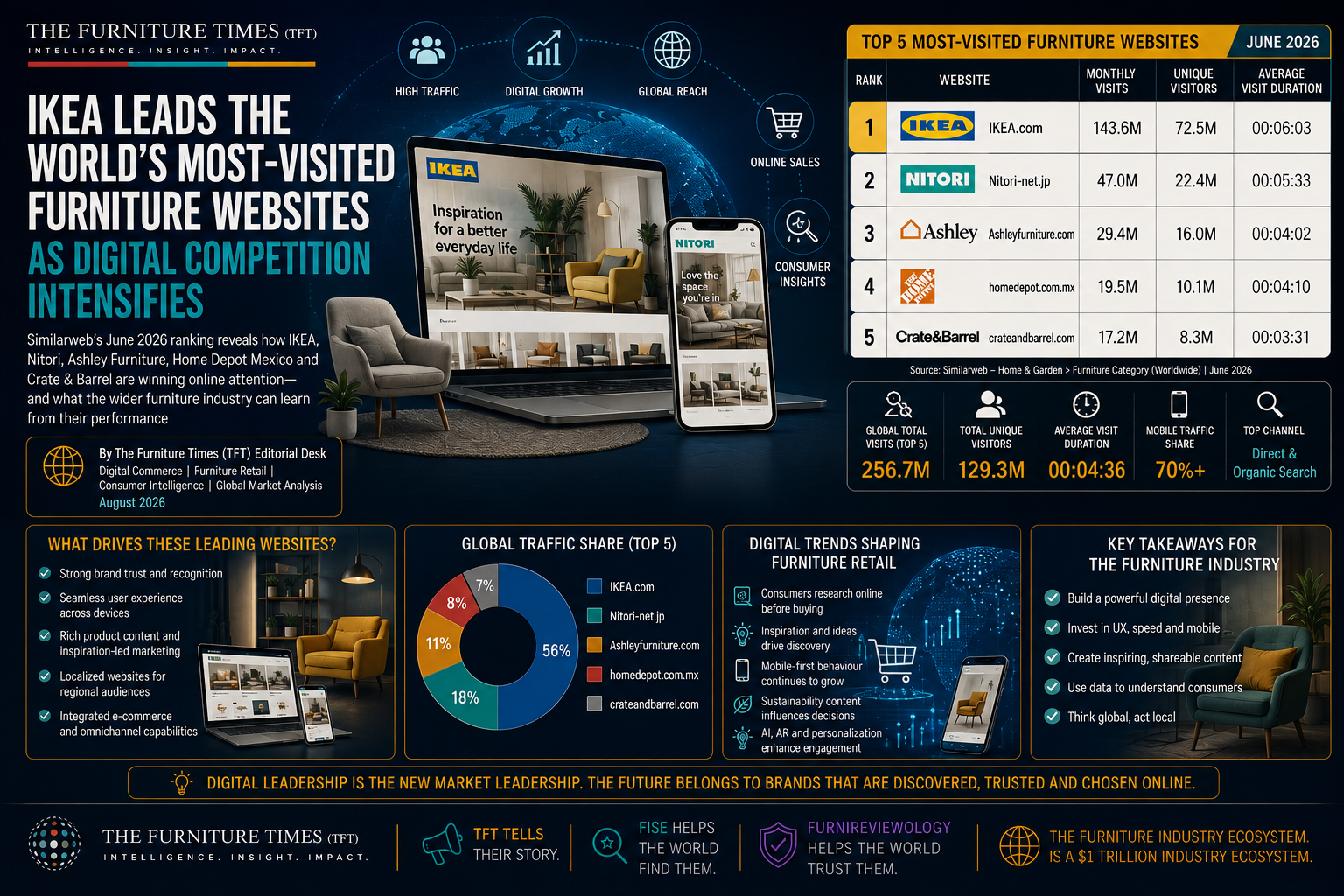
According to Similarweb’s worldwide Furniture-category ranking for June 2026, IKEA operated the world’s most-visited furniture website, followed by Japan’s Nitori, Ashley Furniture, Home Depot Mexico and Crate & Barrel. The ranking was updated on July 1, 2026 and covers “all traffic” within Similarweb’s global Furniture category. Similarweb’s Top Furniture Websites Ranking
The findings offer more than a list of successful websites. They reveal how consumers behave when researching furniture, why digital engagement matters and what smaller manufacturers and retailers can learn from internationally recognised platforms.
The Five Most-Visited Furniture Websites
Similarweb reports the following global order for June 2026:
| Rank | Website | Average visit duration | Pages per visit | Bounce rate |
|---|---|---|---|---|
| 01 | IKEA.com | 4 minutes 49 seconds | 6.80 | 32.84% |
| 02 | Nitori-net.jp | 3 minutes 18 seconds | 3.97 | 53.61% |
| 03 | AshleyFurniture.com | 2 minutes 57 seconds | 3.62 | 53.83% |
| 04 | HomeDepot.com.mx | 3 minutes 02 seconds | 3.74 | 56.17% |
| 05 | CrateandBarrel.com | 3 minutes 00 seconds | 3.92 | 44.16% |
These figures represent estimated website engagement rather than confirmed sales, orders or profitability. A highly visited website may not necessarily produce the highest conversion rate, while a smaller specialist website may generate fewer visits but more valuable transactions.
Nevertheless, the rankings provide a useful picture of which furniture platforms are attracting and retaining online attention.
IKEA’s Digital Leadership Extends Beyond Traffic
IKEA’s first-place position is significant, but the engagement behind that position is even more revealing.
Visitors spent an average of 4 minutes and 49 seconds on IKEA.com and viewed approximately 6.80 pages per visit. Its reported bounce rate was 32.84%, substantially lower than the rates recorded for most of the other top-five websites.
A bounce generally occurs when a visitor leaves after viewing only one page. A lower bounce rate can indicate that visitors are successfully moving deeper into the website, although context remains important.
IKEA therefore does not merely attract visitors. Its platform encourages them to continue exploring.
Several factors may help explain that strength.
A broad product ecosystem
IKEA’s website is not limited to sofas, beds and dining tables. Consumers can search for storage, kitchens, mattresses, lighting, textiles, accessories, children’s products, office furniture and complete room solutions.
A customer arriving to investigate one item may naturally move through several related categories.
Someone considering a bed may also look at:
- Mattresses
- Bedside tables
- Wardrobes
- Lamps
- Bed linen
- Storage boxes
- Curtains
- Bedroom-planning ideas
That interconnected journey increases the possibility of multiple page views and a larger total order.
Room-based inspiration
Many furniture websites are organised almost exclusively around product categories. IKEA also presents the home through rooms, lifestyles, problems and solutions.
Consumers do not always begin with a precise product name. They may search for “small-bedroom storage,” “ideas for a narrow kitchen,” “affordable home office” or “furniture for a studio apartment.”
Room-based content meets consumers closer to the beginning of their decision-making process. It helps them identify a problem before offering the product as a solution.
Planning and visualisation
Furniture purchases involve uncertainty. Consumers want to know whether an item will fit physically, match surrounding products and function in everyday life.
Planning tools, room visualisation, measurements and coordinated collections reduce some of that uncertainty. They allow a furniture website to act as a decision platform—not merely a digital catalogue.
Localised international operations
IKEA has developed a recognisable global identity while adapting its commerce experience to numerous countries. Product availability, prices, delivery options and store information can be localised without losing the company’s overall design language.
This combination of global recognition and local relevance is difficult to reproduce, but it demonstrates an important principle: international brands need consistent identities and locally accurate information.
Nitori Demonstrates the Strength of the Japanese Digital Market
Nitori-net.jp ranked second worldwide during June 2026. Visitors spent an average of 3 minutes and 18 seconds on the website, viewing approximately 3.97 pages per visit. Its reported bounce rate was 53.61%.
Nitori’s position illustrates the importance of Japan as a sophisticated furniture and home-furnishing market.
Japanese consumers frequently need furniture designed for:
- Compact apartments
- Efficient storage
- Flexible rooms
- Multifunctional use
- Easy maintenance
- Precise dimensions
- Coordinated interiors
Nitori’s business extends beyond conventional finished furniture into bedding, storage, home accessories and everyday household products. This broader assortment creates frequent reasons for consumers to return.
The ranking also challenges the assumption that global digital leadership belongs only to American and European brands. A nationally concentrated platform can become one of the world’s most-visited furniture websites when it serves a large, digitally active market effectively.
For furniture companies, Nitori’s position reinforces the importance of local-language search, culturally appropriate product descriptions and furniture scaled to the realities of local housing.
Ashley Furniture Shows the Power of Category Authority
AshleyFurniture.com placed third. Similarweb reports an average visit duration of 2 minutes and 57 seconds, approximately 3.62 pages per visit and a 53.83% bounce rate.
Ashley’s online authority is connected to its extensive presence across the American and international furniture sectors. Consumers may encounter the name through stores, dealers, advertising, search results, social platforms or previous purchases before visiting the website.
That combination of offline familiarity and online discoverability is important. Digital traffic does not exist separately from physical retail. Showrooms, delivery vehicles, advertisements, product labels, news coverage and customer recommendations can all motivate website visits.
Ashley’s position also reflects the commercial importance of the United States, one of the world’s largest furniture consumption and import markets.
American furniture consumers commonly research:
- Sofas and sectionals
- Recliners
- Bedroom collections
- Mattresses
- Dining furniture
- Home-office furniture
- Financing options
- Promotions
- Delivery availability
For products involving significant expenditure, customers may return several times before purchasing. Furniture websites must therefore support both immediate transactions and longer research journeys.
Home Depot Mexico Reflects the Convergence of Furniture and Home Improvement
HomeDepot.com.mx ranked fourth in Similarweb’s Furniture category, recording an average visit duration of 3 minutes and 2 seconds, approximately 3.74 pages per visit and a 56.17% bounce rate.
Its appearance in a furniture ranking is strategically important because it highlights the increasingly blurred boundary between furniture, home improvement, construction, storage and interior renovation.
Consumers do not always see these as separate industries. A person improving a kitchen might search for cabinets, shelving, worktops, lighting, hardware, appliances and dining furniture as part of one connected project.
Home Depot Mexico benefits from participation in this larger home-improvement journey.
Its ranking also shows the rising importance of Mexico as both a consumer market and a North American manufacturing and sourcing location. Urban development, housing needs, regional trade and nearshoring are strengthening Mexico’s position within the furniture ecosystem.
For traditional furniture retailers, the lesson is clear: competition does not come only from other furniture stores. It also comes from marketplaces, home-improvement chains, interior platforms and multi-category retailers capable of solving broader household needs.
Crate & Barrel Shows the Value of Curated Digital Presentation
CrateandBarrel.com occupied fifth place, with visitors spending an average of 3 minutes on the website and viewing approximately 3.92 pages per visit. Its 44.16% bounce rate was lower than those reported for Nitori, Ashley Furniture and Home Depot Mexico.
Crate & Barrel occupies a more curated design and lifestyle position than some mass-market competitors. Its platform brings together furniture, kitchenware, décor, lighting, textiles and gifts through a relatively consistent visual identity.
This highlights a different path to digital success.
Furniture websites do not need to carry the largest possible assortment. A carefully selected collection can perform strongly when the presentation, photography, design language and customer experience are coherent.
For premium and design-led companies, excessive catalogue size may even weaken differentiation. Consumers may find greater value in a platform that helps them make decisions than in one that presents thousands of poorly organised products.
What the Engagement Metrics Actually Mean
Traffic rankings are useful, but the individual measurements need to be interpreted correctly.
Average visit duration
This measures the estimated average amount of time visitors spend on a website.
A longer visit may suggest meaningful research, product comparison or use of planning tools. However, it can occasionally reflect difficulty finding information. Time alone does not prove satisfaction.
Pages per visit
This represents the average number of pages viewed during a visit.
A high number can show that users are exploring multiple products and categories. IKEA’s 6.80 pages per visit stand out strongly in the June 2026 top five.
However, more pages are not always automatically better. If customers are forced to open numerous pages to find delivery charges or dimensions, the website may be creating unnecessary friction.
Bounce rate
Bounce rate generally represents the proportion of visits that end after a single page.
A lower rate often suggests deeper engagement. Yet a one-page visit is not always unsuccessful. A consumer may open a store-location page, find the answer immediately and leave satisfied.
Rank change
Similarweb reported no position change among the five leading websites for the period shown. That stability indicates that these platforms held their relative positions during the reporting period, but it does not guarantee that the ranking will remain unchanged.
The ranking is monthly and should be viewed as a moving indicator.
Digital Traffic Is Not the Same as Furniture Revenue
One of the most important limitations is that website traffic does not equal sales.
The ranking does not by itself reveal:
- Total furniture revenue
- Number of completed orders
- Average order value
- Profit margin
- Conversion rate
- Product-return rate
- Customer-acquisition cost
- Physical-store sales
- App activity
- Marketplace transactions
- Trade and contract orders
- Customer satisfaction
A retailer may receive millions of research visits but experience a relatively low purchase rate. Another company may serve architects, hotels or commercial buyers and receive much less traffic while generating high-value contracts.
Website rankings therefore measure digital visibility and engagement, not overall industry leadership.
Similarweb’s figures are also estimates generated through its own data and modelling. They should be used as market-intelligence indicators rather than audited company accounts.
Why Furniture Websites Require More Work Than Ordinary Product Pages
Furniture is one of the most complicated categories to sell online.
A customer buying a small everyday item may need only a photograph, short description and price. A furniture buyer may need to understand:
- Exact width, depth and height
- Seat height and seat depth
- Doorway and staircase clearance
- Materials and construction
- Fabric colour and texture
- Weight and load capacity
- Assembly requirements
- Delivery times
- Installation conditions
- Warranty coverage
- Maintenance instructions
- Return costs
- Replacement-part availability
Furniture is also experienced in three-dimensional space. Consumers worry about whether a sofa will overpower a room, whether dining chairs will fit under a table or whether a wardrobe can be assembled in the available space.
A successful furniture website must therefore reduce uncertainty.
The leading platforms are increasingly becoming digital decision-support systems incorporating detailed specifications, lifestyle photography, customer reviews, room ideas, comparison tools, stock information and delivery calculations.
The Website Is Becoming the First Showroom
Even when the final purchase happens inside a store, the website may influence which store receives the visit.
A consumer who encounters incomplete information may remove a brand from consideration before speaking with a salesperson. This means the digital experience can lose a customer without the business ever knowing that customer existed.
For modern furniture retailers, the website must perform several showroom functions:
- Introduce the brand
- Present the collection
- Explain product differences
- Demonstrate scale and context
- Build trust
- Answer practical questions
- Show availability
- Direct visitors to stores
- Capture enquiries
- Support purchasing
The physical showroom remains valuable because customers want to touch surfaces, test comfort and examine construction. However, the online showroom increasingly determines who reaches that physical location.
What Smaller Furniture Businesses Can Learn
Small and medium-sized furniture companies cannot necessarily reproduce IKEA’s technology budget, retail footprint or global catalogue. They can still apply the underlying principles.
Make every product searchable
Each important product should have its own clear page containing a descriptive name, category, dimensions, materials, colour options, photographs and availability.
A photograph with only a product code is unlikely to answer consumer questions or help search systems understand the item.
Publish complete dimensions
Furniture businesses frequently lose trust by publishing incomplete measurements.
Dimensions should use a consistent system and explain relevant details, including seat height, internal storage measurements, extension length or mattress compatibility.
Organise by consumer need
Categories such as “sofas” and “tables” are necessary, but businesses should also consider need-based pages:
- Furniture for small apartments
- Outdoor furniture for tropical climates
- Storage for compact bedrooms
- Furniture for cafés
- Accessible furniture
- Easy-maintenance family furniture
- Hotel furniture packages
These pages align more closely with the problems consumers actually search for.
Connect related products
A product page should not become a dead end. Related tables, chairs, cushions, covers, storage, care products and replacement components can encourage deeper browsing.
Explain delivery before checkout
Consumers should not have to reach the final checkout stage to discover that delivery is unavailable, unusually expensive or delayed for several months.
Clear delivery information can reduce abandoned purchases and unnecessary enquiries.
Build visible trust
Businesses should show authentic customer reviews, verified contact information, warranty terms, business history and after-sales procedures.
Trust becomes especially important when customers cannot physically inspect a product before paying.
Improve mobile performance
Many consumers discover furniture through mobile search and social media. A slow, confusing or poorly formatted mobile website can waste advertising expenditure and reduce organic search performance.
Create editorial content
Guides, comparisons, material explanations, maintenance articles and room-planning advice can attract consumers before they have selected a particular product.
Editorial visibility helps a furniture company become a source of knowledge rather than merely another seller.
Manufacturers Must Also Become Digitally Discoverable
The lessons are not limited to retailers.
Many manufacturers depend on exhibitions, agents, personal contacts and PDF catalogues. These channels remain useful, but international buyers increasingly conduct online research before making contact.
A manufacturer’s website should clearly explain:
- Product categories
- Factory location
- Production capabilities
- Materials
- Minimum order quantities
- Export markets
- Certifications
- Customisation
- Packaging
- Quality-control systems
- Lead times
- Contact channels
Component and accessory suppliers need the same visibility. Hardware, mechanisms, castors, fabrics, foam, panels, adhesives and finishes should be presented through searchable technical information.
A buyer searching for a particular component cannot discover a supplier whose entire catalogue exists only inside an unsearchable image or outdated PDF.
Search Is Moving Beyond Google
The furniture discovery journey now includes traditional search engines, marketplaces, social media, image search, review sites and generative AI platforms.
This creates a new requirement: websites must be understandable not only to people, but also to machines.
Search and AI systems need consistent facts about:
- Business identity
- Product categories
- Locations
- Dimensions
- Materials
- prices
- Availability
- Certifications
- Reviews
- Policies
If these facts are missing or contradictory, an AI assistant may be unable to understand or recommend the business.
The coming competition will therefore involve search engine optimisation, answer engine optimisation and AI visibility.
Visibility Must Be Connected to Trust
Traffic can introduce customers to a brand, but trust determines whether attention becomes action.
A highly visited website may still lose customers if reviews reveal poor service, damaged products or unresolved complaints. Conversely, a smaller company can convert visitors effectively when its reputation, information and service are strong.
The furniture industry needs three connected layers:
- Editorial visibility, explaining the business and its contribution
- Search visibility, making the company discoverable
- Review credibility, helping buyers evaluate trust
This is particularly important for smaller manufacturers, retailers, craftspeople and service providers that cannot compete through enormous advertising budgets.
A Strategic Warning for the Invisible 90%
The Similarweb top-five ranking naturally focuses on large and highly visible platforms. However, the furniture ecosystem contains thousands of businesses that remain absent from rankings because they receive limited measurable traffic—or have no effective website at all.
Many of these companies produce excellent furniture. Their problem is not necessarily product quality; it is discoverability.
They may rely on:
- WhatsApp catalogues
- Personal Facebook accounts
- Printed brochures
- Exhibition contacts
- Word-of-mouth referrals
- Unstructured marketplace listings
- Websites that have not been updated for years
These methods can generate business, but they do not create a complete, durable and globally searchable identity.
Digital inequality is consequently becoming an industry issue. Large companies continue accumulating traffic, customer data, backlinks and AI references, while small businesses remain difficult to find.
Creating fair and affordable discovery infrastructure is essential if the global furniture economy wants innovation and craftsmanship to survive beyond its largest corporations.
Conclusion: The Furniture Website Has Become Strategic Infrastructure
Similarweb’s June 2026 ranking demonstrates that digital leadership in furniture is not based on traffic alone. IKEA’s advantage is supported by unusually strong engagement, with visitors exploring more pages, staying longer and leaving after one page less frequently than visitors to most other top-ranked platforms.
Nitori demonstrates the scale of Japan’s digital home-furnishing economy. Ashley Furniture reflects the relationship between brand recognition and online authority. Home Depot Mexico shows how furniture is converging with the larger home-improvement journey. Crate & Barrel illustrates the continuing power of curated lifestyle presentation.
The wider lesson is unmistakable: a furniture website is no longer a secondary brochure.
It is a showroom, catalogue, research centre, sales assistant, trust signal, customer-service platform and structured source of information for search engines and AI systems.
The businesses that invest in complete product data, helpful content, mobile performance, transparent delivery and customer trust will be better positioned to compete.
Those that remain digitally silent risk becoming invisible—even when their craftsmanship deserves global recognition.
Source note: Rankings and engagement statistics in this article refer to Similarweb’s worldwide Furniture-category data for June 2026, updated July 1, 2026. Similarweb data are estimates; rankings can change monthly and should not be interpreted as audited revenue or sales rankings.
The Furniture Times (TFT) & Furniture Industry Search Engine (FISE)
“TFT tells their story. FISE helps the world find them.”
FurniReviewology helps the world trust them.
The furniture industry ecosystem is a $1 trillion industry ecosystem. Be searchable. Be visible. Be trusted.