In Search of a Better Future for Digital Shoppers and Retailers Alike
Worked for 1m 11s
AI-powered product discovery promises to reduce search frustration, improve personalization and connect consumers with better choices—but retailers must protect trust, transparency, competition and control of the customer relationship
By The Furniture Times (TFT) Editorial Desk | Digital Commerce | Retail Technology | AI & Future Commerce
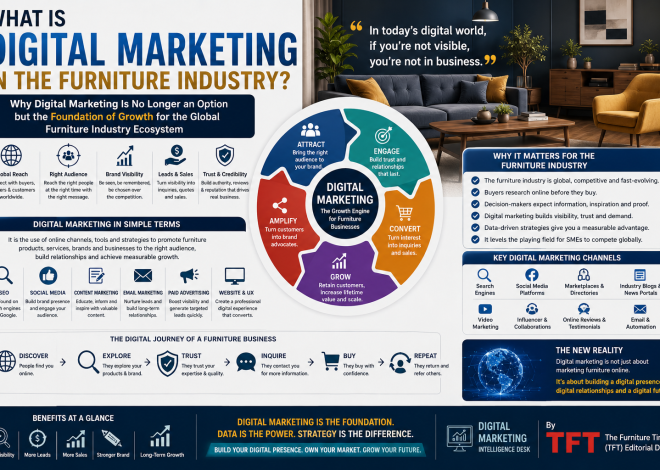
Digital commerce was supposed to make shopping easier.
A consumer could avoid travelling between stores, compare hundreds of products within minutes and complete a purchase at any time. Retailers could reach customers beyond their traditional locations, operate across borders and measure how shoppers interacted with their products.
Yet the expansion of online retail has created a different challenge: too much choice, too little clarity and increasingly difficult product discovery.
A customer searching for a sofa, dining table, office chair or wardrobe may encounter thousands of listings. Some contain insufficient specifications. Others use confusing descriptions, inaccurate availability, repetitive images or unreliable reviews. Sponsored placements may appear above more suitable options, while conventional search boxes struggle to understand detailed, conversational requests.
The result is a digital marketplace containing more products but not necessarily better decisions.
A Forbes feature by David Prosser, titled In Search of a Better Future for Digital Shoppers and Retailers Alike, directs attention toward this central challenge: how can digital retail deliver more useful discovery for consumers while helping retailers convert genuine demand into sustainable business? Read the original Forbes feature
The question has become even more urgent in 2026 as artificial intelligence changes how consumers search, compare and purchase products.
The next phase of e-commerce will not be defined only by larger catalogs or faster websites. It will be shaped by whether digital systems can understand what shoppers are trying to achieve—and whether the recommendations they receive are accurate, transparent and trustworthy.
For the furniture industry, where purchases are highly visual, expensive, infrequent and dependent on dimensions, materials, comfort, delivery and after-sales service, the stakes are particularly high.
The Original Promise of Digital Shopping
The first generation of e-commerce focused on access.
Retailers placed products online, while customers gained the ability to browse from anywhere. The second generation concentrated on convenience, introducing mobile commerce, saved payment details, faster delivery and personalized promotions.
The emerging generation is focused on intelligence.
Consumers do not simply want access to more products. They want help identifying the products most suitable for their circumstances.
A furniture shopper may not know the technical name of the item required. The customer may instead describe a situation:
- A sofa for a narrow living room with two children and a pet
- A dining table for six people that can occasionally accommodate eight
- An office chair suitable for extended daily use
- An outdoor set capable of performing in humid and rainy weather
- A storage bed for a compact apartment
- A wardrobe that can fit beneath a sloping ceiling
- A hotel chair that combines durability with easy maintenance
- A modular sofa that can be expanded after moving to a larger home
Traditional keyword search may identify individual words but fail to understand the complete requirement.
An intelligent product-discovery system should interpret the context, identify the relevant product attributes and present a manageable group of suitable options. It should also explain why those products match the request.
That is the promise of AI-assisted shopping.
Digital Retail’s Product-Discovery Problem
Many online stores were built around rigid categories rather than customer intentions.
A furniture website may organize products into:
- Living room
- Bedroom
- Dining room
- Office
- Outdoor
- Accessories
This structure is useful, but it does not capture the full complexity of furniture decisions.
Customers also think in terms of:
- Room size
- Family size
- Budget
- Climate
- Lifestyle
- Material preference
- Maintenance
- Accessibility
- Delivery constraints
- Existing interior style
- Expected product life
- Commercial or residential use
A shopper looking for an outdoor table in Malaysia may care more about rain resistance, corrosion, drainage and maintenance than about the marketing name of the collection.
If those attributes are missing from the retailer’s data, neither a conventional search engine nor an AI assistant can reliably identify the right product.
Search failure is a revenue problem
When an online store returns irrelevant results, the retailer does not merely create inconvenience. It may lose a ready-to-buy customer.
Shoppers who use an internal search function often demonstrate stronger purchase intent than general browsers. They are actively communicating what they want. A poor search experience wastes that signal.
Common failures include:
- No results for alternative spelling
- Irrelevant products
- Out-of-stock products appearing first
- Filters that do not match the category
- Inability to understand conversational requests
- Missing product dimensions
- Confusing variations
- Duplicate listings
- Poor mobile interfaces
- Results dominated by sponsored products
- Recommendations based only on popularity
The future of digital retail depends on moving beyond “matching words” toward understanding customer needs.
From Keyword Search to Conversational Discovery
AI shopping systems allow consumers to describe what they need in ordinary language.
Instead of searching separately for “small sofa,” “washable fabric sofa” and “pet-friendly sofa,” a customer can ask:
Which compact sofa with easy-to-clean upholstery would be suitable for an apartment with pets?
The system can interpret multiple requirements simultaneously.
This creates a more natural buying journey, especially for customers who lack specialist product knowledge.
Conversational search can educate as well as recommend
A responsible AI assistant should do more than present products. It can explain:
- Why one material may be more suitable than another
- What measurements the customer should confirm
- Which configuration fits the stated room
- How delivery access may affect the choice
- What maintenance the product requires
- Which warranty conditions apply
- Whether the item is currently available
For furniture purchases, education is essential. Customers may be unfamiliar with foam density, fabric abrasion ratings, engineered wood, solid timber movement, powder coating, modular connections or ergonomic adjustments.
A good digital assistant can make this information understandable without overwhelming the shopper.
AI Is Becoming a New Gateway to Retail
The transformation is not limited to search boxes inside retailer websites. Consumers increasingly begin their product research through external AI assistants and conversational search platforms.
They ask for recommendations, comparisons, buying advice and suitable retailers. In some cases, AI systems can move from discovery to cart creation and checkout.
This shift creates a new commercial layer between the retailer and the customer.
Traditionally, a retailer controlled the buying experience through its own website, application or showroom. In an AI-mediated journey, an external agent may decide:
- Which brands enter the consideration set
- Which product features are emphasized
- Which reviews are summarized
- Which price is presented
- Which retailer is recommended
- Whether the customer visits the retailer’s website
- Whether a transaction occurs within another platform
This creates opportunity, but it also raises difficult questions about control, transparency and competition.
The Opportunity for Shoppers
AI-powered discovery could improve the online-shopping experience in several important ways.
Reduced choice overload
Rather than reviewing hundreds of nearly identical products, consumers can receive a smaller selection based on their stated requirements.
Better product comparisons
AI can organize information across price, material, dimensions, availability, delivery and reviews.
Natural-language interaction
Customers do not need to know exact product names or technical terminology.
Faster research
A conversational assistant can summarize buying considerations and identify missing information.
Greater accessibility
Voice and conversational interfaces may help users who find complex website navigation difficult.
Improved discovery of specialist brands
A properly designed system could introduce customers to smaller retailers whose products fit the request, even when those businesses have limited advertising budgets.
More confident purchasing
A shopper who understands dimensions, materials and maintenance before ordering may be less likely to experience disappointment after delivery.
These benefits are particularly valuable in furniture, where an incorrect purchase can be difficult and expensive to return.
The Opportunity for Retailers
Retailers also stand to benefit if AI discovery is implemented effectively.
Higher-quality traffic
A customer arriving after an AI-assisted comparison may have a clearer understanding of the product and stronger purchase intent.
During the 2026 Prime Day period, Adobe data reported by Forbes indicated that shoppers referred by AI-powered services converted at a higher rate than visitors arriving through several established digital channels. The analysis also highlighted a serious obstacle: significant portions of some retail websites remained difficult for machines to read. Forbes’ report on AI-assisted Prime Day shopping
Better use of product catalogs
AI can identify relationships between products that traditional category structures overlook.
For example, it can connect:
- A dining table with compatible chairs
- A sofa with suitable side tables
- An office desk with cable-management accessories
- An outdoor lounge set with protective covers
- A bed with the correct mattress size
- A wardrobe with internal organizers
More effective merchandising
Retailers can analyze questions customers ask and identify missing products, unclear descriptions or emerging demand.
Reduced customer-service pressure
AI assistants can answer routine questions while directing complex matters to human employees.
Support for smaller retailers
Affordable AI tools can give independent businesses access to functions previously associated with major retail platforms.
Lower return risk
Better recommendations and clearer information may help prevent unsuitable purchases, although this depends on the accuracy of the data and advice.
Furniture Retail Is More Complex Than Ordinary E-Commerce
Furniture presents several challenges that AI systems must understand.
Dimensions are decisive
A sofa can be attractive, affordable and well reviewed but still be unsuitable if it does not fit the room, doorway, staircase or lift.
Digital retailers should publish:
- Product width
- Height
- Depth
- Seat height
- Seat depth
- Arm height
- Package dimensions
- Product weight
- Clearance requirements
- Modular configuration measurements
An AI assistant should never recommend a product for a specific space without checking the necessary measurements.
Materials affect performance
Two visually similar tables may perform differently because one uses solid timber and another uses a veneer, laminate or composite panel.
Product information should explain material composition honestly and clearly.
Comfort is subjective
AI may identify features associated with comfort, but it cannot fully reproduce the physical experience of sitting on a sofa, testing a mattress or adjusting an office chair.
Digital assistance should complement—not pretend to replace—showroom testing where physical experience matters.
Delivery is part of the product
For furniture, a successful transaction includes transportation, access, assembly, installation and removal of packaging.
A recommendation that ignores delivery location, lead time and installation requirements is incomplete.
Returns are operationally difficult
Furniture returns can involve collection scheduling, damage assessment, repackaging and significant freight costs.
Better discovery should aim to reduce avoidable mistakes before purchase.
Product Data Is Becoming Retail Infrastructure
The future of AI shopping depends on structured, complete and current product information.
A retailer may possess excellent furniture, but if its catalog only provides a product name, one photograph and a price, AI systems have little reliable information to work with.
A furniture product record should ideally include:
- Brand
- Product name
- SKU or identifier
- Category
- Description
- Dimensions
- Package dimensions
- Materials
- Construction
- Finish
- Color
- Style
- Seating capacity
- Weight or load limit where applicable
- Indoor or outdoor suitability
- Care instructions
- Assembly requirements
- Warranty
- Country of origin where relevant
- Customization options
- Price
- Availability
- Delivery areas
- Delivery time
- Return conditions
- Authentic reviews
- Images and video
Product data must also remain consistent across the website, marketplaces, shopping feeds, stores and customer-service systems.
Inaccurate data destroys trust
If an AI assistant recommends a product as available but the retailer has no stock, the customer may blame both the assistant and the retailer.
If the system presents an incorrect dimension, the consequence can be more serious than an ordinary search error.
Real-time or regularly synchronized information is therefore essential.
Machine Readability Is the New Shelf Availability
In a physical showroom, an unavailable product cannot be seen or tested. In AI commerce, a product that machines cannot understand may be similarly invisible.
Forrester reported in June 2026 that conversational answer engines are beginning to challenge the retailer website’s position as the default starting point for product discovery. Its analysis argued that digital commerce is moving toward journeys that extend beyond websites and applications. Forrester’s analysis of changing retail websites
Retailers should prepare by improving:
- Structured product data
- Search-friendly page architecture
- Product feeds
- Inventory connections
- Accurate metadata
- Image information
- Shipping and return information
- Application programming interfaces where appropriate
- Consistent business identities
- Clear privacy and security policies
The objective is not to build a website for robots instead of people. It is to create information that serves both.
The Risk of AI Becoming a New Gatekeeper
AI shopping can reduce customer frustration, but it may also concentrate influence in the hands of a small number of platforms.
If consumers accept only the first few recommendations, the AI assistant effectively controls access to demand.
This raises important questions:
- Are recommendations based on suitability or commercial payment?
- Are sponsored products clearly identified?
- Are independent retailers included?
- Can consumers understand why a product was recommended?
- Does the system compare a broad market or only commercial partners?
- Can retailers correct inaccurate information?
- Are private-label products favored?
- Do dominant platforms control both the recommendation and transaction?
- Can customers adjust recommendation criteria?
Digital shopping will not automatically become fairer simply because it uses AI.
The system’s objectives matter.
An algorithm designed only to maximize immediate conversion may favor familiar brands, higher-margin products and items with large volumes of existing data. Smaller brands could be excluded even when their products are more suitable.
From Personalization to Manipulation
Personalization can make digital shopping more useful, but it can also limit consumer choice.
A system may learn that a customer regularly purchases mid-priced furniture and stop showing lower-priced alternatives. It may assume a preference based on past behavior even when the customer wants something different.
It may also create a feedback loop:
- The algorithm recommends certain products.
- Those products receive more clicks and sales.
- The increased performance strengthens their ranking.
- Competing products receive less exposure.
- The system interprets their lower exposure as lower demand.
Over time, the marketplace may become narrower.
Retailers and technology providers should offer users meaningful control over:
- Budget
- Brand preferences
- Materials
- Sustainability
- Delivery speed
- Local production
- Product longevity
- Review thresholds
- New or established brands
Personalization should serve the shopper’s stated interests rather than silently determine them.
Reviews Will Become Even More Influential
Customer reviews already affect digital furniture purchasing. AI increases their importance because systems can summarize large volumes of feedback.
An AI assistant may identify repeated comments about:
- Comfort
- Durability
- Assembly difficulty
- Delivery performance
- Color accuracy
- Customer service
- Product stability
- Material quality
- Warranty handling
This can help shoppers understand real-world experience, but review data is vulnerable to manipulation.
Retailers and platforms need systems capable of addressing:
- Fabricated reviews
- Incentivized positive ratings
- Review bombing
- Duplicate reviews
- Reviews for different product versions
- Complaints related to third-party sellers
- Outdated product feedback
Verified purchasing and transparent moderation will become increasingly valuable.
This is also where FurniReviewology can play an important role. AI can summarize information, but a trusted review ecosystem is needed to help ensure that the underlying feedback is authentic, relevant and fairly presented.
The Retailer’s Customer-Relationship Challenge
Retailers gain customers through search engines, marketplaces, social platforms and AI assistants, but every intermediary can weaken the direct relationship.
If an AI agent manages discovery, comparison, checkout and after-sales interaction, the customer may remember the agent more clearly than the retailer.
This creates several risks:
- Reduced brand recognition
- Less first-party customer data
- Dependence on platform policies
- Higher commission or access costs
- Limited control over presentation
- Difficulty building loyalty
- Loss of direct feedback
Retailers should make their products available through emerging channels without surrendering their entire identity.
Strong strategies may include:
- Clear product branding
- Distinctive product information
- Reliable fulfillment
- Manufacturer stories
- Useful post-purchase support
- Loyalty programs
- Direct service channels
- Consistent packaging
- Warranty registration
- Educational content
- Showroom experiences
The transaction may begin through an AI assistant, but the retailer still needs to create a relationship worth remembering.
Physical Showrooms Will Remain Important
AI will not eliminate furniture showrooms.
Instead, digital and physical retail are likely to become more closely connected.
A customer may use AI to:
- Describe room requirements.
- Receive several suitable furniture options.
- Compare prices and materials.
- Check local showroom availability.
- Book an appointment.
- View the product physically.
- Confirm customization.
- Arrange delivery and installation.
The showroom becomes part of an informed journey rather than the only place where discovery occurs.
Furniture retailers should connect online and offline systems so customers can:
- Confirm whether a display model is available
- Reserve a consultation
- Save shortlisted products
- Access digital room plans
- Request material samples
- Continue an online conversation in the showroom
- Complete an order through either channel
- Receive consistent pricing and product information
The future is not purely online or offline. It is integrated.
How Furniture Retailers Should Prepare
1. Audit product information
Identify missing dimensions, materials, images, warranty terms and care instructions.
2. Improve internal search
Test spelling variations, conversational requests, synonyms and complex furniture requirements.
3. Organize the catalog
Use consistent categories, attributes, product identifiers and variation structures.
4. Strengthen visual content
Provide original images, multiple angles, material close-ups, videos and room scenes.
5. Publish decision-support content
Create measurement guides, material comparisons, care instructions and delivery checklists.
6. Connect inventory data
Keep online availability aligned with warehouses and showrooms.
7. Collect authentic reviews
Encourage verified customers to describe product and service experiences honestly.
8. Preserve human support
Give customers direct access to trained employees for complex decisions.
9. Monitor AI discovery
Test how leading AI systems describe the company, products and policies.
10. Protect customer data
Collect only necessary information, communicate how it is used and maintain appropriate security.
What Technology Providers Must Deliver
Retailers should demand more than attractive AI demonstrations.
A responsible product-discovery platform should demonstrate:
- Accurate results
- Explainable recommendations
- Retailer control
- Data protection
- Clear sponsored placement
- Inventory awareness
- Product-attribute understanding
- Multilingual capability
- Analytics
- Human escalation
- Integration with existing systems
- Protection against fabricated information
Retailers should also establish measurable objectives.
These may include:
- Search conversion
- Add-to-cart rate
- Product discovery
- Reduced zero-result searches
- Enquiry quality
- Customer satisfaction
- Lower avoidable returns
- Showroom appointments
- Revenue per search user
- Product diversity in recommendations
The objective should be a better customer decision, not simply more automated interaction.
A Better Future Must Work for SMEs
Large retailers can build proprietary AI systems and negotiate direct integrations with major platforms. Smaller retailers may lack those resources.
If AI commerce is to improve the retail economy broadly, it must remain accessible to:
- Independent stores
- Local manufacturers
- Craftspeople
- Specialist brands
- Regional distributors
- Sustainable producers
- Furniture startups
- Minority and culturally distinctive businesses
Shared industry infrastructure can help.
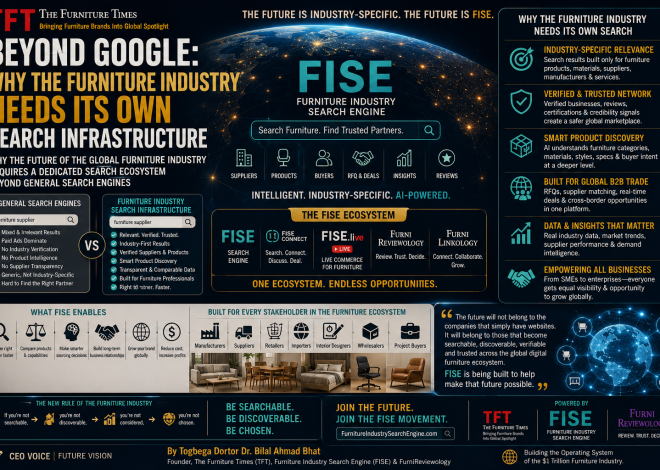
The Furniture Industry Search Engine can support structured discovery across the furniture ecosystem, allowing manufacturers, retailers, products and services to become searchable beyond the largest platforms.
The Furniture Times can document company stories, innovation and expertise.
FurniReviewology can provide a trust layer through transparent review information.
These functions—storytelling, discovery and trust—will become increasingly connected as AI systems influence buying decisions.
The Future of Search Is Not the End of Search
Traditional search is not disappearing. It is changing form.
Consumers will continue using:
- Search engines
- Retail websites
- Marketplaces
- Social platforms
- Visual search
- Voice interfaces
- AI assistants
- Physical stores
- Recommendations from other people
The difference is that discovery will move more fluidly across these environments.
A shopper may photograph a chair, ask an AI assistant to identify the style, compare similar options, read summarized reviews, visit a local showroom and complete the purchase through a mobile device.
Retailers must be present across the journey without publishing conflicting information.
A Consumer Bill of Expectations for AI Shopping
A better future for digital shoppers should include several basic expectations.
Consumers should be able to expect:
- Accurate product information
- Clear identification of sponsored recommendations
- Transparent pricing
- Current availability
- Authentic reviews
- Understandable return policies
- Protection of personal data
- Control over personalization
- Access to human assistance
- Explanation of important recommendation criteria
- Fair presentation of suitable alternatives
- Reliable delivery information
Retail innovation should not require consumers to surrender transparency.
A Retailer Bill of Expectations
Retailers also need fair treatment from AI platforms.
They should be able to expect:
- Accurate representation of their products
- A process for correcting errors
- Transparent integration requirements
- Clear commercial terms
- Access to meaningful performance information
- Protection of proprietary data
- Identification of sponsored and organic results
- Fair opportunities for qualified SMEs
- Control over inventory and price information
- Preservation of brand identity
A healthy digital marketplace must create value for both sides.
Final Analysis: Better Discovery Must Produce Better Decisions
The digital-retail industry has spent years making shopping faster. Its next responsibility is to make shopping better.
Artificial intelligence can reduce search frustration, interpret complex customer needs and identify products hidden inside enormous catalogs. It can help retailers understand demand, improve merchandising and connect specialized products with relevant buyers.
But greater intelligence does not automatically create greater fairness.
If AI recommendations are unclear, commercially distorted or based on incomplete data, digital shopping may become more convenient while becoming less transparent. Consumers could receive fewer meaningful choices, while smaller retailers become invisible behind dominant platforms.
A better future requires balance.
Retailers must improve their product data, digital infrastructure and customer support. Technology companies must design explainable and fair discovery systems. Review platforms must protect authenticity. Consumers need control over personalization, and regulators will need to monitor how recommendation systems influence competition.
For furniture retailers, the immediate message is clear: products must become understandable to both people and machines.
A beautiful sofa with incomplete dimensions is difficult to recommend. A durable table with no material information is difficult to compare. A trusted showroom with inconsistent digital details is difficult to discover.
The winners in the next era of retail will not necessarily be the companies with the largest catalogs. They will be the companies that provide the clearest information, the most suitable choices and the most trustworthy experience.
The search for a better future for digital shoppers and retailers has already begun. The challenge now is ensuring that intelligence serves the market—rather than quietly controlling it.
Primary Source:
Forbes — In Search of a Better Future for Digital Shoppers and Retailers Alike
The Furniture Times (TFT) & Furniture Industry Search Engine (FISE)
“TFT tells their story. FISE helps the world find them.”
FurniReviewology helps the world trust them.
The furniture industry ecosystem is a $1 trillion industry ecosystem.