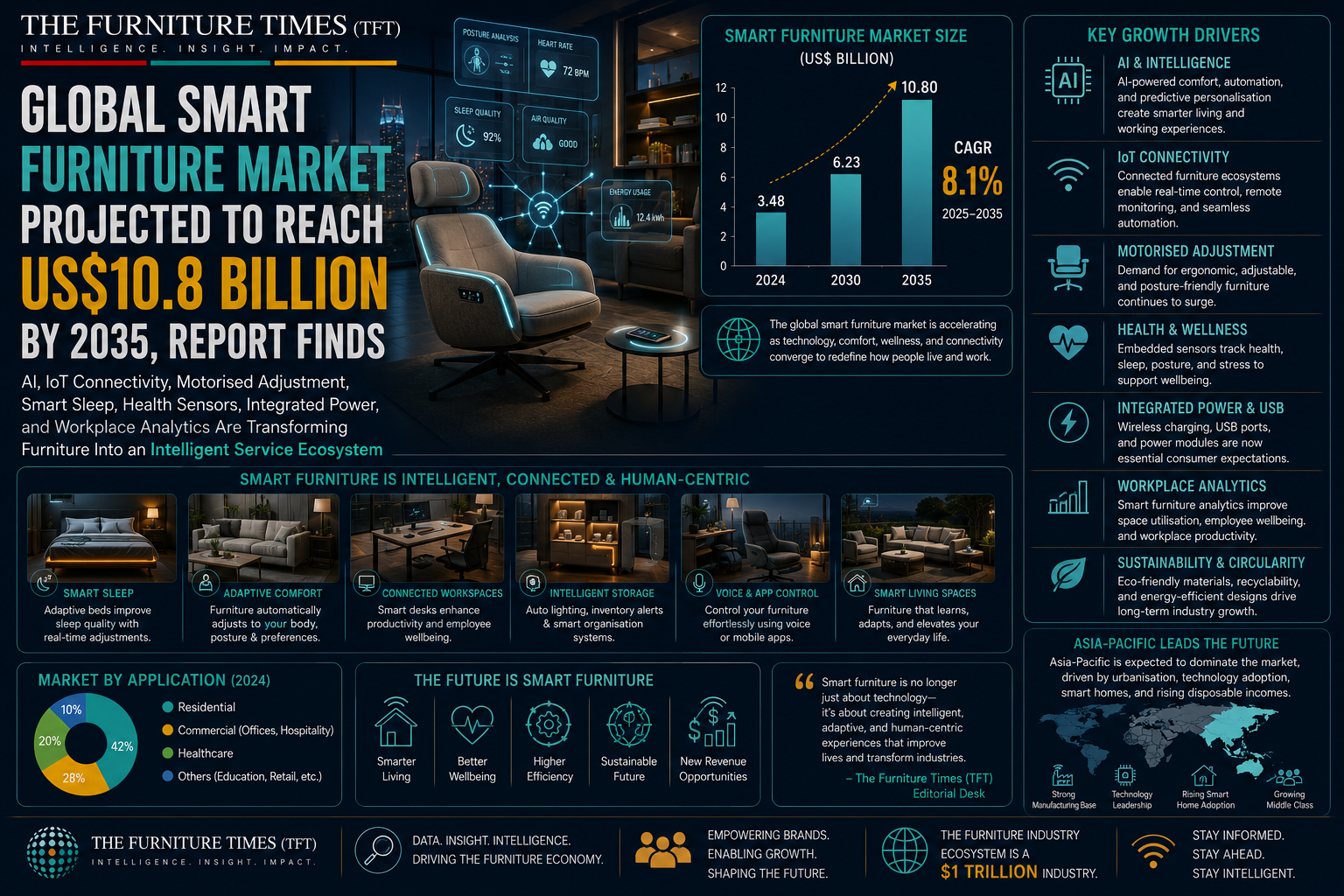
Global Smart Furniture Market Projected to Reach US$10.8 Billion by 2035
Report Finds
AI, IoT Connectivity, Motorised Adjustment, Smart Sleep, Health Sensors, Integrated Power, and Workplace Analytics Are Transforming Furniture Into an Intelligent Service Ecosystem
By The Furniture Times (TFT) Editorial Desk | Smart Furniture | AI & Future Technology Intelligence
The global furniture industry is entering a new technological era in which desks, chairs, beds, tables, storage units, office pods, and architectural systems are evolving from static products into connected, adjustable, and data-enabled environments.
A new report from Next Move Strategy Consulting estimates that the global smart furniture market was valued at US$4.2 billion in 2025 and will reach approximately US$4.6 billion in 2026. The publisher forecasts the market will expand to US$10.8 billion by 2035, representing a compound annual growth rate of 9.9% from 2026 to 2035.
Growth is being driven by hybrid work, workplace ergonomics, smart-home adoption, healthcare modernisation, connected sleep systems, motorised adjustment, integrated power, sensor-enabled furniture, and demand for more efficient use of residential and commercial spaces.
The market is also moving beyond one-time furniture sales. Software subscriptions, analytics dashboards, sleep applications, remote support, and predictive-maintenance services are creating recurring revenue opportunities for manufacturers.
The report’s most important message is that smart furniture is becoming an ecosystem rather than a standalone product category. The value is no longer limited to the chair, desk, or bed itself. It increasingly includes sensors, motors, software, connectivity, applications, data, maintenance, and integration with smart homes or commercial buildings. Next Move Strategy Consulting—Smart Furniture Market
Smart Furniture Market Forecast at a Glance
| Market indicator | Publisher’s estimate |
| Global market value, 2025 | US$4.2 billion |
| Estimated market value, 2026 | US$4.6 billion |
| Forecast market value, 2035 | US$10.8 billion |
| Forecast CAGR, 2026–2035 | 9.9% |
| Largest product category | Desks and tables |
| Fastest-growing product category | Modular and architectural systems |
| Largest technology category | Motorised adjustment |
| Fast-growing technology category | Connectivity and app control |
| Largest end-user market | Commercial offices |
| Fastest-growing end-user market | Healthcare |
| Largest distribution channel | Dealer and contract sales |
| Fastest-growing distribution channel | Direct-to-consumer online |
| Largest revenue stream | Product sales |
| Fastest-growing revenue stream | Subscriptions and software services |
| Largest region | North America |
| Fastest-growing major region | Asia-Pacific |
These figures are estimates published by Next Move Strategy Consulting. Market values can vary among research organisations because of differences in product definitions, included technologies, geographic coverage, revenue treatment, and forecasting methodology.
What Is Smart Furniture?
Smart furniture includes products fitted with electronic, mechanical, or digital capabilities that go beyond the ordinary functions of conventional furniture.
These capabilities can include:
Motorised height or position adjustment
Wireless connectivity
App-based control
Integrated power outlets
USB charging
Wireless charging
Occupancy sensors
Environmental sensors
Posture monitoring
Pressure sensing
Temperature control
Automated movement
Usage analytics
Predictive-maintenance alerts
Integration with smart buildings
Integration with smart-home platforms
Examples include:
Height-adjustable desks
Connected office chairs
Smart beds and mattresses
Sensor-equipped hospital beds
Charging tables
App-controlled recliners
Motorised wall beds
Occupancy-sensing workstations
Intelligent storage systems
Transformable robotic furniture
Connected acoustic pods
Sensor-enabled public seating
A product does not necessarily need artificial intelligence to be considered smart. Motorised adjustment and integrated charging represent more established forms of smart furniture, while AI-supported coaching and predictive analytics represent more advanced applications.
Smart Furniture Has Developed Through Three Major Phases
The report describes smart furniture as having progressed through several stages.
Phase One: Electronic Adjustment
The first stage focused on electrically adjustable products such as:
Sit-stand desks
Powered recliners
Adjustable hospital beds
Motorised bases
Electronic lifting systems
These products used motors and wired controls but were not necessarily connected to the internet.
Phase Two: Connected Furniture
The next stage introduced Bluetooth, Wi-Fi, mobile applications, remote control, and basic usage tracking.
Users gained the ability to:
Save preferred positions
Control furniture through an application
Receive activity reminders
Monitor basic usage
Connect furniture with other devices
Phase Three: AI-Enabled Furniture Ecosystems
The current phase increasingly combines:
Biometric or environmental sensors
Machine-learning analysis
Posture or movement coaching
Predictive maintenance
Smart-building integration
Workplace experience platforms
Health and wellness applications
This development changes the business model.
A manufacturer is no longer selling only a physical object. It may also be responsible for software, data security, updates, connectivity, technical support, and long-term compatibility.
Desks and Tables Form the Largest Product Category
Next Move Strategy Consulting estimates that smart desks and tables generated approximately US$1.5 billion in 2025 and could reach US$3.62 billion by 2035.
Height-adjustable desks are the most established smart furniture product.
Their growth has been supported by:
Hybrid work
Home offices
Workplace ergonomics
Employee-wellness programmes
Corporate office renewal
Co-working spaces
Adjustable educational environments
A modern smart desk may include:
Electric lifting columns
Memory controls
Anti-collision protection
Sitting and standing reminders
Occupancy detection
Wireless charging
Power modules
Cable management
Desk-booking integration
Usage analytics
The desk is becoming an interactive workplace platform.
From Height Adjustment to Workplace Intelligence
The first generation of adjustable desks focused on movement. Newer products may connect with workplace-management systems.
A facilities manager could potentially analyse:
Which desks are occupied
How frequently spaces are used
When maintenance is required
Whether booked workstations are actually used
Which office areas are underutilised
This can help businesses manage flexible workplaces, but it also creates privacy and governance responsibilities.
Employees should understand what data are being collected and why. Workplace analytics should support operational improvement without becoming unjustified surveillance.
Seating Is Becoming More Responsive
The report estimates that smart seating generated approximately US$820 million in 2025 and may grow to about US$1.94 billion by 2035.
Smart seating can include:
Posture sensors
Pressure mapping
Automatic lumbar adjustment
Position reminders
Temperature control
Occupancy detection
Usage tracking
App-connected settings
Applications extend across:
Offices
Healthcare
Hospitality
Automotive environments
Gaming
Senior living
Public spaces
The most commercially useful smart seating will solve practical problems such as adjustment, comfort, pressure distribution, maintenance, accessibility, and shared-user personalisation.
Technology that adds cost without providing clear value may struggle to achieve broad adoption.
Sleep Furniture Is One of the Fastest-Growing Categories
Next Move Strategy Consulting projects smart sleep furniture to expand from approximately US$700 million in 2025 to US$2.1 billion by 2035, representing an estimated CAGR of 11.6%.
This segment includes:
Adjustable bed bases
Connected mattresses
Pressure-sensing surfaces
Sleep monitoring
Temperature regulation
Anti-snoring adjustments
Position memory
Smart-home integration
Application-based sleep reports
Smart beds may appear in:
Residential bedrooms
Hospitals
Rehabilitation facilities
Senior-living communities
Hotels
Wellness resorts
Smart Sleep Moves Furniture Toward Wellness Services
The traditional mattress transaction ends when the product is delivered. A connected sleep system can create a longer relationship through applications, coaching, updates, and subscription services.
However, manufacturers must avoid overstating health benefits.
Sleep data can be useful for personal awareness, but consumer furniture should not be presented as diagnosing or treating a medical condition unless it has appropriate evidence and regulatory authorisation.
Health-related claims require careful control.
Modular and Architectural Systems Could Grow Fastest
The report identifies modular and architectural smart-furniture systems as the fastest-growing product category, projecting growth from about US$520 million in 2025 to US$1.62 billion in 2035.
This category includes:
Motorised wall beds
Transformable storage walls
Automated room dividers
Connected acoustic pods
Retractable workstations
Robotic furniture systems
Modular office architecture
Space-changing hospitality furniture
The trend is being driven by high property costs and smaller urban spaces.
One room may need to function as:
Bedroom
Office
Living space
Dining area
Study room
Entertainment area
Smart transformable furniture can change the use of a room without increasing its floor area.
This creates opportunities in:
Micro-apartments
Student housing
Co-living
Hotels
Co-working spaces
Senior living
Premium residential projects
Motorised Adjustment Remains the Largest Technology Segment
The publisher estimates that motorised adjustment generated US$1.8 billion in 2025, representing approximately 43% of smart-furniture revenue.
This technology appears in:
Desks
Beds
Recliners
Tables
Cabinets
Healthcare furniture
Kitchen systems
Accessible furniture
Television units
Storage systems
Motorised adjustment has broad appeal because its value is easy to understand. It allows furniture to move, lift, recline, open, close, or change position with less physical effort.
Engineering Responsibilities
Motorised furniture requires manufacturers to manage:
Electrical safety
Load capacity
Motor lifespan
Pinch-point protection
Emergency operation
Anti-collision systems
Noise
Heat
Cable routing
Power consumption
Replaceable parts
A motor failure should not require disposal of the entire furniture product.
Smart furniture must be designed so that motors, control boxes, switches, sensors, power supplies, and wiring can be inspected and replaced.
Connectivity and App Control Are Expanding Rapidly
The report projects strong growth for connectivity and app-control technologies.
These systems allow users to:
Save settings
Control furniture remotely
Monitor usage
Receive reminders
Connect with smart-home platforms
Access analytics
Obtain maintenance alerts
Manage shared furniture
The opportunity is substantial, but interoperability remains a major challenge.
A customer may already use smart lighting, thermostats, speakers, security systems, and other connected devices. A new smart-furniture product must either integrate with that environment or provide enough independent value to justify a separate application.
Consumers are unlikely to welcome a different app for every chair, table, bed, or cabinet.
The industry needs simpler and more compatible ecosystems.
Sensors Are Turning Furniture Into an Information Source
Health and environmental sensors can measure or infer information such as:
Occupancy
Movement
Pressure distribution
Posture
Temperature
Humidity
Air quality
Usage frequency
Equipment condition
In offices, this may support space planning.
In healthcare, pressure and position sensors can support staff awareness and patient-care workflows.
In smart bedrooms, sensors can support sleep tracking.
In hospitality, occupancy data may help improve housekeeping or energy management, subject to privacy rules.
Data Must Be Handled Responsibly
Sensor-equipped furniture can collect sensitive information.
Manufacturers and operators must define:
What data are collected
Why they are collected
Who can access them
How long they are retained
Whether they are shared
How they are protected
How users can control consent
What happens when the product is resold
Smart furniture should follow data-minimisation principles, collecting only what is necessary for the intended function.
Integrated Power and Charging Are Becoming Standard Features
Not every smart-furniture innovation requires complex sensors or artificial intelligence.
Integrated power can provide immediate practical value.
Common features include:
Electrical sockets
USB-A ports
USB-C ports
Wireless charging
Concealed cable channels
Power rails
Replaceable charging modules
These features are useful in:
Office desks
Conference tables
Nightstands
Hotel furniture
Airport seating
Café tables
Classroom furniture
Public-space furniture
Integrated charging is likely to become increasingly common in furniture designed for work, hospitality, education, and travel.
However, charging technology changes faster than furniture.
Manufacturers should avoid permanently embedding components that may become obsolete. Replaceable modules can extend product life and support future upgrades.
Climate Control and Wellness Create Premium Opportunities
Some smart-furniture systems can regulate temperature, airflow, or surface comfort.
Applications include:
Heated or cooled beds
Temperature-controlled mattresses
Heated seating
Ventilated chairs
Climate-responsive workstations
These technologies may appeal to premium residential, hospitality, healthcare, and wellness markets.
Yet they also increase energy consumption, product complexity, and service requirements.
Manufacturers should evaluate whether the added functionality provides enough value to justify the cost and environmental impact.
Commercial Offices Represent the Largest End-User Market
Next Move Strategy Consulting estimates that commercial offices generated approximately US$1.6 billion of smart-furniture revenue in 2025. The segment is forecast to reach US$3.62 billion by 2035.
Corporate demand is being shaped by:
Hybrid work
Flexible seating
Ergonomic investment
Desk booking
Occupancy analytics
Space optimisation
Workplace wellness
Employee experience
Smart furniture can help offices move from fixed layouts toward adaptable environments.
However, workplace buyers increasingly expect systems to connect with:
Booking software
Building management
Access control
Facilities management
Energy monitoring
Workplace applications
Furniture companies entering this market need software-integration capabilities and strong technical partners.
Healthcare Is the Fastest-Growing End-User Segment
The report projects healthcare smart furniture to grow at an estimated CAGR of 11.1%, rising from approximately US$560 million in 2025 to US$1.6 billion by 2035.
Products can include:
Electronically adjustable hospital beds
Pressure-monitoring mattresses
Connected patient chairs
Rehabilitation furniture
Sensor-enabled senior-living furniture
Fall-risk awareness systems
Equipment-location tracking
Healthcare furniture must meet higher requirements involving:
Safety
Hygiene
Cleaning resistance
Reliability
Accessibility
Battery backup
Interoperability
Documentation
Maintenance
Regulatory compliance
The healthcare opportunity is significant, but it is not an ordinary consumer-furniture market.
Manufacturers must understand clinical environments and applicable regulations before making health-related performance claims.
Residential Smart Furniture Is Accelerating
The residential segment was valued by the publisher at approximately US$980 million in 2025 and is forecast to reach US$2.48 billion by 2035.
Residential growth is being driven by:
Smart homes
Home offices
Connected sleep systems
Premium housing
Smaller urban spaces
Accessibility
Entertainment
Wellness interest
Successful residential products will need to be easy to install and operate.
Consumers may reject smart furniture that requires complex setup, frequent subscriptions, or unreliable connectivity.
The best products will continue to function as useful furniture even when internet services are unavailable.
Hospitality Has a Distinct Smart-Furniture Opportunity
The report projects hospitality smart furniture to approach US$980 million by 2035.
Hotels and resorts may adopt:
Integrated charging
Smart beds
Adjustable work surfaces
Occupancy-responsive furniture
Motorised room systems
Connected minibars and storage
Smart mirrors and dressing units
Transformable furniture for smaller rooms
Hospitality operators value technology that improves guest experience, room flexibility, energy management, and maintenance.
They are less likely to value features that create more technical complaints.
Hotel smart furniture must be durable, intuitive, secure, and easy for maintenance teams to service.
Education and Public Spaces Will Adopt Practical Technologies
Smart furniture for education may include:
Height-adjustable desks
Charging tables
Connected collaboration furniture
Reservable study pods
Technology-integrated lecture seating
Mobile modular systems
Public-space applications include:
Charging benches
Airport seating
Connected waiting areas
Smart library furniture
Sensor-enabled public workstations
These markets prioritise durability, safety, security, accessibility, and maintenance.
Technology must survive intensive use by many different people.
Dealer and Contract Sales Remain the Largest Channel
Next Move Strategy Consulting estimates dealer and contract sales generated approximately US$1.4 billion in 2025.
This reflects the strength of commercial, healthcare, education, and hospitality procurement.
Smart-furniture projects often require:
Consultation
Space planning
Technical specification
System integration
Product testing
Installation
Training
Maintenance
Software setup
Ongoing service
Traditional dealer relationships remain important because smart furniture is more complex than ordinary product delivery.
Dealers may increasingly need skills in electronics, connectivity, data platforms, and building integration.
Direct-to-Consumer Online Is the Fastest-Growing Channel
The report projects direct-to-consumer online sales to grow at a CAGR of approximately 13%, from US$520 million in 2025 to US$1.78 billion in 2035.
E-commerce is especially relevant to:
Adjustable desks
Smart beds
Connected mattresses
Gaming furniture
Charging tables
App-controlled seating
For online success, companies need:
Clear demonstrations
Accurate specifications
Setup guidance
Compatibility information
Warranty clarity
Customer reviews
Remote troubleshooting
Replacement-part support
Smart furniture often requires more explanation than conventional furniture. Video, interactive configuration, augmented reality, and detailed FAQs can reduce uncertainty.
OEM and Private-Label Manufacturing Will Expand
Next Move Strategy Consulting projects OEM and private-label channels to grow rapidly.
This creates opportunities for manufacturers that can supply:
Lifting columns
Motors
Control boxes
Sensors
Charging systems
Connected modules
Complete furniture platforms
Software integration
Traditional furniture brands may partner with specialised technology companies rather than developing every electronic component internally.
The industry will increasingly depend on collaboration among:
Furniture manufacturers
Hardware companies
Electronics producers
Software developers
Cloud providers
Sensor manufacturers
Building-technology companies
Healthcare specialists
Software Subscriptions Could Transform Revenue Models
The report identifies subscriptions and software services as the fastest-growing revenue stream, projecting a CAGR of 18.4%.
Recurring services may include:
Workplace analytics
Sleep coaching
Furniture management
Predictive maintenance
Remote diagnostics
Software upgrades
Extended digital warranties
Fleet monitoring
This changes how furniture companies measure customer value.
Under a conventional model, revenue is received when the furniture is sold. Under a connected model, the manufacturer may maintain a digital relationship throughout the product’s life.
The Risk of Subscription Fatigue
Not every feature should require a monthly payment.
Consumers may resist paying continuously for basic functions already included in an expensive product.
Companies should separate:
Essential furniture functionality
Optional premium services
Enterprise analytics
Genuine ongoing support
Furniture should not become unusable because a software subscription ends.
North America Leads the Market
The report estimates that North America generated approximately US$1.7 billion in smart-furniture revenue in 2025 and could reach US$4.1 billion by 2035.
Growth is supported by:
Enterprise ergonomics
Height-adjustable desk adoption
Smart homes
Connected sleep products
Healthcare investment
Technology vendors
E-commerce
The United States represents the largest national market within the publisher’s analysis.
Asia-Pacific Is Forecast to Grow Fastest
Next Move Strategy Consulting projects Asia-Pacific smart-furniture revenue to grow from approximately US$800 million in 2025 to US$2.7 billion by 2035 at a CAGR of 12.8%.
The region’s growth is connected with:
Urbanisation
Premium real estate
Smart cities
Commercial development
Technology manufacturing
Healthcare modernisation
Compact living
Rising middle-class demand
China is identified as the fastest-growing national market in the region, with a projected CAGR of 14.2%.
India, Japan, South Korea, Singapore, Malaysia, Vietnam, Indonesia, and Australia also present different opportunities across smart homes, commercial furniture, healthcare, hospitality, and manufacturing.
Asia-Pacific has an additional advantage: it already produces many of the electronic, mechanical, and furniture components required for connected products.
Hybrid Work Is a Major Market Driver
Hybrid work has changed expectations for both commercial and residential furniture.
Employees want better home workstations. Employers want flexible offices. Facilities managers want accurate space-usage information.
This supports demand for:
Adjustable desks
Ergonomic chairs
Mobile furniture
Reservable workstations
Acoustic pods
Collaboration systems
Charging furniture
Occupancy sensors
The strongest smart-office systems will balance data, employee comfort, privacy, and adaptability.
Smart Homes Create an Enabling Ecosystem
Smart furniture benefits from the wider adoption of connected homes.
Consumers already use:
Smart lighting
Thermostats
Speakers
Security systems
Voice assistants
Appliances
Wearable devices
Furniture can become part of this environment.
A smart bed might coordinate with lighting and temperature. A desk might connect with a calendar or wellness application. Storage could incorporate locks, lighting, charging, or inventory functions.
Interoperability will determine whether these experiences feel seamless or frustrating.
High Prices Remain the Largest Adoption Barrier
The report identifies price as a major restraint.
Smart furniture can cost significantly more than conventional alternatives because it includes:
Motors
Sensors
Electronics
Software
Certification
Technical support
Development costs
The premium may be acceptable where technology creates measurable value, such as workplace productivity, healthcare support, space savings, or accessibility.
It is harder to justify when the feature is primarily decorative or unnecessary.
Manufacturers need products at several price levels:
Basic motorised functionality
Connected mid-range products
Advanced sensor and AI-enabled systems
Modular technology can allow customers to upgrade without replacing the full product.
Interoperability Is a Structural Challenge
Smart-furniture products may use different applications, data formats, communication protocols, and cloud services.
This creates difficulty for:
Consumers
Facilities managers
Healthcare operators
Hotels
IT departments
Dealers
A commercial buyer may hesitate to purchase furniture that cannot connect with its building-management or workplace platform.
Manufacturers should prioritise:
Open standards
Documented APIs
Secure integrations
Data export
Replaceable controllers
Long-term software support
Vendor lock-in may create short-term revenue but damage long-term trust.
Cybersecurity Must Become a Furniture Responsibility
Connected furniture creates new security risks.
A desk or bed that connects to a network becomes part of the digital environment.
Manufacturers must consider:
Secure authentication
Encryption
Software updates
Vulnerability reporting
Access controls
Data minimisation
Product end-of-support policies
Secure factory settings
Furniture companies without cybersecurity expertise should work with qualified technology partners.
Security cannot be added only after a connected product reaches customers.
Repairability Is Essential
Conventional furniture may remain usable for decades. Electronics often have shorter replacement cycles.
Smart furniture must therefore be designed for component replacement.
Replaceable elements may include:
Motors
Sensors
Batteries
Controllers
Power supplies
Charging ports
Wiring
Communication modules
Permanent electronic integration can turn a minor technical failure into the premature disposal of an entire product.
A circular smart-furniture strategy should include:
Modular electronics
Spare parts
Repair manuals
Upgrade paths
Software support
Recycling information
Product identification
Smart Furniture Must Be Sustainable, Not Disposable Technology
Smart functionality does not automatically make furniture sustainable.
A product’s environmental performance depends on:
Material sourcing
Energy use
Electronics
Product lifespan
Repairability
Upgradeability
Packaging
End-of-life recovery
Manufacturers should avoid designing furniture around short-lived technology trends.
The physical product should remain valuable even if software or connectivity changes.
What Manufacturers Should Do Now
1. Start With a Real User Problem
Do not add technology simply to call a product smart.
2. Design Hardware and Software Together
Furniture engineering, electronics, and digital experience must be coordinated.
3. Make Electronic Components Replaceable
The furniture should outlast vulnerable modules.
4. Prioritise Interoperability
Avoid unnecessary dependence on closed platforms.
5. Build Cybersecurity Into Product Development
Connected furniture must be secure from the beginning.
6. Establish Data-Governance Policies
Define what information is collected and how it is used.
7. Support Manual Operation
Important furniture functions should remain available when connectivity fails.
8. Develop Long-Term Software Support
Customers need clarity on updates and product support.
9. Train Dealers and Installers
Smart products require technical knowledge.
10. Create Recurring Value Carefully
Subscriptions should deliver genuine ongoing benefits.
What Retailers Must Prepare For
Smart-furniture retailers need to communicate:
What the technology does
Which systems it supports
Whether a subscription is required
What happens without internet access
How long software will be supported
How repairs are handled
What data are collected
How the product is installed
Retail staff may need more technical training than conventional furniture salespeople.
Online retailers should provide setup videos, compatibility guides, warranty information, and remote support.
AI Search Will Influence Smart-Furniture Discovery
Customers will increasingly ask AI assistants:
Which smart desk is best for a home office?
Which adjustable bed works without a subscription?
Which connected chair supports multiple users?
Is this smart furniture compatible with my home system?
Which manufacturer provides replacement motors?
Brands need structured, accurate information that AI systems can understand.
Product pages should clearly publish:
Technical features
Compatibility
Dimensions
Security policies
Privacy information
Warranty
Software requirements
Spare-parts availability
Certifications
Support period
The brand that is most understandable and verifiable may gain greater AI-search visibility than the brand making the most ambitious claims.
Conclusion: Furniture Is Becoming a Platform
Next Move Strategy Consulting’s forecast that the smart furniture market could reach US$10.8 billion by 2035 reflects a larger transformation.
Furniture is moving from passive utility toward adaptive environments that can move, connect, sense, charge, monitor, and respond.
The strongest growth opportunities are expected around:
Height-adjustable desks
Smart sleep systems
Healthcare furniture
Modular architectural systems
App-controlled products
Sensor-enabled furniture
Direct-to-consumer sales
Subscription software
Asia-Pacific expansion
Yet the future of smart furniture will not be determined by technology alone.
It will depend on whether products are useful, reliable, secure, repairable, affordable, interoperable, and trustworthy.
A smart desk that cannot be repaired is not intelligent. A connected bed that exposes sensitive information is not responsible. A chair with unnecessary sensors is not automatically better. A subscription that removes basic functionality may weaken customer trust.
The winners will be companies that combine the long-life principles of furniture with the adaptability of technology.
Smart furniture should not become disposable electronics with upholstery or timber attached. It should become durable furniture enhanced by technology that can be maintained, upgraded, and trusted throughout the product’s life.
The Furniture Times (TFT) & Furniture Industry Search Engine (FISE)
“TFT tells their story. FISE helps the world find them.”
FurniReviewology helps the world trust them.
The furniture industry ecosystem is a $1 trillion industry ecosystem.