
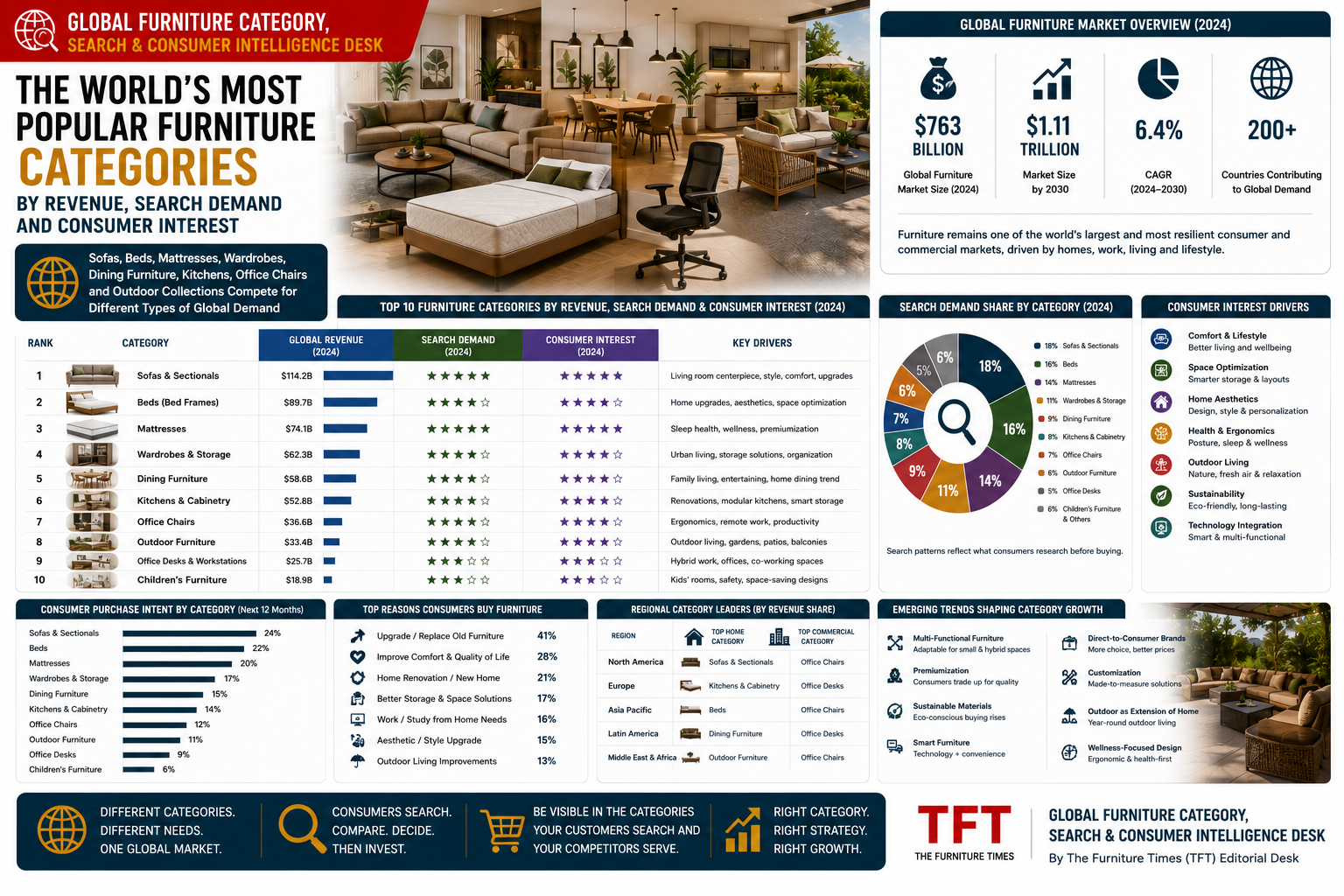
The World’s Most Popular Furniture Categories by Revenue, Search Demand and Consumer Interest
Sofas, Beds, Mattresses, Wardrobes, Dining Furniture, Kitchens, Office Chairs and Outdoor Collections Compete for Different Types of Global Demand
Global Furniture Category, Search & Consumer Intelligence Desk
By The Furniture Times (TFT) Editorial Desk
What is the world’s most popular furniture category?
The answer depends on how popularity is measured.
Bedroom furniture can lead a market assessment because almost every household needs beds, mattresses and clothing storage. Living-room furniture can generate the highest revenue in another dataset because sofas and seating systems carry substantial transaction values. Mattresses may attract intense online research because comfort cannot be judged easily from photographs. Office chairs can experience rapid search growth when work patterns change. Sofa beds can become disproportionately popular in cities where one room must perform several functions.
Furniture popularity should therefore be evaluated through at least three different measures:
- Revenue: How much money the category generates.
- Search demand: How frequently customers search for related products, questions and suppliers.
- Consumer interest: How strongly the category attracts attention, comparison, reviews, inspiration and purchase consideration.
These measures do not always produce the same ranking.
A premium kitchen can generate more revenue than several smaller furniture purchases combined, but consumers do not replace kitchens frequently. A side table may attract many online searches because it is affordable and easy to buy, but its revenue per transaction is limited. A mattress may not be the most visually shared furniture item, yet buyers can spend weeks researching firmness, support, materials and trial policies.
The wider furniture economy is substantial. One current estimate values the global market at approximately US$736.2 billion in 2025 and projects it to reach about US$1.21 trillion by 2035. Another places the market at US$597.7 billion in 2025 and forecasts US$996.4 billion by 2034. The difference reflects varying definitions, product coverage and points of sale.
Within that market, bedroom furniture represented approximately 35.69% of global furniture revenue in 2025 under one broad product analysis. Another home-furniture assessment found that combined living-room and dining-room products accounted for 32.74% of home-furniture revenue in 2025, while home-office furniture was expected to produce the fastest category growth through 2031.
A separate consumer-market forecast places living-room furniture at approximately US$215.85 billion in global market volume for 2026, demonstrating how different product definitions can change the category leader.
The central conclusion is not that one source is necessarily wrong.
It is that the furniture industry requires a multidimensional category ranking.
The Difference Between Revenue and Popularity
Furniture executives often assume that the largest category by revenue must also be the most popular.
That is not always true.
Revenue Is Influenced by Price
A category can generate high revenue because products are expensive.
Examples include:
- Complete kitchens
- Large wardrobes
- Premium sofas
- Bedroom systems
- Hotel room packages
- Executive office furniture
Search Demand Is Influenced by Uncertainty
Customers search more when they need help understanding:
- Dimensions
- Materials
- Comfort
- Compatibility
- Maintenance
- Warranties
- Delivery
- Price comparisons
Consumer Interest Is Influenced by Visibility
Products that strongly affect the appearance or lifestyle of a room may receive more attention through:
- Social media
- Interior-design publications
- Videos
- Showrooms
- Customer reviews
- Visual search
A dining table may generate strong emotional interest because it represents gathering and family life. A wardrobe may produce less lifestyle content but remain essential to household organisation.
Businesses should therefore avoid using one data point to make every commercial decision.
A Practical Global Ranking
Based on market revenue, household necessity, search behaviour, e-commerce activity and lifestyle attention, the world’s major furniture categories can be organised broadly as follows.
Global Revenue Leaders
- Bedroom furniture
- Living-room furniture
- Kitchen and dining furniture
- Office furniture
- Mattresses and sleep systems
- Storage and wardrobes
- Outdoor furniture
- Children’s and youth furniture
- Commercial hospitality furniture
- Accent and occasional furniture
Strongest Search-Demand Categories
- Sofas and sofa beds
- Beds and mattresses
- Dining tables and chairs
- Wardrobes and storage
- Office chairs and desks
- Outdoor furniture
- Kitchen cabinets
- Recliners and armchairs
- Children’s beds and study desks
- Coffee tables and television units
Strongest Lifestyle and Consumer-Interest Categories
- Sofas and modular seating
- Beds and bedroom design
- Dining tables
- Outdoor lounge furniture
- Statement chairs
- Kitchen islands and cabinets
- Home-office furniture
- Storage furniture
- Vintage and handcrafted furniture
- Smart and multifunctional furniture
These rankings are directional rather than universal. Search behaviour varies by language, country, season, housing type and advertising activity. Google Trends itself provides relative interest rather than exact worldwide purchase numbers, so it should be combined with sales, product and trade data.
Number One: Bedroom Furniture
Bedroom furniture is one of the strongest categories in the global furniture economy because sleeping and clothing storage are universal human needs.
The category includes:
- Beds
- Mattresses
- Headboards
- Bedside tables
- Wardrobes
- Dressers
- Chests of drawers
- Vanity units
- Bedroom benches
- Storage beds
One major market analysis estimated that bedroom furniture represented 35.69% of the global furniture market in 2025, making it the largest product segment under that classification. Urbanisation, housing development, rental demand, comfort and space-saving design were identified as important drivers.
Why Bedroom Furniture Generates High Revenue
A bedroom is rarely furnished with only one product.
A complete purchase may include:
- Bed frame
- Mattress
- Two bedside tables
- Wardrobe
- Dresser
- Mirror
- Bench or chair
Bedroom furniture also serves every major customer group:
- Children
- Students
- Couples
- Families
- Hotel guests
- Senior citizens
- Healthcare users
Strongest Bedroom Search Themes
- Best mattress
- Bed size guide
- Storage bed
- Wardrobe for small room
- King versus queen bed
- Mattress firmness
- Bedroom furniture package
- Adjustable bed
- Bunk bed
- Children’s bed
Future Growth Drivers
- Greater awareness of sleep quality
- Smaller homes requiring storage beds
- Ageing populations
- Smart sleep systems
- Hospitality development
- Mattress replacement cycles
- Rental and student accommodation
Strategic Position
Bedroom furniture is likely to remain the strongest necessity-driven global category.
Number Two: Living-Room Furniture
The living room is the emotional and social centre of many homes.
Its main categories include:
- Sofas
- Sectionals
- Armchairs
- Recliners
- Sofa beds
- Coffee tables
- Side tables
- Television units
- Shelving
- Consoles
- Ottomans
A consumer-market forecast places living-room furniture at approximately US$215.85 billion in 2026, making it the largest segment in that particular market structure.
Another assessment found combined living-room and dining-room furniture accounted for 32.74% of global home-furniture revenue in 2025.
Why Living-Room Furniture Attracts Strong Consumer Interest
The living room is:
- Highly visible
- Frequently shared with guests
- Central to relaxation
- Important in photographs and videos
- Strongly connected with personal identity
A sofa is often the largest visual object in the room.
Customers therefore spend significant time comparing:
- Shape
- Size
- Fabric
- Colour
- Comfort
- Cushion firmness
- Modularity
- Durability
- Reviews
Sofas Dominate Living-Room Search
Search interest is particularly strong around:
- Small apartment sofas
- Modular sofas
- Curved sofas
- Pet-friendly fabrics
- Easy-clean sofas
- Sectional sofas
- Sofa beds
- Recliners
- Luxury sofas
Search and reader-interest evidence from the United Kingdom showed especially strong demand for sofa beds, with one 2025 analysis reporting approximately 301,000 monthly searches for the category. This is one country-specific estimate rather than a global total, but it illustrates the strength of multifunctional seating demand.
Future Growth Drivers
- Smaller homes
- Modular living
- Multifunctional rooms
- Home entertainment
- Performance fabrics
- Replacement covers
- Growing rental populations
Strategic Position
Living-room furniture is the strongest category for emotional attraction, design identity and social-media visibility.
Number Three: Mattresses and Sleep Systems
Mattresses occupy a distinctive position between furniture, wellness and consumer healthcare.
The mattress is often purchased separately from the bed frame, and consumers may spend substantial time researching it.
Why Mattress Search Demand Is High
Mattress customers compare:
- Firmness
- Support
- Foam
- Springs
- Hybrid construction
- Temperature control
- Motion transfer
- Trial periods
- Warranties
- Sleep positions
Unlike a table or wardrobe, a mattress cannot be evaluated reliably through appearance.
The customer must trust:
- Technical claims
- Reviews
- Brand reputation
- Trial policies
- Retail advice
Important Mattress Search Themes
- Best mattress for back support
- Firm versus medium mattress
- Memory foam versus spring
- Best mattress for couples
- Mattress for side sleepers
- Cooling mattress
- Mattress trial period
- Mattress warranty
- Orthopaedic mattress
- Mattress for older adults
Commercial Demand
Mattresses are also central to:
- Hotels
- Hospitals
- Care homes
- Student accommodation
- Serviced residences
- Rental properties
Future Growth Drivers
- Sleep awareness
- Ageing populations
- Smart sleep technologies
- Hospitality growth
- Mattress replacement
- Online mattress brands
- Home healthcare
Strategic Position
Mattresses are among the most research-intensive and trust-sensitive furniture purchases.
Number Four: Kitchen and Dining Furniture
Kitchen and dining furniture connects household function with property value, food culture and family life.
The category includes:
- Kitchen cabinets
- Kitchen islands
- Pantry systems
- Dining tables
- Dining chairs
- Benches
- Bar stools
- Sideboards
- Buffets
- Breakfast counters
One market estimate values the global kitchen and dining furniture sector at approximately US$132.5 billion in 2025, projecting it to reach US$211.8 billion by 2034.
Why Kitchen Furniture Generates High Revenue
Kitchen furniture often involves:
- Custom measurement
- Large product quantities
- Cabinets and hardware
- Counter coordination
- Installation
- Appliances
- Lighting
- Long project periods
The transaction value can be much higher than for ordinary movable furniture.
Why Dining Furniture Attracts Consumer Interest
The dining table represents:
- Family gathering
- Hospitality
- Celebration
- Food
- Work and study
- Cultural identity
Strongest Search Themes
- Dining table for six
- Round versus rectangular dining table
- Extendable dining table
- Dining table size guide
- Solid wood dining table
- Kitchen cabinet material
- Modular kitchen
- Kitchen island design
- Small apartment dining set
- Easy-clean dining chairs
Future Growth Drivers
- Renovation
- Urban storage needs
- Multifunctional dining tables
- Open-plan living
- Outdoor kitchens
- Premium hardware
- Modular systems
Strategic Position
Kitchen furniture leads through transaction value, while dining furniture leads through emotional and multifunctional household use.
Number Five: Wardrobes and Storage Furniture
Storage is one of the most functionally important furniture categories.
It includes:
- Wardrobes
- Closets
- Drawer units
- Shoe cabinets
- Bookcases
- Wall storage
- Storage benches
- Pantry systems
- Under-bed storage
- Modular shelving
Why Storage Demand Is Growing
Households are dealing with:
- Smaller properties
- More clothing
- Work equipment
- Children’s products
- Sports equipment
- Technology
- Seasonal belongings
- Limited built-in storage
Storage purchases are problem-driven.
Customers are not simply buying a cabinet. They are attempting to restore order and reclaim usable space.
Strongest Search Themes
- Wardrobe for small bedroom
- Sliding-door wardrobe
- Floor-to-ceiling wardrobe
- Shoe cabinet for entryway
- Storage bed
- Modular closet
- Bookshelf with storage
- Apartment storage ideas
- Wardrobe internal layout
- Custom wardrobe near me
Search and Revenue Relationship
Storage may not always attract the same social-media attention as sofas, but it generates strong high-intent searches.
A person searching for “custom wardrobe manufacturer near me” may be closer to purchase than someone casually viewing living-room inspiration.
Future Growth Drivers
- Urbanisation
- Smaller homes
- Home offices
- Multigenerational living
- Custom interiors
- Modular construction
- Rental living
Strategic Position
Storage is one of the most durable problem-solving categories and a major opportunity for customisation.
Number Six: Office Furniture
Office furniture includes both commercial workplace and residential home-office products.
The category includes:
- Task chairs
- Desks
- Workstations
- Meeting tables
- Storage
- Lockers
- Reception furniture
- Acoustic booths
- Collaborative seating
- Height-adjustable desks
Why Office Chairs Attract High Search Demand
Consumers compare:
- Ergonomics
- Adjustability
- Lumbar support
- Seat depth
- Materials
- Weight capacity
- Warranty
- Price
Office chairs are frequently searched because customers recognise that comfort and posture matter, but often do not understand the technical differences.
Home-Office Growth
One market analysis found home-office furniture was expected to achieve the fastest product growth within the home-furniture market through 2031, at an estimated 4.10% compound annual growth rate.
Strongest Search Themes
- Best ergonomic office chair
- Office chair for long hours
- Small home-office desk
- Height-adjustable desk
- Desk with storage
- Gaming chair versus office chair
- Office furniture supplier
- Modular workstation
- Acoustic office pod
- Commercial office chairs
Future Growth Drivers
- Hybrid work
- Freelancing
- Home businesses
- Corporate workplace redesign
- Employee wellbeing
- Flexible offices
- Gaming and creator workstations
Strategic Position
Office furniture is one of the strongest categories for technical comparison, recurring commercial orders and hybrid residential demand.
Number Seven: Outdoor Furniture
Outdoor furniture has moved from a seasonal category into a lifestyle, hospitality and property-value market.
It includes:
- Outdoor sofas
- Dining sets
- Loungers
- Daybeds
- Balcony sets
- Benches
- Parasols
- Pool furniture
- Rooftop furniture
- Outdoor kitchens
Why Consumer Interest Is Growing
Outdoor areas are becoming:
- Living rooms
- Dining areas
- Workspaces
- Wellness spaces
- Hospitality venues
- Social environments
Strongest Search Themes
- Outdoor furniture for rain
- Rustproof outdoor furniture
- Teak versus aluminium
- Balcony furniture
- Pool loungers
- Outdoor sofa
- Resort furniture supplier
- Rooftop restaurant furniture
- Weather-resistant cushions
- Garden dining set
Future Growth Drivers
- Outdoor living
- Hospitality development
- Balcony use
- Rooftop venues
- Tourism
- Wellness
- Climate-specific design
Strategic Position
Outdoor furniture is among the strongest lifestyle-growth categories and one of the most important markets for material-performance education.
Number Eight: Children’s and Youth Furniture
Children’s furniture creates repeated purchases as the child grows.
The category includes:
- Cots
- Children’s beds
- Bunk beds
- Study desks
- Chairs
- Toy storage
- Wardrobes
- Changing units
- Montessori furniture
Search-trend research published in 2026 identified substantial interest in products such as Montessori beds, toddler floor beds and related children’s sleep categories. One trend analysis estimated approximately 91,000 searches for “Montessori bed” and 58,000 for “toddler floor bed,” though the geography and platform methodology should be considered when interpreting those figures.
Why Search Demand Is Strong
Parents research:
- Safety
- Age suitability
- Materials
- Stability
- Size
- Adjustability
- Development
- Storage
- Durability
Strongest Search Themes
- Montessori bed
- Toddler bed
- Bunk bed with desk
- Children’s study table
- Adjustable student desk
- Toy storage
- Safe children’s furniture
- Small bedroom for siblings
- Cot that converts to bed
- Children’s wardrobe
Future Growth Drivers
- Child development awareness
- Digital education
- Compact family homes
- Adjustable furniture
- Safety standards
- Multifunctional rooms
Strategic Position
Children’s furniture is a high-trust, safety-sensitive category with strong repeat-purchase potential.
Number Nine: Commercial Hospitality Furniture
Hospitality furniture includes products for:
- Hotels
- Resorts
- Restaurants
- Cafés
- Bars
- Serviced apartments
- Event venues
- Spas
- Beach clubs
The category may not generate the same public search volume as sofas or beds, but professional searches can lead to very large contracts.
High-Value Search Terms
- Hotel furniture manufacturer
- Hotel FF&E supplier
- Resort outdoor furniture
- Restaurant chair supplier
- Commercial pool loungers
- Hotel bedroom furniture
- Custom hospitality furniture
- Furniture supplier with installation
Why Revenue Potential Is High
One hotel project may require:
- Hundreds of beds
- Headboards
- Wardrobes
- Desks
- Chairs
- Lobby furniture
- Restaurant furniture
- Outdoor collections
Commercial search volume can be lower than residential volume while the average transaction value is dramatically higher.
Future Growth Drivers
- Global tourism
- Hotel renovation
- Branded residences
- Restaurants
- Resort development
- Lifestyle hospitality
- Wellness tourism
Strategic Position
Hospitality furniture is one of the highest-value business-to-business categories despite lower public search visibility.
Number Ten: Accent and Occasional Furniture
This category includes:
- Coffee tables
- Side tables
- Consoles
- Mirrors
- Benches
- Ottomans
- Accent chairs
- Display shelves
- Decorative cabinets
These products often carry lower transaction values but high visual and e-commerce appeal.
Why They Perform Well Online
They are generally:
- Smaller
- Easier to ship
- Easier to visualise
- Less comfort-sensitive
- Lower risk
- More trend-driven
- Suitable for impulse or upgrade purchases
Strongest Search Themes
- Coffee table for small living room
- Nesting tables
- Accent chair
- Console table
- Entryway bench
- Ottoman with storage
- Side table
- Statement mirror
Strategic Position
Occasional furniture is an important online and design-interest category with lower barriers to first purchase.
The Special Rise of Multifunctional Furniture
Multifunctional furniture cuts across several categories.
Examples include:
- Sofa beds
- Storage beds
- Extendable dining tables
- Folding desks
- Modular sofas
- Coffee tables with lift-up surfaces
- Bunk beds with workstations
- Storage benches
Sofa beds have shown particularly strong search interest in space-constrained markets. Reader and search evidence during 2025 also showed strong attention toward compact, stylish products that serve as both everyday seating and guest sleeping solutions.
Why Multifunctionality Is Growing
- Smaller homes
- Expensive property
- Rental living
- Home working
- Guest accommodation
- Household flexibility
- Urban mobility
Strategic Position
Multifunctional furniture is not one category—it is a design principle reshaping every major category.
Revenue Leaders Versus Search Leaders
A useful category strategy should recognise the difference between high-revenue and high-search products.
High Revenue, Lower Purchase Frequency
- Kitchens
- Complete bedrooms
- Wardrobes
- Premium sofas
- Hotel furniture
- Office fit-outs
These categories require longer sales journeys and professional consultation.
High Search, High Comparison
- Mattresses
- Sofas
- Office chairs
- Dining tables
- Outdoor furniture
- Children’s beds
These categories require educational content, reviews and comparison tools.
High Interest, Lower Transaction Value
- Coffee tables
- Accent chairs
- Side tables
- Mirrors
- Small shelves
These categories can perform strongly through e-commerce and visual media.
High Contract Value, Lower Public Search Volume
- Hotel FF&E
- Healthcare furniture
- Education furniture
- Retail fixtures
- Corporate offices
These require technical visibility rather than mass consumer attention.
Search Demand Is Not the Same as Sales
A search can indicate several different intentions.
Informational Search
The customer wants to learn.
Examples:
- What sofa fabric is best?
- What size dining table do I need?
- Is MDF durable?
Commercial Investigation
The customer is comparing options.
Examples:
- Best modular sofa brands
- Teak versus aluminium furniture
- Office-chair reviews
Transactional Search
The customer may be ready to purchase.
Examples:
- Sofa available today
- Dining table price
- Wardrobe supplier near me
- Buy mattress online
Professional Procurement Search
The buyer is seeking a supplier or quotation.
Examples:
- Hotel furniture manufacturer
- School desk supplier
- Commercial furniture tender
Furniture companies should measure the quality and intent of search traffic rather than counting every search equally.
Consumer Interest Changes by Life Stage
Students and First-Time Renters
Strong interest in:
- Beds
- Mattresses
- Desks
- Chairs
- Portable storage
- Sofa beds
Young Couples
Strong interest in:
- Bedroom furniture
- Sofas
- Dining sets
- Wardrobes
- Home offices
Families
Strong interest in:
- Sectional sofas
- Storage
- Children’s furniture
- Extendable dining
- Durable upholstery
Established Homeowners
Strong interest in:
- Replacement sofas
- Premium dining
- Kitchens
- Outdoor furniture
- Custom storage
Older Consumers
Strong interest in:
- Supportive chairs
- Recliners
- Adjustable beds
- Accessible storage
- Easy-maintenance furniture
Consumer Interest Changes by Region
North America
Strong categories include:
- Sofas and sectionals
- Mattresses
- Bedroom furniture
- Outdoor living
- Home offices
- Storage
Europe
Strong categories include:
- Kitchens
- Compact furniture
- Dining
- Certified wood products
- Modular storage
- Repairable furniture
Asia-Pacific
Strong categories include:
- Bedroom furniture
- Apartment storage
- Mattresses
- Dining
- Modular furniture
- Home offices
Asia-Pacific represented approximately 49.06% of the global furniture market in 2025 under one broad assessment, reflecting its large population, manufacturing base and expanding consumer demand.
Middle East
Strong categories include:
- Living-room seating
- Dining furniture
- Bedroom collections
- Luxury furniture
- Hospitality products
- Outdoor furniture
Africa
High-potential categories include:
- Beds and mattresses
- Affordable storage
- Dining furniture
- School furniture
- Metal furniture
- Basic living-room products
Latin America
Strong categories include:
- Bedroom furniture
- Sofas
- Dining products
- Kitchens
- Mattresses
- Outdoor furniture
The Mid-Market Is the Largest Commercial Battlefield
A major global home-furniture assessment found that mid-range furniture represented approximately 50.77% of revenue in 2025, while premium products were expected to record faster growth through 2031.
This means furniture businesses face competition from both directions.
Affordable brands compete through:
- Price
- Fast delivery
- Flat-pack efficiency
- Promotions
Premium brands compete through:
- Design
- Materials
- Craftsmanship
- Service
- Customisation
Mid-market brands must combine:
- Credible quality
- Attractive design
- Practical durability
- Transparent materials
- Reliable delivery
- Reasonable pricing
The middle market cannot rely on being merely “not too expensive.”
It must provide a clear reason to choose it.
E-Commerce Changes Which Categories Win
Online furniture sales favour products that are:
- Easy to understand
- Easy to measure
- Easy to deliver
- Less dependent on physical comfort testing
- Supported by clear reviews
A current estimate places the global furniture e-commerce market at approximately US$123.18 billion in 2025, with projected growth to US$236.09 billion by 2034. Estimates vary significantly, but the long-term direction indicates rapid digital expansion.
Categories Well Suited to E-Commerce
- Desks
- Shelving
- Coffee tables
- Side tables
- Dining chairs
- Small storage
- Children’s furniture
- Flat-pack beds
Categories Requiring Greater Reassurance
- Sofas
- Mattresses
- Recliners
- Premium dining tables
- Custom wardrobes
- Outdoor lounge systems
These products need:
- Videos
- Samples
- Trials
- Reviews
- Augmented reality
- Showrooms
- Clear return conditions
Seasonality Affects Category Demand
Beginning of the Year
Interest may rise in:
- Home offices
- Storage
- Organisation
- Fitness-related furniture
Spring and Summer
Demand often increases for:
- Outdoor furniture
- Garden dining
- Balcony furniture
- Loungers
- Parasols
School and University Seasons
Demand rises for:
- Study desks
- Student chairs
- Beds
- Storage
- Dormitory furniture
Festive and Wedding Seasons
Demand can increase for:
- Bedroom sets
- Sofas
- Dining furniture
- Mattresses
- Complete household packages
Renovation Periods
Demand rises for:
- Kitchens
- Wardrobes
- Built-in storage
- Dining furniture
- Replacement sofas
Retailers should plan content, inventory and promotions around genuine category cycles.
Categories With the Highest Repeat-Purchase Potential
Some furniture categories have longer replacement cycles than others.
Strong Replacement Categories
- Mattresses
- Sofas
- Office chairs
- Children’s furniture
- Outdoor cushions
- Dining chairs
Expansion Categories
- Modular sofas
- Wardrobes
- Shelving systems
- Dining-chair sets
- Office systems
Refurbishment Categories
- Sofas
- Armchairs
- Solid-wood tables
- Outdoor furniture
- Hotel furniture
After-sales services can create recurring revenue through:
- Replacement covers
- Cushions
- Hardware
- Refinishing
- Reupholstery
- Additional modules
What Furniture Businesses Should Track
Manufacturers and retailers should build category intelligence using:
- Revenue by category
- Unit sales
- Average transaction value
- Gross margin
- Search volume
- Search growth
- Conversion rate
- Return rate
- Delivery damage
- Replacement cycle
- Review volume
- Review sentiment
- Regional demand
- Customer age group
- Residential versus commercial use
A category with high revenue may have weak margins because of freight and returns.
A category with lower revenue may be highly profitable because it is easy to manufacture and deliver.
Popularity without profitability is not enough.
Strategic Priorities for Furniture Manufacturers
Manufacturers should:
- Build strong positions in two or three core categories.
- Avoid entering every category without expertise.
- Develop complete bedroom and living-room systems.
- Invest in modular and multifunctional design.
- Create category-specific quality standards.
- Provide replacement parts.
- Improve packaging for e-commerce.
- Design compact products for urban homes.
- Separate residential and commercial specifications.
- Publish detailed searchable product information.
- Monitor material and lifestyle searches.
- Develop product families that encourage repeat purchase.
- Use search questions to guide new products.
- Test high-interest categories before scaling.
- Measure category profitability after delivery and warranty costs.
Strategic Priorities for Furniture Retailers
Retailers should:
- Organise navigation by room, product and customer problem.
- Create clear bedroom, living, dining and office pathways.
- Publish category comparison guides.
- Display room packages.
- Offer category-specific filters.
- Show exact dimensions.
- Use customer reviews prominently.
- Create material and comfort guides.
- Build local category pages.
- Connect online discovery with showroom testing.
- Promote replacement components.
- Track searches that produce sales.
- Avoid relying only on broad “furniture” keywords.
- Create professional pages for commercial categories.
- Plan inventory around regional and seasonal demand.
The Future Category Winners Through 2035
Strongest Overall Revenue Position
Bedroom and living-room furniture
Universal household demand and high transaction values will protect these categories.
Strongest Search Position
Sofas, beds, mattresses, dining tables, wardrobes and office chairs
These products require significant comparison and reassurance.
Strongest Multifunctional Growth
Sofa beds, storage beds, extendable tables and modular furniture
Smaller homes and flexible living will support demand.
Strongest Commercial Opportunity
Hotel, office, healthcare and education furniture
Individual searches can lead to large projects and recurring contracts.
Strongest Lifestyle Growth
Outdoor furniture
Gardens, balconies, rooftops and hospitality spaces are expanding the category.
Strongest Problem-Solving Growth
Storage furniture
Urban living and household complexity will make organisation increasingly valuable.
Strongest Technology Opportunity
Smart beds, adjustable desks and connected storage
Technology will succeed where it solves practical problems.
Strongest Circular Opportunity
Refurbishable sofas, solid-wood products and modular systems
Repair, resale and component replacement will become more commercially important.
The Most Popular Category Depends on the Question
Which category produces the greatest revenue?
Bedroom or living-room furniture may lead, depending on market definitions.
Which category attracts the most emotional attention?
Sofas and living-room products are among the strongest.
Which category produces the deepest research?
Mattresses, sofas, office chairs and material-sensitive outdoor products.
Which category solves the most urgent urban problem?
Storage and multifunctional furniture.
Which category can create the largest single contract?
Commercial hospitality, office and institutional furniture.
Which category has one of the strongest lifestyle-growth opportunities?
Outdoor furniture.
Which category will remain universally necessary?
Beds, mattresses and bedroom storage.
There is no single furniture category that wins every measure.
Revenue Shows Economic Scale—Search Shows Future Intent
Revenue tells the industry what customers have already purchased.
Search demand reveals what customers are trying to understand, compare or purchase next.
Consumer interest shows which categories are shaping lifestyles, design conversations and future expectations.
Furniture companies need all three.
A brand that studies revenue alone may react too slowly to changing demand.
A brand that studies searches alone may chase attention without profitability.
A brand that studies consumer interest alone may follow short-lived trends.
The strongest strategy combines:
- Market revenue
- Search behaviour
- Customer problems
- Product margins
- Regional lifestyles
- Operational capability
The world’s most popular furniture categories are not simply the products occupying the largest rooms.
They are the categories that solve the most important human needs:
- Sleep
- Comfort
- Storage
- Gathering
- Work
- Learning
- Hospitality
- Outdoor connection
Furniture businesses that understand how revenue, search and consumer interest interact will be better positioned to manufacture the right products, publish the right information and meet demand before competitors recognise where the market is moving.
