
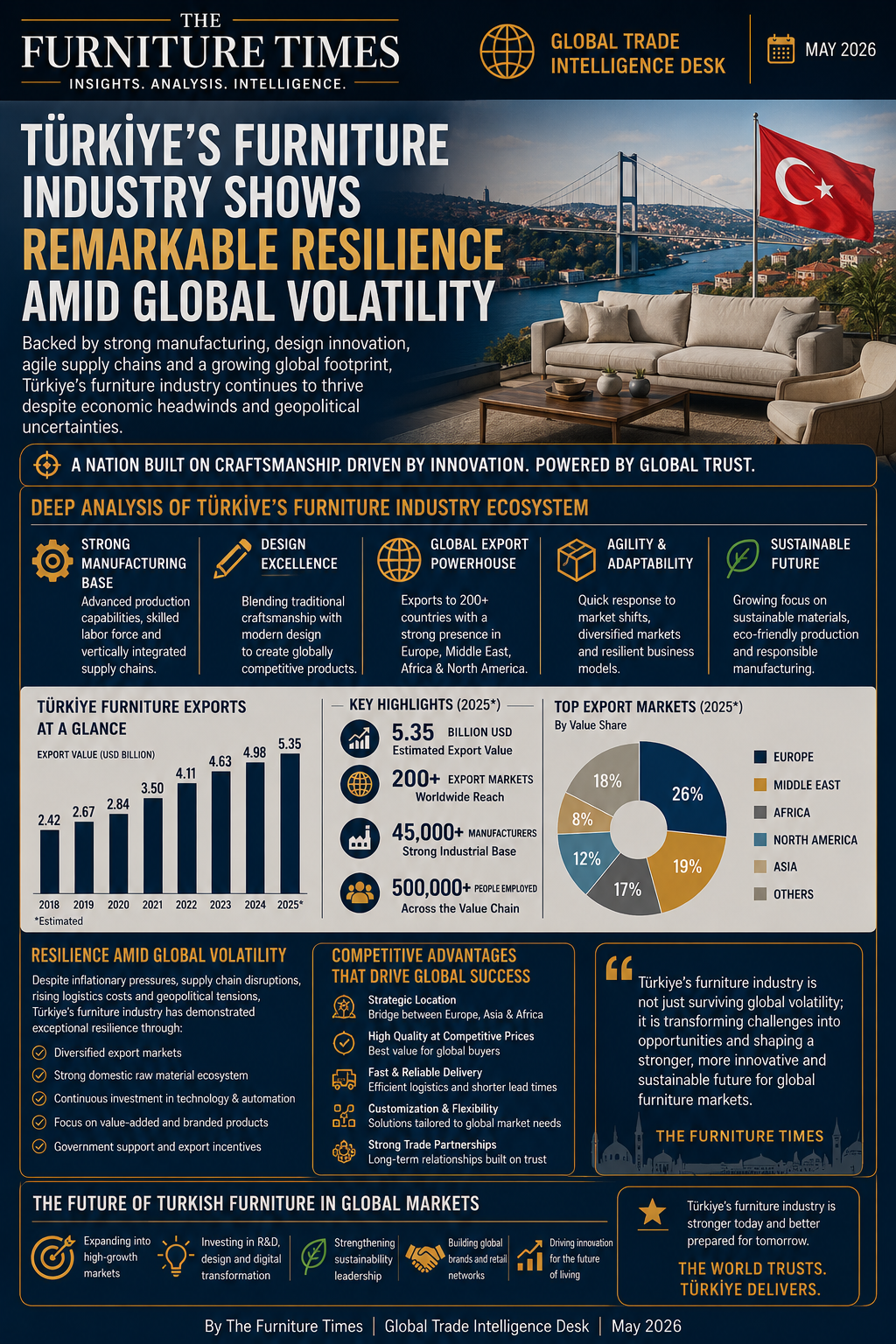
Türkiye’s Furniture Industry Shows Remarkable Resilience Amid Global Volatility
Deep Analysis of Türkiye’s Furniture Industry Ecosystem, Export Growth, Manufacturing Strength & the Future of Turkish Furniture in Global Markets
By The Furniture Times | Global Furniture Trade Intelligence Report | Global Trade Intelligence Desk | May 2026
Türkiye’s furniture industry continues proving itself as one of the strongest and most resilient manufacturing ecosystems in the global furniture economy.
Despite:
geopolitical uncertainty
inflation pressure
global logistics instability
slowing international demand
trade fragmentation
Türkiye’s furniture sector continues expanding its influence across global markets.
According to industry leaders in Türkiye, the sector remains one of the country’s major industrial growth engines, supported by:
manufacturing infrastructure
export diversification
SME industrialization
digital transformation
skilled craftsmanship ecosystems.
The Turkish furniture industry is increasingly becoming:
one of the most strategically important furniture ecosystems in the world.
Türkiye’s Furniture Industry Continues Expanding
Industry data highlighted that Türkiye’s furniture, paper, and forestry product exports reached:
US$8.4 billion in 2025
while the country strengthened its position as:
the world’s seventh-largest furniture exporter.
Net furniture exports reportedly reached:
US$4.6 billion
showing the sector’s continuing export strength despite global economic pressure.
This reflects something important:
Türkiye is no longer simply a regional furniture player.
It is increasingly becoming:
a global furniture manufacturing power.
The Strength of Türkiye’s Manufacturing Ecosystem
One of Türkiye’s biggest advantages remains:
industrial depth.
The country has spent decades building:
woodworking infrastructure
machinery ecosystems
export manufacturing systems
skilled labour networks
supplier ecosystems
Industry representatives stated that the country’s long-term industrialization efforts helped create:
more than 40,000 furniture-related businesses
employment exceeding 420,000 workers.
This scale gives Türkiye:
manufacturing resilience.
Why Türkiye Remains Competitive Globally
Türkiye’s furniture industry benefits from several strategic advantages:
1. Geographic Position
Türkiye connects:
Europe
Asia
Middle East
North Africa
This creates major export advantages.
2. Skilled Craftsmanship
Türkiye remains globally respected for:
woodworking skill
upholstery expertise
decorative craftsmanship
custom furniture manufacturing
The country successfully combines:
traditional craftsmanship + industrial production.
3. Flexible SME Manufacturing
Unlike highly rigid industrial systems,
Türkiye benefits from:
flexible SMEs
adaptive production capacity
custom manufacturing strength
This allows Turkish manufacturers to react quickly to:
trend changes
project-based demand
hospitality customization
4. Strong Export Culture
Türkiye’s furniture ecosystem is heavily export-oriented.
Industry leaders confirmed exports exceeding:
US$1 million annually to 150 countries.
This level of diversification reduces dependence on:
single-market risk
regional instability
Istanbul, Bursa & Kayseri Continue Leading
Several Turkish cities continue serving as major furniture manufacturing hubs.
According to the report:
Istanbul led exports with US$3.5 billion
Bursa (İnegöl) reached US$910 million
İzmir exported US$820 million
Kayseri achieved US$600 million
Gaziantep exported US$590 million.
Each city contributes differently to:
Türkiye’s furniture ecosystem architecture.
İnegöl: One of Türkiye’s Furniture Capitals
İnegöl in Bursa remains especially important.
Globally recognized for:
furniture manufacturing
sofa systems
bedroom furniture
export-oriented production
İnegöl symbolizes:
Türkiye’s industrial furniture strength.
The city has become one of the strongest furniture clusters in:
Europe
Middle East
Eurasia
Gulf Markets Are Becoming Critical
One of the most significant developments highlighted by industry leaders:
rapid growth in Gulf markets.
Saudi Arabia reportedly recorded annual growth exceeding:
200 percent.
This reflects the increasing influence of Turkish furniture in:
UAE
Qatar
Saudi Arabia
Kuwait
Middle East hospitality markets
Turkish furniture increasingly appeals to Gulf buyers because it combines:
luxury aesthetics
European styling
competitive pricing
customization flexibility
Iraq Remains a Major Export Destination
The report also highlighted Iraq as Türkiye’s leading export destination, followed by:
United Kingdom
Germany
United States
Libya
France.
This export diversification strategy strengthens:
long-term industrial stability.
The Rise of Digital Transformation
Another important factor behind Türkiye’s resilience:
SME digital transformation.
Turkish furniture manufacturers increasingly adopt:
digital marketing
AI-supported systems
export platforms
automated manufacturing
CNC machinery
online discoverability strategies
This transition helps the industry remain globally competitive.
Türkiye’s Free Zones Support Industrial Growth
Türkiye’s free zones continue playing a major role in export manufacturing.
Exports from free zones reportedly increased to:
US$4.2 billion in the first four months of 2026.
The country’s industrial ecosystem increasingly supports:
medium-high technology manufacturing
export-oriented production
integrated logistics systems.
This benefits furniture manufacturers heavily.
The Global Volatility Challenge
Despite strong resilience,
Türkiye’s furniture industry still faces major challenges:
inflation pressure
rising energy costs
global trade instability
freight volatility
geopolitical uncertainty
The global furniture industry overall remains under pressure due to:
tariffs
slowing consumer spending
supply chain disruptions
Yet Türkiye continues showing:
industrial adaptability.
Sustainability Will Become Increasingly Important
The future global furniture market increasingly demands:
sustainable sourcing
FSC-certified wood
environmentally responsible production
carbon-conscious manufacturing
Türkiye’s furniture sector will increasingly need to strengthen:
green manufacturing systems
ESG compliance
sustainable production infrastructure
especially for:
European markets
luxury export sectors
AI & Visibility Will Shape the Future
The next phase of global furniture competition may not depend only on:
manufacturing strength
It may increasingly depend on:
discoverability
AI visibility
searchability
digital authority
Turkish furniture businesses that successfully combine:
craftsmanship
manufacturing
visibility infrastructure
may dominate future international markets.
Türkiye’s Furniture Industry Is Entering a New Era
The Turkish furniture industry is now evolving from:
manufacturing economy
toward:
intelligent furniture ecosystem economy.
The future may increasingly depend on:
digital discoverability
AI-readable businesses
global visibility systems
structured export branding
TFT Industry Insight
Türkiye’s resilience proves one important industrial truth:
Manufacturing strength alone is no longer enough.
Long-term success now depends on adaptability, discoverability, market diversification, and ecosystem intelligence.
Türkiye’s furniture ecosystem continues surviving because it combines:
industrial capability
craftsmanship culture
export flexibility
strategic geography
production adaptability
This creates:
structural resilience.
Final Thought
The global furniture industry continues facing:
uncertainty
volatility
restructuring
AI transformation
supply chain instability
Yet Türkiye’s furniture sector continues demonstrating:
industrial resilience.
The country’s strong manufacturing culture, export diversification, SME flexibility, and growing digital transformation efforts position Türkiye as one of the most important furniture ecosystems of the modern era.
And in the future global furniture economy,
the countries that combine:
craftsmanship
manufacturing
discoverability
adaptability
may become the real winners.
Closing Insight
“Türkiye’s furniture industry is proving that resilience in the modern global economy is no longer built only through factories. It is built through adaptability, ecosystem strength, market diversification, craftsmanship culture, and the ability to evolve during uncertainty.”
