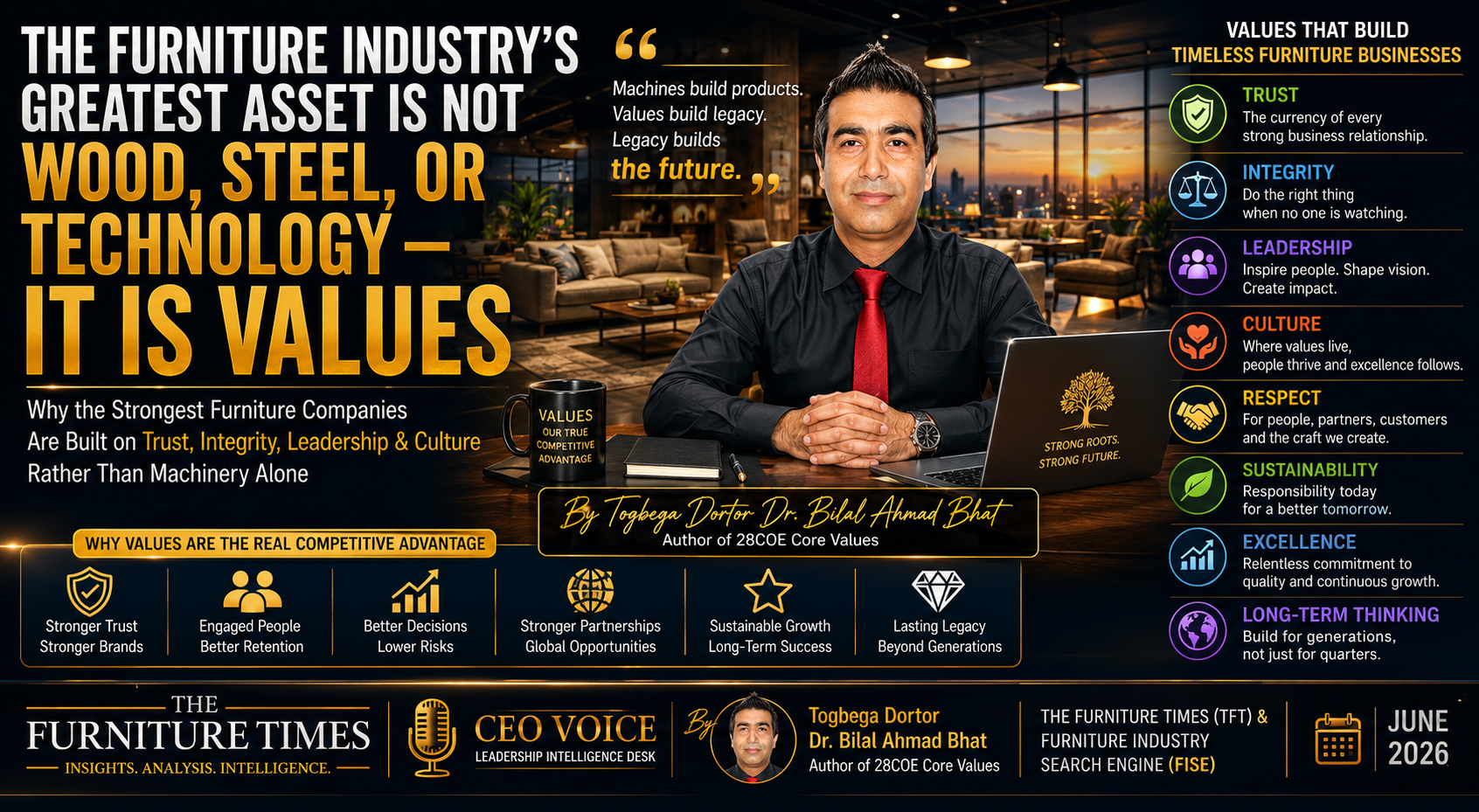
The Furniture Industry’s Greatest Asset Is Not Wood, Steel, or Technology — It Is Values
Why the Strongest Furniture Companies Are Built on Trust, Integrity, Leadership & Culture Rather Than Machinery Alone
CEO Voice | Leadership Intelligence Desk
By Togbega Dortor Dr. Bilal Ahmad Bhat
Author of 28COE Core Values
The Furniture Times (TFT) & Furniture Industry Search Engine (FISE) | June 2026
The global furniture industry is often measured by numbers.
Factory size.
Production capacity.
Export volume.
Revenue.
Machinery.
Technology.
Raw materials.
These are the metrics that dominate conversations in boardrooms, exhibitions, industry reports, and investment meetings.
Yet after spending decades observing businesses across the furniture ecosystem, I have come to a powerful conclusion:
The greatest asset in the furniture industry is not wood.
It is not steel.
It is not machinery.
It is not technology.
It is values.
This may sound surprising in an industry built on manufacturing, production efficiency, and global trade.
But history repeatedly proves one truth:
The companies that survive generations are not necessarily those with the biggest factories.
They are the companies with the strongest values.
The Furniture Industry Has Never Been Short of Products
Walk through any major furniture exhibition in the world.
You will find thousands of products.
Thousands of suppliers.
Thousands of factories.
Thousands of catalogs.
Thousands of promises.
The reality is that the world does not have a shortage of furniture.
The world has a shortage of trust.
It has a shortage of leadership.
It has a shortage of accountability.
It has a shortage of long-term thinking.
These are not manufacturing problems.
These are values problems.
Why Some Furniture Companies Survive for Generations
Have you ever wondered why some furniture businesses survive for 50 years, 75 years, or even 100 years while others disappear within a few years?
The answer is rarely machinery.
Machines can be purchased.
Technology can be copied.
Processes can be replicated.
Products can be imitated.
But values cannot be duplicated easily.
Values become embedded into the DNA of an organization.
They influence:
- Decision-making
- Customer relationships
- Employee engagement
- Supplier partnerships
- Business ethics
- Crisis management
The strongest companies build cultures.
Not just products.
Technology Is Powerful, But Values Guide Technology
Artificial Intelligence is transforming industries.
Automation is reshaping manufacturing.
Digital platforms are changing sourcing.
Search engines are redefining discoverability.
The furniture industry is entering what I often describe as the Intelligence Economy.
But technology alone is not enough.
Technology without values creates risk.
Technology with values creates opportunity.
A company may invest millions into advanced machinery.
But if it lacks integrity, customers eventually leave.
A company may build an impressive digital presence.
But if it lacks transparency, trust eventually collapses.
Technology accelerates performance.
Values determine direction.
Trust Is the New Currency
In today’s furniture industry, trust has become more valuable than ever.
Buyers have more choices.
More suppliers.
More information.
More alternatives.
When options increase, trust becomes the deciding factor.
Trust influences:
- Purchasing decisions
- Partnerships
- Referrals
- Customer loyalty
- Brand reputation
A customer may forget a product.
They rarely forget how a company made them feel.
Trust transforms transactions into relationships.
Relationships create sustainable growth.
The Hidden Cost of Operating Without Values
Many businesses focus on profits while ignoring values.
Initially, this may appear successful.
But eventually the consequences emerge.
Without strong values:
- Employees disengage
- Customers lose confidence
- Suppliers become skeptical
- Reputation weakens
- Culture deteriorates
The cost is rarely visible immediately.
But over time, the damage compounds.
Values are often invisible when present.
They become painfully visible when absent.
Leadership Is Not a Position
One of the biggest misconceptions in business is that leadership belongs only to executives.
True leadership exists at every level.
In the furniture industry:
Leadership exists on factory floors.
Leadership exists in warehouses.
Leadership exists in design studios.
Leadership exists in customer service departments.
Leadership exists in logistics operations.
Every employee contributes to the reputation of the business.
When values are deeply embedded, leadership becomes a shared responsibility rather than a job title.
The 28 Core Values and the Future of Furniture
The 28COE Core Values framework was created to help individuals, organizations, and communities build stronger foundations for sustainable success.
These values include principles such as:
- Integrity
- Accountability
- Respect
- Excellence
- Vision
- Commitment
- Leadership
- Service
- Trust
- Purpose
For furniture companies, these are not abstract concepts.
They are operational assets.
Every value directly influences performance.
Integrity strengthens trust.
Trust strengthens relationships.
Relationships strengthen growth.
Growth strengthens legacy.
Why Culture Is Becoming a Competitive Advantage
The furniture industry is becoming increasingly competitive.
Manufacturing advantages are narrowing.
Technology is becoming more accessible.
Products are becoming easier to replicate.
As these differences diminish, culture becomes more important.
Culture influences:
- Talent retention
- Innovation
- Collaboration
- Customer experiences
- Organizational resilience
The future winners will not necessarily be those with the biggest factories.
They will be those with the strongest cultures.
Sustainability Begins With Values
The furniture industry increasingly discusses sustainability.
Environmental responsibility.
Responsible sourcing.
Circular economies.
Waste reduction.
These initiatives are important.
But sustainability begins with values.
A company that lacks integrity cannot be truly sustainable.
A company that ignores accountability cannot create lasting environmental impact.
Values are the foundation upon which sustainability is built.
The Next Generation Wants Purpose
Today’s workforce is different.
Young professionals increasingly seek:
- Meaning
- Purpose
- Impact
- Values alignment
They want to know:
What does this company stand for?
What difference does it make?
Why does it exist?
Furniture businesses that embrace values attract stronger talent.
Talent drives innovation.
Innovation drives growth.
The Future Furniture Brand
The future furniture brand will not compete solely on:
- Price
- Production
- Products
It will compete on:
- Trust
- Purpose
- Leadership
- Culture
- Visibility
- Values
The brands that understand this shift will build stronger connections with customers, employees, and communities.
My Message to the Global Furniture Industry
After decades of experience across industries and ecosystems, I believe the furniture sector stands at a defining moment.
We are entering a future shaped by:
- AI
- Data
- Search
- Visibility
- Global connectivity
But amidst all this change, one thing remains constant.
Human values.
Technology will evolve.
Markets will change.
Consumer preferences will shift.
But values endure.
They remain the foundation upon which lasting businesses are built.
Final Thoughts
The furniture industry’s greatest asset has never been machinery.
Machinery can manufacture products.
Values manufacture trust.
Machinery can create furniture.
Values create legacy.
Machinery can generate revenue.
Values generate respect.
And in the long run, respect is what transforms businesses into institutions.
As we move toward the future, let us remember:
Wood can build furniture.
Steel can build factories.
Technology can build systems.
But only values can build greatness.
The strongest furniture companies of the future will not simply be known for what they make.
They will be known for what they stand for.
By Togbega Dortor Dr. Bilal Ahmad Bhat
Author of 28COE Core Values
CEO Voice | Leadership Intelligence Desk
The Furniture Times (TFT) & Furniture Industry Search Engine (FISE)
“Managers manage today. Entrepreneurs manage tomorrow.”
“TFT tells their story. FISE helps the world find them.”
The furniture industry ecosystem is a $1 Trillion Dollar Industry.