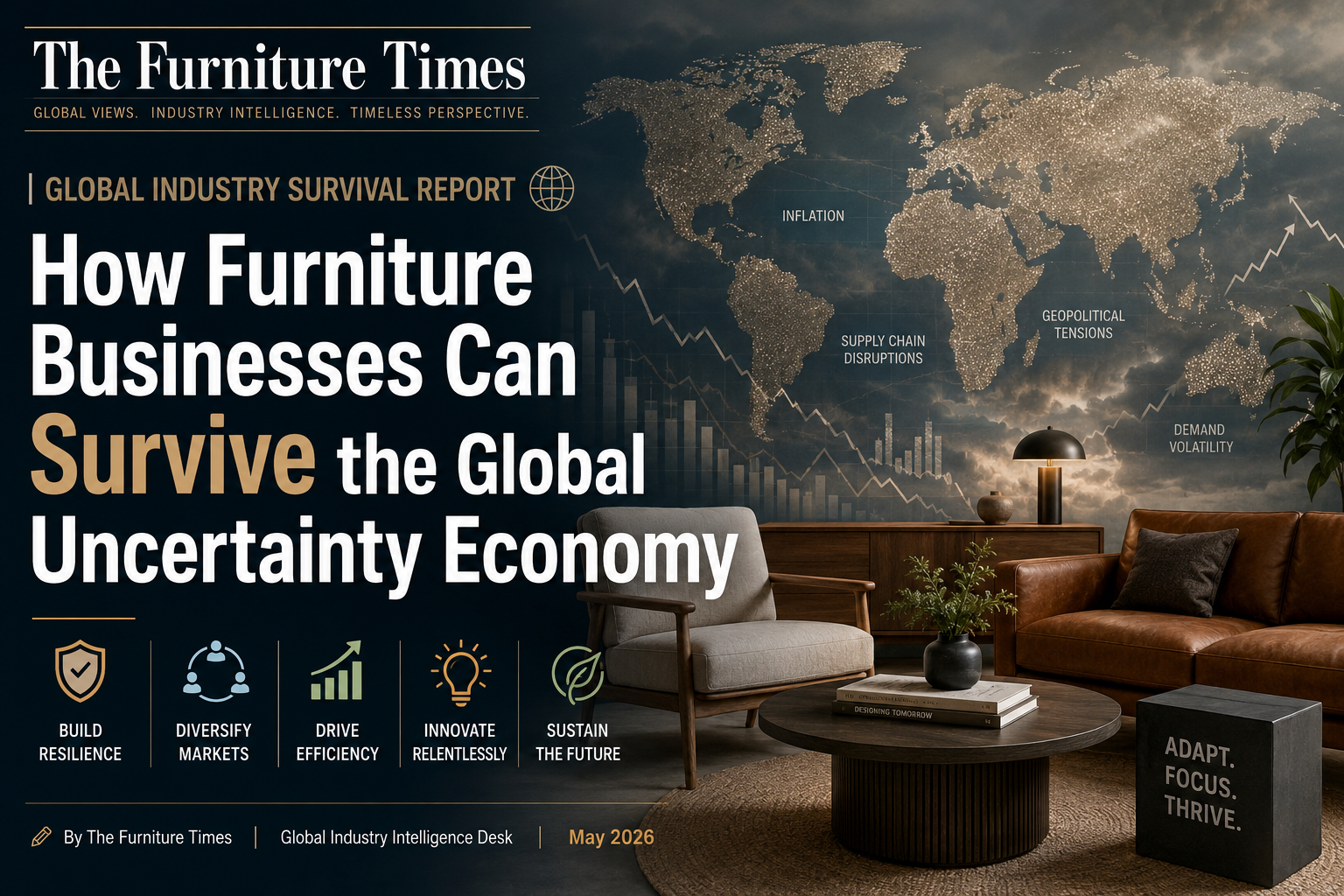
How Furniture Businesses Can Survive the Global Uncertainty Economy
Global Industry Survival Report | The Furniture Times
By The Furniture Times | Global Industry Intelligence Desk | May 2026
The global furniture industry is no longer operating in a stable environment.
War-related uncertainty, rising shipping costs, inflation, supply-chain instability, labor pressure, and digital disruption are reshaping how furniture businesses survive and compete.
For many companies, the old business model is under pressure.
What worked five years ago may not work anymore.
But while uncertainty is hurting many businesses, it is also creating a new generation of resilient, adaptive, and infrastructure-driven companies.
The next winners in the furniture industry will not necessarily be the biggest companies.
They will be the most adaptable.
The New Reality of the Global Furniture Economy
The furniture industry is entering what many analysts describe as an “uncertainty economy.”
This environment is characterized by:
- geopolitical instability
- trade disruption
- energy volatility
- cautious consumer spending
- AI-driven competition
- digital transformation
The industry is no longer facing isolated challenges.
Everything is now connected:
- shipping affects pricing
- war affects fuel
- inflation affects consumers
- AI affects sourcing
- communication affects sales
- visibility affects survival
1. Diversification Is No Longer Optional
For decades, many furniture companies depended heavily on:
- one country
- one supplier
- one export market
- one trade fair cycle
- one communication channel
That model is becoming dangerous.
The Risk of Overdependence
Recent global disruptions have shown how quickly:
- shipping routes can change
- tariffs can increase
- material costs can spike
- currencies can weaken
Businesses that rely entirely on one sourcing region or one customer market are highly vulnerable.
What Smart Companies Are Doing
Forward-looking furniture businesses are now:
- sourcing from multiple countries
- developing regional supplier networks
- building backup manufacturing options
- expanding into new markets
Countries such as Vietnam, Malaysia, and India are benefiting from diversification strategies as global buyers seek alternatives and flexibility.
Resilience now matters more than dependency.
2. Visibility Has Become a Survival Tool
One of the biggest hidden problems in the furniture industry is invisibility.
Thousands of furniture businesses still depend on:
- referrals
- exhibitions
- old buyer networks
But global uncertainty is changing buyer behavior.
Buyers are searching online faster, comparing globally, and looking for verified suppliers who can respond quickly.
The New Competitive Advantage
Today, businesses that are:
- searchable
- visible
- digitally active
- responsive
have a major advantage.
Why This Matters
When uncertainty increases, buyers become more cautious.
They want:
- faster responses
- verified suppliers
- clear communication
- visible company presence
If buyers cannot find you digitally, they may assume you do not exist.
3. Regional Sourcing Is Becoming the New Strategy
Global sourcing is not disappearing.
But regional sourcing is growing rapidly.
Why?
Companies want:
- faster shipping
- lower risk
- diversified production
- reduced geopolitical exposure
Regional Hubs Are Rising
Malaysia
ASEAN trade gateway + export flexibility
Vietnam
manufacturing scale + export momentum
United Arab Emirates
trade & logistics hub
India
large-scale manufacturing growth
The future supply chain may become more regional, distributed, and resilient.
4. Communication Infrastructure Is Becoming Critical
The furniture industry still relies heavily on fragmented communication:
- emails
- scattered chats
- disconnected follow-ups
This creates:
- missed leads
- delayed quotations
- lost opportunities
- confusion
During Crisis, Communication Becomes Even More Important
When markets become unstable:
- buyers need faster updates
- suppliers need structured communication
- projects need visibility
Businesses that communicate clearly and quickly gain trust.
The Industry Shift
The furniture ecosystem is beginning to move toward:
- structured communication systems
- lead tracking
- RFQ management
- connected business infrastructure
This is where communication platforms and industry systems become increasingly valuable.
The future of business communication will not be random messaging.
It will be structured deal flow.
5. AI & Automation Are No Longer Future Concepts
Artificial Intelligence is already entering the furniture ecosystem.
AI is helping businesses:
- predict demand
- improve sourcing
- optimize inventory
- analyze pricing
- automate communication
Smart Factories Are Expanding
Automation is growing in:
- CNC machinery
- panel processing
- warehouse systems
- logistics management
Companies adopting technology are improving:
- efficiency
- speed
- consistency
- scalability
The Risk of Ignoring Technology
Businesses that resist digital transformation may face:
- slower operations
- weaker visibility
- lower competitiveness
- declining margins
The industry is moving toward data-driven decision making.
6. SMEs Must Adapt Faster Than Large Corporations
Large companies may survive disruption through:
- capital reserves
- larger supply networks
- stronger logistics systems
But SMEs and artisans face greater pressure.
Their Biggest Challenges
- rising material costs
- weaker cash flow
- lower visibility
- limited digital systems
- fewer backup suppliers
But SMEs Also Have an Advantage
Smaller businesses can:
- move faster
- adapt faster
- specialize faster
- personalize faster
The Key Requirement
They must embrace:
- digital visibility
- connected ecosystems
- modern communication systems
- strategic partnerships
7. The Industry Is Entering the “Resilience Economy”
The old furniture economy focused on:
- cost
- production
- scale
The new furniture economy focuses on:
- resilience
- speed
- flexibility
- visibility
- intelligence
- connectivity
The Winning Businesses Will Be Those That Can:
- adapt quickly
- source intelligently
- communicate effectively
- operate digitally
- diversify risk
- stay visible globally
TFT Deep Industry Insight
The furniture industry is not collapsing.
It is evolving into a more connected, more digital, and more resilient ecosystem.
The next decade may belong to companies that can combine:
- manufacturing capability
- digital discoverability
- communication infrastructure
- data intelligence
- customer responsiveness
Strategic Recommendations for Furniture Businesses
1. Diversify Suppliers
Avoid dependence on one sourcing region.
2. Strengthen Digital Presence
Improve visibility across search and digital ecosystems.
3. Build Communication Systems
Move beyond scattered messaging.
4. Explore Regional Markets
Regional trade flexibility is becoming important.
5. Adopt AI & Automation Gradually
Technology adoption is becoming a competitive necessity.
6. Focus on Trust & Transparency
Reliable communication and verified presence matter more during uncertainty.
Final Thought
The global uncertainty economy is creating pressure across the furniture industry.
But uncertainty also creates opportunity.
The companies that survive the next decade may not be the strongest.
They may be the most adaptable, visible, connected, and resilient.
The future furniture industry will likely belong to businesses that can:
- move fast
- think globally
- communicate clearly
- adapt strategically
- operate inside connected ecosystems

Related Posts
Global Furniture Industry Shows Signs of Strategic Transformation Amid Economic Uncertainty
Why Core Values Will Become the New Competitive Advantage in the Furniture Industry