Future Connected Lighting Ecosystems
By The Furniture Times (TFT) | Indoor & Outdoor Lighting | Smart Lighting & AI
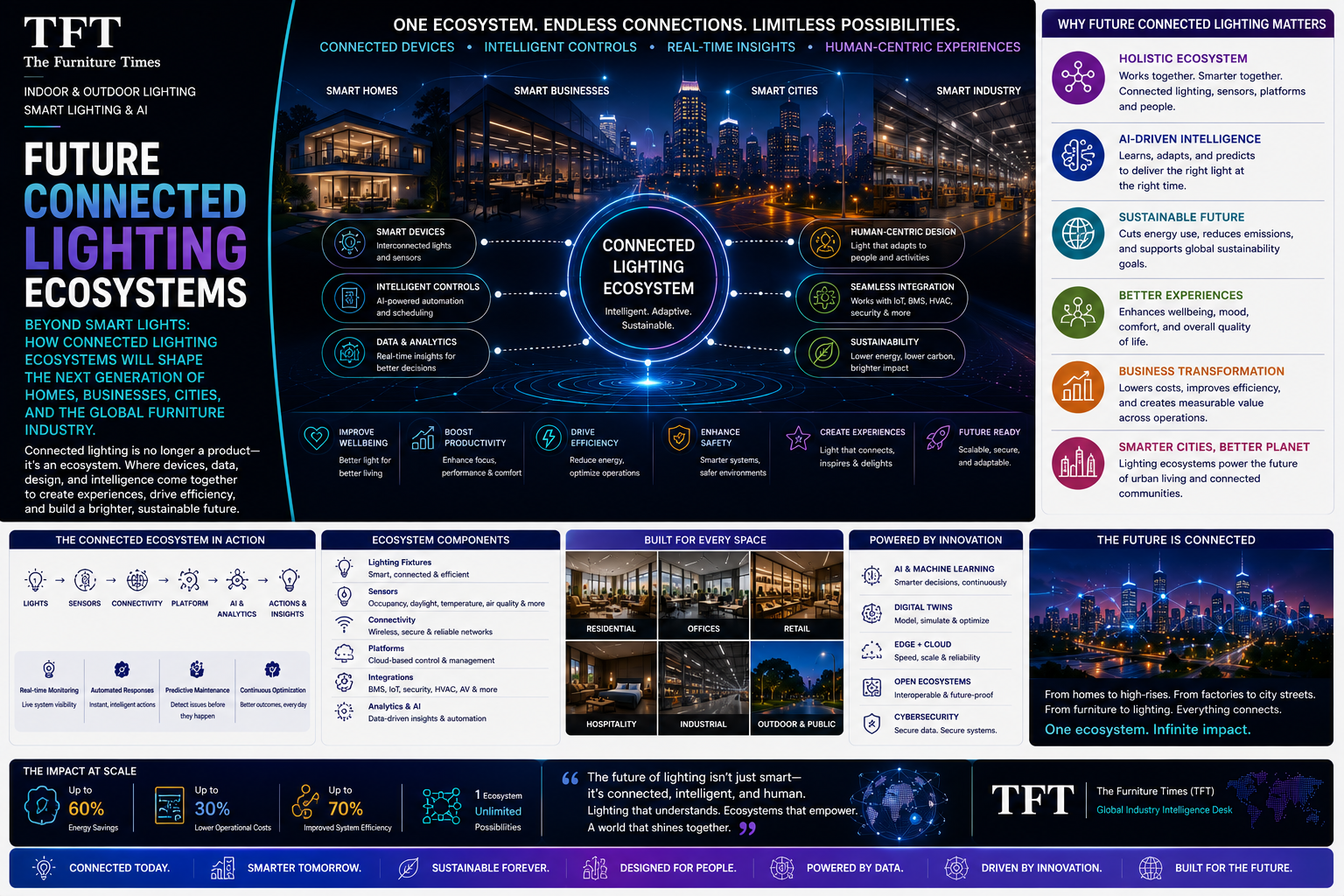
Beyond Smart Lights: How Connected Lighting Ecosystems Will Shape the Next Generation of Homes, Businesses, Cities, and the Global Furniture Industry
There was a time when lighting had one simple purpose—to help people see. A light bulb illuminated a room, a streetlamp lit a road, and a desk lamp made it easier to work. For decades, that was enough.
Today, lighting is becoming something far more significant.
Around the world, lights are evolving into intelligent digital platforms that communicate with buildings, furniture, appliances, sensors, vehicles, security systems, renewable energy networks, and even the people who use them. What was once a standalone product is becoming part of a connected ecosystem capable of collecting information, learning from behaviour, and responding automatically in real time.
This transformation is giving rise to Connected Lighting Ecosystems—networks where every lighting device works together with Artificial Intelligence (AI), the Internet of Things (IoT), cloud computing, digital twins, wireless controls, and smart infrastructure to create safer, healthier, more sustainable, and highly personalised environments.
The implications extend well beyond the lighting industry.
For the global furniture industry ecosystem, connected lighting is opening entirely new opportunities for product innovation, intelligent manufacturing, interior design, hospitality, commercial real estate, healthcare, education, retail, and smart city development.
The future will not be built around isolated smart devices.
It will be built around connected ecosystems where every component works together to improve how people live, work, learn, shop, travel, and connect.
Lighting Is Becoming the Digital Nervous System of Buildings
Modern buildings already contain thousands of lighting fixtures.
Instead of functioning independently, these fixtures are increasingly connected through intelligent networks that continuously exchange information.
Lighting now communicates with:
- Occupancy sensors.
- HVAC systems.
- Security platforms.
- Building management systems.
- Smart furniture.
- Renewable energy systems.
- Elevators.
- Emergency services.
- Digital twins.
- Artificial Intelligence platforms.
Rather than simply providing illumination, lighting becomes one of the central communication networks within a building.
Smart Homes Will Feel More Natural Than Ever
Connected lighting ecosystems are transforming residential living.
Instead of manually controlling every room, homeowners will experience environments that automatically adapt throughout the day.
Imagine arriving home after sunset.
The entrance lights recognise your arrival.
The hallway softly illuminates your path.
The living room adjusts to your preferred evening brightness.
Your kitchen lighting changes automatically while preparing dinner.
As bedtime approaches, warm lighting gradually prepares your body for sleep.
Nothing requires manual adjustment.
The home quietly responds to your routine.
Technology becomes almost invisible.
Furniture Will Become an Active Participant
Furniture is rapidly evolving from passive objects into intelligent products.
Connected lighting ecosystems will increasingly integrate with:
- Wardrobes.
- Kitchen cabinetry.
- Bed frames.
- Home office desks.
- Bookshelves.
- Display cabinets.
- Dining furniture.
- Hotel furniture.
- Healthcare furniture.
- Retail fixtures.
Imagine opening a wardrobe and having the lighting automatically adjust to daylight conditions.
Picture a work desk that creates personalised lighting based on your calendar and meeting schedule.
Or a hotel bedside table that remembers your preferred lighting every time you return.
Furniture becomes more than functional—it becomes interactive.
Commercial Buildings Will Continuously Learn
Commercial offices are changing rapidly.
Hybrid work, flexible seating, collaboration spaces, and digital workplaces require buildings that can adapt continuously.
Connected lighting ecosystems allow offices to understand:
- Occupancy patterns.
- Space utilisation.
- Employee movement.
- Collaboration trends.
- Energy consumption.
- Meeting room demand.
- Maintenance needs.
- Environmental conditions.
- Workplace wellbeing.
- Operational efficiency.
Lighting becomes an intelligent business resource rather than simply an operating expense.
Retail Will Become More Personal
Retail stores are increasingly blending physical shopping with digital intelligence.
Connected lighting ecosystems can respond dynamically to:
- Customer traffic.
- Promotional campaigns.
- Product launches.
- Seasonal collections.
- Window displays.
- Store occupancy.
- Luxury product areas.
- Customer engagement.
- Energy demand.
- Store performance.
Lighting helps create experiences that encourage customers to stay longer and interact more naturally with products.
Hospitality Will Deliver Truly Personalised Experiences
Hotels are moving beyond standard room controls.
Future connected lighting ecosystems may remember a guest’s preferences across every property within a hotel brand.
Lighting may automatically recognise:
- Preferred wake-up times.
- Reading preferences.
- Relaxation settings.
- Dining ambience.
- Spa experiences.
- Wellness programmes.
- Conference requirements.
- Accessibility needs.
- Family travel.
- Frequent guest behaviour.
Every stay becomes more comfortable because the environment already understands the guest.
Healthcare Will Become More Intelligent
Hospitals and healthcare facilities will increasingly rely on connected lighting ecosystems to support both patients and caregivers.
Lighting systems may coordinate with:
- Patient monitoring.
- Medical equipment.
- Nurse call systems.
- Emergency alerts.
- Recovery programmes.
- Circadian rhythm support.
- Elderly care.
- Rehabilitation.
- Infection control.
- Facility management.
Lighting becomes part of the healthcare experience rather than simply hospital infrastructure.
Artificial Intelligence Connects Everything Together
Artificial Intelligence is the intelligence layer that allows connected ecosystems to operate seamlessly.
Instead of responding to individual commands, AI analyses information from thousands of connected devices simultaneously.
Future AI may automatically:
- Predict occupancy.
- Balance daylight and artificial lighting.
- Reduce electricity demand.
- Detect equipment failures.
- Improve workplace comfort.
- Personalise environments.
- Coordinate emergency responses.
- Support predictive maintenance.
- Enhance sustainability.
- Continuously optimise building performance.
Every connected device contributes to a smarter overall ecosystem.
Sustainability Becomes Automatic
Connected lighting ecosystems make sustainability part of everyday operations rather than a separate initiative.
Intelligent systems continuously optimise:
- Energy consumption.
- Carbon emissions.
- Occupancy scheduling.
- Renewable energy integration.
- LED performance.
- Maintenance planning.
- Resource allocation.
- Environmental reporting.
- Water-energy coordination.
- ESG performance.
Instead of reacting to inefficiencies, buildings automatically prevent them.
Opportunities Across the Furniture Industry Ecosystem
Connected lighting ecosystems are creating opportunities for:
- Furniture manufacturers.
- Lighting manufacturers.
- Architects.
- Interior designers.
- Hospitality groups.
- Property developers.
- Smart home companies.
- Healthcare providers.
- Retail businesses.
- Technology innovators.
Businesses that combine furniture, AI, lighting, cloud computing, IoT, digital twins, and intelligent automation into integrated customer experiences will lead the next generation of market innovation.
Challenges That Cannot Be Ignored
As connected ecosystems expand, important challenges remain.
These include:
- Cybersecurity.
- Data privacy.
- Global interoperability.
- Technology standards.
- Consumer trust.
- Skilled workforce shortages.
- Infrastructure investment.
- Long-term software maintenance.
- Digital resilience.
- Responsible AI governance.
The future will depend not only on technological innovation but also on responsible implementation.
The Next Decade Will Be Defined by Connected Intelligence
Over the next ten years, connected lighting ecosystems will extend far beyond buildings.
They will connect with:
- Smart cities.
- Autonomous vehicles.
- Public transport.
- Renewable energy grids.
- Digital healthcare.
- Urban infrastructure.
- Intelligent manufacturing.
- Logistics systems.
- Retail supply chains.
- Entire community ecosystems.
Lighting will become one of the invisible technologies that quietly links everything together.
Lighting Is No Longer a Product—It Is an Ecosystem
The lighting industry is experiencing one of the most important transformations since the invention of electric illumination.
The conversation has shifted from brighter lamps and lower energy consumption to intelligent ecosystems that continuously learn, communicate, and improve.
For the global furniture industry ecosystem, this creates extraordinary opportunities to rethink how furniture, lighting, architecture, AI, cloud platforms, digital twins, and connected technologies work together to create spaces that are healthier, more productive, more sustainable, and more human-centred.
The future of lighting is no longer about individual devices.
It is about relationships.
Relationships between technology and people.
Between buildings and data.
Between furniture and intelligence.
Between sustainability and innovation.
The organisations that understand these connections today will be the ones shaping the homes, workplaces, hotels, hospitals, retail spaces, and smart cities of tomorrow.
Because in the connected world ahead, lighting will not simply illuminate our environments.
It will help orchestrate them.
The Furniture Times (TFT) & Furniture Industry Search Engine (FISE)
“TFT tells their story. FISE helps the world find them.”
“FurniReviewology helps the world trust them.”
The furniture industry ecosystem is a $1 trillion industry ecosystem.