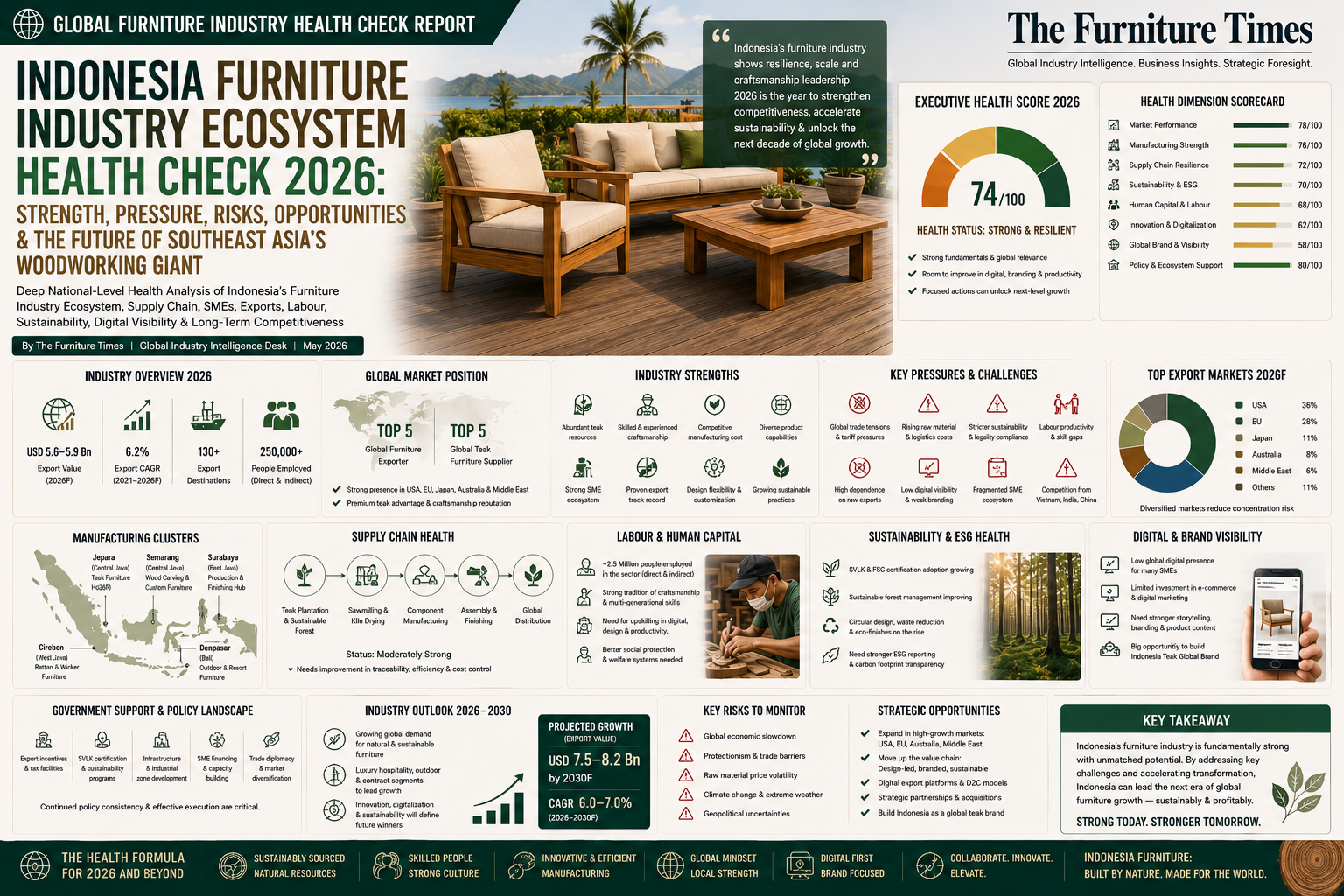
Indonesia Furniture Industry Ecosystem Health Check 2026: Strength, Pressure, Risks, Opportunities & the Future of Southeast Asia’s Woodworking Giant
Global Furniture Industry Health Check Report | The Furniture Times
Deep National-Level Health Analysis of Indonesia’s Furniture Industry Ecosystem, Supply Chain, SMEs, Exports, Labour, Sustainability, Digital Visibility & Long-Term Competitiveness
By The Furniture Times | Global Industry Intelligence Desk | May 2026
Indonesia’s furniture industry ecosystem is one of the most important woodworking economies in the world.
The country possesses:
globally respected teakwood resources
artisanal craftsmanship heritage
hospitality furniture expertise
strong SME ecosystems
export manufacturing infrastructure
natural luxury positioning
Yet in 2026, the industry stands at a major crossroads.
Indonesia’s furniture ecosystem is currently experiencing:
strong global opportunity
while simultaneously facing:
structural pressure
global competition
labour shifts
digital transformation challenges
sustainability demands
geopolitical uncertainty
This report provides a:
full ecosystem health check
of Indonesia’s furniture industry.
Executive Ecosystem Health Rating (2026)
| Sector | Health Status |
| Teakwood Resources | Strong |
| Craftsmanship Culture | Strong |
| SME Ecosystem | Moderate Risk |
| Export Potential | Strong |
| Digital Visibility | Weak |
| AI Discoverability | Weak |
| Sustainability Position | Improving |
| Logistics Ecosystem | Moderate |
| Skilled Labour Availability | Under Pressure |
| Hospitality Market Position | Strong |
| Global Brand Strength | Moderate |
| Innovation & Automation | Developing |
| Long-Term Industry Opportunity | Very Strong |
Overall Industry Health Status
Indonesia Furniture Industry Ecosystem:
“Stable but Under Transformation Pressure”
Indonesia’s furniture ecosystem remains fundamentally strong because of:
natural resource advantage
teakwood specialization
woodworking heritage
global hospitality demand
artisanal production capability
However, major structural pressures are increasingly visible beneath the surface.
1. Raw Material Health Check
Status: Strong but Sensitive
Indonesia remains globally respected for:
teakwood resources.
The country’s plantation systems continue supporting:
teak furniture manufacturing
hospitality projects
outdoor furniture ecosystems
export production
Teakwood continues offering strong global advantage because of:
durability
weather resistance
luxury positioning
long product lifespan
Key Strengths
Strong teakwood identity
International recognition
Premium positioning potential
Outdoor furniture leadership
Key Risks
Rising timber costs
Sustainability pressure
Certification requirements
Illegal logging concerns
Plantation management dependency
Health Insight
Indonesia still holds one of the world’s strongest natural furniture material advantages.
However:
future competitiveness increasingly depends on:
sustainable resource governance.
2. Manufacturing Ecosystem Health Check
Status: Strong but Fragmented
Indonesia possesses one of Asia’s most diverse furniture manufacturing ecosystems.
Major manufacturing clusters include:
Jepara
Semarang
Surabaya
Bali
Yogyakarta
The industry combines:
SMEs
family workshops
export factories
handcrafted production systems
Key Strengths
Flexible manufacturing structure
Strong craftsmanship capability
Customized production ability
Hospitality specialization
Strong teakwood processing experience
Key Risks
Fragmented production systems
Uneven quality control
Limited factory modernization
Weak technology adoption in SMEs
Dependence on manual systems
Health Insight
Indonesia’s manufacturing capability remains highly respected globally.
But future industrial health increasingly depends on:
modernization + scalability.
3. Labour & Workforce Health Check
Status: Under Pressure
Indonesia’s furniture ecosystem remains heavily dependent on:
skilled human labour.
The industry still relies strongly on:
carpenters
woodworkers
carvers
finishers
upholstery workers
installers
Key Strengths
Strong craftsmanship culture
Multi-generational woodworking knowledge
Hand-finishing expertise
Strong artisanal identity
Key Risks
Younger generations are avoiding woodworking careers
Labour migration toward cities & technology sectors
Ageing skilled workforce
Difficulty regenerating traditional craftsmanship skills
Productivity pressure
Health Insight
Indonesia’s biggest hidden risk may become:
craftsmanship succession failure.
Without younger workers entering the industry,
long-term artisanal capability may weaken.
4. Export Ecosystem Health Check
Status: Strong Opportunity
Indonesia continues exporting strongly to:
USA
Europe
Middle East
Australia
Japan
hospitality sectors globally
The country remains especially competitive in:
teakwood furniture
outdoor systems
resort furniture
villa interiors
handcrafted hospitality products
Key Strengths
Strong hospitality positioning
Global teakwood reputation
Outdoor furniture competitiveness
Tropical luxury identity
Key Risks
Competition from Vietnam
Shipping cost volatility
Geopolitical trade pressure
Global economic slowdown risks
Currency fluctuations
Health Insight
Export opportunity remains:
very strong.
But future success increasingly depends on:
branding
speed
digital visibility
supply chain efficiency
5. SME Ecosystem Health Check
Status: High Risk but High Potential
Indonesia’s furniture ecosystem is dominated by:
SMEs.
Thousands of:
workshops
micro-factories
family manufacturers
form the backbone of the industry.
Key Strengths
Entrepreneurial flexibility
Strong local craftsmanship
Community manufacturing culture
Adaptability to custom orders
Key Risks
Weak digital infrastructure
Poor online visibility
Limited financing access
Lack of branding systems
Weak AI discoverability
Heavy dependence on intermediaries
Health Insight
Indonesia’s SMEs are:
globally talented but digitally invisible.
This may become the industry’s biggest structural weakness in the AI economy.
6. Digital Ecosystem Health Check
Status: Weak
This is currently one of Indonesia’s most serious industry weaknesses.
Many furniture businesses still lack:
SEO systems
structured websites
AI-friendly product catalogs
searchable infrastructure
digital branding systems
Key Risks
Low discoverability
Poor Google indexing
Weak AI visibility
Overdependence on exhibitions
Limited online trust-building
Health Insight
The future furniture economy increasingly rewards:
discoverability.
Indonesia risks losing long-term visibility and power if digital infrastructure remains weak.
Why FISE & TFT Become Critical
Indonesia urgently needs:
searchable ecosystems
furniture discovery infrastructure
category visibility systems
supplier indexing
AI discoverability architecture
This is where:
FISE
TFT
FISE Connect
FISE Live
FurniLinkology
can become transformational.
7. Sustainability Health Check
Status: Improving
Global buyers increasingly demand:
certified wood
ESG compliance
sustainable forestry
legal sourcing
environmental transparency
Indonesia’s SVLK system helped strengthen:
export legitimacy.
Key Strengths
Plantation teak systems
Increasing sustainability awareness
Government certification initiatives
Key Risks
International environmental scrutiny
Certification cost burden for SMEs
Deforestation reputation concerns
Increasing ESG pressure
Health Insight
The future market increasingly rewards:
sustainability trust.
Indonesia must continue positioning itself as:
ethical
traceable
environmentally responsible
8. Logistics Ecosystem Health Check
Status: Moderate
Indonesia’s geographic structure creates:
both:
strategic trade advantage
and:
logistical complexity.
The industry depends heavily on:
container shipping
port efficiency
inland transport systems
export consolidation
Key Strengths
Strategic maritime location
Strong export gateways
Access to Asia-Pacific routes
Key Risks
Inter-island logistics complexity
Freight cost fluctuations
Port congestion risks
Global shipping uncertainty
Health Insight
Logistics remains manageable,
but efficiency improvements remain essential for future competitiveness.
9. Hospitality Market Position Health Check
Status: Very Strong
Indonesia remains globally respected in:
hospitality furniture.
Especially for:
resorts
villas
beach clubs
outdoor systems
tropical interiors
Key Strengths
Bali-inspired lifestyle identity
Tropical luxury positioning
Strong outdoor furniture capability
Wellness hospitality alignment
Health Insight
Hospitality may remain Indonesia’s strongest long-term global positioning advantage.
10. Future Innovation Health Check
Status: Developing
Indonesia’s furniture ecosystem is gradually moving toward:
CNC integration
digital catalogs
smart manufacturing
modular furniture systems
minimalist design
However, innovation adoption remains uneven.
Key Risks
Slow SME digital adoption
Limited Industry 4.0 integration
Automation gaps
Limited R&D investment
Health Insight
The future industry increasingly rewards:
intelligent manufacturing + digital ecosystems.
Indonesia’s Biggest Hidden Industry Risks
1. Digital Invisibility
Many great manufacturers remain undiscoverable globally.
2. Youth Labour Decline
Traditional craftsmanship may weaken over time.
3. Export Dependency
Global shocks heavily affect the industry.
4. Fragmentation
SMEs remain disconnected digitally.
5. AI Search Transformation
Future visibility increasingly depends on structured digital ecosystems.
Indonesia’s Biggest Future Opportunities
1. Sustainable Luxury Living
Indonesia strongly aligns with global natural living trends.
2. Wellness Interiors
Wood-based calm environments continue growing globally.
3. Outdoor Living Expansion
Teakwood remains globally competitive outdoors.
4. Hospitality Growth
Luxury tourism continues expanding worldwide.
5. AI Discoverability Transformation
Digital visibility remains massively underdeveloped.
6. Emotional Furniture Branding
Indonesia possesses strong craftsmanship storytelling power.
The Industry’s Future Direction
Indonesia’s furniture ecosystem may increasingly move toward:
premium positioning.
The future may no longer depend on:
producing cheaper products
but increasingly on:
storytelling
sustainability
emotional design
discoverability
craftsmanship identity
natural luxury branding
TFT Philosophical Industry Insight
Indonesia’s furniture ecosystem reveals one important truth:
Great furniture industries are not built only through factories.
They are built through culture, labour, material intelligence, logistics, digital visibility, sustainability, and emotional identity.
Indonesia already possesses:
the wood
the craftsmanship
the heritage
the hospitality aesthetics
the global respect
The next challenge is:
ecosystem transformation.
Final Ecosystem Verdict (2026)
Indonesia Furniture Industry Health Check:
“Strong Foundations — Critical Transformation Phase”
Indonesia’s furniture ecosystem remains:
globally respected
strategically valuable
emotionally powerful
naturally competitive
But future success increasingly depends on:
digital infrastructure
AI discoverability
sustainability leadership
younger workforce regeneration
premium positioning
ecosystem connectivity
If Indonesia successfully modernizes while protecting its craftsmanship identity,
the country may become:
one of the world’s most powerful natural furniture economies in the future global market.
Closing Insight
“Indonesia’s furniture industry is not facing a collapse crisis.
It is facing a transformation test.
The countries that combine craftsmanship heritage with digital visibility, sustainability, emotional living, and intelligent ecosystem infrastructure may define the next era of the global furniture economy.”

Related Posts
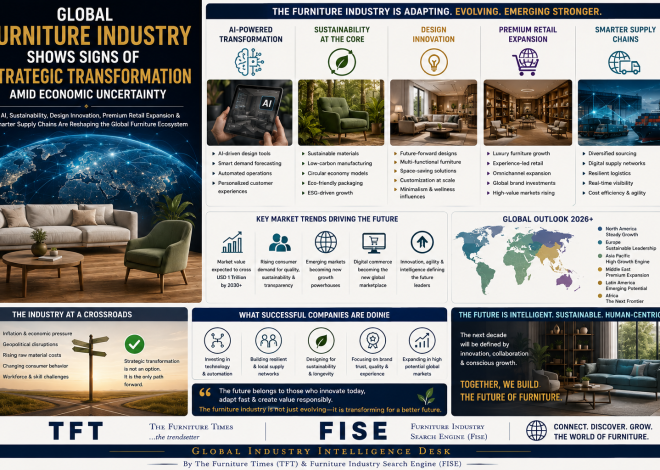
Global Furniture Industry Shows Signs of Strategic Transformation Amid Economic Uncertainty
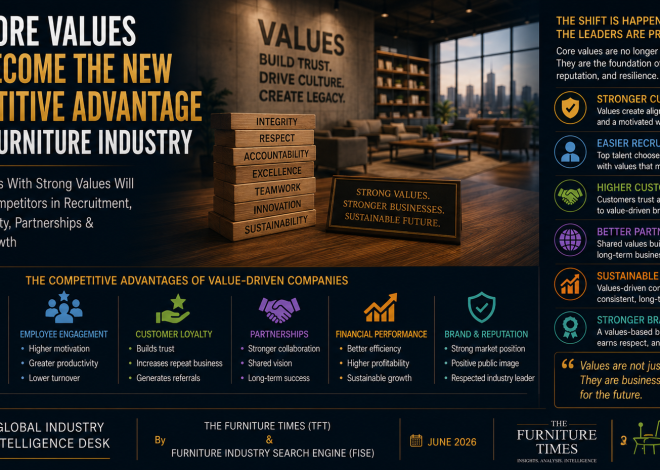
Why Core Values Will Become the New Competitive Advantage in the Furniture Industry