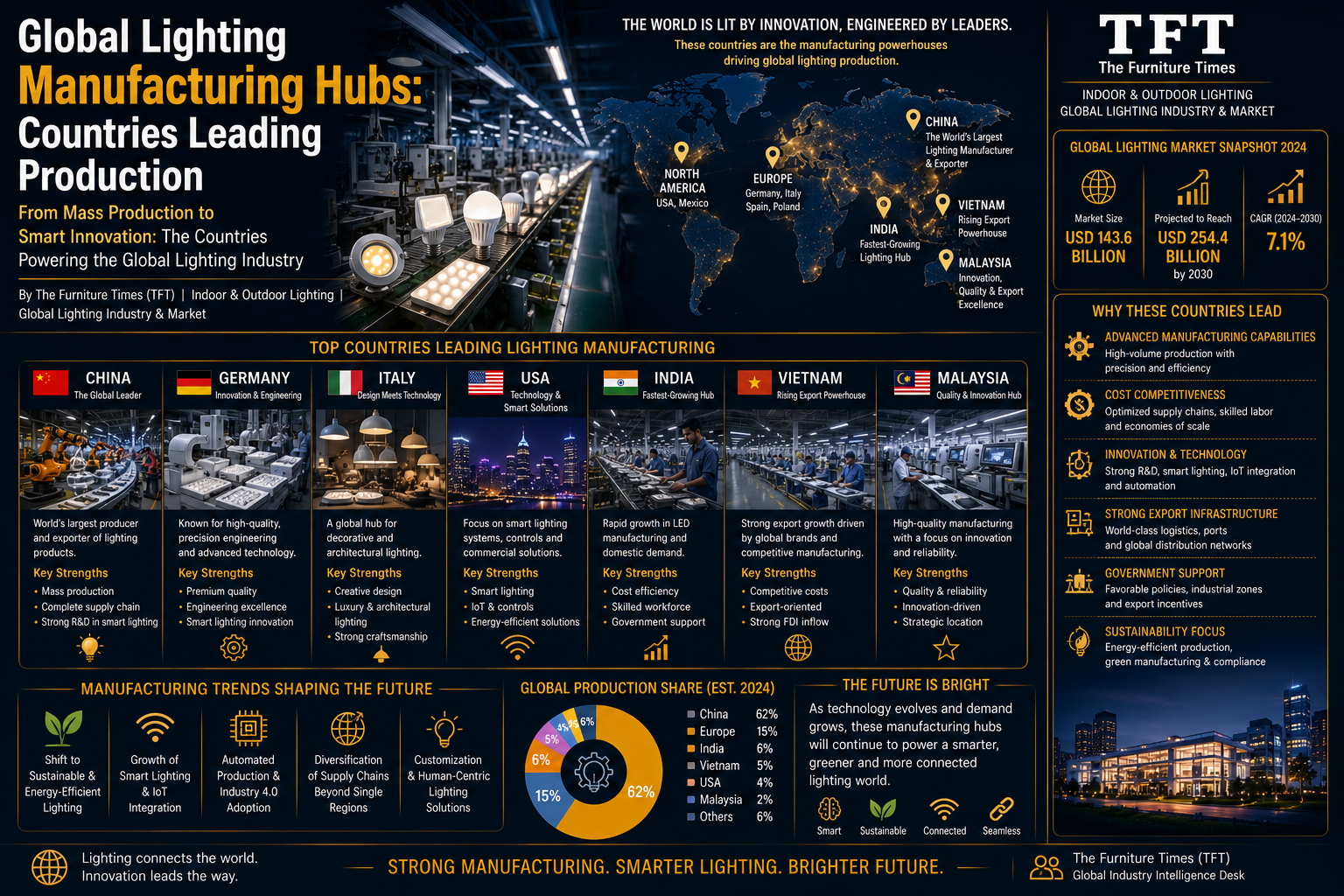
Global Lighting Manufacturing Hubs: Countries Leading Production
By The Furniture Times (TFT) | Indoor & Outdoor Lighting | Global Lighting Industry & Market
From Mass Production to Smart Innovation: The Countries Powering the Global Lighting Industry
The global lighting industry has become one of the world’s most important manufacturing sectors, supplying products that illuminate homes, offices, factories, hospitals, airports, hotels, retail stores, highways, public infrastructure, and smart cities. As lighting technology evolves from conventional fixtures to intelligent ecosystems powered by Artificial Intelligence (AI), the Internet of Things (IoT), cloud connectivity, and advanced sensors, manufacturing has become increasingly sophisticated and globally interconnected.
Today, lighting manufacturing is no longer concentrated in a single region. Instead, a network of specialized production hubs across Asia, Europe, North America, and emerging markets contributes to a highly competitive and innovative global supply chain. Some countries dominate large-scale manufacturing, while others specialize in premium architectural lighting, design innovation, smart lighting technologies, precision engineering, or sustainable production.
For manufacturers, distributors, architects, interior designers, furniture companies, developers, retailers, investors, and governments, understanding where lighting products are designed, manufactured, and exported provides valuable insight into the future direction of one of the fastest-evolving industries in the built environment.
The Global Manufacturing Landscape
The lighting industry supports millions of jobs across research, engineering, manufacturing, logistics, electronics, industrial design, software development, installation, and maintenance.
The industry’s manufacturing ecosystem includes:
- LED chips and semiconductor production
- Electronic drivers
- Smart sensors
- Lighting fixtures
- Decorative luminaires
- Industrial lighting systems
- Outdoor lighting equipment
- Smart lighting controls
- Optical components
- Sustainable materials
No single country dominates every stage of production. Instead, global manufacturing depends on international collaboration across raw materials, electronics, design, software, assembly, testing, certification, and distribution.
China: The World’s Largest Lighting Manufacturing Hub
China remains the largest lighting manufacturing center in the world.
Over the past three decades, the country has built an extensive ecosystem of suppliers, component manufacturers, electronics companies, logistics providers, and export infrastructure.
Chinese manufacturers produce:
- LED bulbs
- Decorative lighting
- Commercial lighting
- Industrial lighting
- Outdoor lighting
- Smart lighting systems
- Solar lighting
- Architectural lighting
- Street lighting
- Consumer lighting products
Industrial clusters such as those in Guangdong Province have become globally recognized for lighting production, attracting international buyers, designers, and sourcing professionals.
China’s strengths include:
- Large-scale production capacity
- Integrated supply chains
- Competitive manufacturing costs
- Strong export infrastructure
- Continuous investment in automation
- Rapid product development
- Extensive OEM and ODM capabilities
- Growing smart lighting innovation
While China continues to lead volume production, manufacturers increasingly focus on quality, automation, sustainability, and intelligent lighting technologies.
Germany: Engineering Excellence and Premium Lighting
Germany is internationally respected for precision engineering and advanced industrial manufacturing.
German lighting companies specialize in:
- Architectural lighting
- Industrial lighting
- Intelligent building systems
- Premium commercial lighting
- Energy-efficient technologies
- Smart controls
- Automotive lighting
- Research and development
German manufacturers emphasize:
- Product reliability
- Engineering quality
- Sustainability
- Long product lifecycles
- Innovation
- Precision manufacturing
- Technical standards
- Industrial automation
Germany remains one of Europe’s leading exporters of high-performance lighting solutions.
Italy: Where Lighting Meets Design
Italy has established itself as one of the world’s most influential centers for decorative and architectural lighting.
Italian manufacturers are renowned for combining:
- Contemporary design
- Luxury craftsmanship
- Artistic creativity
- Premium materials
- Innovative engineering
- Elegant aesthetics
- Hospitality lighting
- Residential lighting
Italian lighting brands frequently collaborate with architects, furniture manufacturers, luxury hotels, and interior designers to create products that function as both lighting and works of art.
The country’s strong design heritage continues influencing global lighting trends.
United States: Innovation and Smart Lighting Technologies
The United States remains a major center for lighting innovation, research, and intelligent building technologies.
American companies lead development in:
- AI-powered lighting
- Smart building integration
- Commercial lighting
- Healthcare lighting
- Industrial automation
- Human-centric lighting
- Software platforms
- Building management systems
- Cloud-based lighting controls
- Sustainability solutions
Rather than competing primarily on manufacturing volume, many U.S. companies focus on technological innovation, software, advanced engineering, and integrated lighting ecosystems.
Japan: Precision Electronics and Advanced Technology
Japan’s expertise in electronics and semiconductor technologies has significantly influenced lighting innovation.
Japanese manufacturers emphasize:
- High-efficiency LEDs
- Miniaturization
- Optical engineering
- Human-centric lighting
- Smart controls
- Industrial reliability
- Precision manufacturing
- Energy efficiency
- Long-term durability
- Advanced materials
Japan continues contributing important technological advancements that influence lighting manufacturers worldwide.
South Korea: Electronics and Connected Lighting
South Korea has become a major player in lighting technologies through its strong electronics industry.
Key strengths include:
- LED components
- Display technologies
- Semiconductor manufacturing
- Smart home integration
- AI applications
- Consumer electronics
- IoT platforms
- Building connectivity
- Digital innovation
- Research investment
Its expertise in advanced electronics supports the growing demand for connected lighting ecosystems.
India: A Rapidly Expanding Manufacturing Base
India’s lighting industry continues growing rapidly due to:
- Urbanization
- Infrastructure development
- Residential construction
- Government electrification programs
- Rising domestic demand
- Manufacturing investment
- Export opportunities
- Smart city initiatives
Indian manufacturers increasingly produce:
- LED lighting
- Commercial fixtures
- Residential products
- Street lighting
- Solar lighting
- Industrial lighting
Government initiatives supporting domestic manufacturing have further strengthened India’s position within the global lighting supply chain.
Vietnam: Emerging Manufacturing Destination
Vietnam has attracted increasing investment from international lighting manufacturers seeking diversified production locations.
The country’s advantages include:
- Competitive labor costs
- Strategic geographic location
- Expanding export infrastructure
- Manufacturing investment
- Skilled workforce
- Regional trade agreements
- Growing industrial parks
- Supply chain diversification
Vietnam continues strengthening its position within Southeast Asia’s manufacturing ecosystem.
Malaysia: Growing Regional Opportunities
Malaysia offers attractive opportunities within the lighting industry through its strengths in electronics manufacturing, industrial production, logistics, and regional connectivity.
Its strategic location supports exports throughout ASEAN and beyond.
Malaysia’s lighting sector benefits from:
- Strong electrical manufacturing capabilities
- Electronics expertise
- Modern industrial infrastructure
- Skilled engineering talent
- Growing smart building adoption
- Sustainable manufacturing initiatives
- Regional logistics connectivity
- Supportive investment environment
As Southeast Asia continues expanding economically, Malaysia is well positioned to support higher-value lighting production and technology development.
Europe: Premium Manufacturing and Sustainability
Several European countries continue leading specialized lighting manufacturing through innovation and sustainability.
Manufacturers across Europe focus on:
- Architectural lighting
- Decorative lighting
- Smart controls
- Sustainable materials
- Circular economy manufacturing
- Premium hospitality lighting
- Museum lighting
- Urban infrastructure
- Design excellence
- Technical certifications
European companies frequently emphasize product quality, environmental performance, and long-term reliability.
Manufacturing Is Becoming Smarter
The lighting industry is rapidly embracing Industry 4.0 technologies.
Modern factories increasingly deploy:
- Robotics
- Artificial Intelligence
- Machine vision
- Automated inspection
- Predictive maintenance
- Digital twins
- IoT-enabled production
- Advanced analytics
- Cloud manufacturing
- Smart logistics
These technologies improve efficiency, product quality, flexibility, and sustainability while reducing production costs.
Sustainability Is Changing Manufacturing Priorities
Global manufacturers increasingly prioritize environmentally responsible production.
Key initiatives include:
- Renewable energy usage
- Energy-efficient factories
- Recyclable materials
- Circular economy practices
- Waste reduction
- Carbon footprint reduction
- Sustainable packaging
- Responsible sourcing
- Water conservation
- Green certifications
Customers increasingly evaluate suppliers based not only on product quality but also on environmental performance.
Supply Chain Diversification Becomes Essential
Recent global disruptions highlighted the importance of resilient supply chains.
Lighting manufacturers increasingly diversify:
- Production facilities
- Component sourcing
- Logistics networks
- Regional manufacturing
- Strategic inventory
- Supplier partnerships
- Technology providers
- Export markets
- Distribution channels
- Digital procurement
This diversification improves business continuity while reducing operational risk.
Furniture and Lighting Manufacturing Are Becoming More Connected
The furniture industry increasingly collaborates with lighting manufacturers.
Integrated lighting now appears in:
- Kitchen cabinetry
- Wardrobes
- Office furniture
- Hospitality furniture
- Retail displays
- Entertainment units
- Luxury storage systems
- Smart home products
- Bathroom furniture
- Interior architectural systems
This convergence creates new opportunities for innovation across both industries.
Investment Opportunities Across Manufacturing
The next decade offers significant investment potential in:
- LED chip manufacturing
- Smart lighting software
- AI-powered controls
- Semiconductor technologies
- Sustainable materials
- Human-centric lighting
- Industrial automation
- Cloud management platforms
- Renewable energy integration
- Smart city infrastructure
Investors increasingly recognize lighting manufacturing as an important component of the global technology economy.
Looking Ahead
Global lighting manufacturing is evolving from labor-intensive production into an advanced technology industry driven by automation, artificial intelligence, digital engineering, sustainability, and international collaboration.
Countries that combine manufacturing excellence with innovation, skilled talent, resilient supply chains, and environmental responsibility will lead the next generation of industry growth.
For architects, developers, furniture manufacturers, retailers, governments, technology companies, and investors, understanding global lighting manufacturing hubs provides valuable insight into future sourcing strategies, technological innovation, and market competitiveness.
The future of lighting manufacturing will not be defined solely by production volume.
It will be defined by intelligence, quality, sustainability, resilience, and the ability to deliver innovative lighting solutions that support smarter homes, connected buildings, resilient infrastructure, and sustainable cities around the world.