
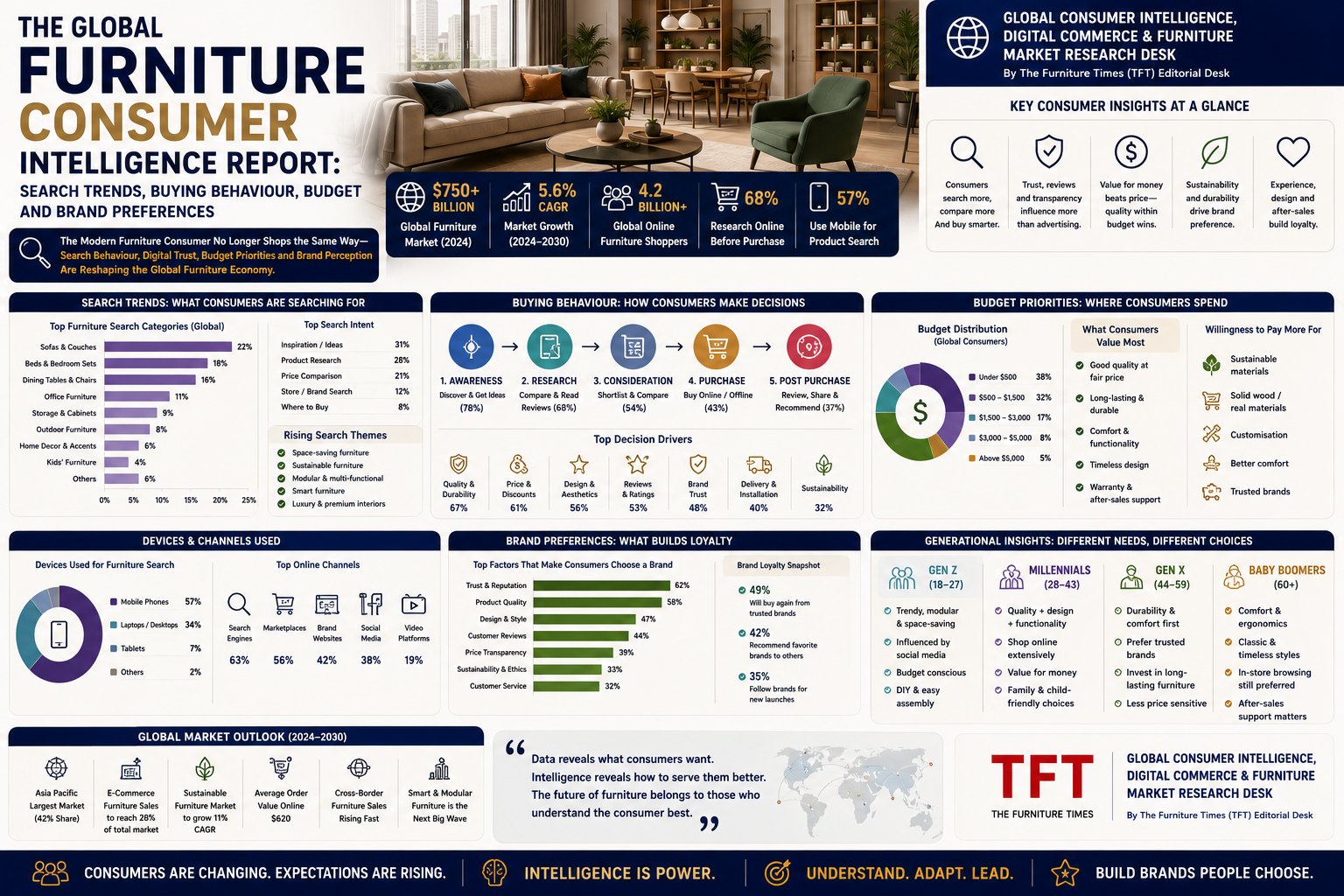
The Global Furniture Consumer Intelligence Report: Search Trends, Buying Behaviour, Budget and Brand Preferences
The Modern Furniture Consumer No Longer Shops the Same Way—Search Behaviour, Digital Trust, Budget Priorities and Brand Perception Are Reshaping the Global Furniture Economy
Global Consumer Intelligence, Digital Commerce & Furniture Market Research Desk
By The Furniture Times (TFT) Editorial Desk
The global furniture industry is experiencing one of the most significant transformations in its history.
For decades, furniture buying followed a relatively predictable journey. Consumers visited local furniture stores, compared products, negotiated prices and completed their purchases in person.
Today, that journey has fundamentally changed.
Modern consumers begin with a search.
They compare dozens of brands.
They read reviews.
They watch videos.
They ask AI assistants.
They browse social media.
They compare delivery times.
They evaluate warranties.
They visit physical stores.
They return online.
Only then do they make a purchasing decision.
The furniture industry has entered the age of Consumer Intelligence.
Manufacturers, retailers, designers, distributors and investors are no longer competing only on product quality or pricing.
They are competing for consumer attention, digital trust, search visibility and buying confidence.
The global furniture market continues to expand alongside rising urbanisation, household formation, digital commerce and renovation activity. At the same time, consumers are becoming more informed, more selective and more willing to compare brands before making significant purchases.
Understanding the modern furniture buyer is therefore becoming as important as understanding manufacturing, design or logistics.
Companies that understand consumer behaviour can anticipate demand before orders are placed.
Companies that ignore consumer intelligence risk becoming invisible in an increasingly competitive marketplace.
The New Furniture Buying Journey
Today’s furniture buying journey typically follows several stages.
Stage 1: A Need Appears
The trigger may include:
- Marriage
- Buying a new home
- Renovation
- Relocation
- Family growth
- Office expansion
- Retirement
- Lifestyle changes
The consumer recognises that furniture is needed.
Stage 2: Digital Discovery
The consumer begins searching online using:
- AI search assistants
- YouTube
- Social media
- Marketplaces
- Brand websites
Searches often include:
- Best sofa for small apartment
- Luxury dining tables
- Outdoor furniture for tropical climate
- Ergonomic office chair
- Modular wardrobes
- Sustainable furniture brands
Stage 3: Brand Comparison
Consumers compare:
- Price
- Materials
- Reviews
- Warranty
- Delivery
- Sustainability
- Brand reputation
- Product availability
Stage 4: Physical Validation
Many buyers still prefer to:
- Visit showrooms
- Test comfort
- Examine materials
- Compare finishes
- Verify quality
Stage 5: Purchase Decision
The final decision often reflects a balance between:
- Budget
- Trust
- Quality
- Design
- Availability
- Service
The buying journey has become multi-channel rather than linear.
Search Is Becoming the New Showroom
Consumers increasingly discover furniture before entering a physical store.
Search behaviour now influences:
- Brand awareness
- Product discovery
- Purchase consideration
- Retail visits
- Final conversion
Companies that cannot be found online may never reach the consumer’s shortlist.
Digital visibility has become commercial visibility.
AI Is Changing Product Discovery
Consumers increasingly ask AI systems questions such as:
- Which sofa lasts the longest?
- Best furniture brands for young families.
- Compare oak versus walnut dining tables.
- Affordable Scandinavian furniture.
- Furniture suitable for tropical climates.
Instead of searching only with keywords, consumers increasingly search using complete questions.
Furniture companies should prepare content that answers these questions directly.
Consumer Search Behaviour by Product Category
Living room buyers search:
- Sofa
- Sectional
- Coffee table
- TV cabinet
- Entertainment unit
Bedroom buyers search:
- Bed frame
- Mattress
- Wardrobe
- Storage bed
Dining buyers search:
- Dining table
- Dining chairs
- Extendable dining table
Outdoor buyers search:
- Garden furniture
- Patio dining
- Pool loungers
- Outdoor sofa
Office buyers search:
- Ergonomic chair
- Standing desk
- Home office
Every category follows different search patterns.
Search Behaviour by Customer Intent
Consumers search differently according to their stage.
Inspiration
- Living room ideas
- Luxury interiors
- Small apartment inspiration
Research
- Best sofa materials
- Solid wood versus engineered wood
- Furniture reviews
Comparison
- IKEA versus custom furniture
- Leather versus fabric sofa
- Best dining table brands
Purchase
- Furniture near me
- Buy dining table online
- Sofa delivery today
Understanding search intent improves marketing efficiency.
Consumer Buying Behaviour
Furniture purchasing is influenced by four major factors.
Functional Needs
Consumers need furniture that:
- Fits the space
- Performs well
- Lasts
- Supports daily living
Emotional Needs
Consumers also buy because furniture represents:
- Success
- Comfort
- Identity
- Family
- Lifestyle
Financial Needs
Consumers compare:
- Price
- Financing
- Warranty
- Maintenance cost
- Long-term value
Social Influence
Buying decisions are shaped by:
- Family
- Friends
- Interior designers
- Reviews
- Influencers
- Social media
Furniture combines practical and emotional purchasing.
Budget Segmentation
Consumers generally fall into several spending groups.
Budget Buyers
Priorities include:
- Affordability
- Functionality
- Easy replacement
Value Buyers
Focus on:
- Price-to-quality ratio
- Durability
- Warranty
Premium Buyers
Seek:
- Design
- Materials
- Brand reputation
- Exclusivity
Luxury Buyers
Value:
- Bespoke furniture
- Craftsmanship
- Heritage
- Personalisation
Manufacturers should develop strategies for clearly defined customer segments.
Budget Allocation by Room
Consumers often spend more on:
- Sofas
- Mattresses
- Dining tables
Moderate budgets are common for:
- Coffee tables
- TV units
- Sideboards
Lower budgets are frequently allocated to:
- Decorative furniture
- Accent tables
- Temporary storage
Understanding room priorities improves product positioning.
Brand Preferences
Consumers trust brands that demonstrate:
- Consistent quality
- Reliable delivery
- Strong warranties
- Positive reviews
- Transparent communication
Brand trust often reduces price sensitivity.
Consumers frequently pay more for brands they believe will deliver dependable value.
Local Brands Versus International Brands
Local brands often compete through:
- Faster delivery
- Better service
- Local manufacturing
- Customisation
International brands compete through:
- Global recognition
- Design leadership
- Standardisation
- Established reputation
Both models can succeed when positioned effectively.
Sustainability Influences Brand Choice
Consumers increasingly evaluate:
- Certified timber
- Recycled materials
- Low-emission products
- Ethical manufacturing
- Repairability
- Circular design
Sustainability is becoming part of mainstream buying behaviour rather than a niche preference.
Reviews Build Consumer Confidence
Online reviews influence:
- Brand credibility
- Product trust
- Conversion
- Repeat purchasing
Consumers often read multiple reviews before purchasing expensive furniture.
Authenticity is more valuable than perfect ratings.
The Importance of Product Information
Consumers expect:
- Dimensions
- Materials
- Weight
- Care instructions
- Warranty
- Delivery information
- Assembly guidance
- Product images
- Videos
Incomplete information increases purchase hesitation.
Photography and Video
Consumers increasingly expect:
- Multiple product images
- Room settings
- Close-up material views
- 360-degree images
- Video demonstrations
Visual content reduces uncertainty.
Social Media Influence
Consumers discover furniture through:
- TikTok
- YouTube
They save:
- Living-room inspiration
- Dining-room layouts
- Outdoor spaces
- Home offices
Social media increasingly creates demand before active shopping begins.
The Rise of Creator-Led Commerce
Interior designers, architects and home creators increasingly influence:
- Brand awareness
- Product comparisons
- Buying decisions
- Design trends
Professional recommendations create consumer confidence.
Showrooms Still Matter
Physical stores remain valuable because consumers want to:
- Test comfort
- Compare finishes
- Experience quality
- Discuss options
The future belongs to integrated online and offline experiences.
Delivery Expectations
Consumers increasingly compare:
- Delivery speed
- Installation
- Assembly
- Tracking
- Returns
Convenience has become part of product value.
Warranty Expectations
Consumers expect:
- Transparent warranty terms
- Replacement support
- Spare parts
- Responsive service
After-sales support influences repeat business.
Consumer Intelligence by Generation
Generation Z
Values:
- Digital research
- Sustainability
- Affordable design
- Flexible furniture
Millennials
Focus on:
- Homeownership
- Family
- Lifestyle
- Functionality
Generation X
Seek:
- Long-term value
- Quality
- Reliability
Baby Boomers
Prioritise:
- Comfort
- Accessibility
- Durability
Each generation searches differently.
Consumer Intelligence by Region
Asia-Pacific
Strong digital adoption, apartment living and urban growth.
Europe
High renovation activity and sustainability awareness.
North America
Large suburban housing, home improvement and omnichannel shopping.
Middle East
Luxury living, premium interiors and hospitality-driven demand.
Africa
Growing urbanisation and first-home furniture demand.
Latin America
Increasing middle-class spending and renovation markets.
Regional consumer behaviour differs significantly.
The Rise of Furniture Financing
Consumers increasingly use:
- Instalment payments
- Buy now, pay later
- Retail financing
- Credit facilities
Financing expands purchasing capacity.
Personalisation
Consumers increasingly expect:
- Fabric choices
- Finish options
- Modular configurations
- Custom dimensions
Personalisation strengthens customer satisfaction.
Furniture Replacement Behaviour
Consumers replace furniture because of:
- Wear
- Renovation
- Relocation
- Lifestyle changes
- Better income
- Family growth
Replacement creates recurring demand throughout the furniture lifecycle.
Consumer Trust
Trust develops through:
- Honest communication
- Consistent quality
- Reliable service
- Positive customer experiences
Trust often becomes a stronger competitive advantage than price alone.
AI Will Build Consumer Intelligence
Future AI systems will analyse:
- Search patterns
- Property purchases
- Lifestyle changes
- Consumer preferences
- Product comparisons
Manufacturers will increasingly personalise recommendations.
Strategic Recommendations
Furniture companies should:
- Study consumer search behaviour continuously.
- Build educational content.
- Improve search visibility.
- Publish complete product information.
- Invest in reviews and testimonials.
- Strengthen omnichannel retail.
- Segment customers by lifestyle and budget.
- Improve delivery transparency.
- Develop AI-ready product data.
- Measure customer lifetime value.
Consumer Intelligence Is the Future of Furniture
Furniture manufacturing creates products.
Consumer intelligence creates demand.
Understanding:
- Search trends
- Buying behaviour
- Budget priorities
- Brand preferences
- Lifestyle changes
- Digital trust
will become essential competitive advantages.
The future leaders of the furniture industry will not simply manufacture better furniture.
They will understand consumers better than anyone else.
The next generation of furniture companies will compete not only through craftsmanship and design—but through their ability to understand, anticipate and serve the evolving needs of the global furniture consumer before the customer even enters the showroom.
