
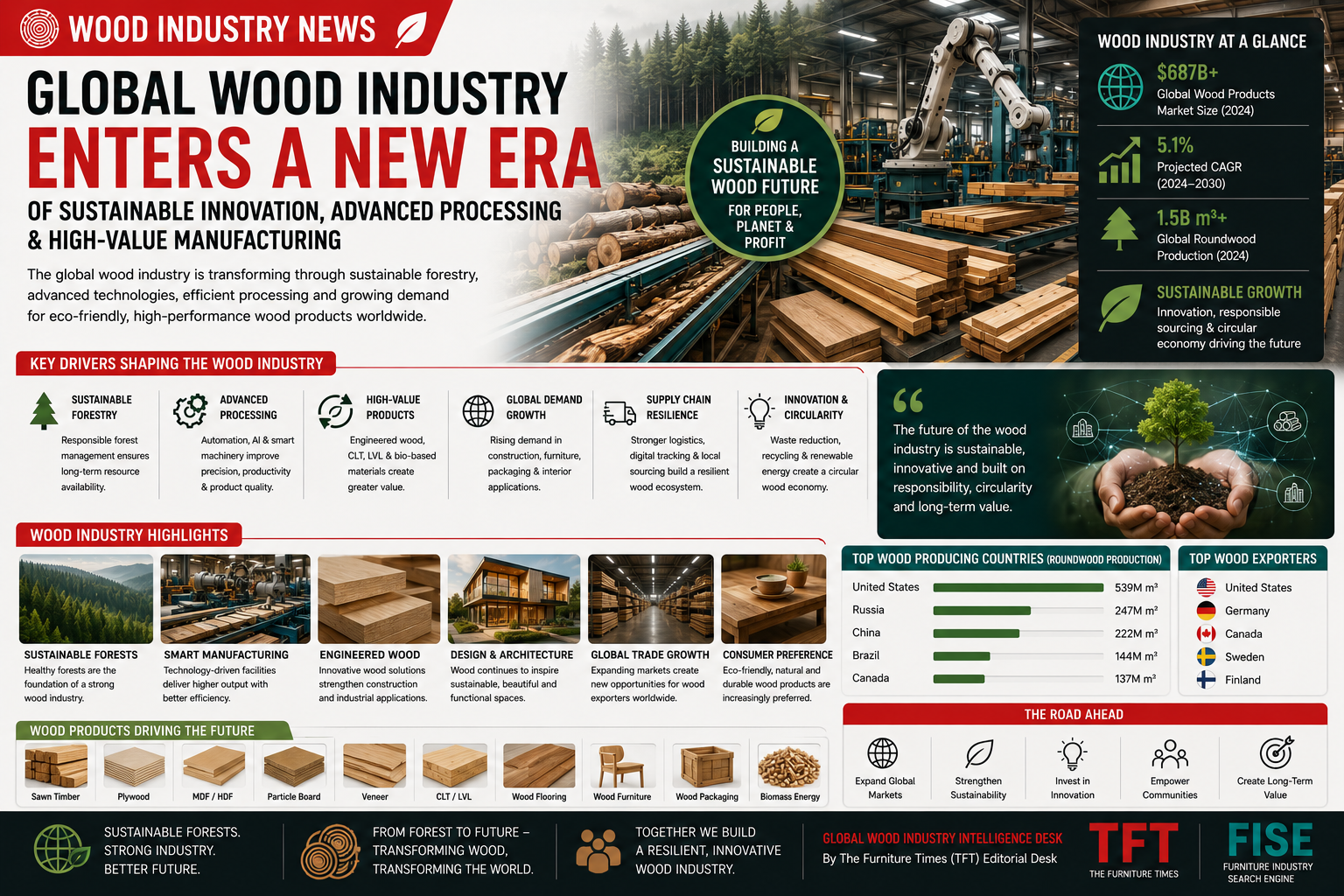
Global Wood Industry Enters a New Era of Sustainable Innovation, Advanced Processing & High-Value Manufacturing
Global Wood Industry Intelligence Desk
By The Furniture Times (TFT) Editorial Desk
Executive Summary
The global wood industry is entering a period of significant transformation as sustainability, advanced manufacturing, renewable materials and digital technologies reshape one of the world’s oldest industries.
For centuries, wood has served as the foundation of construction, furniture manufacturing, paper production and countless industrial applications.
Today, the industry is evolving far beyond traditional timber production.
Governments, manufacturers, researchers and investors are increasingly focusing on:
- Sustainable forestry
- Value-added wood processing
- Engineered wood products
- Bio-based materials
- Renewable energy
- Circular economy
- Artificial Intelligence (AI)
- Smart manufacturing
Around the world, companies are investing in technologies that convert timber into higher-value products while improving resource efficiency and reducing environmental impact. Recent developments include plans in New Zealand to establish an integrated wood-processing hub that would produce engineered wood products, biofuels, sustainable aviation fuel and renewable chemicals from forest resources.
According to The Furniture Times (TFT), the future of the wood industry will not be determined simply by harvesting more timber.
It will be defined by how intelligently wood is processed, managed, certified and transformed into sustainable products that support multiple industries, including the global furniture ecosystem.
The Wood Industry Remains the Foundation of Furniture Manufacturing
Every furniture product begins with raw materials.
For wooden furniture, that journey begins in responsibly managed forests.
The wood industry supports:
- Furniture manufacturing
- Interior design
- Construction
- Packaging
- Flooring
- Doors and windows
- Paper production
- Renewable energy
- Bio-based chemicals
Without a healthy wood industry, the global furniture sector cannot thrive.
Sustainability Is Driving Industry Transformation
Environmental responsibility has become one of the industry’s highest priorities.
Governments and manufacturers are investing in:
Responsible forest management.
Certified timber.
Reforestation.
Efficient harvesting.
Waste reduction.
Circular manufacturing.
Consumers and international buyers increasingly expect products sourced from responsibly managed forests.
Certification systems continue playing an important role in demonstrating sustainable forestry practices.
Value-Added Processing Is Creating New Opportunities
Instead of exporting raw logs, many countries are investing in value-added manufacturing.
These include:
Engineered wood.
Furniture components.
Decorative panels.
Wood flooring.
Mass timber.
Cross-laminated timber.
Bio-based materials.
Wood chemicals.
This approach creates:
Higher revenues.
More employment.
Greater export value.
Improved industrial competitiveness.
Innovation Beyond Traditional Timber
Wood is becoming a source of innovation.
Modern processing technologies allow manufacturers to produce:
Biofuels.
Renewable aviation fuel.
Engineered construction materials.
Green chemicals.
Advanced wood composites.
New Zealand’s proposed integrated processing hub reflects this broader global trend toward extracting greater economic value from forest resources.
Engineered Wood Is Expanding
Demand continues growing for:
Plywood.
Laminated timber.
Medium-density fibreboard (MDF).
Particleboard.
Oriented strand board (OSB).
Cross-laminated timber (CLT).
These products improve material efficiency while supporting modern architecture and furniture manufacturing.
Asia Continues Leading Production
Asia remains one of the world’s largest consumers and processors of wood products.
Major manufacturing countries include:
China.
Vietnam.
Malaysia.
Indonesia.
India.
Rapid urbanisation, construction activity and furniture manufacturing continue driving regional demand.
Vietnam Continues Strengthening the Wood Sector
Vietnam’s wood industry continues expanding through:
Value-added manufacturing.
Sustainable production.
Export diversification.
Investment in automation.
Clean energy adoption.
The country recently surpassed US$17 billion in annual timber and wood-product exports while continuing its transition toward higher-value and more sustainable production.
Europe Focuses on Green Manufacturing
European producers continue investing in:
Carbon reduction.
Sustainable sourcing.
Energy-efficient production.
Circular economy.
Certified timber.
Innovation in engineered wood.
Environmental standards continue influencing purchasing decisions throughout European markets.
Artificial Intelligence Is Entering the Wood Industry
AI is beginning to support:
Forest monitoring.
Demand forecasting.
Production optimisation.
Quality inspection.
Inventory planning.
Supply chain management.
Predictive maintenance.
Digital technologies are helping improve efficiency while supporting better resource management.
Digital Manufacturing Improves Productivity
Modern wood-processing facilities increasingly integrate:
Automation.
CNC machinery.
Robotics.
Smart sensors.
Real-time analytics.
Digital production planning.
Factories are becoming more productive while reducing waste.
Furniture Manufacturing Benefits
A stronger wood industry directly benefits furniture manufacturers by providing:
Reliable raw materials.
Higher-quality timber.
Improved consistency.
Engineered wood solutions.
Sustainable materials.
Innovative products.
Furniture innovation begins with material innovation.
Circular Economy Is Growing
Wood remains one of the world’s most renewable industrial materials when forests are managed responsibly.
Businesses increasingly support:
Wood recycling.
Furniture refurbishment.
Material recovery.
Biomass utilisation.
Production waste reduction.
Circular economy initiatives help maximise resource efficiency.
Global Trade Continues Expanding
International trade in wood products remains strong.
Demand continues for:
Sawn timber.
Panels.
Engineered wood.
Furniture components.
Construction materials.
Finished wood products.
Countries investing in value-added processing continue strengthening export competitiveness.
Challenges Facing the Industry
The global wood industry continues managing:
Illegal logging.
Climate change.
Rising logistics costs.
Labour shortages.
Changing regulations.
Market volatility.
Supply chain pressures.
Businesses increasingly respond through innovation, certification and technology adoption.
The Future of Wood Processing
Future investment will likely focus on:
Bio-based products.
Carbon-efficient manufacturing.
Renewable materials.
Smart factories.
Digital forestry.
Precision processing.
Advanced composites.
Integrated industrial clusters.
The industry is moving beyond commodity production toward higher-value manufacturing.
The Furniture Times Analysis
The wood industry is no longer simply a supplier of raw materials.
It is becoming a strategic innovation sector supporting:
Furniture.
Construction.
Renewable energy.
Green manufacturing.
Industrial technology.
Circular economy.
Countries that invest in responsible forestry, advanced processing and sustainable innovation will strengthen both their wood industries and their furniture manufacturing ecosystems.
Final Verdict
The global wood industry stands at the beginning of a new era.
An era defined by:
Sustainability.
Innovation.
Technology.
Value-added manufacturing.
Renewable resources.
International collaboration.
The future belongs to countries and companies that transform forests into long-term economic value while protecting them for future generations.
For the furniture industry, a stronger wood sector means stronger manufacturing, better products, improved sustainability and greater global competitiveness.
The wood industry is no longer simply about timber.
It is about building the foundation of tomorrow’s green economy.
By The Furniture Times (TFT) Editorial Desk
Global Wood Industry Intelligence Desk | July 2026
“TFT tells their story. FISE helps the world find them.”
The furniture industry ecosystem is a $1 Trillion Dollar Industry.
