
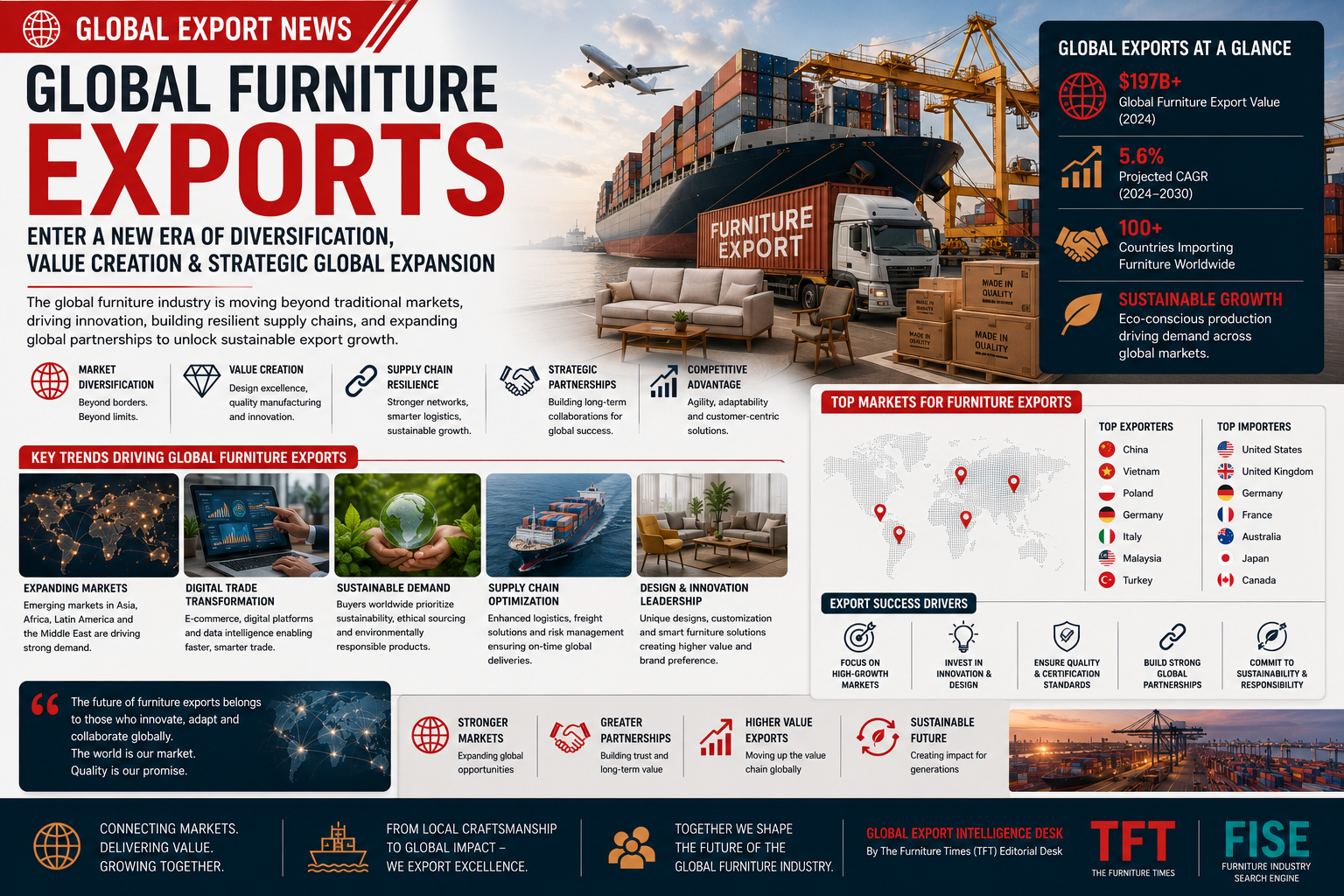
Global Furniture Exports Enter a New Era of Diversification, Value Creation & Strategic Global Expansion
Global Export Intelligence Desk
By The Furniture Times (TFT) Editorial Desk
Executive Summary
The global furniture export industry is entering a new phase of transformation.
For decades, international success was measured largely by export volumes and manufacturing capacity. Today, the definition of a successful exporter has expanded significantly.
Furniture exporters are now competing through:
- Product innovation
- Sustainable manufacturing
- Brand development
- Digital visibility
- AI-powered business intelligence
- Faster logistics
- Market diversification
- Customer trust
International buyers are becoming more selective, placing greater emphasis on long-term partnerships, compliance, transparency and supply chain resilience rather than simply choosing the lowest-cost supplier. Exporting remains one of the most effective ways for manufacturers to expand into international markets and generate economic growth.
According to The Furniture Times (TFT), the future of furniture exports will belong to companies that export not only products but also quality, innovation, reliability and trust.
Global Furniture Exports Continue Growing
Furniture remains one of the world’s most internationally traded manufactured products.
Every year, billions of dollars’ worth of furniture crosses international borders.
Products include:
- Residential furniture
- Office furniture
- Hospitality furniture
- Outdoor furniture
- Healthcare furniture
- Educational furniture
- Custom-built furniture
Despite economic uncertainty, global demand continues to create opportunities for exporters that can adapt to changing customer expectations and international regulations.
Export Markets Are Becoming More Diverse
One of the biggest changes in international furniture trade is market diversification.
Exporters are no longer relying heavily on one or two countries.
Instead, they are expanding into:
- Europe
- North America
- Middle East
- Southeast Asia
- Africa
- Australia
- Latin America
Diversifying export destinations reduces commercial risk while creating new long-term growth opportunities.
Asia Continues Leading Furniture Exports
Asia remains the world’s largest furniture export region.
Major exporting countries include:
- China
- Vietnam
- Malaysia
- Indonesia
- India
Vietnam continues strengthening its global export position through investment in manufacturing, compliance, skilled labour and international partnerships, while many buyers continue adopting “China+1” sourcing strategies.
Export Buyers Want More Than Low Prices
International buyers increasingly evaluate suppliers based on:
Quality.
Consistency.
Compliance.
Production capacity.
Communication.
Delivery performance.
Environmental responsibility.
After-sales support.
The conversation has shifted from “Who is cheapest?” to “Who is the most reliable long-term partner?”
Sustainability Is Becoming an Export Requirement
Many international markets increasingly expect suppliers to demonstrate:
Responsible timber sourcing.
Environmental compliance.
Reduced emissions.
Sustainable packaging.
Traceable supply chains.
Export competitiveness increasingly depends upon meeting these expectations rather than treating sustainability as an optional feature. The European Union continues implementing rules requiring greater due diligence for products such as timber and furniture placed on its market.
Brand Manufacturing Is Replacing Pure OEM
Many exporters are moving beyond contract manufacturing.
Instead of producing only for international brands, manufacturers are increasingly investing in:
Own-brand development.
Product design.
Marketing.
Digital commerce.
International distribution.
This transition improves long-term profitability and strengthens global recognition.
AI Is Supporting Export Growth
Artificial Intelligence is becoming a valuable export tool.
Businesses use AI for:
Market research.
Customer communication.
Demand forecasting.
Translation.
Sales support.
Export documentation.
Inventory planning.
These technologies help exporters respond faster to international buyers while improving operational efficiency.
Digital Visibility Is the New Export Gateway
Today’s buyers rarely begin by visiting factories.
They begin online.
They search for:
Manufacturers.
Products.
Certifications.
Factory capabilities.
Customer reviews.
Videos.
Project portfolios.
Companies that are easy to discover digitally gain a significant competitive advantage.
Trade Exhibitions Continue Creating Opportunities
International furniture exhibitions remain among the industry’s most important export platforms.
Events across Asia, Europe and North America continue connecting manufacturers with buyers, distributors and designers from around the world.
Recent international furniture fairs have continued attracting thousands of buyers and generating substantial export business despite global market uncertainty.
Export Logistics Remain Critical
Reliable logistics directly influence export success.
Businesses continue investing in:
Container optimisation.
Warehouse efficiency.
Cross-border distribution.
Shipment tracking.
Customs documentation.
Delivery reliability.
Efficient logistics strengthen customer satisfaction and reduce operational risks.
SMEs Have Greater Global Opportunities
Technology has reduced many barriers to exporting.
Small and medium-sized manufacturers can now reach international customers through:
Professional websites.
Digital catalogues.
Virtual meetings.
Video marketing.
Industry platforms.
Search optimisation.
Online trade promotion.
Global business is becoming more accessible than ever before.
Challenges Facing Exporters
Furniture exporters continue managing:
Freight volatility.
Currency fluctuations.
Trade regulations.
Labour shortages.
Raw material costs.
Geopolitical uncertainty.
Environmental compliance.
Businesses that plan strategically are better positioned to navigate these challenges.
The Importance of Long-Term Relationships
Successful exporting is built on relationships rather than one-time transactions.
International buyers increasingly value suppliers who offer:
Reliable communication.
Consistent quality.
Flexible production.
Transparent operations.
Continuous improvement.
Trust remains one of the strongest competitive advantages.
The Furniture Times Analysis
The global export environment is changing rapidly.
Future export leadership will depend upon:
Innovation.
Quality.
Sustainability.
Technology.
Digital discoverability.
International partnerships.
Operational excellence.
The businesses that invest in these capabilities today will become tomorrow’s global export leaders.
Final Verdict
Furniture exporting is no longer simply about shipping products overseas.
It is about building global relationships.
Creating trusted brands.
Meeting international standards.
Delivering consistent quality.
Adapting to changing markets.
The next generation of successful exporters will not compete only on manufacturing capacity.
They will compete on intelligence.
Innovation.
Customer confidence.
Digital visibility.
And the ability to serve international markets with excellence.
Because in today’s global economy…
Every shipment represents more than furniture.
It represents a country’s craftsmanship.
A company’s reputation.
And a promise delivered across borders.
By The Furniture Times (TFT) Editorial Desk
Global Export Intelligence Desk | July 2026
“TFT tells their story. FISE helps the world find them.”
The furniture industry ecosystem is a $1 Trillion Dollar Industry.
