
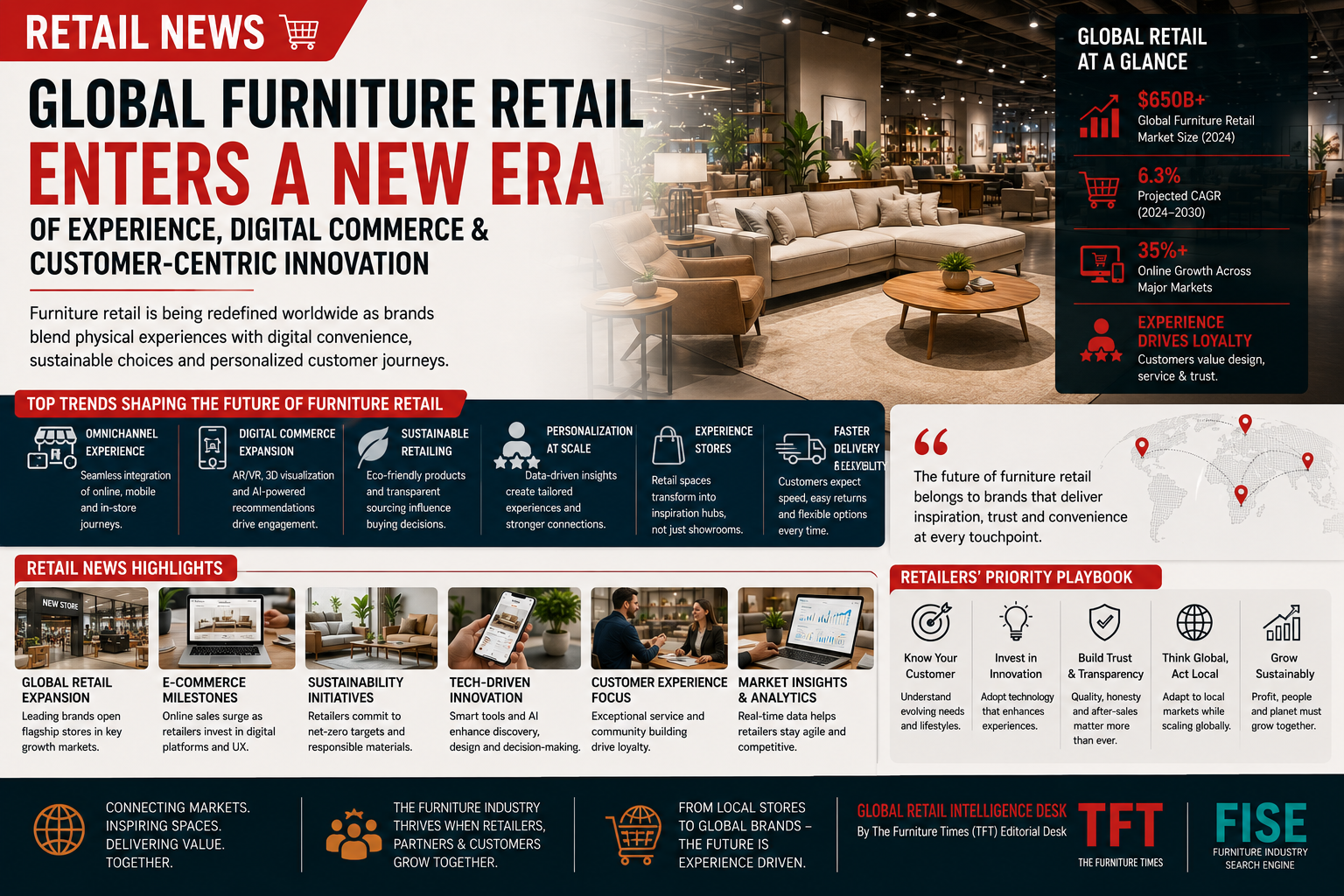
Global Furniture Retail Enters a New Era of Experience, Digital Commerce & Customer-Centric Innovation
Global Retail Intelligence Desk
By The Furniture Times (TFT) Editorial Desk
Executive Summary
The global furniture retail industry is undergoing one of the most significant transformations in its history.
Traditional furniture stores are evolving into experience centres, while digital commerce, Artificial Intelligence (AI), omnichannel retailing and personalised customer experiences are reshaping how consumers discover, evaluate and purchase furniture.
Today’s customers no longer visit stores simply to buy a sofa or dining table.
They arrive after researching products online, comparing prices, reading reviews, watching videos and exploring interior design inspiration across multiple digital platforms.
As a result, retailers are redefining the role of the physical showroom.
It is no longer just a place to display products.
It is becoming a destination where customers can experience furniture, receive expert advice and build confidence before making purchasing decisions.
According to The Furniture Times (TFT), the future of furniture retail will belong to businesses that successfully integrate physical stores, digital platforms, AI-driven services and exceptional customer experiences into one seamless retail ecosystem.
The Retail Landscape Is Changing
Furniture retail has traditionally relied on:
- Large showrooms
- Printed catalogues
- Walk-in customers
- Sales representatives
- Seasonal promotions
Today, retail success depends on much more.
Retailers now compete through:
- Digital visibility
- Customer experience
- Online convenience
- Personalisation
- AI-assisted shopping
- Fast delivery
- Flexible payment options
- After-sales service
Retail has become a continuous customer journey rather than a single transaction.
Consumers Shop Differently Today
Modern furniture buyers often begin their journey online.
They:
Search on Google.
Ask AI assistants.
Watch product videos.
Read customer reviews.
Compare brands.
Browse social media.
Visit websites.
Only after extensive research do many customers visit a showroom—or they may complete the purchase entirely online.
This shift requires retailers to maintain consistent experiences across every customer touchpoint.
The Rise of Omnichannel Retail
Consumers expect flexibility.
They may:
Browse online.
Visit a store.
Order through a mobile device.
Collect in-store.
Arrange home delivery.
Request virtual consultations.
Successful retailers integrate these experiences rather than treating online and offline channels separately.
Experience Is the New Competitive Advantage
Customers increasingly seek more than products.
They seek inspiration.
Modern furniture retailers are creating:
Lifestyle showrooms.
Interactive room settings.
Design consultation areas.
Digital product displays.
Material experience zones.
Hospitality-inspired retail environments.
Luxury brands are investing in immersive flagship galleries that combine retail with hospitality and design experiences, demonstrating how physical stores are evolving beyond traditional showrooms.
Artificial Intelligence Is Reshaping Retail
AI is transforming furniture retail through:
Personalised recommendations.
Virtual assistants.
Product comparisons.
Demand forecasting.
Inventory optimisation.
Customer service.
Visual room planning.
Retailers using AI effectively can improve customer experiences while supporting better business decisions.
E-Commerce Continues Expanding
Online furniture sales continue growing worldwide.
Customers increasingly expect:
Detailed product information.
High-quality images.
Product videos.
Augmented Reality visualisation.
Customer reviews.
Fast delivery.
Flexible returns.
The digital storefront has become as important as the physical showroom.
Reviews Influence Purchasing Decisions
Trust has become a decisive factor in furniture retail.
Customers increasingly rely on:
Verified reviews.
Ratings.
Customer photographs.
Project case studies.
Real experiences.
Strong reputations improve confidence before customers enter a showroom or complete an online purchase.
Digital Marketing Drives Retail Growth
Retailers invest heavily in:
Search Engine Optimisation (SEO).
Search advertising.
Content marketing.
Email campaigns.
Social media.
Video marketing.
Local search.
Educational content.
Retail success increasingly begins with digital discoverability.
Sustainability Influences Consumer Choices
Today’s consumers increasingly consider:
Sustainable materials.
Responsible sourcing.
Recyclable packaging.
Product longevity.
Repairability.
Circular economy initiatives.
Retailers communicating these values effectively strengthen customer trust.
Personalisation Is Becoming Standard
Customers increasingly expect furniture tailored to their lifestyles.
Retailers now offer:
Custom fabrics.
Personalised finishes.
Modular configurations.
Room planning.
Interior design advice.
Product recommendations.
Personalisation increases customer satisfaction while strengthening brand loyalty.
Physical Stores Remain Important
Although e-commerce continues expanding, physical stores remain essential.
Customers often prefer seeing:
Comfort.
Texture.
Materials.
Colours.
Construction quality.
Scale.
Modern stores increasingly function as experience centres rather than purely transactional spaces.
Global Retail Trends
Across international markets, retailers are investing in:
Smaller urban formats.
Flagship experience centres.
Click-and-collect services.
Digital showrooms.
Warehouse optimisation.
Customer relationship management.
Some retailers are also reshaping their store portfolios by closing underperforming locations while expanding digital capabilities and home-delivery services, reflecting broader changes in customer shopping behaviour.
The Growing Role of Data
Retailers increasingly use data to understand:
Customer behaviour.
Product demand.
Buying trends.
Seasonal preferences.
Inventory levels.
Marketing performance.
Data-driven decisions improve efficiency while supporting better customer experiences.
Opportunities for Independent Retailers
Independent furniture retailers remain important contributors to local economies.
They can compete successfully by focusing on:
Exceptional customer service.
Local expertise.
Community relationships.
Curated product selections.
Digital visibility.
Authentic storytelling.
Technology enables smaller businesses to reach wider audiences than ever before.
Challenges Facing Furniture Retail
Retailers continue managing:
Changing consumer expectations.
Rising operating costs.
Competition from online marketplaces.
Supply chain disruptions.
Inventory management.
Workforce recruitment.
Businesses that remain agile and customer-focused are better positioned to navigate these challenges.
The Furniture Times Analysis
Furniture retail is entering a customer-first era.
The retailers that succeed will not necessarily be those with the largest number of stores.
They will be those that provide:
Outstanding experiences.
Trusted brands.
Digital convenience.
Knowledgeable service.
Seamless online and offline integration.
Retail is becoming an experience business as much as a product business.
Final Verdict
The future of furniture retail is no longer defined solely by showroom size or inventory.
It is defined by how effectively retailers connect with customers before, during and after every purchase.
Businesses that embrace:
Digital transformation.
Artificial Intelligence.
Customer education.
Sustainability.
Personalisation.
Omnichannel retailing.
Will become the next generation of retail leaders.
The future belongs to retailers that inspire confidence, create memorable experiences and build long-term customer relationships.
Because in modern furniture retail…
Customers do not simply buy furniture.
They invest in homes, lifestyles and experiences.
By The Furniture Times (TFT) Editorial Desk
Global Retail Intelligence Desk | July 2026
“TFT tells their story. FISE helps the world find them.”
The furniture industry ecosystem is a $1 Trillion Dollar Industry.
