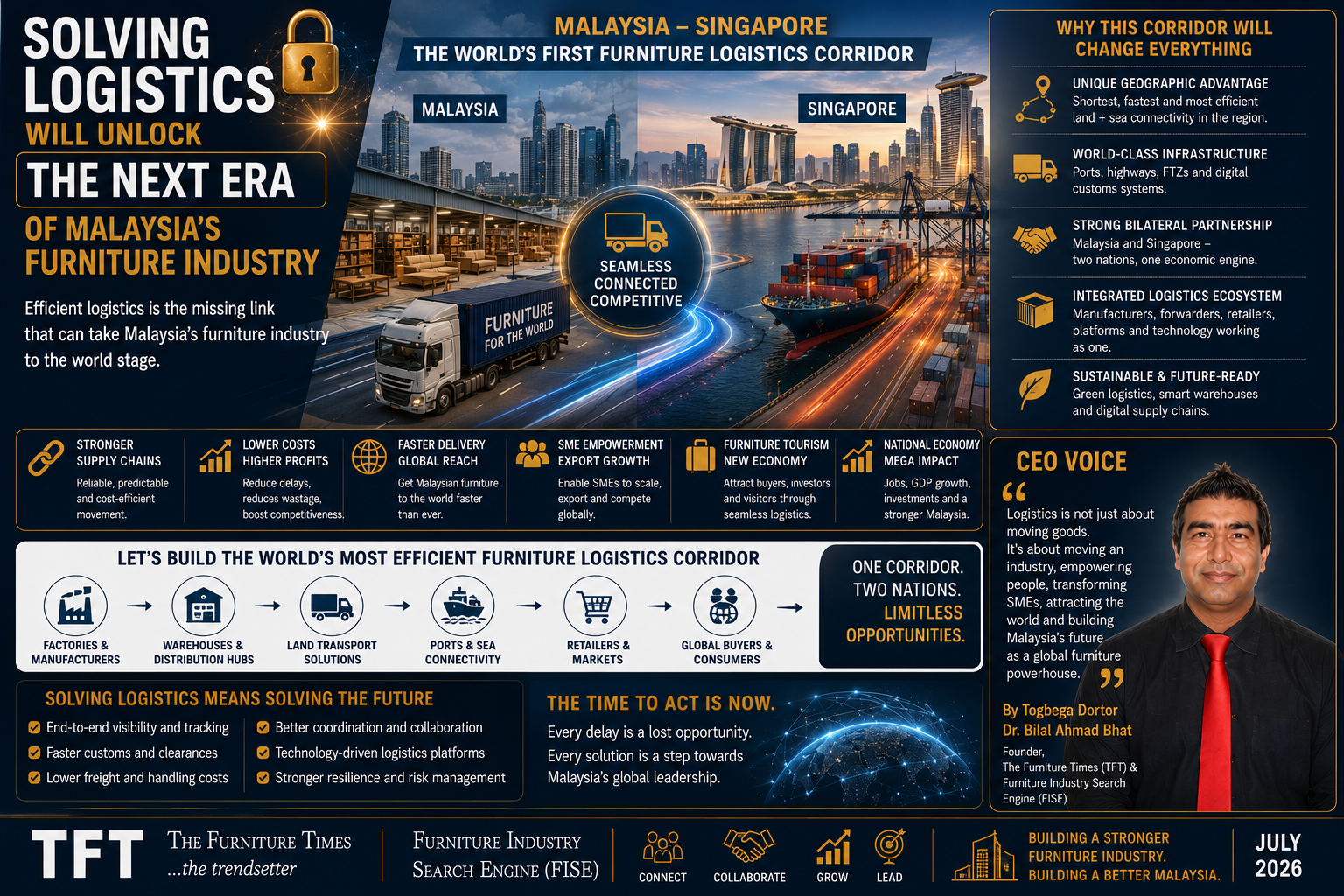
Solving Logistics Will Unlock the Next Era of Malaysia’s Furniture Industry
Why Malaysia–Singapore Should Become the World’s First Furniture Logistics Corridor and How It Can Transform Manufacturing, Retail, SMEs, Tourism & the National Economy
CEO Voice | Global Logistics & Supply Chain Intelligence Desk
By Togbega Dortor Dr. Bilal Ahmad Bhat
Founder, The Furniture Times (TFT) & Furniture Industry Search Engine (FISE)
For more than thirty years, I have lived and worked inside the furniture industry.
I have seen manufacturers grow.
I have seen retailers succeed.
I have seen exporters build global brands.
I have also witnessed excellent companies struggle—not because their products were poor, but because their logistics were inefficient.
After three decades in this industry, I have reached one conclusion.
The next revolution in the Malaysian furniture industry will not begin inside a factory.
It will begin inside the logistics network.
If Malaysia wants to strengthen its position as one of the world’s leading furniture manufacturing nations, logistics must become a national priority—not only for exports, but also for domestic distribution and cross-border trade.
Today, I propose a practical first phase.
The Malaysia–Singapore Furniture Logistics Corridor.
This is not merely a transport project.
It is an economic development strategy.
A manufacturing strategy.
An SME strategy.
A tourism strategy.
And a national competitiveness strategy.
Malaysia Already Has the Manufacturing Strength
Malaysia has earned an international reputation for quality furniture manufacturing.
Its manufacturers supply markets across Asia, Europe, Australia, the Middle East and North America.
The country benefits from experienced manufacturers, recognised certification systems, modern ports and established export capabilities.
Yet many businesses continue facing one common challenge.
Moving furniture efficiently.
Logistics Is No Longer a Support Function
Traditionally, logistics has been viewed as something that happens after production.
Manufacture first.
Ship later.
That thinking belongs to the past.
Today logistics determines:
Customer satisfaction.
Delivery speed.
Export competitiveness.
Inventory efficiency.
Cash flow.
Business profitability.
A beautiful product delivered late can become a failed product.
A reliable logistics system creates confidence before the customer even opens the package.
Why Begin with Malaysia and Singapore?
Every transformation needs a realistic starting point.
Malaysia and Singapore already enjoy one of the world’s closest economic relationships.
The two countries continue strengthening cooperation through initiatives such as the Johor–Singapore Special Economic Zone, designed to improve investment, logistics and the movement of goods and people.
This makes the Malaysia–Singapore corridor the ideal first phase for a dedicated Furniture Logistics Economy.
The objective is simple.
Move furniture faster.
Move furniture smarter.
Move furniture more predictably.
Imagine a Dedicated Furniture Logistics Corridor
Imagine a future where furniture manufacturers in:
Muar.
Johor Bahru.
Klang.
Shah Alam.
Kuala Lumpur.
Penang.
Batu Pahat.
Can serve Singapore through an integrated logistics ecosystem.
Instead of fragmented deliveries…
There is one coordinated system.
Warehousing.
Cross-border consolidation.
Installation scheduling.
Digital tracking.
Customer communication.
Professional after-sales support.
Furniture reaches customers more efficiently.
Everyone benefits.
The Furniture Logistics Economy
The Furniture Logistics Economy is much larger than transportation.
It includes:
Warehousing.
Cross-border distribution.
Inventory management.
Packaging.
Installation.
Assembly.
Returns management.
Reverse logistics.
After-sales services.
Digital tracking.
Supply chain technology.
Every one of these services creates businesses.
Every business creates employment.
Malaysian Manufacturers Gain a Competitive Advantage
Better logistics allows manufacturers to:
Reduce delivery times.
Lower operational costs.
Improve customer satisfaction.
Accept smaller orders.
Expand into new markets.
Increase repeat business.
Offer installation services.
Strengthen export readiness.
Good logistics becomes a sales tool.
Malaysian Retailers Can Sell Beyond Borders
Furniture retailers increasingly compete online.
Customers compare:
Price.
Quality.
Delivery speed.
Installation.
Warranty.
If Malaysian retailers can deliver seamlessly into Singapore, they gain access to a nearby, high-value market while strengthening customer confidence.
Logistics becomes market expansion.
SMEs Will Benefit the Most
Large corporations often build their own logistics networks.
SMEs cannot.
Shared logistics infrastructure allows smaller manufacturers to compete on delivery quality without massive investment.
Instead of building separate systems…
They share a professional ecosystem.
That creates inclusion.
Tourism Meets Logistics
Furniture Business Tourism and logistics naturally complement one another.
International buyers visiting Malaysia need more than factory tours.
They also need confidence that products can be delivered efficiently.
A strong logistics ecosystem completes the buyer journey.
Visit.
Select.
Purchase.
Ship.
Install.
Support.
Without efficient logistics, Furniture Tourism remains incomplete.
Thousands of New Jobs
Improved logistics creates opportunities for:
Warehouse operators.
Furniture installers.
Drivers.
Supply chain coordinators.
Customer service specialists.
Digital tracking managers.
Packaging experts.
Export consultants.
Customs specialists.
Last-mile delivery providers.
Technology companies.
Training institutions.
This is employment beyond manufacturing.
Digital Logistics Is the Future
Malaysia has already begun investing in smarter logistics and digital integration, including initiatives that connect freight forwarding, warehousing and transport through digital platforms.
The furniture industry should become one of the leading beneficiaries of these developments.
Future systems should include:
Real-time delivery tracking.
AI route optimisation.
Digital proof of delivery.
Inventory visibility.
Customer notifications.
Predictive logistics.
Technology reduces uncertainty.
Public-Private Partnership Is Essential
Governments cannot do this alone.
Industry cannot do this alone.
Success requires collaboration between:
Federal agencies.
State governments.
Furniture associations.
Logistics providers.
Technology companies.
Manufacturers.
Retailers.
Banks.
Insurance companies.
Ports.
Customs authorities.
Universities.
The strongest logistics ecosystems are built through partnership.
A National Furniture Logistics Council
Malaysia should consider establishing a dedicated platform bringing together:
Furniture manufacturers.
Retailers.
Freight companies.
Warehousing providers.
Digital logistics companies.
Export agencies.
Government representatives.
Academic experts.
Its role would be to identify bottlenecks and recommend practical improvements that strengthen industry competitiveness.
From Malaysia to ASEAN
The Malaysia–Singapore corridor is only the beginning.
Once proven, similar furniture logistics corridors can expand to:
Thailand.
Indonesia.
Vietnam.
Brunei.
The Philippines.
Eventually creating one connected ASEAN Furniture Logistics Network.
Malaysia has the opportunity to lead.
The Role of TFT & FISE
The Furniture Times believes logistics deserves the same attention as manufacturing.
Furniture Industry Search Engine (FISE) can strengthen this vision by helping buyers discover manufacturers, logistics providers, installation companies, warehousing services and cross-border partners through one searchable ecosystem.
Manufacturing creates products.
Logistics delivers value.
Visibility connects both.
CEO Perspective
According to Togbega Dortor Dr. Bilal Ahmad Bhat:
“After more than thirty years in the furniture industry, I believe the next breakthrough will not come from building another factory. It will come from building a smarter logistics ecosystem. Malaysia has the manufacturing capability. Now we must build the logistics capability that matches it.”
He adds:
“We should begin with Malaysia and Singapore because success creates confidence. Once the model works, it can expand across ASEAN and eventually connect the global furniture industry.”
And concludes:
“A manufacturer cannot grow if products cannot move efficiently. Logistics is no longer a cost centre. It is a growth engine. Whoever solves logistics will unlock the next chapter of Malaysia’s furniture industry.”
TFT & FISE Analysis
The future competitiveness of the Malaysian furniture industry will depend not only on product quality but also on logistics quality.
Manufacturing.
Distribution.
Technology.
Tourism.
Cross-border trade.
Digital visibility.
These are no longer separate industries.
They form one integrated ecosystem.
Countries that integrate them successfully will become global furniture leaders.
Final Verdict
Malaysia already has the factories.
It already has skilled people.
It already has internationally recognised manufacturers.
It already has strategic ports and logistics capabilities.
The next step is integration.
A dedicated Furniture Logistics Economy beginning with the Malaysia–Singapore corridor can create faster trade, stronger SMEs, better customer experiences, more employment, greater investment and higher international competitiveness.
This is more than moving furniture.
It is about moving an entire industry forward.
By Togbega Dortor Dr. Bilal Ahmad Bhat
Founder, The Furniture Times (TFT) & Furniture Industry Search Engine (FISE)
CEO Voice | Global Logistics & Supply Chain Intelligence Desk
“TFT tells their story. FISE helps the world find them.”
The furniture industry ecosystem is a $1 Trillion Dollar Industry.

Related Posts
Global Drivers Analysis: How the Furniture Logistics Market Is Rapidly Evolving
The Furniture Economy 2050: How Manufacturing, Tourism, AI, Logistics, Education, Finance & Sustainability Will Become One Connected Ecosystem