Discover the Best Furniture E-Commerce Platform in 2026
Why the Future of Furniture Retail Depends on More Than Just a Website
Digital Commerce Intelligence Report
By The Furniture Times (TFT) & Furniture Industry Search Engine (FISE)
June 2026
The furniture industry has entered a completely new digital era.
A decade ago, having a website was enough.
Five years ago, having an online store became an advantage.
Today, neither is enough.
The world’s most successful furniture companies are no longer asking:
“Do we need an e-commerce website?”
Instead, they ask:
“Can our digital platform deliver the same confidence, expertise, personalization, and experience as our best showroom?”
That question is changing the entire furniture industry.
Furniture e-commerce has evolved beyond online selling.
It is now about:
- Customer experience
- AI-powered discovery
- Product intelligence
- Visualization
- Personalization
- Trust
- Speed
- Omnichannel integration
The businesses that understand this shift will define the future of furniture commerce.
Industry experts increasingly emphasize AI capabilities, centralized product information, omnichannel selling, visualization tools, and seamless user experiences as critical features for modern furniture e-commerce platforms.
Furniture E-Commerce Is Different From Traditional Online Retail
Selling furniture online is fundamentally different from selling fashion, electronics, or consumer goods.
Furniture purchases involve:
- Higher budgets
- Longer decision cycles
- Space planning
- Material evaluation
- Design compatibility
- Delivery logistics
- Installation considerations
Customers rarely buy furniture impulsively.
Instead, they research.
Compare.
Measure.
Consult family members.
Review specifications.
Visit showrooms.
Return to websites multiple times.
A furniture e-commerce platform must therefore reduce uncertainty at every stage.
What Makes a Great Furniture E-Commerce Platform?
A successful furniture platform does far more than display products.
It creates confidence.
The most successful platforms combine:
AI-Powered Search
Customers should describe what they need naturally.
For example:
“I need weather-resistant outdoor furniture for a beachfront hotel.”
Instead of searching keywords, the platform understands intent.
Rich Product Information
Every product should include:
- Materials
- Dimensions
- Finishes
- Assembly
- Care instructions
- Warranty
- Certifications
- Sustainability information
The better the information, the higher the buyer confidence.
High-Quality Visual Experience
Furniture is visual.
Customers expect:
- Multiple images
- Lifestyle photography
- Zoom capability
- 360-degree views
- Room scenes
- Videos
Visualization reduces purchase hesitation.
Product Personalization
Modern buyers increasingly expect customization.
They want to choose:
- Fabrics
- Colours
- Sizes
- Configurations
- Materials
Personalization improves customer satisfaction while reducing purchase uncertainty.
Mobile-First Experience
Most furniture discovery now begins on smartphones.
A slow or poorly optimized mobile website immediately reduces credibility.
Omnichannel Integration
The best platforms connect:
- Online stores
- Physical showrooms
- Sales representatives
- Inventory systems
- Customer service
- Payment gateways
Customers expect one seamless experience.
AI Recommendations
Future platforms will recommend:
- Matching furniture
- Complementary products
- Room collections
- Alternative materials
- Better configurations
The website becomes a digital interior consultant.
Top 10 Furniture E-Commerce Platforms in 2026
📦 Top 10 Leading E-Commerce Platforms for Furniture Businesses
1. Shopify – Excellent for scalability, app ecosystem, omnichannel selling, and ease of use.
2. Adobe Commerce (Magento) – Ideal for enterprise furniture manufacturers and large retailers needing extensive customization.
3. BigCommerce – Strong for B2B and B2C operations with robust built-in commerce tools.
4. WooCommerce (WordPress) – Flexible solution for businesses wanting complete control and SEO capabilities.
5. Salesforce Commerce Cloud – Enterprise platform with advanced personalization and CRM integration.
6. Wix eCommerce – Suitable for small and medium furniture retailers looking for fast deployment.
7. Squarespace Commerce – Best for design-focused furniture brands and premium visual presentation.
8. commercetools – API-first platform for businesses building highly customized digital commerce experiences.
9. Shift4Shop (formerly 3dcart) – Comprehensive e-commerce platform with integrated selling features.
10. Ecwid – Flexible solution for adding e-commerce to existing websites and multichannel selling.
These platforms are frequently recognized in current industry comparisons because they offer varying combinations of scalability, integrations, omnichannel commerce, AI support, customization, and enterprise capabilities.
How to Choose the Right Furniture E-Commerce Platform
Every furniture business has different requirements.
The best platform depends on your business model.
Manufacturers
Need:
- Dealer portals
- RFQ systems
- Bulk ordering
- Product configurators
- Export management
Retailers
Need:
- Beautiful storefronts
- Easy checkout
- Promotions
- Customer reviews
- Mobile shopping
Hospitality Suppliers
Need:
- Project quotation tools
- Large catalog management
- Custom specifications
- Contract pricing
Outdoor Furniture Brands
Need:
- Lifestyle presentation
- Material education
- Project galleries
- Product configurators
Kitchen Cabinet & Wardrobe Companies
Need:
- Design consultation
- Appointment booking
- Room planning
- CAD integration
- Configuration tools
Questions Every Business Should Ask
Before selecting an e-commerce platform, ask:
- Will this platform support growth?
- Is it mobile friendly?
- Does it support SEO?
- Is AI-ready?
- Can it integrate with ERP systems?
- Does it support multiple currencies?
- Can it manage thousands of products?
- Does it support wholesale customers?
- Is customer support reliable?
- Will it still meet our needs five years from now?
Choosing technology should be a long-term strategic decision.
10 Tips to Sell More Furniture Online
1. Invest in professional photography.
2. Write detailed product descriptions.
3. Add dimensions and room planning guides.
4. Offer 360° images and videos.
5. Build trust with customer reviews.
6. Improve website speed and mobile performance.
7. Publish buying guides and educational content.
8. Optimize for AI search and SEO.
9. Use personalized recommendations and cross-selling.
10. Stay visible through content, press releases, and search marketing.
The companies that educate customers generally outperform those that simply display products.
Why AI Is Becoming the New Salesperson
Artificial Intelligence is transforming furniture e-commerce.
Customers increasingly ask:
“What sofa is best for a family with children?”
“Recommend outdoor furniture for tropical weather.”
“Which dining table suits a modern apartment?”
The platform that understands intent—not just keywords—will become the preferred destination.
This marks the beginning of Agentic Commerce.
The Future Is Not About Platforms Alone
Technology alone does not guarantee success.
The winning furniture businesses will combine:
- Great products
- Great data
- Great content
- Great customer experience
- Great visibility
A platform is only as strong as the information it contains.
Why FISE Matters
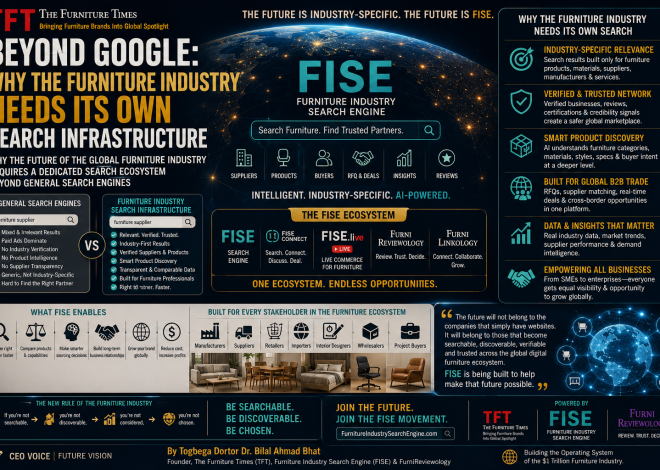
This is exactly why Furniture Industry Search Engine (FISE) was created.
Furniture businesses need more than websites.
They need discoverability.
Searchability.
Structured product information.
Industry-specific intelligence.
The future customer may never type a keyword into Google.
They may simply ask an AI assistant.
The businesses that are searchable, understandable, and trusted will become the businesses AI recommends.
TFT & FISE Analysis
The furniture industry is moving beyond traditional e-commerce.
The next generation of digital commerce will combine:
- AI
- Personalization
- Product intelligence
- Visualization
- Omnichannel experiences
- Search
- Trust
The website is no longer just an online store.
It is becoming the digital headquarters of every furniture business.
Final Verdict
Choosing an e-commerce platform is no longer a technology decision alone.
It is a business strategy.
The right platform should help businesses:
- Sell more
- Build trust
- Improve customer experience
- Increase discoverability
- Prepare for AI-driven commerce
The future belongs to furniture businesses that combine outstanding products with outstanding digital experiences.
Because in 2026:
Customers no longer buy from the biggest website.
They buy from the website that gives them the most confidence.
By The Furniture Times (TFT) & Furniture Industry Search Engine (FISE)
Digital Commerce Intelligence Report | June 2026
“TFT tells their story. FISE helps the world find them.”
The furniture industry ecosystem is a $1 Trillion Dollar Industry.