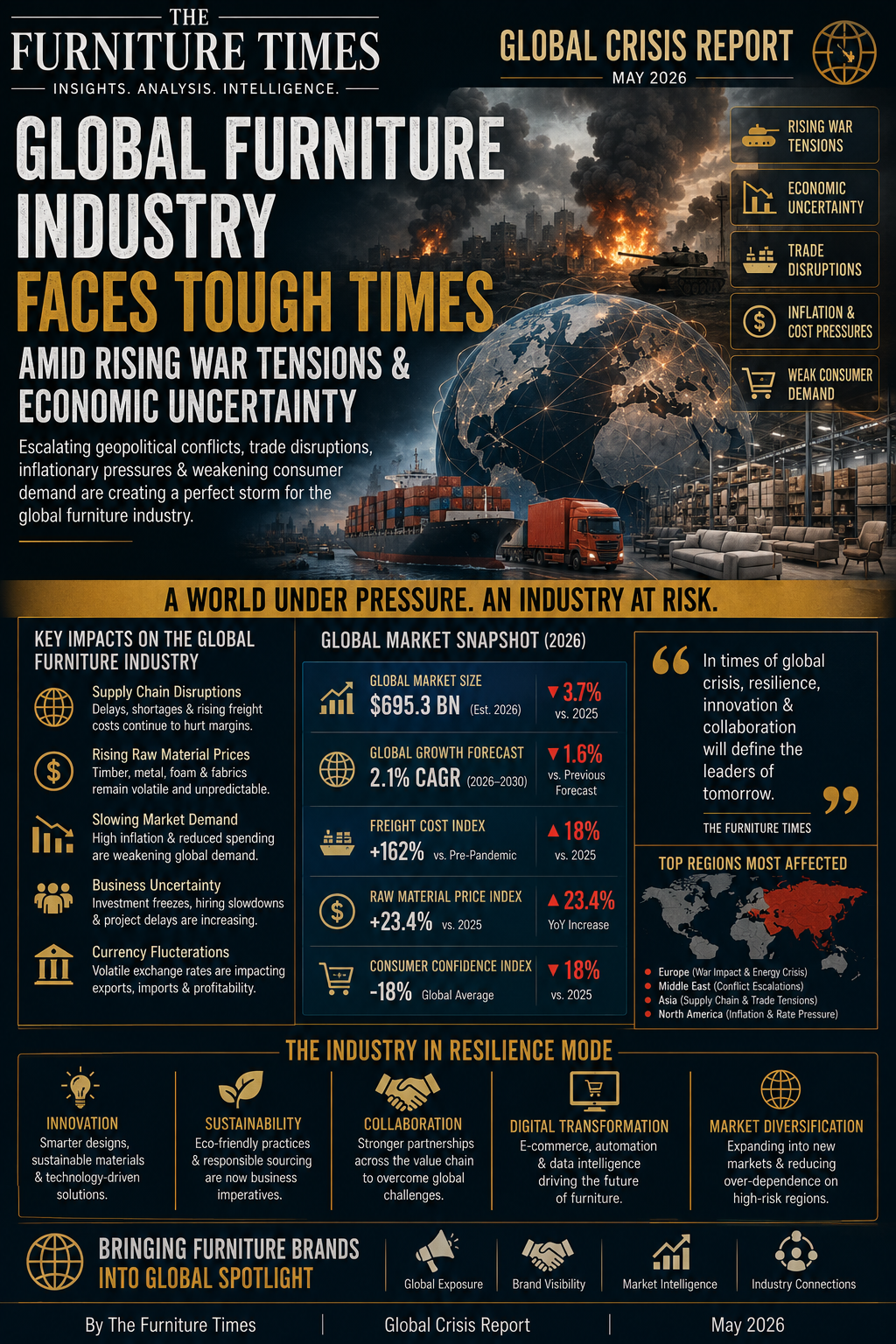
Global Furniture Industry Faces Tough Times Amid Rising War Tensions & Economic Uncertainty
Global Crisis Report | By The Furniture Times
Bringing Furniture Brands Into Global Spotlight
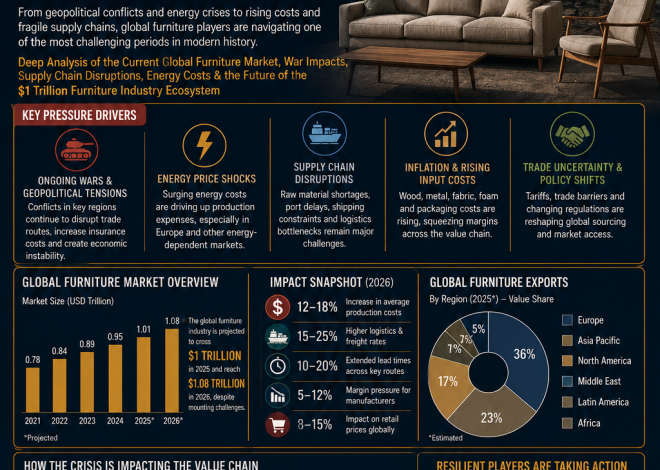
The global furniture industry ecosystem is entering one of its most challenging periods in recent years as ongoing geopolitical conflicts, trade tensions, tariff wars, shipping disruptions, and economic uncertainty continue placing enormous pressure on manufacturers, suppliers, retailers, exporters, and logistics providers worldwide.
From the Middle East conflict and the Strait of Hormuz disruptions to rising trade protectionism, container instability, energy price volatility, and shifting supply chains, furniture businesses across Asia, Europe, the United States, and the Middle East are increasingly struggling to maintain profitability, stable production, and predictable demand.
Industry analysts warn that the furniture sector is particularly vulnerable because furniture products are bulky, logistics-heavy, and highly dependent on stable global shipping networks. Rising fuel prices, rerouted shipping lanes, insurance surcharges, and geopolitical instability are significantly increasing landed costs across the international furniture trade ecosystem.
The recent instability surrounding the Middle East and the ongoing disruptions near key global shipping corridors such as the Red Sea, Bab al-Mandeb Strait, and Strait of Hormuz are forcing many shipping companies to reroute vessels around longer routes, adding delays and operational expenses.
At the same time, escalating tariff tensions and global trade fragmentation are creating additional uncertainty for furniture manufacturers heavily dependent on exports and imported raw materials. Trade policy volatility is disrupting forecasting, inventory planning, procurement systems, and long-term expansion strategies.
The Furniture Times believes the current crisis is exposing structural weaknesses within the global furniture ecosystem, particularly overdependence on fragmented supply chains, inconsistent sourcing systems, poor digital visibility, and lack of coordinated industry infrastructure.
Retailers are also facing slowing consumer confidence in multiple regions. Rising inflation, housing market pressure, uncertain consumer spending, and higher logistics costs are causing showroom traffic and discretionary furniture purchases to weaken in several international markets.
However, despite these difficult conditions, some hidden opportunities are beginning to emerge.
Furniture businesses are increasingly shifting toward:
Regional sourcing models
Nearshoring strategies
Multi-country manufacturing systems
Digital discoverability ecosystems
AI-driven supply chain visibility
Sustainable manufacturing approaches
Faster-response regional logistics networks
Industry experts believe companies capable of adapting quickly through diversification, digital transformation, operational resilience, and stronger ecosystem collaboration will survive the current turbulence more effectively than those relying entirely on outdated business models.
The global furniture industry is no longer operating in a predictable environment. Geopolitics, energy security, trade policy, digital infrastructure, sustainability demands, and logistics resilience are now directly influencing the future of furniture manufacturing and international trade.
The Furniture Times believes this difficult period may eventually become a major turning point for the industry. Businesses that invest in visibility, adaptability, stronger regional partnerships, smarter supply chains, and resilient digital ecosystems today may emerge stronger during the next phase of global recovery.
The furniture industry remains a trillion-dollar global ecosystem — but survival increasingly depends on resilience, speed, innovation, discoverability, and the ability to adapt during uncertainty.