The State of the Global Furniture Industry
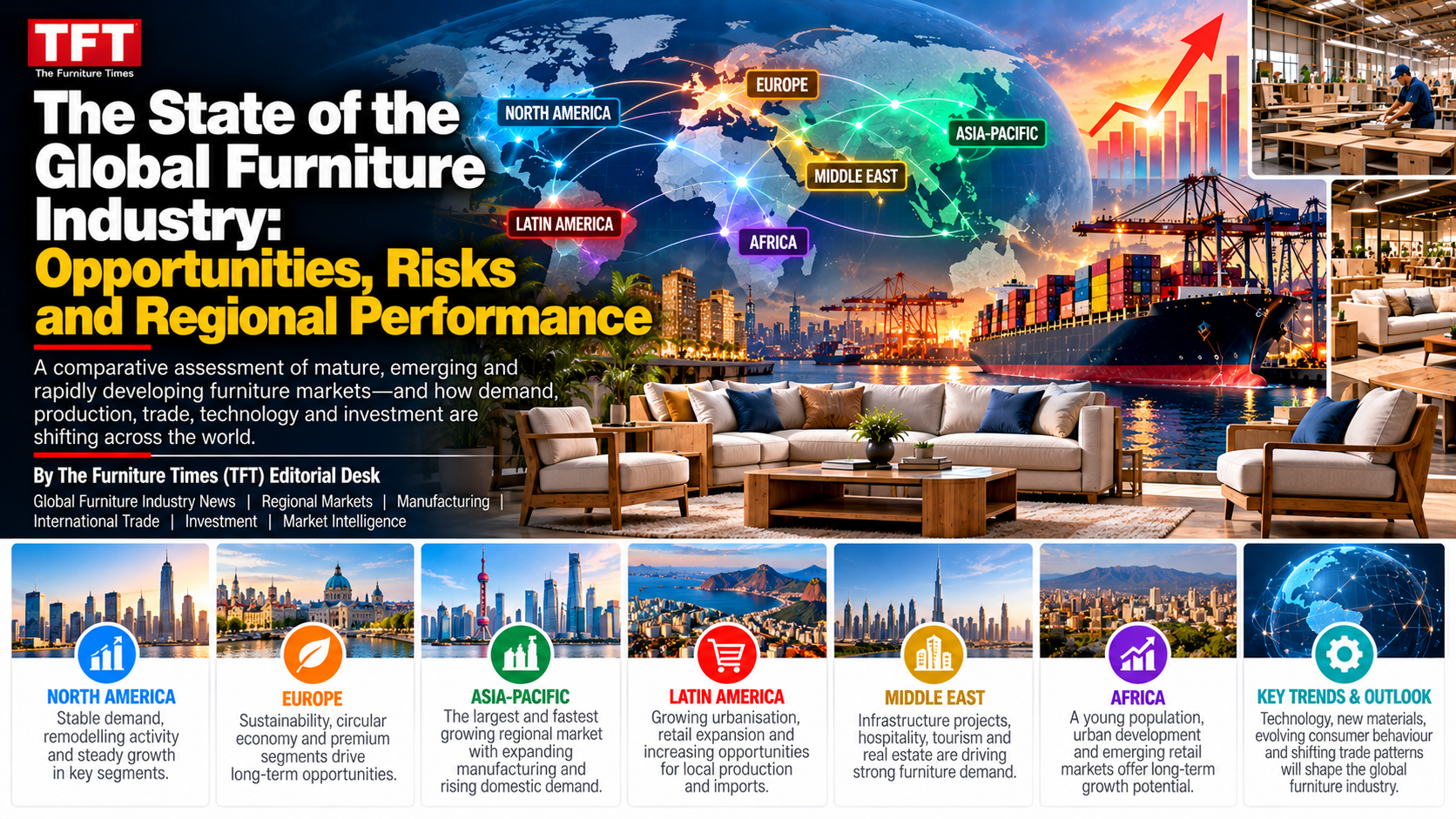
The State of the Global Furniture Industry: Opportunities, Risks and Regional Performance
A comparative assessment of mature, emerging and rapidly developing furniture markets—and how demand, production, trade, technology and investment are shifting across the world
By The Furniture Times (TFT) Editorial Desk | Global Furniture Industry News | Regional Markets | Manufacturing | International Trade | Investment | Market Intelligence
The global furniture industry is becoming larger, more connected and more commercially complex—but its performance is increasingly divided by geography.
Mature markets such as the United States, Western Europe, Japan, Canada and Australia retain substantial consumer purchasing power, established retail networks and sophisticated contract-furniture demand. However, growth is constrained by ageing populations, expensive housing, cautious consumers and saturated product ownership.
Established manufacturing centres—including China, Vietnam, Poland, Italy, Germany, Malaysia, Indonesia and Türkiye—continue to influence global furniture production and exports. Yet they face changing tariffs, higher costs, pressure to automate and stronger competition for international orders.
Rapidly developing markets such as India, parts of Southeast Asia, the Gulf, Africa and Central Asia offer long-term opportunities created by urbanisation, tourism, infrastructure and household formation. Their potential is considerable, but so are the risks involving currency, credit, logistics, regulation and political instability.
The condition of the industry therefore cannot be described through one global growth rate.
The global furniture industry is expanding in some markets, consolidating in others and undergoing structural transformation almost everywhere.
Furniture consumption was expected to remain weak during 2026, with CSIL-linked analysis indicating only a marginal global recovery in 2027.
The broader economy provides some support. The International Monetary Fund forecasts world economic growth of 3.4% in 2027, following 3.1% in 2026. However, that recovery remains exposed to conflict, debt, inflation, energy costs and financial-market volatility.
The key question is no longer whether the global furniture industry will grow.
It is:
Where will growth occur, who will capture it, and what risks must businesses accept to participate?
The Global Market Map
| Market group | Representative regions | Primary strengths | Principal risks |
|---|---|---|---|
| Mature consumer markets | United States, Canada, Western Europe, Japan, Australia | High purchasing power, developed retail, contract demand | Slow growth, ageing populations, high costs, saturation |
| Mature design and manufacturing markets | Italy, Germany, Scandinavia, Japan | Design, engineering, quality, premium positioning | Labour, energy, regulation, import competition |
| Large-scale manufacturing markets | China, Vietnam, Poland, Türkiye, Malaysia | Production capacity, supply chains, export expertise | Tariffs, external-demand dependence, margin pressure |
| Emerging consumer markets | India, Indonesia, Vietnam, Mexico, Brazil | Urbanisation, household formation, middle-income growth | Currency, affordability, infrastructure, regulation |
| Project-led markets | Saudi Arabia, UAE, Qatar and other Gulf states | Hospitality, real estate, infrastructure, public investment | Conflict, shipping, oil-revenue volatility, project delays |
| Rapidly developing frontier markets | Parts of Africa, Central Asia and South Asia | Population growth, housing need, low current penetration | Finance, logistics, informality, political risk |
| Reconstruction markets | Ukraine and conflict-affected territories | Large future demand for housing and institutions | Security, funding, corruption, procurement risk |
This classification is not permanent.
China is simultaneously a mature manufacturing power, a vast consumer market and an emerging global brand exporter. Poland is a developed European economy and a large export-manufacturing base. The Gulf contains wealthy consumer markets but remains rapidly developing in hospitality and urban infrastructure.
Countries must therefore be assessed by function, not by one label.
Mature Markets: Large, Valuable and Difficult
Mature furniture markets remain commercially important because they possess:
- High household purchasing power
- Established homeownership
- Large replacement markets
- Strong commercial property sectors
- Developed hospitality industries
- Reliable payment systems
- Organised retail
- Product-compliance frameworks
- Demand for design and branded furniture
Their challenge is limited volume growth.
Most households already own the essential furniture they require. Demand comes from moving, renovation, replacement, fashion, lifestyle changes and commercial projects rather than first-time ownership.
This makes mature markets highly competitive. Manufacturers must persuade customers to replace something they already possess.
United States: The World’s Most Influential Import Market
The United States remains central to global furniture trade.
CSIL-linked reporting indicates that American furniture imports represent approximately one quarter of worldwide furniture imports. Twenty-four of the countries included in its analysis identify the United States as their principal export destination, and ten send more than half their furniture exports to the American market.
This concentration makes US demand a global industry issue.
When American retailers reduce inventory, the impact reaches factories across China, Vietnam, Malaysia, Indonesia, Mexico, Italy and other exporting countries.
Opportunities
- Large replacement market
- New residential construction
- Outdoor living
- Mattresses and sleep products
- Home-office furniture
- Senior-living furniture
- Hospitality refurbishment
- Healthcare and institutional furniture
- Nearshoring
- Premium and customised products
Risks
- High mortgage costs
- Tariff uncertainty
- Retail consolidation
- Expensive customer acquisition
- High final-mile costs
- Product-liability exposure
- Consumer dependence on promotions
- Inventory volatility
The US market rewards scale, compliance and delivery reliability. It can also punish suppliers that depend too heavily on one major customer.
Exporters should not confuse a large purchase order with a secure long-term relationship.
Canada and Australia: Smaller but Sophisticated Markets
Canada and Australia share several characteristics:
- High urbanisation
- Expensive housing
- Large homes in some regions but increasing apartment living
- Dependence on imports
- Developed retail systems
- Demand for outdoor furniture
- Strong consumer expectations around safety and warranties
Opportunities exist for compact products, outdoor living, hospitality, premium design and sustainable furniture.
However, long shipping distances, smaller populations and strict compliance requirements can make market entry expensive.
Companies need reliable local distributors, accurate product information and strong after-sales support.
Western Europe: A Market of Many Markets
Europe should never be treated as one furniture market.
Germany, France, Italy, Spain, the Netherlands, Scandinavia and the United Kingdom differ in design preferences, housing size, retail structure, regulations and consumer behaviour.
The region combines:
- Major consumers
- Leading exporters
- International design brands
- Strong manufacturing clusters
- Advanced sustainability requirements
- Sophisticated contract markets
At the same time, Europe faces slow economic growth, high energy costs, expensive labour, weak construction in selected countries and uncertainty connected to the war in Ukraine.
The eurozone economy was expected to expand only modestly during 2026, illustrating the restrained environment confronting consumer-durable categories.
Opportunities
- Premium design
- Sustainable materials
- Circular furniture
- Healthcare and elderly care
- Hospitality refurbishment
- Urban storage
- Small-space furniture
- Acoustic office products
- Repair and remanufacturing
- Institutional procurement
Risks
- Slow household consumption
- Regulation and documentation costs
- Import competition
- Retail closures
- High energy prices
- Demographic ageing
- Public-debt pressure
- Labour cost
European success will depend less on producing more furniture and more on producing differentiated, compliant and repairable furniture.
Italy, Germany, Poland and Scandinavia: Different European Strengths
Italy
Italy remains a global design and premium-furniture leader. Its strength lies in brand heritage, creativity, craftsmanship, luxury, kitchens, lighting and contract interiors.
Its challenge is converting design reputation into commercially scalable growth while managing high production costs and fragmented SMEs.
Germany
Germany brings engineering, machinery, manufacturing systems and a substantial consumer base. Yet weak consumer confidence, import dependence and industrial costs are pressuring the sector.
Poland
Poland remains one of the world’s leading furniture exporters. Its position comes from manufacturing scale, European market access, supply networks and competitive production.
Polish businesses nevertheless face wage pressure, energy costs and dependence on Western European demand.
Scandinavia
Scandinavian companies benefit from globally recognised design principles involving simplicity, natural materials, functionality and sustainability.
Their main challenge is protecting premium positioning while competing against lower-cost interpretations of the same aesthetic.
Japan and South Korea: Mature Consumers, Advanced Expectations
Japan’s ageing population and limited residential space influence demand for compact, functional and accessible furniture.
Opportunities include:
- Senior-living furniture
- Small-space products
- High-quality storage
- Multifunctional furniture
- Minimalist design
- Premium craftsmanship
South Korea combines advanced digital commerce, design awareness and highly urban living.
Both markets are demanding. Buyers expect quality, accurate delivery and strong product presentation. Foreign suppliers require local knowledge and trusted distribution relationships.
China: A Category of Its Own
China cannot be classified simply as an emerging market.
It is:
- The world’s largest furniture exporter
- One of its largest domestic markets
- A major materials and components supplier
- A machinery and technology centre
- A fast-growing direct-commerce power
- An increasingly important design and brand market
China remains the world’s largest furniture exporter, followed by Vietnam, Poland, Italy and Germany in CSIL-linked rankings. fordaq.com
Its manufacturing advantages include:
- Deep supplier clusters
- Production scale
- Port infrastructure
- Automation
- Fast product development
- Packaging expertise
- E-commerce integration
- Competitive component supply
The main challenge is domestic demand.
The IMF expects Chinese growth to slow to approximately 4% in 2027 and has highlighted weak household demand and the continuing property crisis.
A weak property market affects furniture purchases connected to home completions, relocations and renovation.
China’s response is increasingly international. Manufacturers are expanding exports, building brands, joining foreign marketplaces and shipping directly to consumers.
Global implication
Chinese overcapacity does not remain inside China. It can produce lower international prices and stronger competition in almost every furniture market.
India: The Most Important Rapid-Growth Opportunity
India combines a large population, rising incomes, urbanisation, organised retail, hospitality development, office demand and domestic manufacturing policy.
The IMF expects India to remain the fastest-growing major economy, with growth around 7% through 2027.
Opportunities
- First-time home furnishing
- Urban apartments
- Mattresses
- Modular kitchens
- Office furniture
- Hospitality
- Education
- Healthcare
- Online retail
- Domestic manufacturing
- Furniture components
- Machinery and technology
Risks
- Price sensitivity
- Informal competition
- Complex distribution
- Certification
- Infrastructure differences
- Product-standard requirements
- Regional consumer variation
The Indian furniture market is formalising.
Manufacturers that previously competed through informal production and low prices must prepare for stronger expectations around testing, documentation, factory systems and product traceability.
The opportunity is enormous, but market participation will become more structured.
Vietnam: Export Power With Concentration Risk
Vietnam has become one of the most important global furniture-exporting countries.
Its strengths include:
- Export-oriented factories
- Skilled labour
- Wood-product experience
- Access to major shipping routes
- Foreign investment
- Competitive manufacturing
- Trade-agreement access
The country has benefited from buyers diversifying production beyond China.
However, Vietnam remains exposed to:
- US demand
- Tariff changes
- Timber legality scrutiny
- Labour costs
- Freight disruption
- Competition from neighbouring countries
- Dependence on imported components
Vietnam’s next development stage must involve more original design, local branding, automation and diversified export markets.
Remaining solely a contract-production base limits margins and bargaining power.
Malaysia: Strong Capability, Insufficient Global Visibility
Malaysia has decades of experience in furniture manufacturing and exports.
Its advantages include:
- Established manufacturing clusters
- Rubberwood expertise
- Export knowledge
- English-language business capability
- Regional connectivity
- Hospitality experience
- Skilled entrepreneurs
- Access to Southeast Asian supply networks
Its challenges include:
- Labour availability
- Rising operating costs
- Raw-material competition
- Limited domestic scale
- Dependence on export demand
- Weak branding among smaller manufacturers
- Digital invisibility
- Cross-border e-commerce pressure
Many Malaysian companies are capable of producing for international brands but remain unknown under their own identities.
This is a strategic weakness.
Malaysia must move from being recognised only as a manufacturing source toward being visible for its companies, designs, technical abilities and service ecosystem.
Indonesia: Materials, Craftsmanship and Domestic Potential
Indonesia combines a large domestic population with strong traditions in wood, rattan, craftsmanship and outdoor furniture.
Opportunities
- Natural-material furniture
- Rattan
- Hospitality products
- Outdoor living
- Artisan collections
- Sustainable furniture
- Domestic urban demand
- International design collaborations
Risks
- Logistics across an archipelago
- Production consistency
- Informal supply chains
- Certification
- Export documentation
- Factory productivity
- Raw-material traceability
Indonesia’s greatest opportunity is to connect craftsmanship with consistent industrial quality and global visibility.
Thailand and the Wider ASEAN Market
Thailand combines tourism, manufacturing, retail, property development and design capability.
The broader ASEAN region benefits from:
- Population growth
- Intra-regional trade
- Urbanisation
- Tourism
- Manufacturing investment
- Supply-chain diversification
However, Asian growth is forecast to slow from 4.8% in 2026 to approximately 4.4% in 2027. The IMF cites energy costs, tighter financial conditions and uneven benefits from technology investment as important risks.
ASEAN remains one of the strongest long-term furniture regions, but its growth will be divided between countries connected to investment and technology flows and those facing higher energy and financing costs.
Türkiye: A Strategic Manufacturing Bridge
Türkiye occupies a valuable position between Europe, Asia, the Middle East and Africa.
Its furniture strengths include:
- Large manufacturing base
- Wide product range
- Textile and upholstery capability
- Geographic proximity to major markets
- Flexible production
- Strong entrepreneurial networks
Its risks include:
- Currency volatility
- Inflation
- Financing costs
- Regional instability
- Imported input costs
- Dependence on nearby export markets
Türkiye can benefit from nearshoring as European and Gulf buyers seek shorter supply chains.
However, suppliers must protect quotation validity and manage currency exposure carefully.
The Gulf: High-Value Projects Under High Geopolitical Risk
Saudi Arabia, the UAE, Qatar, Kuwait, Bahrain and Oman remain important project-furniture markets.
Demand comes from:
- Hotels and resorts
- Luxury residences
- Offices
- Healthcare
- Education
- Restaurants
- Entertainment
- Sports facilities
- Urban-development projects
- Government investment
The commercial opportunity is significant, particularly for companies offering contract furniture, custom joinery, outdoor products, lighting and full fit-out capabilities.
But conflict has changed the regional risk profile.
The IMF projects that the broader Middle East, North Africa and Pakistan region will contract during 2026 before a potentially strong but uneven rebound in 2027. That recovery depends critically on restored energy production, secure shipping and economic normalisation.
Risks
- Strait of Hormuz disruption
- Red Sea insecurity
- War-risk insurance
- Energy volatility
- Flight disruption
- Project delays
- Public-revenue pressure
- Payment risk
- Imported-material dependence
The Gulf should be treated as a high-opportunity, high-volatility market—not as guaranteed project growth.
Furniture companies need local partners, contractual protection and alternative logistics.
Africa: The Furniture Industry’s Long-Term Frontier
Africa’s furniture opportunity is frequently described through population and urbanisation statistics. Those factors matter, but they do not automatically create commercially accessible demand.
The continent includes more than 50 countries with very different incomes, currencies, political systems, climates, building practices and trade conditions.
Opportunity drivers
- Rapid city growth
- Housing shortages
- School construction
- Healthcare investment
- Hotel development
- Offices
- Public infrastructure
- Young populations
- Local entrepreneurship
- Demand for affordable furniture
Constraints
- Expensive finance
- Weak currencies
- Electricity shortages
- Port and road limitations
- Import duties
- Informal retail
- Limited consumer credit
- Political instability
- Conflict
- Inconsistent standards enforcement
The WTO expected strong African import and export growth during 2026, showing the region’s increasing importance to global trade.
The best furniture strategy for Africa may involve regional production, component supply, training and partnerships rather than shipping expensive finished furniture from distant markets.
Products must be designed for actual local conditions, including heat, humidity, dust, electricity availability, transport constraints and repair capacity.
Latin America: Large Markets With Uneven Momentum
Latin America contains major furniture economies, including Brazil and Mexico, alongside growing markets such as Colombia and Chile.
The region offers:
- Timber resources
- Manufacturing capability
- Large urban populations
- Design talent
- Regional trade
- Nearshoring opportunities
- Domestic consumer demand
However, the IMF lowered its regional growth forecast to approximately 2.5% for 2027, citing energy pressure, limited benefits from the AI investment boom and tighter financial conditions.
Brazil
Brazil possesses a large domestic market, material resources and established manufacturing clusters. Its scale can protect it from total dependence on exports, but taxes, interest rates and logistics remain challenging.
Mexico
Mexico is increasingly important because of its proximity to the United States. Nearshoring can support furniture, components, mattresses and commercial products.
Wider region
Currency instability and financing costs can suppress imported furniture demand while creating opportunities for local production.
Central Asia and the Caucasus: Emerging Connectivity Markets
Kazakhstan, Uzbekistan, Azerbaijan, Georgia and neighbouring markets are receiving increasing attention.
Growth is supported by:
- Urban development
- New housing
- Trade corridors
- Hospitality
- Government projects
- Regional investment
These markets are smaller than China or India but can offer attractive opportunities for specialised manufacturers and early distribution partners.
Challenges include inland logistics, currency, customs procedures and limited market data.
Companies entering these markets should avoid assuming that one distributor can cover the entire region effectively.
Reconstruction Markets: Future Demand With Exceptional Responsibility
Ukraine and other conflict-affected regions will eventually require enormous volumes of furniture and interior products.
Demand will include:
- Beds and mattresses
- Residential furniture
- School furniture
- Hospital furniture
- Kitchens
- Storage
- Office furniture
- Temporary accommodation
- Public facilities
These opportunities must be approached responsibly.
Suppliers will need:
- Transparent procurement
- Anti-corruption systems
- End-user verification
- Durable and repairable products
- Local partnerships
- Efficient transport
- Human-rights safeguards
- Documentation
- Realistic warranties
Reconstruction should build local economic capacity rather than creating permanent dependence on imported finished products.
Regional Furniture Performance by Category
| Region | Residential | Office | Hospitality | Outdoor | Institutional |
|---|---|---|---|---|---|
| North America | Moderate, housing-sensitive | Selective | Positive in key markets | Strong lifestyle category | Stable |
| Western Europe | Slow, replacement-led | Restructuring | Refurbishment opportunity | Selective | Stronger in health and ageing |
| China | Property-constrained | Competitive | Domestic and export opportunity | Manufacturing strength | Policy-dependent |
| India | Growing | Growing | Strong potential | Emerging | Expanding |
| Southeast Asia | Mixed but improving | Growing in cities | Strong tourism link | Strong production base | Developing |
| Gulf | Project-driven | Project-driven | High potential | Strong commercial demand | Government-led |
| Africa | Affordability-led | Urban opportunity | Selective | Climate-specific | Major long-term need |
| Latin America | Uneven | Selective | Tourism-led | Regional opportunity | Budget-dependent |
| Central Asia | Developing | Emerging | Growing | Climate-specific | Infrastructure-led |
Where the Best Opportunities May Be Found
For mass manufacturers
- India
- Southeast Asia
- Selected African markets
- Value-focused North American retail
- Regional private-label partnerships
For premium brands
- United States
- Gulf
- Western Europe
- Japan
- South Korea
- Luxury hospitality markets
For contract-furniture companies
- Saudi Arabia
- UAE
- Qatar
- India
- Southeast Asian tourism markets
- Healthcare and education projects worldwide
For component suppliers
- Vietnam
- India
- Malaysia
- Indonesia
- Türkiye
- Poland
- Mexico
- Emerging African production hubs
For circular-economy businesses
- Western Europe
- North America
- Australia
- Japan
- Advanced Asian cities
For technology providers
- China
- Europe
- United States
- India
- Export-oriented Southeast Asian factories
The Major Global Risks
Geopolitical fragmentation
Countries are reconsidering trade dependencies, strategic industries and national security.
Tariffs and trade defence
Furniture exporters may face duties, investigations, localisation policies and rules-of-origin scrutiny.
Energy volatility
Furniture manufacturing depends on electricity, fuel, petrochemicals, metals, glass, foam, adhesives and transport.
Freight disruption
The Strait of Hormuz, Red Sea, Black Sea and other routes remain exposed to conflict.
Currency movement
A profitable order can become unprofitable between quotation and payment.
High interest rates
Furniture demand, housing activity and business investment are all sensitive to finance costs.
Overcapacity
Excess factory capacity creates aggressive pricing and margin destruction.
Retail consolidation
Manufacturers face greater dependence on fewer, larger buyers.
Digital-platform power
Marketplace commissions, algorithms and advertising costs can reduce seller profitability.
Compliance
Product safety, environmental disclosure, timber legality and chemical rules are becoming more demanding.
Climate change
Floods, storms, drought and heat affect forests, factories, workers, ports and logistics.
A Better Global Expansion Strategy
Furniture companies should not choose export markets based only on population or headline growth.
Each target market should be scored across:
| Evaluation area | Key question |
|---|---|
| Demand | Is the relevant furniture category actually growing? |
| Affordability | Can target customers pay the required price? |
| Competition | Is the market already overcrowded? |
| Freight | Can the product be delivered competitively? |
| Duties | What is the complete landed cost? |
| Compliance | Which standards and documents are required? |
| Distribution | Who will store, sell and service the product? |
| Currency | Can margins survive exchange-rate movement? |
| Payment | How secure are customer and distributor payments? |
| Visibility | Can buyers discover and verify the company? |
| Service | Who will manage delivery, assembly and warranty? |
| Political risk | Could policy or conflict disrupt the market? |
The most attractive country on a market-size chart may not be the most profitable market for a particular company.
What the Regional Shift Means for SMEs
Small and medium furniture companies cannot compete in every country.
They need focused international positioning.
An SME can succeed globally by becoming known for one clear capability:
- Outdoor furniture for resorts
- Custom hotel furniture
- Certified school seating
- Solid-wood dining furniture
- Repairable office chairs
- Compact apartment furniture
- Senior-living furniture
- Rattan craftsmanship
- Fast-turnaround upholstery
- Replacement cushions
- Specialist furniture hardware
Specialisation makes a smaller business easier to understand, discover and recommend.
Trying to appear capable of producing every furniture category often makes a company less credible.
TFT, FISE and FurniReviewology: Connecting Regional Opportunity
A fragmented global industry needs infrastructure that connects markets, businesses and trust.
The Furniture Times—TFT reports regional developments, trade changes, investment opportunities and company stories.
Furniture Industry Search Engine—FISE helps buyers discover manufacturers, suppliers, retailers, designers, installers and service providers by category and location.
FurniReviewology adds a credibility layer through reviews, reputation and customer experience.
The Furniture Times tells their story.
Furniture Industry Search Engine helps the world find them.
FurniReviewology helps the world trust them.
Regional growth is commercially useful only when buyers can identify the businesses capable of serving it.
If companies remain invisible, opportunity passes around them.
Final Assessment
The state of the global furniture industry is defined by divergence.
Mature markets remain large but difficult. Emerging manufacturing countries are gaining orders but facing margin pressure. Rapidly developing markets offer growth but require patient, localised strategies. Project-led regions can generate significant contracts while exposing suppliers to geopolitical and payment risks.
The winners will not be determined only by country.
Within every region, some businesses will grow while others contract.
The strongest companies will:
- Understand regional demand
- Diversify customers and suppliers
- Build visible identities
- Meet compliance requirements
- Protect margins
- Localise products
- Develop trusted partners
- Provide after-sales support
- Use data before entering markets
- Remain flexible when conditions change
The global furniture industry is not moving toward one centre.
It is becoming a network of interconnected regional markets.
The opportunity is global—but success will be local, specialised and deeply informed.
Sources:
International Monetary Fund—World Economic Outlook, October 2026
IMF—Regional Economic Outlooks
World Trade Organization—Global Trade Outlook and Statistics
World Bank—Regional Economic Updates
CSIL—Global Furniture Industry
UN Comtrade—Global Merchandise Trade Data