Global Ergonomic Furniture Market Projected to Reach US$34.5 Billion by 2033
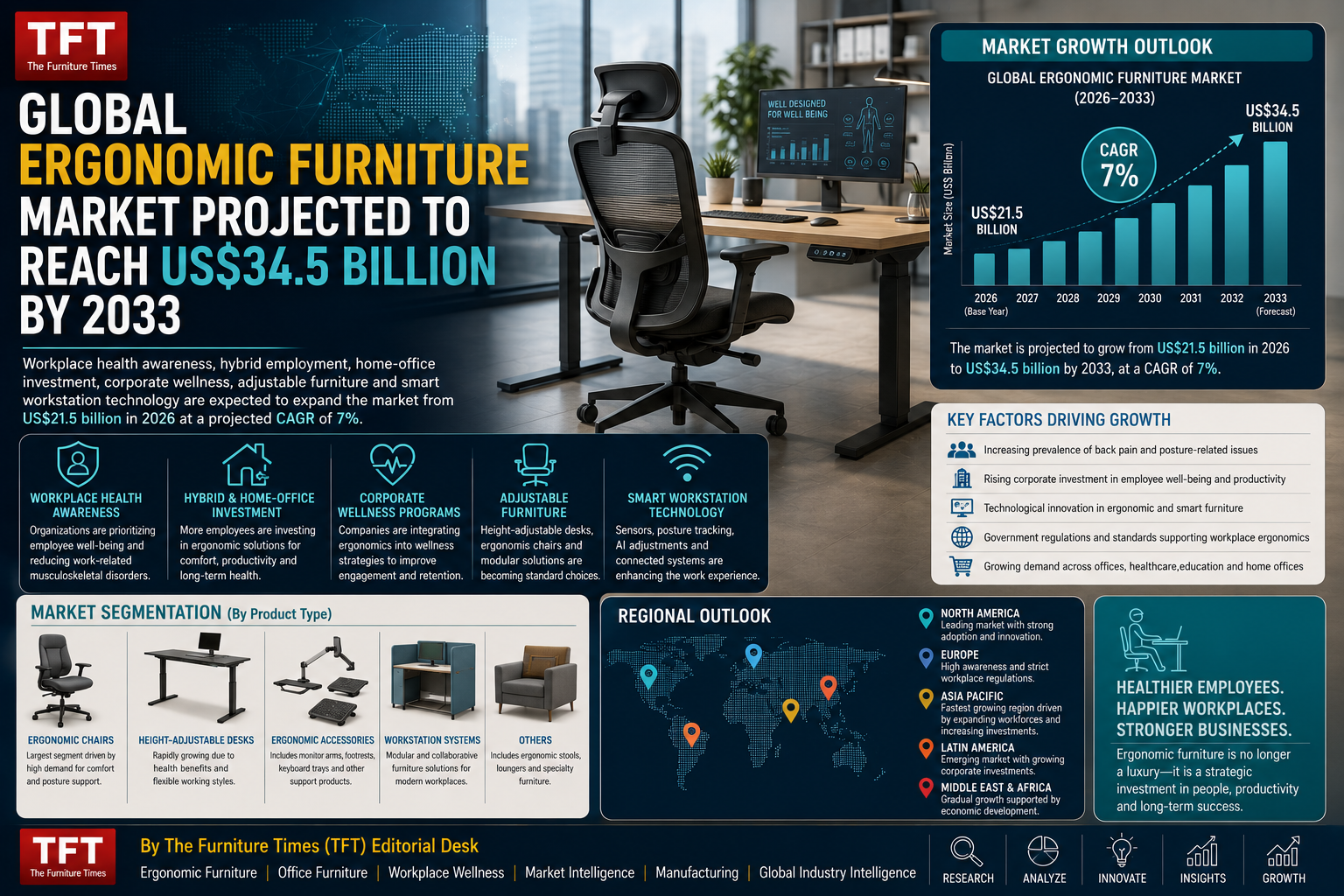
Workplace health awareness, hybrid employment, home-office investment, corporate wellness, adjustable furniture and smart workstation technology are expected to expand the market from US$21.5 billion in 2026 at a projected CAGR of 7%
By The Furniture Times (TFT) Editorial Desk | Ergonomic Furniture | Office Furniture | Workplace Wellness | Market Intelligence | Manufacturing | Global Industry Intelligence
The global ergonomic furniture market is entering a new phase of expansion as employers, institutions and individual consumers increasingly recognise that furniture is not merely part of an interior—it directly influences how people work, move, concentrate and experience physical comfort.
According to an August 2026 market report highlighted by Interior Daily, the global ergonomic furniture market is projected to increase from US$21.5 billion in 2026 to US$34.5 billion by 2033, representing a compound annual growth rate of approximately 7%.
If achieved, the forecast would add approximately US$13 billion in annual market value over seven years—an expansion of more than 60% from the estimated 2026 level.
The outlook is being supported by growing awareness of posture, workplace comfort, employee productivity and work-related musculoskeletal problems. Demand is expanding across ergonomic chairs, sit-stand desks, adjustable tables, adaptable workstations, monitor arms, footrests, keyboard trays and other workplace accessories. Interior Daily
The market is no longer limited to large corporate offices. Hybrid and remote work have moved ergonomic procurement into homes, co-working spaces and small businesses. Healthcare facilities, educational institutions, government departments, industrial workplaces and hospitality organisations are also becoming relevant end-user groups.
The result is a widening furniture category positioned at the intersection of health, workplace design, technology, sustainability and productivity.
The market forecast at a glance
The underlying Persistence Market Research report provides the following principal projections:
- Estimated market size in 2026: US$21.5 billion
- Projected market size in 2033: US$34.5 billion
- Forecast CAGR from 2026 to 2033: 7%
- Estimated increase in annual value: US$13 billion
- Projected North American share in 2026: approximately 34%
- Projected Asia-Pacific CAGR: approximately 8.3%
- Projected ergonomic-chair share in 2026: approximately 38%
- Projected metal-material share in 2026: approximately 42%
- Projected corporate-office end-user share: approximately 46%
- Projected offline distribution share: approximately 58%
These projections are specific to the referenced research provider and its definition of the ergonomic furniture market. Market-size estimates from other research organisations may differ because of variations in methodology, geographical scope, product inclusion, pricing assumptions and treatment of accessories.
The forecast should therefore be interpreted as a directional market outlook rather than a guaranteed result. Persistence Market Research
Ergonomics is moving from specialist feature to purchasing priority
Ergonomic furniture was once associated primarily with premium corporate offices, specialist occupational-health programmes and high-end task seating.
That positioning is changing.
Work has become more screen-dependent, and people now spend extended periods using computers in offices, homes, schools and shared workplaces. Employers and users increasingly understand that a desk or chair affects posture, movement, fatigue and the overall work experience.
The U.S. National Institute for Occupational Safety and Health defines ergonomics as designing work tasks to fit the capabilities of workers. NIOSH states that ergonomics can help reduce or eliminate work-related musculoskeletal disorders and improve safety. NIOSH
The U.S. Occupational Safety and Health Administration also notes that there is no single correct posture or workstation arrangement suitable for everyone. Workstations should instead be designed around fundamental principles that allow users to improve posture, component placement and comfort. OSHA Computer Workstations
This distinction is important for manufacturers and marketers.
Ergonomics is not one shape, one lumbar cushion or one promotional word. It is a design approach that considers variation among users, tasks, body dimensions, movement patterns and work duration.
What belongs in the ergonomic furniture market?
The category extends well beyond the conventional office chair.
The referenced report covers a range of product groups, including:
Ergonomic chairs
These may include adjustable seat height, lumbar support, armrests, backrest resistance, seat depth, recline and other features intended to accommodate different users and postures.
Sit-stand desks
Manual and electric height-adjustable desks allow users to alternate between sitting and standing positions.
Ergonomic tables
Adjustable or task-specific tables may support individual work, collaboration, healthcare, education or industrial applications.
Monitor arms
Adjustable monitor supports help users position screens according to their workstation and task requirements.
Keyboard trays
These can help users position keyboards and input devices at an appropriate height and angle.
Footrests
Footrests can support users whose feet do not comfortably reach the floor after the chair has been adjusted to the work surface.
Ergonomic stools
Industrial, laboratory, healthcare and active-seating stools serve specialised tasks and environments.
Storage and accessories
Mobile pedestals, equipment supports, laptop stands and cable-management products can contribute to a more adaptable workstation.
The commercial opportunity therefore extends across complete furniture systems, mechanisms, components, accessories, software and professional services.
Ergonomic chairs are expected to remain the largest segment
Ergonomic chairs are projected to account for approximately 38% of the market in 2026, making seating the largest product category in the cited research.
This position is understandable.
The chair directly supports the body during seated work and may be used continuously for several hours. It is also purchased across almost every relevant end-user environment, including offices, homes, schools, healthcare, government and industrial administration.
OSHA states that a well-designed and appropriately adjusted chair is an important part of a safe and productive computer workstation. A good chair should provide support while reducing exposure to awkward posture and contact stress. Adjustability is particularly important where several people share the same chair. OSHA chair guidance
Manufacturers competing in this segment will need to address more than visual styling. Buyers are increasingly likely to examine:
- Seat-height range
- Seat-depth adjustment
- Lumbar-support position
- Backrest movement
- Recline control
- Armrest adjustability
- Load capacity
- User-size accommodation
- Control accessibility
- Foam and upholstery durability
- Mechanism reliability
- Caster performance
- Warranty coverage
- Replaceable components
- Testing and certification
An ergonomic chair that is difficult to adjust may fail to deliver its intended benefit. Clear user instructions and installation support should therefore be considered part of the product.
Sit-stand desks are positioned as the fastest-growing product category
The cited research expects sit-stand desks to record the strongest growth during the forecast period.
Their expansion reflects a broader understanding that remaining in one position throughout the day is undesirable, even when the seated posture appears correct.
OSHA advises workers to change position frequently, make adjustments, stretch, walk periodically and perform suitable tasks while standing. OSHA workstation-position guidance
Sit-stand desks support this behavioural flexibility, but the desk itself is not a complete solution.
Effective use also depends on:
- Suitable height ranges
- Adequate work-surface depth
- Stable lifting mechanisms
- Monitor positioning
- Keyboard placement
- Cable management
- Movement education
- User training
- Anti-collision systems in motorised products
- Reliable motors and controls
- Appropriate load capacity
Manufacturers should avoid suggesting that standing continuously is the answer to prolonged sitting. The stronger product proposition is movement and variation.
Hybrid work has created two furniture markets for one employee
Before the global expansion of remote and hybrid work, many organisations concentrated ergonomic investment in central offices.
Today, one employee may require suitable working arrangements in multiple places:
- Corporate office
- Home office
- Co-working space
- Client site
- Satellite office
- Shared or flexible workspace
This has changed purchasing responsibility.
Some employers provide standardised home-office packages. Others offer allowances or reimbursement. Many employees purchase furniture independently through retail and e-commerce channels.
The result is a fragmented but much larger addressable market.
Manufacturers now need product strategies for both B2B and B2C customers:
- Corporate project collections
- Compact home-office products
- Flat-pack adjustable desks
- Direct-to-consumer task chairs
- Affordable ergonomic accessories
- Subscription or rental programmes
- Replacement and upgrade components
- Remote setup support
A product designed for a central office may not suit a small apartment. Home users may need smaller footprints, quieter motors, simple assembly, domestic aesthetics and easier delivery.
The future of ergonomic furniture will therefore require industrial performance with residential sensitivity.
Corporate offices remain the largest end-user segment
Corporate offices are expected to account for approximately 46% of the market in 2026, according to the underlying report.
Large organisations possess several advantages as buyers:
- Formal procurement budgets
- Centralised standards
- Occupational-health teams
- Facilities-management departments
- Bulk-purchasing capability
- Periodic refurbishment cycles
- Workplace-design consultants
- Multi-location requirements
Employers may view ergonomic furniture as part of a wider strategy involving employee experience, wellness, safety, productivity and talent retention.
However, corporate procurement will become more demanding. Buyers may require:
- Product testing
- Environmental certifications
- Extended warranties
- Spare-part availability
- Repairability
- Installation support
- User training
- Asset-management data
- Reconfiguration services
- End-of-life recovery
- National or international delivery capability
Manufacturers selling only a product may struggle against competitors selling a complete workplace solution.
Home offices are expected to grow fastest
Although corporations remain the largest buyers, home offices are projected to become the fastest-growing end-user category.
Several factors support this development:
- Long-term hybrid employment
- Greater awareness of home-working discomfort
- Growth in freelancing and entrepreneurship
- Online education
- Gaming and content creation
- Smaller businesses operating from residences
- Expansion of direct-to-consumer furniture sales
The home-office opportunity extends beyond wealthy consumers purchasing premium chairs.
A large middle market exists for affordable products offering essential adjustability without the cost or complexity of high-end corporate seating.
Manufacturers must determine which functions deliver the most meaningful value at each price point.
Removing unnecessary decorative features can make products more accessible, but reducing mechanism quality, structural stability or safety may create complaints and early failures.
The strongest affordable products will simplify intelligently rather than merely reducing quality.
North America expected to retain market leadership
North America is projected to hold approximately 34% of the global market in 2026, making it the leading region in the referenced forecast.
The report connects this position with:
- Workplace-safety awareness
- Corporate wellness investment
- Office modernisation
- Established furniture brands
- Hybrid-working practices
- Home-office expenditure
- Replacement demand
- Preference for certified products
- Developed distribution systems
The United States is expected to account for approximately 85% of North American market demand in 2026 under the report’s estimates.
The region also has established dealers, workplace consultants, designers and contract-furniture networks capable of delivering large ergonomic programmes.
However, market maturity creates intense competition. Manufacturers must differentiate through design, performance, sustainability, service and measurable value rather than relying only on the word “ergonomic.”
Asia-Pacific positioned as the fastest-growing regional market
Asia-Pacific is projected to expand at a CAGR of approximately 8.3% between 2026 and 2033, faster than the overall global market.
Growth factors identified by the research include:
- Office construction
- Urbanisation
- Expansion of white-collar employment
- Growth in technology and service industries
- Multinational corporate investment
- Workplace modernisation
- Increasing health awareness
- Improving domestic manufacturing
- Competitive regional pricing
China remains a major production and consumption centre. India’s information technology, business-process outsourcing and corporate-services sectors are creating demand for modern workstations. Japan combines an ageing workforce with precision-oriented manufacturing and premium ergonomic expectations. South Korea’s technology sector and hybrid-work adoption support additional demand.
Asia-Pacific manufacturers possess significant opportunities, but low price alone will not guarantee success.
International and sophisticated domestic buyers increasingly expect:
- Verified performance
- Consistent specifications
- Reliable components
- Adjustable products for diverse users
- Environmental responsibility
- After-sales support
- Replacement parts
- Clear warranties
- Compliance documentation
The region can move from being a cost-focused production base to becoming an innovation centre for ergonomic furniture.
Europe combines ergonomics with sustainability
Europe remains an important market because workplace design, occupational health, product quality and environmental performance frequently influence procurement.
Germany is projected to represent approximately 27% of the European market in 2026 in the cited report, followed by significant contributions from the United Kingdom and France.
European demand may increasingly favour furniture that combines:
- Human-centred design
- Recycled or responsibly sourced materials
- Repairability
- Replaceable mechanisms
- Low-emission materials
- Product traceability
- Extended service life
- Take-back programmes
- Circular procurement
- Transparent environmental information
Manufacturers should not treat ergonomics and sustainability as separate product stories.
A chair that supports the user but becomes irreparable after one mechanism fails cannot be considered a fully responsible long-term solution.
Metal expected to remain the leading material
Metal is projected to account for approximately 42% of the ergonomic furniture market in 2026.
Steel and aluminium are widely used in:
- Chair mechanisms
- Bases
- Gas-lift systems
- Desk frames
- Sit-stand columns
- Monitor arms
- Structural supports
- Adjustment systems
Their strength and consistency make them well suited to furniture exposed to movement, repeated adjustment and intensive commercial use.
However, raw-material price volatility can affect manufacturing margins. Producers working under long-term corporate contracts may face pressure when steel, aluminium, foam, plastics or freight costs increase after pricing has been agreed.
Manufacturers can reduce exposure through:
- Supplier diversification
- Component standardisation
- Design-for-manufacture
- Material optimisation
- Local sourcing where viable
- Inventory planning
- Contract adjustment clauses
- Modular product platforms
Plastic is expected to grow rapidly, particularly in lightweight accessories and chair components. The commercial opportunity will increasingly depend on durability, recyclability and material disclosure.
Offline retail remains important—but online growth is accelerating
Offline channels are projected to account for approximately 58% of the market in 2026.
Ergonomic furniture remains highly experiential. Customers often want to sit in a chair, test the controls, compare back support and examine construction before purchasing.
Physical stores and showrooms can offer:
- Product demonstrations
- Professional fitting
- Comparative testing
- Immediate expert guidance
- Fabric and finish evaluation
- Corporate procurement support
- After-sales assistance
Online retail, however, is expected to grow faster.
E-commerce has expanded access to products that were previously available only through specialist office dealers. Direct-to-consumer brands can reach home workers and small businesses without large physical networks.
To sell ergonomic furniture online effectively, companies need:
- Accurate dimensions
- Adjustment-range information
- User-height guidance
- Weight capacities
- Assembly videos
- Clear return policies
- Warranty information
- Spare-part availability
- Verified customer reviews
- High-quality demonstrations
- Transparent delivery conditions
Ergonomic products create a significant return risk when buyers cannot determine whether the furniture fits their bodies, rooms or tasks.
Digital product information must therefore do more than show attractive images.
Smart ergonomic furniture creates a new opportunity—and new responsibilities
Sensor-enabled ergonomic products are identified as a major growth opportunity.
Potential features include:
- Posture reminders
- Sitting-time monitoring
- Standing prompts
- Occupancy measurement
- Automatic desk-height adjustment
- Saved user preferences
- Workplace-utilisation analytics
- Mobile applications
- Wellness dashboards
- Predictive maintenance
These features can create recurring engagement after the initial sale and potentially support service-based revenue.
But connected ergonomic furniture also introduces cybersecurity and privacy risks.
A sensor-enabled desk or chair may collect information about occupancy, location, working patterns and personal preferences. Manufacturers must determine what data is necessary, where it is stored, how long it is retained and who can access it.
A smart ergonomic product should not improve posture while weakening privacy.
Security updates, data protection, cloud-service continuity and support periods must become part of the product-development plan.
Sustainability will reshape competitive positioning
Interior Daily identifies sustainability and modularity as important growth opportunities.
This reflects changing buyer expectations, particularly in commercial procurement. Buyers increasingly want furniture that can remain in service through several workplace cycles.
Future ergonomic products may need:
- Replaceable upholstery
- Repairable controls
- Standardised mechanisms
- Replaceable desk motors
- Recyclable material combinations
- Disassembly instructions
- Spare components
- Refurbishment programmes
- Take-back services
- Certified materials
- Product carbon information
Modularity can reduce lifecycle cost by allowing a damaged or outdated component to be replaced without discarding the complete product.
The next competitive frontier may not be which manufacturer offers the greatest number of adjustments. It may be which manufacturer keeps the product functional longest.
The danger of unverified ergonomic claims
As demand increases, more products are being marketed as ergonomic.
The term can be applied loosely. A curved backrest, headrest or thick cushion does not automatically make a chair appropriate for every user.
Manufacturers and retailers should avoid unsupported medical or performance claims such as:
- Prevents all back pain
- Corrects posture automatically
- Guarantees productivity
- Eliminates injury
- Suitable for every body type
Ergonomics involves the relationship between the user, furniture, equipment, task and environment.
A product can support a better setup, but it cannot replace appropriate adjustment, movement, training and individual assessment.
Credibility will become a competitive advantage as buyers learn to distinguish real ergonomic engineering from superficial marketing.
What buyers should examine before purchasing ergonomic chairs
A purchasing decision should consider whether the product:
- Fits the intended user population
- Offers an appropriate seat-height range
- Provides usable lumbar support
- Allows changes in posture
- Has adjustable armrests where required
- Provides sufficient seat-depth options
- Uses accessible controls
- Remains stable during movement
- Carries an appropriate load rating
- Has replaceable high-wear parts
- Includes clear adjustment instructions
- Is supported by testing and warranty information
- Can be maintained locally
A premium chair that users do not know how to adjust may provide less value than a simpler chair introduced with effective training.
What buyers should examine before purchasing sit-stand desks
Important considerations include:
- Minimum and maximum height
- Suitability for seated and standing users
- Stability at maximum extension
- Lifting capacity
- Motor noise
- Adjustment speed
- Anti-collision protection
- Control accessibility
- Work-surface depth
- Leg clearance
- Cable management
- Power requirements
- Warranty coverage
- Replaceable motors and controls
- Installation quality
The desk should support a complete workstation rather than operating as an isolated mechanism.
Opportunities for furniture-component manufacturers
Growth in ergonomic furniture will create demand throughout the supply chain.
Component opportunities include:
- Synchronous chair mechanisms
- Adjustable armrests
- Lumbar systems
- Seat slides
- Headrests
- Gas lifts
- Castors
- Mesh materials
- High-performance foam
- Electric lifting columns
- Control boxes
- Motors
- Handsets
- Anti-collision sensors
- Monitor arms
- Cable-management systems
- Power and charging modules
Component reliability will directly affect the reputation of the finished brand.
A failed desk motor or chair mechanism can make an otherwise strong product unusable. Furniture manufacturers should evaluate component suppliers on testing, consistency, service life, spare-part support and traceability—not only unit price.
Opportunities beyond corporate offices
The ergonomic market can expand into several underdeveloped sectors.
Education
Adjustable desks and seating can help institutions accommodate students of different ages, sizes and needs.
Healthcare
Clinicians, administrators, patients and caregivers use furniture for demanding and sometimes extended periods. Ergonomics can support staff workflows and user comfort.
Manufacturing
Industrial seating, workbenches and task-specific supports can help workplaces address physical demands beyond computer-based work.
Government
Public-sector office upgrades can create significant project demand, especially when procurement standards include durability and accessibility.
Hospitality
Front desks, administrative offices, reservation centres and hotel-room workspaces can benefit from ergonomic design.
Senior living
An ageing population increases demand for seating and tables that consider support, movement, access and ease of use.
Gaming and content creation
Extended screen use has created a consumer category that overlaps with office ergonomics while demanding different styling and equipment integration.
What manufacturers should prepare for
The US$34.5 billion forecast represents an opportunity, but growth will not be distributed equally.
Manufacturers should prepare through several strategic actions.
Build genuine ergonomic expertise
Product development should involve qualified designers, engineers, occupational-health specialists and representative users.
Test with diverse users
A product should be evaluated across different body sizes, tasks and working environments.
Improve product instructions
Adjustment education should be treated as part of the product, not an optional brochure.
Design for repair
High-wear components should be replaceable without discarding the entire chair or desk.
Protect product quality
Mechanisms and moving parts require lifecycle testing appropriate to the intended environment.
Create multiple price tiers
Manufacturers should offer clear value at entry, mid-market and premium levels without making misleading claims.
Develop omnichannel distribution
Showrooms, dealer networks, direct sales and e-commerce can serve different buyers and purchasing journeys.
Prepare for smart-product responsibilities
Connected furniture requires cybersecurity, privacy and software-maintenance capability.
Build searchable product data
Buyers and AI systems need structured information about dimensions, adjustability, materials, testing, warranties and applications.
Market growth will depend on education
Limited awareness and premium pricing remain obstacles, especially in developing markets and among small businesses.
Many buyers do not understand how to assess ergonomic furniture. Others may purchase a product but never adjust it correctly.
The industry must therefore invest in education.
Manufacturers, dealers, retailers, designers and occupational-health professionals can publish practical guidance covering:
- Workstation setup
- Chair adjustment
- Desk height
- Monitor positioning
- Movement and posture variation
- Shared-workstation configuration
- Product selection for different users
- Maintenance
- Replacement planning
Education can expand the market while reducing disappointment and misleading expectations.
TFT analysis: ergonomics is becoming an infrastructure category
The most important development is not simply that more ergonomic chairs and desks may be sold.
The deeper change is that ergonomic furniture is becoming part of workplace infrastructure.
Employers increasingly view furniture as connected to:
- Employee experience
- Occupational health
- Productivity
- Talent retention
- Hybrid-work policy
- Office utilisation
- Accessibility
- Corporate wellness
- Sustainability
- Property strategy
This gives the furniture industry a more strategic role—but also creates greater accountability.
Manufacturers must demonstrate performance. Retailers must provide accurate advice. Employers must train users. Designers must consider diversity. Component suppliers must support long service lives.
The category will grow most responsibly when ergonomics is treated as a system rather than a marketing label.
TFT, FISE and FurniReviewology: connecting the ergonomic furniture ecosystem
The Furniture Times provides market intelligence and helps ergonomic furniture companies communicate their innovation, research, product development and commercial achievements.
The Furniture Industry Search Engine helps buyers find ergonomic chair manufacturers, sit-stand desk suppliers, component producers, workplace consultants, dealers, testing organisations and other ecosystem participants.
FurniReviewology adds the trust layer by helping users evaluate comfort, durability, adjustment, service, delivery, warranty support and long-term product experience.
TFT tells their story.
FISE helps the world find them.
FurniReviewology helps the world trust them.
The furniture industry ecosystem is a $1 trillion industry ecosystem.
Final outlook
The projected expansion from US$21.5 billion in 2026 to US$34.5 billion by 2033 reflects a market responding to fundamental changes in work, health awareness, technology and interior design.
Ergonomic chairs are expected to retain a leading position. Sit-stand desks are forecast to grow rapidly. Corporate offices will remain important, while home offices, Asia-Pacific markets, online retail and smart furniture could generate some of the strongest new opportunities.
But market growth will also attract weak products and exaggerated claims.
The companies most likely to succeed will combine:
- Authentic ergonomic design
- Reliable mechanisms
- Inclusive adjustability
- Evidence-based communication
- Competitive pricing
- Repairability
- Sustainable materials
- Clear warranties
- Strong distribution
- Trustworthy after-sales service
Ergonomic furniture is moving from a workplace upgrade to an essential part of how the modern world works.
The opportunity is not merely to sell more chairs and desks. It is to design healthier, more adaptable and more human-centred environments.
Be visible. Be searchable. Be trusted. Be part of the movement shaping the future of ergonomic furniture.