
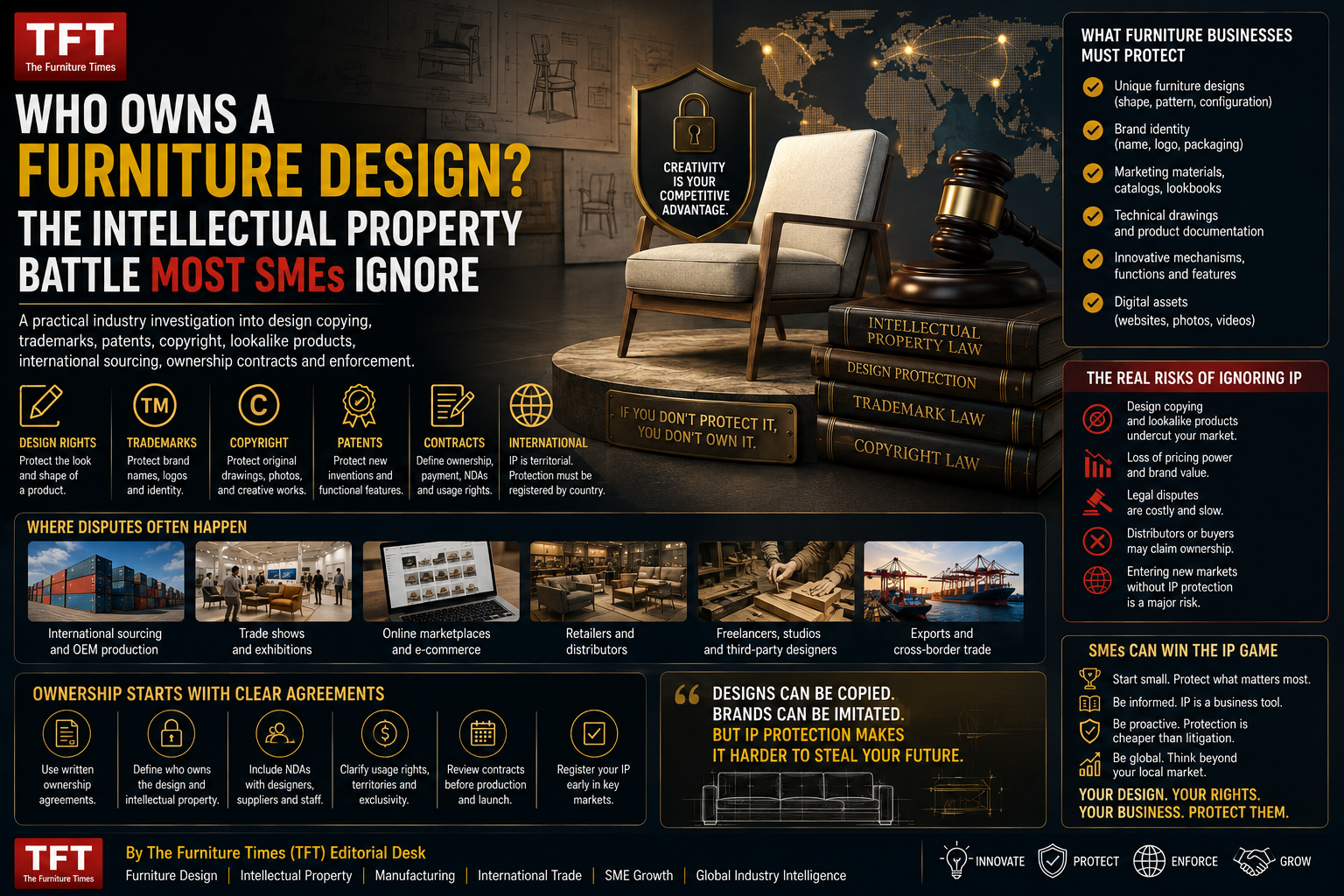
Who Owns a Furniture Design? The Intellectual Property Battle Most SMEs Ignore
A practical industry investigation into design copying, trademarks, patents, copyright, lookalike products, international sourcing, ownership contracts and enforcement
By The Furniture Times (TFT) Editorial Desk | Furniture Design | Intellectual Property | Manufacturing | International Trade | SME Growth | Global Industry Intelligence
A furniture company spends months developing a new chair.
Its designer studies ergonomics, proportions, frame geometry, materials, joinery, production costs and packaging. Prototypes are manufactured, tested and modified. Photographs are commissioned. A name is selected, catalogues are printed and the collection is introduced at an exhibition.
Six months later, a remarkably similar chair appears online.
The proportions are nearly identical. The arms, legs and backrest appear to follow the same visual language. The competing product is cheaper, carries another name and may have been manufactured by a factory with access to the original drawings or sample.
The SME’s founder is furious and declares: “That is our design.”
But is it?
Who created the design? Was that person an employee, freelance designer, co-founder, supplier or customer? Was ownership transferred to the company in writing? Was the design registered before it was shown publicly? Which parts are new? Which features are functional? In what countries does the company hold enforceable rights? Is the competitor copying the protected design, using a confusingly similar brand or merely following a market trend?
These questions determine whether the company owns a legally enforceable asset—or simply possesses a product it introduced first.
The furniture industry is highly design-dependent but frequently underprepared for intellectual-property disputes. Many small and medium-sized businesses treat intellectual property as paperwork for large corporations. They invest in prototypes, tooling, photography, exhibitions and distribution but postpone questions of ownership until copying occurs.
By then, evidence may be incomplete, novelty may have been lost, contracts may be unclear and the alleged copy may already be available in several countries.
The essential lesson is simple:
Creating, commissioning, manufacturing, paying for or selling a furniture product does not automatically answer every question about who owns its intellectual property.
Ownership depends on the applicable law, the type of right, the identity of the creator, contractual terms, registration status and territories in which protection is sought.
This report provides general industry information, not legal advice. Furniture businesses should obtain advice from qualified intellectual-property counsel in each relevant jurisdiction.
One furniture product can contain several different intellectual-property rights
There is no single universal “furniture copyright” covering everything associated with a product.
One chair, table, bed or cabinet can contain several intellectual-property assets, each protecting something different.
| Intellectual-property right | What it may protect in furniture |
|---|---|
| Registered design or design patent | The product’s visual appearance, shape, configuration, ornamentation or selected visual features |
| Unregistered design right | Certain aspects of appearance or configuration for a limited period, depending on jurisdiction |
| Utility patent | A new and inventive functional mechanism, construction or technical solution |
| Copyright | Original drawings, photographs, catalogues and—in some countries or circumstances—artistic aspects of the product |
| Trademark | Brand names, logos, collection names, slogans and other source-identifying signs |
| Trade dress or shape mark | A distinctive product or packaging appearance that identifies commercial source, subject to demanding legal requirements |
| Trade secret | Confidential drawings, manufacturing know-how, formulas, processes, supplier information or unreleased designs |
| Contractual rights | Ownership, licensing, exclusivity, confidentiality, tooling, improvements and permitted manufacturing arrangements |
The strongest protection strategy may combine several of these rights.
A registered design might protect the appearance of a chair. A utility patent could protect its folding mechanism. A trademark may protect the collection name. Copyright may protect product photography and an original decorative carving. Trade-secret protection may cover an undisclosed production method.
These rights are not interchangeable. Registering a trademark for the chair’s name does not necessarily protect the chair’s shape. Owning copyright in a photograph does not automatically give ownership of the product depicted in it. A utility patent for a mechanism does not necessarily prevent a competitor from creating a visually similar product using a different mechanism.
Industrial design protection: the furniture industry’s central right
For many furniture companies, industrial design protection is the most directly relevant legal tool because it concerns the product’s appearance.
Depending on the jurisdiction, the right may be called:
- A registered design
- An industrial design
- A design patent
- A registered EU design
- A national design registration
WIPO explains that industrial design rights generally protect the ornamental or aesthetic aspects of an article. Protection can relate to three-dimensional features, such as the product’s shape, or two-dimensional features, including patterns, lines and colours.
In the United States, the USPTO may grant a design patent for a new, original and ornamental design for an article of manufacture. USPTO design-patent guidance
In the United Kingdom, a registered design protects the appearance of a product or part of a product. The features involved may include lines, contours, colours, shape, texture and material. A UK registration can be renewed every five years for a maximum term of 25 years. UK Government design-registration guidance
In the European Union, a design must generally be new and possess individual character to qualify for registered EU design protection. An unregistered EU design is also available under specified conditions but provides shorter and more limited protection. EUIPO design guidance
Furniture is a natural candidate for design protection because its commercial value frequently lies in its appearance.
However, registration should not be treated as an automatic certificate of originality in every dispute. The scope and validity of a design right can be challenged. Poorly prepared representations, earlier public designs and functional constraints may affect protection.
Registration drawings can define the commercial battlefield
Furniture businesses often treat the images submitted with a design application as an administrative formality.
They are not.
Those images can be central to defining what is protected. The choice of perspective, line style, shading, colour and omitted features may affect how the registration is interpreted.
A design application may include:
- Perspective views
- Front and rear views
- Side views
- Top and bottom views
- Close-ups
- Variants
- Partial-product views
- Surface decoration
- Disclaimed or excluded features
A company that files unclear or inconsistent images may obtain a right that is narrower, more uncertain or more difficult to enforce than expected.
Furniture SMEs should coordinate their designer, product engineer and IP professional before filing. A legal representative cannot correct a weak design strategy after disclosure or copying has already occurred.
The novelty trap: exhibiting before filing
One of the furniture industry’s most common mistakes is revealing a new design too early.
Businesses frequently introduce products through:
- Trade exhibitions
- Dealer previews
- Websites
- Social media
- Digital catalogues
- Crowdfunding campaigns
- Distributor presentations
- Online marketplaces
- Press announcements
- Uncontrolled factory sampling
Public disclosure can affect whether the design is still considered new.
WIPO warns that once an industrial design has been publicly disclosed—for example, through advertising on a company website—it may no longer satisfy novelty or originality requirements. Some jurisdictions provide a grace period, commonly six or 12 months, but businesses should not assume that every country offers the same protection. WIPO industrial-design FAQs
This matters greatly to exporters.
A designer may disclose a chair in one country believing that a local grace period protects it, only to discover that the disclosure has damaged eligibility in an important overseas market.
The safest working rule is:
File before public disclosure whenever commercially and legally possible.
If pre-launch discussions are necessary, use carefully prepared confidentiality agreements and restrict access to drawings, prototypes and digital files.
Unregistered design rights: useful but dangerous to depend upon
Some jurisdictions offer automatic design protection without formal registration.
In the European Union, an unregistered EU design can provide protection for three years from the date the design is first disclosed within the EU, subject to the relevant legal requirements. An important limitation is that unregistered protection generally focuses on copying; proving that the accused business copied the design can be more difficult than relying on a registered right.
The United Kingdom provides more than one form of automatic design protection. UK guidance states that certain three-dimensional shape and configuration features may receive automatic design-right protection, subject to statutory limits. A supplementary unregistered design can protect aspects of appearance for three years after public disclosure. UK unregistered-design guidance
Unregistered protection can be valuable for short-life collections or businesses that release many designs.
But it creates practical challenges:
- The company must prove when and where the design was disclosed.
- It may need to prove copying rather than mere similarity.
- The duration is shorter.
- The geographical scope may be limited.
- Different rights may protect different features.
- Ownership and qualification rules can be complicated.
- Enforcement may require strong documentary evidence.
An SME should not assume that “automatic protection” means “easy protection.”
Copyright: important, but furniture is a useful product
Furniture companies often say that every product is automatically protected by copyright. That statement can be dangerously incomplete.
Copyright rules vary substantially between countries, particularly when artistic creation is incorporated into a functional product.
In the United States, furniture is treated as a “useful article.” The U.S. Copyright Office explains that copyright does not protect useful articles as such, although pictorial, graphic or sculptural features may be protected if they can be identified separately from—and exist independently of—the article’s utilitarian aspects. U.S. Copyright Office
This means copyright may protect an original sculptural or decorative feature without protecting the entire functional chair in the way its owner expects.
However, copyright can remain extremely important for furniture companies because it may protect:
- Technical and presentation drawings, subject to applicable rules
- Original sketches
- Renderings
- Product photography
- Videos
- Catalogues
- Website copy
- Packaging artwork
- Surface patterns
- Decorative graphics
- Instruction manuals
- Software and digital visualisation assets
Owning a physical sample does not automatically mean owning the copyright in the photograph, drawing or rendering associated with it.
If an outside photographer creates product images, the furniture company should obtain a written agreement explaining ownership and permitted uses. The same principle applies to architects, interior designers, agencies, 3D visualisers and freelance product designers.
Patents: protecting how furniture works
A patent may be appropriate when the innovation is functional rather than merely visual.
Potential examples include:
- A new recliner mechanism
- A folding or transforming system
- An adjustable ergonomic structure
- A new joining method
- A concealed storage mechanism
- A height-adjustment system
- A modular connection
- An assembly innovation
- A structural safety improvement
- A new manufacturing process
Patent law generally requires novelty and an inventive or non-obvious step, depending on the jurisdiction. The invention must usually be described in sufficient technical detail.
A utility patent does not protect the general idea of making a “comfortable chair” or “space-saving table.” It protects the invention defined by its legally examined claims.
Patent drafting is specialised work. A poorly drafted application may disclose the invention to the world while delivering limited enforceable protection.
Public disclosure can also create problems. WIPO notes that an inventor’s disclosure before filing can prevent patent protection in countries applying strict novelty rules, although some countries offer grace periods. WIPO patent FAQs
Furniture businesses developing new mechanisms should seek professional advice before exhibiting, advertising or sending technical drawings to uncontrolled third parties.
Trademark: protecting the identity, not automatically the object
Trademarks help customers identify the commercial source of goods and services.
A furniture company may register:
- Its corporate name
- Brand name
- Logo
- Collection name
- Product name
- Slogan
- Distinctive symbol
- In some cases, a shape or other non-traditional sign
A trademark is not a substitute for design protection.
Registering the name of a chair does not ordinarily prevent another manufacturer from producing a visually similar chair under a different name. It can, however, help prevent competitors from using a confusingly similar name, logo or source identifier.
Trademark protection is particularly important when copies appear online. A lookalike product using the original company’s brand, product images or a confusingly similar name may involve trademark infringement, copyright infringement, passing off, unfair competition or several overlapping claims.
Companies should register priority brands in the markets where they manufacture, sell, license and distribute.
Trade dress and product-shape trademarks
In some jurisdictions, a product’s overall appearance may eventually identify its source strongly enough to receive trademark-related protection.
In the United States, this concept may be described as trade dress. The USPTO explains that trade dress protects the commercial look and feel of a product or service.
However, product-configuration claims can be demanding. The company may need to demonstrate distinctiveness, non-functionality and consumer association with a single commercial source.
A newly launched furniture shape will not automatically qualify simply because it is attractive or unusual.
Product-shape protection is generally a specialised, fact-intensive strategy. It should not replace timely design registration.
Trade secrets: protecting what the customer never sees
Not every valuable furniture innovation should be registered publicly.
Some business information may be more appropriately protected as a trade secret, provided it remains confidential and the company takes reasonable steps to preserve secrecy.
Potential furniture-industry trade secrets include:
- Manufacturing tolerances
- Finishing formulas
- Upholstery methods
- Foam combinations
- Costing models
- Supplier arrangements
- Unreleased collections
- Customer lists
- Pricing structures
- CAD libraries
- Prototyping methods
- Factory layouts
- Quality-control processes
Trade-secret protection can potentially continue while the information remains secret and legally qualifies for protection.
But secrecy cannot survive careless behaviour.
If sensitive information is freely shared through unsecured emails, open factory tours, unrestricted cloud folders or supplier groups without confidentiality obligations, enforcement may become more difficult.
Who owns the design when an employee creates it?
This is one of the most important questions in furniture businesses—and one of the most dangerous to answer with assumptions.
Ownership of employee-created intellectual property varies according to:
- Country
- Type of IP right
- Employment status
- Employee’s role
- Scope of duties
- Contract language
- Circumstances of creation
- Local mandatory law
A full-time furniture designer hired to develop products may be treated differently from a sales manager who creates a concept outside assigned duties.
The company should have written employment provisions addressing:
- Ownership of designs and inventions
- Duty to disclose creations
- Assignment of rights
- Assistance with registrations
- Confidentiality
- Use of company resources
- Moral rights, where applicable
- Treatment of improvements
- Responsibilities after employment ends
WIPO advises SMEs to include IP-ownership provisions in employee agreements and to clarify ownership among co-founders. WIPO SME guidance
Paying a freelance designer may not transfer ownership
Furniture businesses often believe that if they paid a designer, agency, architect or consultant, they automatically own everything created.
That may not be true.
Payment may purchase a service, physical prototype or limited licence without transferring every underlying intellectual-property right.
A proper design agreement should address:
- Who owns background materials brought into the project
- Who owns the new design
- Whether rights are assigned or licensed
- Countries covered
- Duration
- Exclusivity
- Permitted product categories
- Right to modify the design
- Right to sublicense
- Ownership of CAD and source files
- Registration responsibility
- Enforcement responsibility
- Attribution and moral rights
- Royalties
- Termination
- Treatment of rejected concepts
- Confidentiality
- Warranties concerning originality
WIPO recommends that ownership and permitted uses be clearly addressed whenever employees or contractors create copyright works for a business. WIPO copyright guidance for SMEs
The agreement should be signed before work begins. The earliest sketches and prototypes may already create rights and future disputes.
Co-design creates chain-of-title problems
Furniture products are often developed collaboratively.
A founder proposes the concept. A freelance designer creates the form. An engineer changes the structure. A factory modifies the joints. A customer requests alterations. A component supplier develops a mechanism.
Who owns the final product?
Without written agreements, the answer can become extremely complicated. Several parties may claim authorship, inventorship, design ownership or permission to reuse their contribution.
Investors, buyers and licensees want a clean chain of title—a documented sequence showing how the company obtained ownership of every relevant right.
If the chain is incomplete, the business may struggle to:
- Enforce against copiers
- License the design
- Sell the brand
- Attract investment
- Enter distribution agreements
- Register rights internationally
- Defend against ownership claims
A company should audit ownership before commercial success makes the dispute valuable.
The factory made it—but does the factory own it?
International sourcing creates some of the furniture industry’s most serious IP risks.
A brand may send drawings to an overseas factory, pay for tooling and assume the factory can manufacture only for that brand. But unless the contract clearly restricts use, the commercial arrangement may not reflect that assumption.
The sourcing agreement should address:
- Ownership of product designs
- Ownership of tooling, moulds and jigs
- Permitted production quantities
- Prohibition on overruns
- Prohibition on sale of seconds and rejects
- Use of subcontractors
- Confidentiality
- Access to CAD files
- Ownership of factory-created modifications
- Return or destruction of confidential materials
- Quality-control rights
- Audit rights
- Territorial exclusivity
- Post-termination obligations
- Dispute resolution
- Governing law
- Enforcement cooperation
A non-disclosure agreement alone may be insufficient. The commercial manufacturing contract must define what the factory may and may not do.
Brands should also investigate whether their “exclusive” design was actually taken from a factory catalogue and offered to several customers.
Private-label furniture creates hidden conflicts
Private-label arrangements are common in furniture.
A retailer asks a manufacturer to produce a collection under the retailer’s brand. The retailer may believe the product is exclusive, while the manufacturer believes only the label is exclusive.
The contract must distinguish between:
- Brand exclusivity
- Product exclusivity
- Design ownership
- Market exclusivity
- Customer-channel exclusivity
- Geographic exclusivity
- Exclusivity for a limited period
- Exclusivity conditioned on minimum orders
If these matters are not defined, both sides can sincerely hold incompatible beliefs about ownership.
Inspired, similar or infringing?
Not every similar product is legally infringing.
Furniture design operates within functional, ergonomic and manufacturing constraints. Chairs need support. Tables require stable structures. Beds must accommodate standard mattress dimensions. Cabinets require doors, drawers and storage.
Design trends can also produce similarities:
- Rounded edges
- Bouclé upholstery
- Fluted surfaces
- Cane panels
- Sculptural bases
- Minimalist timber frames
- Modular upholstery
- Organic silhouettes
A legal analysis may consider:
- The protected features
- The scope and validity of the right
- The overall impression
- Earlier designs
- Functional constraints
- Independent creation
- Evidence of access or copying
- Differences and similarities
- The informed user or consumer perspective
- Applicable national law
An emotional reaction to similarity is not a legal conclusion.
Before sending allegations publicly, a business should obtain a qualified infringement assessment. A careless accusation can create commercial, reputational and legal risk.
Copying an iconic design does not become safe merely because it is old
Furniture companies frequently assume that a famous design is free to reproduce because it was created many decades ago.
That assumption can be wrong.
Different rights may expire at different times. Copyright duration may depend on the author’s life and national law. Trademarks may remain renewable. A manufacturer may own registered marks, archives, authorised production rights or distinctive branding.
Even if the original form has entered the public domain in one jurisdiction, using protected brand names, copied photographs or misleading statements of authenticity may create separate problems.
Businesses producing “inspired,” “replica” or “style” furniture should conduct a country-specific rights review and ensure their marketing does not confuse consumers about origin, authorisation or authenticity.
International protection is territorial
An intellectual-property right obtained in one country does not automatically protect a furniture design everywhere.
A company must consider:
- Where the design is created
- Where products are manufactured
- Where suppliers operate
- Where goods are sold
- Where major distributors are located
- Where exhibitions take place
- Where copies are likely to appear
- Where enforcement is commercially realistic
WIPO’s Hague System allows eligible applicants to seek design protection in multiple participating jurisdictions through one international application, using one language and one set of fees in one currency. The application still operates through designated jurisdictions, whose offices may apply their own legal requirements. WIPO Hague System
WIPO’s Global Design Database also permits searches across Hague registrations and participating national and regional collections. WIPO Global Design Database
International systems simplify administration. They do not create one universal worldwide furniture-design right.
Enforcement: owning a right is only the beginning
Registration does not automatically remove copies from the market.
The owner must detect suspected infringement, preserve evidence, assess the right and choose an appropriate response.
Possible enforcement steps may include:
- Confirm ownership and validity.
- Preserve dated evidence of the suspected copy.
- Purchase and retain a sample where lawful and useful.
- Record listings, sellers, prices and territories.
- Analyse the alleged infringement with counsel.
- Review contracts with factories, distributors and designers.
- Send an appropriate notice or cease-and-desist letter.
- Use marketplace complaint procedures where justified.
- Consider customs enforcement mechanisms.
- Explore negotiation, licensing or settlement.
- Pursue administrative or court proceedings when proportionate.
Not every dispute should become litigation. The commercial objective may be to stop sales, remove online listings, recover tooling, obtain attribution, negotiate a licence or protect a key market.
Enforcement should be proportionate to the value at risk.
Online marketplaces are both evidence sources and enforcement channels
Copying can now spread internationally within days.
A photograph from an exhibition may be uploaded to a sourcing platform. A sample may be recreated, listed and offered worldwide before the original company has completed distribution.
Furniture businesses should monitor:
- Major marketplaces
- Search engines
- Social-commerce platforms
- Wholesale sourcing sites
- Competitor catalogues
- Exhibition directories
- Image-search results
- Distributor websites
- Import and customs data where available
Marketplace takedown procedures can be useful, but claims must be accurate. Platforms may require registration numbers, proof of ownership, exact URLs and jurisdictional information.
Abusive or poorly supported takedown requests can damage credibility and may expose the claimant to liability.
Border enforcement can interrupt physical trade
In suitable cases, registered IP rights may support customs action against suspected infringing imports or exports.
The process varies by jurisdiction and may require advance recordation or an application for customs action.
The EUIPO’s IP Enforcement Portal, for example, supports electronic filing and management of customs applications for action. EUIPO IP Enforcement Portal
Customs enforcement is particularly relevant when copies are moving in commercial quantities. Rights holders may need to provide product information, authorised supply chains, images and indicators that help officials distinguish genuine goods from suspected infringements.
Why SMEs avoid intellectual-property protection
Smaller furniture businesses often postpone protection because they believe:
- Registration is too expensive.
- Copying will never happen.
- The design is not important enough.
- A contract can be prepared later.
- Social-media publication proves ownership.
- The factory can be trusted informally.
- The brand name protects the product shape.
- The product can be registered after it becomes successful.
- Litigation is the only enforcement option.
These assumptions can cost far more than an early IP review.
Not every product deserves registration in every country. SMEs need a selective strategy, not indiscriminate filing.
The business should prioritise designs with:
- Strong visual distinctiveness
- High development cost
- Long commercial life
- Export potential
- Licensing potential
- High copying risk
- Strategic importance to the brand
- Significant tooling investment
- Strong projected margins
A practical furniture-IP protection framework
Before design work begins
- Identify every creator and contributor.
- Sign employment, commissioning and confidentiality agreements.
- Define ownership of existing and newly created IP.
- Decide who owns modifications and rejected concepts.
During development
- Maintain dated drawings, CAD files and prototype records.
- Restrict access to sensitive information.
- Record contributions and approvals.
- Conduct design and patent searches.
- Investigate third-party materials and components.
Before disclosure
- Decide which markets matter.
- Assess registration options.
- File before exhibitions or online launches where appropriate.
- Confirm ownership and applicant details.
- Review product names and trademarks.
- Prepare manufacturing agreements.
During production
- Control drawings and source files.
- Mark tooling and clarify ownership.
- Restrict subcontracting.
- Monitor overruns, seconds and rejected stock.
- Document factory modifications.
After launch
- Preserve evidence of first disclosure.
- Monitor the market.
- Maintain registrations and renewals.
- Record authorised distributors.
- Collect evidence of brand recognition.
- Respond consistently to suspected infringement.
Every furniture SME needs an IP register
A simple internal intellectual-property register can transform how a company manages designs.
For each product, record:
- Product and collection name
- Designer or inventor
- Creation date
- Employment or contractor agreement
- Ownership document
- First disclosure date
- Countries of disclosure
- Registered-design numbers
- Patent applications
- Trademark registrations
- Copyright assets
- Tooling ownership
- Factory and supplier access
- Licensing terms
- Renewal deadlines
- Known infringements
- Enforcement actions
This register can become critical during investment, licensing, acquisition, customs action or litigation.
Without it, evidence may remain scattered across employee laptops, emails, messaging apps and old factory folders.
The strategic value extends beyond stopping copies
Intellectual property should not be viewed only as a legal weapon.
A well-managed furniture design portfolio can support:
- Licensing revenue
- Brand valuation
- Investment
- Franchise development
- Distribution negotiations
- Product collaborations
- Export expansion
- Company acquisition
- Design-led positioning
- Royalty arrangements
- Collateral or financing in suitable settings
- Succession planning
A documented design is an asset. An undocumented design may remain merely an attractive product.
TFT analysis: the industry must stop treating design as decoration
Furniture design determines far more than appearance.
It influences comfort, material usage, manufacturability, logistics, safety, repairability, brand identity and customer willingness to pay. It is often the result of extensive commercial and technical investment.
Yet many SMEs protect buildings, machinery and stock while neglecting the intangible asset that makes those physical resources commercially valuable.
The consequences become visible when a designer leaves, a factory supplies a competitor, a distributor claims exclusivity or a lookalike appears online.
By then, the question is not simply, “Who copied us?”
It is:
What exactly did we own, where did we own it, and can we prove it?
TFT, FISE and FurniReviewology: visibility must be supported by ownership and trust
The Furniture Times helps furniture businesses tell the stories behind their designs, manufacturing capabilities, product development and market contributions.
The Furniture Industry Search Engine helps buyers find manufacturers, designers, component suppliers, retailers, artisans and service providers across the global ecosystem.
FurniReviewology helps the market evaluate those businesses through reputation, customer experience and trust signals.
But visibility must be supported by responsibility. Businesses should respect the intellectual property of designers, document ownership accurately and avoid presenting copied products as original creations.
TFT tells their story.
FISE helps the world find them.
FurniReviewology helps the world trust them.
The furniture industry ecosystem is a $1 trillion industry ecosystem.
Final conclusion: do not wait for a copy to discover what you own
The most expensive time to investigate ownership is after infringement begins.
Furniture companies should determine ownership before commissioning work, clarify rights before sending files to factories, consider registration before public disclosure and monitor markets after launch.
The goal is not to register everything or litigate against every similar product.
The goal is to make informed commercial decisions.
A strong design strategy connects creativity with contracts, registration, manufacturing discipline, international planning and proportionate enforcement.
If design creates your competitive advantage, intellectual-property management must become part of your business strategy—not an emergency response after somebody copies you.
