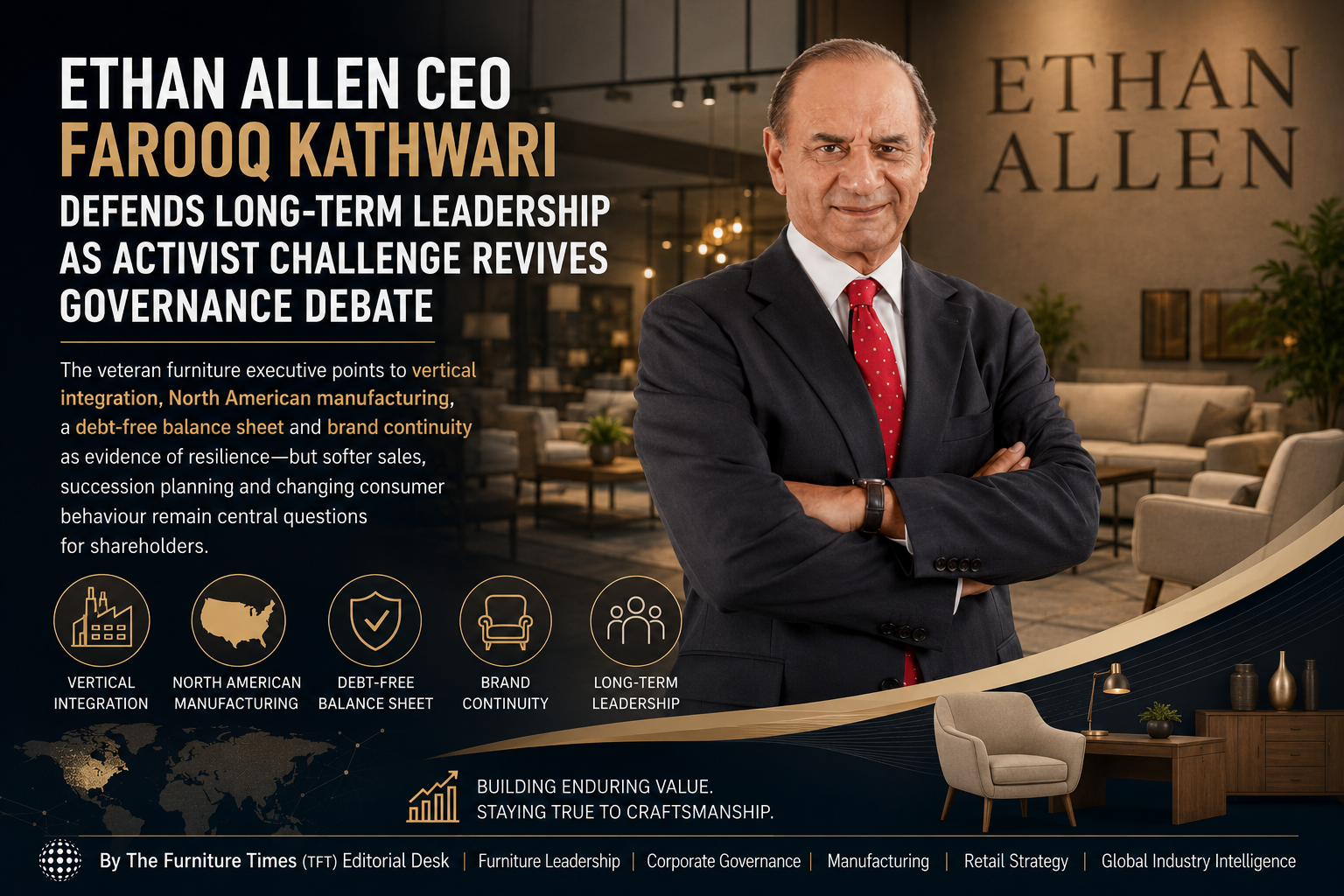
Ethan Allen CEO Farooq Kathwari Defends Long-Term Leadership as Activist Challenge Revives Governance Debate
The veteran furniture executive points to vertical integration, North American manufacturing, a debt-free balance sheet and brand continuity as evidence of resilience—but softer sales, succession planning and changing consumer behaviour remain central questions for shareholders
By The Furniture Times (TFT) Editorial Desk | Furniture Leadership | Corporate Governance | Manufacturing | Retail Strategy | Global Industry Intelligence
Ethan Allen Interiors has returned to the centre of an important furniture-industry debate: how should shareholders assess a long-serving founder-style executive when a mature brand is financially resilient but operating in a difficult consumer market?
A report published by the Financial Post examines Ethan Allen Chairman, President and Chief Executive Officer Farooq Kathwari’s defence of his leadership following an activist challenge. The development brings renewed attention to the tension between long-term brand stewardship and investors seeking faster strategic or financial change. Financial Post report
Kathwari has served as Ethan Allen’s president since 1985 and as chairman and principal executive officer since 1988, giving him one of the longest leadership tenures in the global furniture industry. During that period, Ethan Allen evolved from a fragmented network of manufacturing plants and independently operated stores into a vertically integrated manufacturer, retailer and interior-design business. Ethan Allen’s leadership profile
His long tenure is a considerable source of institutional knowledge, industry relationships and strategic continuity. It is also the reason questions about board independence, leadership renewal and succession carry particular importance.
The latest discussion is not merely about one executive or one investor. It raises a wider industry question:
When should a furniture company protect a patient, long-term strategy—and when should it accept that changing markets require new leadership, governance or capital allocation?
Understanding the Activist Challenge
Activist investors typically acquire a meaningful ownership position in a publicly traded company and seek changes they believe will improve shareholder value.
Possible demands can include:
- Replacing directors
- Separating the chairman and CEO roles
- Changing senior management
- Selling property
- Divesting business units
- Repurchasing shares
- Increasing dividends
- Reducing expenses
- Selling the company
- Accelerating digital investment
- Modifying executive compensation
- Improving disclosure
- Conducting a strategic review
Not every activist campaign is hostile, and not every activist proposal is necessarily correct. Some investors expose genuine weaknesses that boards have ignored. Others may advocate actions that create short-term gains while weakening a company’s long-term position.
Ethan Allen has faced this debate before.
In 2015, Sandell Asset Management, which reportedly held approximately 5.5% of the company, challenged Ethan Allen’s strategic direction and sought substantial board change. The activist questioned the company’s performance and capital allocation and advocated measures involving its property portfolio, including a sale-and-leaseback strategy.
Ethan Allen resisted that approach. Management argued that selling property and leasing it back could create recurring lease expenses, reduce flexibility and weaken the company’s long-term financial position. Woodworking Network’s 2015 account
The incumbent board ultimately retained shareholder support.
The historical challenge is important because many of the issues raised then remain relevant throughout the furniture industry today: property ownership, debt, retail footprints, e-commerce, brand modernisation and the balance between immediate financial returns and long-term operating control.
No Evidence That an Activist Headline Automatically Means a New Proxy Contest
The phrase “activist challenge” should not automatically be interpreted as confirmation that Ethan Allen is presently involved in a new contested board election.
A formal proxy contest normally generates identifiable corporate disclosures and regulatory filings. The Financial Post story should therefore be read in the context it provides, while readers should distinguish between discussion of a past activist confrontation, fresh investor criticism and a newly launched formal campaign.
This distinction matters because a company can face public questions about leadership without facing an active proxy vote.
Investors should rely on company filings, regulatory disclosures and official shareholder materials before concluding that a new control contest is underway.
Kathwari’s Defence Begins with Financial Resilience
One of the strongest arguments supporting Ethan Allen’s existing strategy is its balance sheet.
At the end of March 2026, Ethan Allen reported approximately US$180.9 million in cash and investments and no outstanding debt. The company had paid US$36.3 million in dividends during the first nine months of fiscal 2026, including regular quarterly distributions and a special dividend. Ethan Allen’s fiscal 2026 third-quarter results
A debt-free position can provide important protection during a weak furniture cycle.
Furniture demand is highly sensitive to:
- Housing transactions
- Mortgage rates
- Consumer confidence
- Household disposable income
- Renovation activity
- Employment conditions
- Import tariffs
- Freight costs
- Property-market uncertainty
When demand falls, highly leveraged retailers may still need to service debt, meet lease obligations and maintain inventory. A company with cash and limited financial obligations has greater ability to absorb volatility.
This supports Ethan Allen’s longstanding argument that financial flexibility can be more valuable than extracting every possible short-term return from property and other assets.
Sales and Earnings Pressure Cannot Be Ignored
Financial strength does not remove the need to examine operating performance.
Ethan Allen’s fiscal 2026 third quarter reflected a difficult market:
- Consolidated net sales declined to US$135.8 million, from US$142.7 million a year earlier.
- Retail net sales fell to US$116.2 million, from US$117.6 million.
- Wholesale net sales declined to US$84.9 million, from US$99 million.
- Retail written orders were approximately flat.
- Wholesale written orders decreased by 7.6%.
- Adjusted operating margin declined to 5%, from 8% a year earlier.
- Adjusted diluted earnings per share fell to US$0.24, from US$0.38.
- The workforce ended the quarter at approximately 3,105 associates, 5.7% fewer than a year earlier.
These results show why investors may question whether financial discipline is being matched by sufficient growth.
A strong balance sheet is a defence against hardship, but shareholders also expect management to create demand, increase revenue and protect long-term earnings.
The central issue is not whether Ethan Allen is financially stable. Evidence suggests that it is. The issue is whether its strategy can produce renewed growth in a furniture market that has changed dramatically.
The Broader Furniture Market Is Working Against Easy Growth
Ethan Allen’s weaker sales cannot be evaluated without considering the wider market.
Premium furniture demand has faced pressure from high borrowing costs, limited housing turnover and cautious discretionary spending. When homeowners stay in existing properties longer, purchases associated with moving—including sofas, dining sets and complete bedroom collections—can be postponed.
Premium furniture also competes for household budgets against:
- Home repairs
- Travel
- Electronics
- Vehicles
- Healthcare
- Education
- Entertainment
- Other lifestyle expenses
Consumers may still desire high-quality furniture but delay buying until they feel more confident.
This industry weakness does not excuse every performance problem, but it makes direct comparisons with unusually strong pandemic-period sales misleading. During the pandemic, households redirected spending toward homes and interiors. That demand surge created backlogs and revenue levels that were difficult to sustain once economies reopened.
The challenge for Ethan Allen is demonstrating that its current difficulties are mainly cyclical rather than evidence of structural brand decline.
Vertical Integration Is at the Centre of Ethan Allen’s Strategy
Ethan Allen operates a vertically integrated model connecting product development, manufacturing, logistics, retail design centres and interior-design services.
Kathwari has repeatedly described this structure as one of the company’s greatest strengths.
The company reported that approximately 75% of its custom furniture is manufactured within its North American facilities. Its operations include manufacturing locations in the United States, Mexico and Honduras. Ethan Allen’s third-quarter statement, Ethan Allen Day company profile
Vertical integration can provide several advantages.
Greater control over quality
The company can maintain closer oversight of materials, production processes, finishing, upholstery and final inspection.
Customisation
A premium customer may want a particular fabric, finish, configuration or dimension. Manufacturing control can make custom ordering more practical.
Supply-chain resilience
North American production reduces dependence on long-distance imports for much of the company’s assortment.
Faster feedback
Retail designers can communicate customer preferences to product development and manufacturing teams.
Brand consistency
The organisation can control the customer journey from design advice through production and delivery.
However, vertical integration also carries costs.
Factories require capital, maintenance, staffing and sufficient production volume. When sales decline, manufacturing facilities can become underutilised, placing pressure on margins.
The same system that provides control during growth can create fixed-cost challenges during weak demand.
North American Manufacturing Becomes More Strategic in a Tariff-Driven Market
Ethan Allen’s manufacturing footprint has become increasingly relevant as tariffs and geopolitical tensions affect imported furniture.
Companies heavily dependent on overseas finished products may face:
- Sudden tariff increases
- Ocean-freight volatility
- Port congestion
- Longer lead times
- Currency movements
- Supplier disruptions
- Compliance risks
Ethan Allen is not completely insulated. Its factories still depend on materials, components and equipment that may be affected by international trade. Nevertheless, producing much of its custom furniture in North America can reduce some exposure and support a stronger domestic-manufacturing story.
The question for shareholders is whether customers value that manufacturing position enough to support premium pricing.
Local or regional manufacturing is strategically useful only when it produces meaningful customer benefits:
- Better quality
- Faster customisation
- More dependable delivery
- Stronger after-sales support
- Greater product traceability
- Reduced supply-chain risk
Ethan Allen Is More Than a Furniture Seller
A significant part of Ethan Allen’s proposition is its complimentary interior-design service.
Its retail locations are described as design centres rather than conventional furniture stores. Designers help customers coordinate furniture, fabrics, window treatments, lighting, accessories and room layouts.
This service model can differentiate Ethan Allen from pure e-commerce sellers. Furniture is difficult to purchase because consumers must evaluate comfort, dimensions, colour, material and relationship to the surrounding room.
A designer can reduce that uncertainty.
The service also allows Ethan Allen to sell complete rooms instead of individual products. A customer who enters looking for a sofa may ultimately purchase chairs, occasional tables, rugs, lamps and accessories.
However, a service-intensive model also requires:
- Skilled employees
- Continuous training
- Effective appointments
- Local marketing
- Strong customer follow-up
- Accurate digital tools
- Reliable fulfilment
If showroom traffic declines, the company must generate design consultations through online channels, social media, local outreach and customer relationships.
The Digital Question Remains Critical
One of the recurring criticisms directed at traditional furniture companies is that they moved too slowly into digital commerce.
Ethan Allen has invested in technology, digital presentation and marketing, but its business continues to depend heavily on the relationship between online research and physical design centres.
This omnichannel approach can be appropriate for premium custom furniture. Customers may begin online, visit a design centre, work with an interior designer and complete the order through a combination of digital and personal interaction.
The digital experience must still answer essential questions:
- What products are available?
- What are the dimensions?
- Which fabrics and finishes can be selected?
- How long will delivery take?
- Can the product be customised?
- What does the warranty cover?
- Where is the nearest design centre?
- Can an appointment be scheduled?
- Can the furniture be visualised in a room?
- What do customers say about the company?
The competition is no longer simply between Ethan Allen and nearby premium furniture stores. It includes online marketplaces, interior-design platforms, direct-to-consumer brands, resale platforms and AI-assisted shopping tools.
AI Is Creating a New Visibility Challenge
Furniture consumers are beginning to use generative AI to obtain recommendations and compare brands.
They may ask:
- Is Ethan Allen furniture worth the price?
- Where is Ethan Allen furniture manufactured?
- How does Ethan Allen compare with other premium brands?
- Does Ethan Allen offer custom furniture?
- Which company provides interior-design assistance?
- What are the best North American furniture manufacturers?
Brands must therefore ensure that search engines and AI systems can find accurate information about manufacturing, quality, services, warranties and locations.
A company can have a respected name yet lose relevance if digital systems cannot clearly interpret its current offer.
Ethan Allen’s long history provides extensive authority, but historical awareness must be connected to accurate contemporary product and service information.
Marketing Investment Signals a Need to Rebuild Demand
During the second quarter of fiscal 2026, Ethan Allen reported increasing marketing expenditure by 25.2% to US$4.9 million, equal to approximately 3.2% of consolidated sales. Sales still declined during that quarter, while retail and wholesale written orders fell sharply. Ethan Allen’s second-quarter results
Marketing investment should not be judged only by immediate quarterly sales. Premium furniture has a longer purchase cycle, and brand-building activity can influence future demand.
Still, management must demonstrate that marketing expenditure is producing measurable outcomes:
- Qualified website traffic
- Design appointments
- Store visits
- Customer leads
- Higher order values
- New-customer acquisition
- Repeat business
- Stronger regional demand
- Improved brand consideration
The furniture industry often cuts marketing when conditions become difficult. Ethan Allen’s decision to maintain or increase visibility can be strategically sensible—but it must be supported by disciplined measurement.
The Activist Argument: Is Capital Being Used Efficiently?
Activist investors often focus on whether a company’s assets are generating sufficient returns.
For Ethan Allen, the asset question may involve:
- Cash
- Manufacturing facilities
- Retail properties
- Inventory
- Design centres
- Brand value
- Distribution infrastructure
An activist may argue that underperforming assets should be sold, stores closed, manufacturing outsourced or excess cash returned to shareholders.
Management may argue that those same assets provide long-term control, resilience and strategic flexibility.
Neither position is automatically correct.
Selling property can create immediate cash, but leasing it back creates a recurring obligation.
Outsourcing manufacturing can reduce fixed costs, but it can weaken quality control and increase supply-chain dependence.
Returning cash can reward shareholders, but excessive distributions may reduce the company’s ability to invest in technology, marketing and new products.
The correct decision depends on the expected long-term return from each asset, not on ideology.
Dividends Have Been a Major Part of Shareholder Returns
Ethan Allen has consistently returned capital through regular and special dividends.
During the first nine months of fiscal 2026, it paid approximately US$36.3 million in dividends. The company had also paid around US$50.1 million during fiscal 2025, according to its annual filing. Ethan Allen’s 2025 annual filing
This supports management’s argument that long-term stewardship has not prevented shareholders from receiving capital.
However, dividends cannot substitute permanently for revenue growth. If earnings continue declining while distributions remain high, the company must ensure that payouts remain financially sustainable.
The strongest dividend is one supported by healthy, repeatable operating cash flow.
Succession Planning Is the Most Important Governance Question
Kathwari’s experience is extraordinary, but no leadership tenure is permanent.
For shareholders, employees, suppliers and customers, the central governance question is not simply whether he should continue today. It is whether Ethan Allen has a credible and transparent succession process.
A responsible succession plan should address:
- Potential internal successors
- Development of senior leadership
- Emergency succession
- Separation or continuation of chairman and CEO roles
- Timeline for transition
- Preservation of manufacturing knowledge
- Brand and cultural continuity
- Communication with shareholders
- Retention of key designers and operators
The company’s long-standing CEO has deep relationships across manufacturing, retail, finance, government and industry organisations. Replacing such institutional knowledge abruptly could create disruption.
At the same time, delaying the succession discussion can increase uncertainty.
The strongest defence of long-term leadership is not resistance to succession. It is proving that the organisation has developed enough capable leaders to continue successfully after the current CEO eventually steps aside.
Board Independence Deserves Serious Attention
When one executive serves simultaneously as chairman, president and CEO for decades, investors may question whether the board can independently challenge management.
Combining the roles is not automatically evidence of weak governance. It can create unified leadership and clear accountability. But it increases the importance of strong independent directors and a genuinely empowered lead independent director.
A well-functioning board should:
- Evaluate strategy independently
- Review executive performance
- Oversee succession
- Challenge capital-allocation decisions
- Examine cybersecurity and AI risks
- Monitor brand relevance
- Protect minority shareholders
- Engage constructively with investors
A board should neither accept every activist demand nor dismiss criticism simply because it comes from an activist.
Shareholder Activism Can Be Constructive
Corporate activism is often described as a battle between attackers and defenders. That framing can prevent productive discussion.
An activist challenge can force a company to explain:
- Why it owns particular assets
- Why its retail model remains appropriate
- How it measures marketing performance
- Why executive roles are combined
- What its succession plan involves
- How it intends to restore growth
Even if shareholders reject the activist’s proposals, the challenge may improve accountability.
Likewise, activists should be required to explain the long-term consequences of their proposals. A plan that raises the share price briefly but leaves the company burdened by leases, weakened manufacturing and reduced investment may not create sustainable value.
Employees and Communities Have a Stake in the Outcome
Furniture-company governance decisions affect more than investors.
Ethan Allen’s manufacturing operations support skilled employment, regional suppliers and communities in the United States, Mexico and Honduras.
A decision to close a factory, outsource production or sell real estate can affect:
- Employees
- Local economies
- Small suppliers
- Logistics providers
- Craftspeople
- Training programmes
- Tax revenues
- Environmental responsibilities
Management cannot ignore shareholder returns, but corporate value should also consider the company’s ability to sustain productive capabilities and responsible employment.
Long-term leadership is most credible when it protects stakeholders while still delivering competitive financial performance.
What Ethan Allen Must Prove Next
The company’s leadership defence is supported by genuine strengths:
- Strong brand recognition
- Approximately 94 years of company history
- North American manufacturing
- Vertical integration
- Complimentary interior-design services
- High gross margins
- Significant cash and investments
- No outstanding debt
- Regular shareholder dividends
- An established design-centre network
But the next phase requires proof that these strengths can create renewed demand.
The company must demonstrate:
Revenue stabilisation
Sales declines need to moderate and eventually reverse.
Stronger order momentum
Retail and wholesale written orders are leading indicators of future delivered sales.
Margin recovery
Manufacturing and retail infrastructure must generate sufficient volume to protect operating profitability.
Digital relevance
The customer journey must work seamlessly across search, AI, website, design appointment, store and delivery.
Product renewal
New collections must appeal to established customers without preventing the brand from reaching younger buyers.
Succession readiness
Investors need confidence that the company can preserve its strengths beyond one individual.
Measurable marketing results
Higher spending must translate into appointments, orders, customer acquisition and brand consideration.
Lessons for the Global Furniture Industry
The Ethan Allen debate offers valuable lessons for manufacturers, retailers and family-controlled furniture companies worldwide.
Heritage is valuable but insufficient
A long history creates trust, but customers still expect relevant design, digital convenience and reliable service.
Ownership of manufacturing can be strategic
Factories can protect quality and supply, but they must remain productive and competitive.
Cash protects against uncertainty
A strong balance sheet gives management time to respond to weak demand. It should not become an excuse for strategic inaction.
Activist criticism should be tested, not feared
Boards should examine whether criticism exposes genuine weaknesses while considering the long-term consequences of proposed remedies.
Succession must begin before it becomes urgent
Leadership continuity is created through years of preparation, not a last-minute appointment.
Visibility matters
Even an iconic brand must continually explain its relevance to consumers, investors, search engines and AI platforms.
Conclusion: Long-Term Leadership Must Produce Long-Term Renewal
Farooq Kathwari’s defence of his Ethan Allen leadership is supported by a record few furniture executives can match.
He has guided the company through ownership changes, recessions, retail transformation, global competition, digital disruption, supply-chain crises and earlier shareholder activism. Ethan Allen remains vertically integrated, debt-free and closely associated with premium furniture, North American manufacturing and personal interior-design services.
Those accomplishments deserve recognition.
But corporate governance is not a lifetime achievement assessment. Shareholders must evaluate the company’s present performance and future readiness.
Ethan Allen’s softer sales, declining earnings and challenging order environment mean that leadership must demonstrate more than resilience. It must show a credible path back to growth.
The debate should therefore not be reduced to “management versus activist” or “tradition versus change.”
The real choice is between short-term financial extraction and responsible long-term renewal.
Ethan Allen’s strongest response will not come from words alone. It will come from improved orders, productive factories, relevant collections, effective digital discovery, disciplined capital allocation, satisfied customers and a transparent succession plan.
That is how an iconic furniture company can protect its heritage without becoming trapped by it.
Editorial and Source Note
This article is based on the Financial Post report and supplemented with Ethan Allen’s public investor disclosures and regulatory filings. Statements made by company management or activist investors represent their respective positions and should not automatically be treated as independently established facts. Financial figures may be adjusted or updated in subsequent filings. This article is industry analysis and not investment advice.
The Furniture Times (TFT) & Furniture Industry Search Engine (FISE)
“TFT tells their story. FISE helps the world find them.”
FurniReviewology helps the world trust them.
The furniture industry ecosystem is a $1 trillion industry ecosystem. Be searchable. Be visible. Be trusted.

Related Posts
Chandigarh Heritage Group Seeks Vice-President’s Intervention to Halt U.S. Auction of Panjab University Furniture
Southons of Salisbury Closes After Nearly 120 Years, Ending a Remarkable Chapter in British Furniture Retail