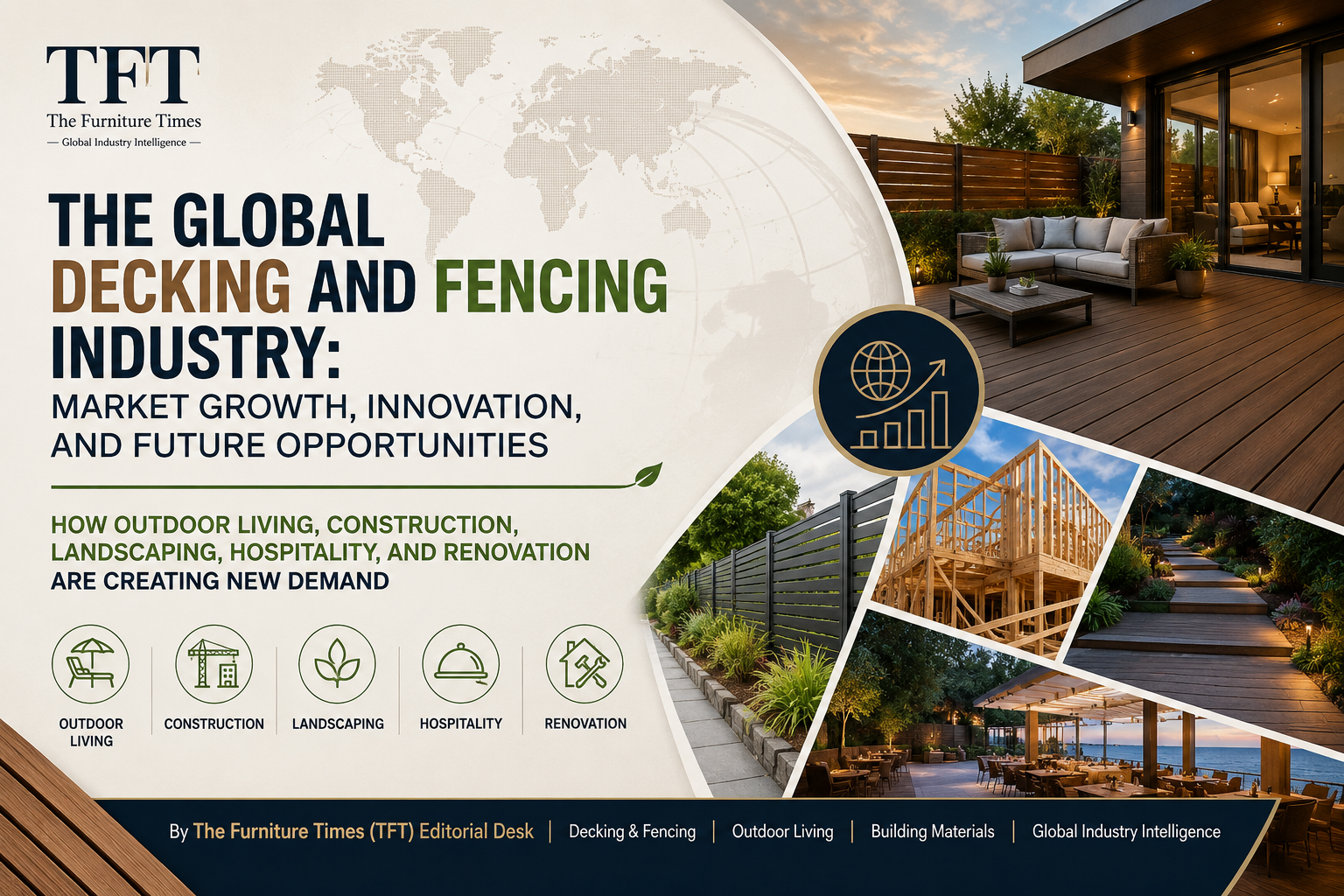
The Global Decking and Fencing Industry: Market Growth, Innovation, and Future Opportunities
The Hidden Economy Behind Decking and Fencing
Manufacturers, Material Suppliers, Distributors, Contractors, Architects, Landscapers, Retailers, and Installers
By The Furniture Times (TFT) Editorial Desk | Decking & Fencing | Outdoor Living | Building Materials | Global Industry Intelligence
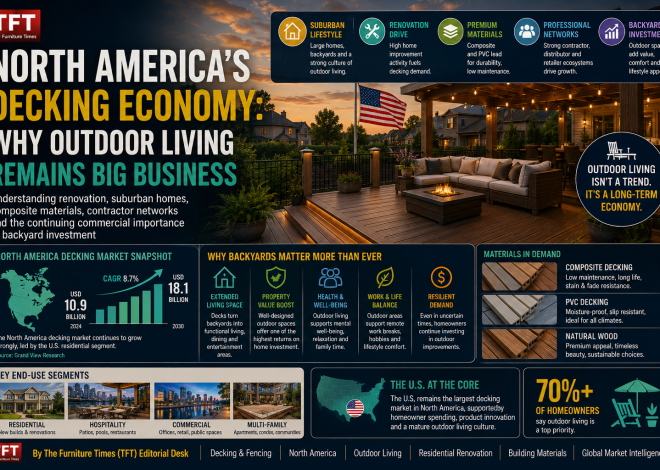
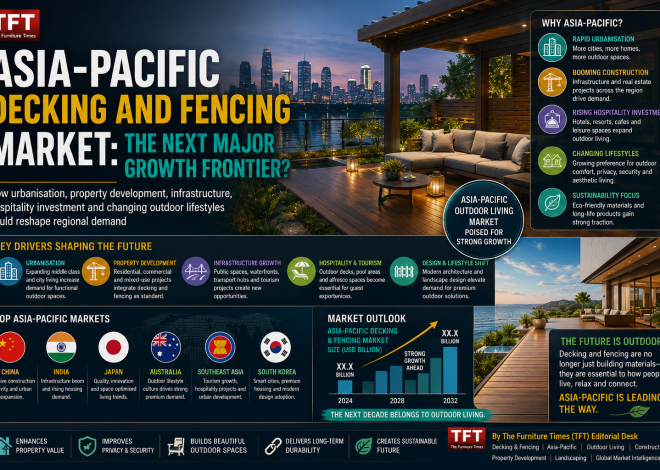
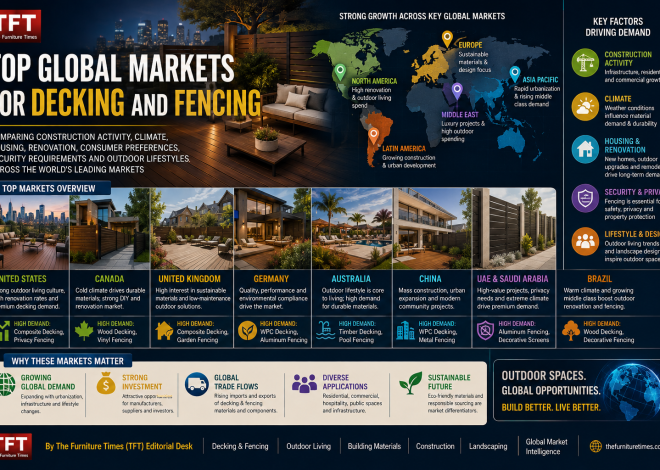
The decking and fencing industry is much larger than the products visible in a garden, around a hotel, beside a swimming pool, or along the boundary of a commercial property.
Behind every finished deck and every installed fence sits a complex commercial ecosystem.
There are timber producers supplying raw wood.
Polymer companies providing materials for composite products.
Metal producers supplying aluminium and steel.
Manufacturers extruding profiles.
Hardware companies producing fasteners, clips, posts and connectors.
Distributors moving products across regions.
Architects specifying materials.
Landscape designers integrating them into projects.
Retailers presenting choices to consumers.
Contractors building the systems.
Installers determining whether those systems perform properly.
Transport companies deliver the materials.
Technology platforms influence how buyers discover suppliers.
Testing laboratories help establish performance.
Certification bodies shape procurement.
Hospitality operators, developers, municipalities and homeowners ultimately create the demand.
What appears to the consumer as a deck or fence is therefore the final visible outcome of a much larger hidden economy.
Understanding that economy is essential because the future of the sector will not be determined by manufacturers alone.
Growth will depend on how effectively the entire ecosystem works together.
Decking and Fencing Are System Industries
The most important starting point is to stop thinking of decking and fencing as isolated products.
A deck is not simply a board.
It is a system.
A finished deck may require:
surface boards, joists, subframes, pedestals, fasteners, clips, connectors, drainage, trims, railings, steps, lighting, coatings and installation equipment.
The same principle applies to fencing.
A fence may require:
panels, posts, brackets, foundations, rails, fasteners, gates, hinges, locks, access systems, finishes and installation hardware.
This means each completed project supports multiple businesses.
The economic value extends across dozens of suppliers before the finished product is ever seen by the customer.
1. Manufacturers: The Visible Centre of the Industry
Manufacturers sit near the centre of the ecosystem because they transform raw materials into finished products.
They may produce:
timber decking, composite decking, PVC decking, aluminium decking, timber fencing, composite fencing, aluminium fencing, steel systems, railings, privacy screens and architectural panels.
But even manufacturers rarely operate independently.
They depend on material suppliers.
They depend on machinery companies.
They depend on tooling.
They depend on coatings.
They depend on logistics.
They depend on distributors.
They depend on contractors.
The manufacturer therefore sits inside a network rather than at the top of a simple supply chain.
The strongest manufacturers increasingly understand this.
They do not only ask:
“How can we improve our product?”
They also ask:
“How can we improve the ecosystem around our product?”
Manufacturing Is Becoming More Technical
Decking and fencing manufacturing is also becoming more sophisticated.
Composite products require careful control over material formulations.
Extrusion systems need consistency.
Timber requires grading, drying, treatment and finishing.
Aluminium profiles require precision.
Steel systems require coating and corrosion protection.
Surface textures influence appearance and grip.
Colour systems influence long-term visual performance.
Manufacturers are therefore becoming increasingly dependent on engineering, material science and quality control.
This creates demand for another hidden layer of the economy:
technical consultants, chemical suppliers, equipment manufacturers, laboratories and testing providers.
2. Raw-Material Suppliers: The Industry Before the Industry
Before any deck or fence can be manufactured, materials have to come from somewhere.
Timber manufacturers depend on forestry and timber-processing industries.
Composite manufacturers depend on polymers, wood fibres, additives, pigments and recycled material streams.
Metal fencing companies depend on aluminium or steel supply chains.
Glass fencing depends on processed glass and specialist hardware.
Coatings manufacturers influence durability and appearance.
These suppliers have enormous influence over product quality.
A decking brand may have excellent marketing, but inconsistent raw materials can undermine performance.
For this reason, raw-material sourcing is becoming strategically important.
Manufacturers increasingly need to evaluate:
quality, traceability, availability, cost volatility, sustainability and geographic supply risk.
Timber Supply Chains Remain Critical
Natural wood remains central to the decking and fencing sector.
But timber supply chains are complex.
Species availability varies by region.
Harvesting regulations differ.
Certification requirements vary.
Transportation costs influence competitiveness.
Moisture content affects product stability.
Treatment methods influence outdoor durability.
Manufacturers therefore need strong relationships with sawmills, processors, timber traders and forestry suppliers.
The future of premium timber decking will increasingly depend on credible sourcing and traceability.
Buyers are becoming more interested in where the wood comes from.
That means responsible forestry is not simply an environmental issue.
It is becoming a commercial issue.
Recycled Materials Create a New Supply Economy
Composite decking and fencing create another interesting material ecosystem.
Some manufacturers use recycled polymers or recycled wood fibres as inputs.
This connects the industry with recycling companies, waste-management businesses and material recovery systems.
In the future, the relationship may become even deeper.
Instead of simply buying recycled material, manufacturers could develop closed-loop systems.
Old decking might eventually return to processing facilities.
Industrial waste could be reintroduced into production.
Packaging waste could become another input stream.
The industry could therefore become more circular.
This would create an entirely new economic layer involving collection, sorting, processing and material recovery.
3. Machinery and Equipment Suppliers: The Invisible Enablers
Behind manufacturers are the companies that build the machines.
Extrusion lines.
Sawing equipment.
Planers.
Moulding systems.
Surface-texturing equipment.
Coating systems.
Cutting machinery.
CNC machines.
Packaging equipment.
Testing instruments.
Factory automation.
These suppliers rarely appear in consumer conversations, yet they help determine productivity, consistency and production cost.
As decking and fencing manufacturers modernize, machinery companies will benefit.
Automation can reduce production variability.
Digital monitoring can improve quality control.
Robotics can improve packaging and handling.
AI-powered manufacturing systems may eventually help predict maintenance requirements or detect defects.
The machinery industry is therefore an important part of the hidden economy.
4. Hardware and Component Suppliers
Many products that determine the success of a deck or fence are almost invisible after installation.
That does not make them unimportant.
Fasteners.
Clips.
Brackets.
Anchors.
Hinges.
Locks.
Connectors.
Post bases.
Pedestals.
Subframes.
Drainage components.
These parts can determine whether the final system remains strong and stable.
A premium decking board installed with poor-quality fasteners can still produce a disappointing result.
A beautiful gate fitted with unreliable hinges can fail quickly.
This means component suppliers play a strategically important role.
The future could see closer integration between main-product manufacturers and hardware companies.
Complete system warranties may become more common.
5. Distributors: The Bridge Between Factory and Market
Manufacturers cannot reach every customer directly.
Distributors therefore play a critical role.
They store products.
They provide regional availability.
They support contractors.
They provide samples.
They consolidate orders.
They manage logistics.
They sometimes provide technical support.
In many markets, the distributor has a stronger relationship with contractors than the manufacturer itself.
This makes distribution strategically important.
A manufacturer can have an excellent product but still struggle if its distribution network is weak.
Availability matters.
Contractors often purchase what they can reliably obtain.
The best marketing campaign cannot compensate for a product that is constantly out of stock.
Distribution Is Becoming More Data-Driven
Traditional distribution is also changing.
Distributors increasingly need accurate information about:
inventory, demand, project pipelines, seasonal patterns and regional preferences.
Digital inventory management can improve availability.
Online ordering can reduce friction.
Contractor portals can make repeat purchasing easier.
Manufacturers and distributors may increasingly share demand data.
This can improve forecasting and reduce unnecessary stock.
The future distributor may therefore become both a logistics partner and an information partner.
6. Wholesalers and Building-Material Merchants
Between large distributors and end users are wholesalers and building-material merchants.
These businesses serve builders, contractors, landscapers and smaller retailers.
They are particularly important in fragmented markets where local relationships remain strong.
A contractor may purchase nearly every project material from the same merchant.
If that merchant recommends one decking brand over another, the recommendation can influence substantial sales.
Manufacturers should therefore recognize the importance of trade relationships at the local level.
Industry growth does not happen only through international branding.
It also happens through thousands of everyday recommendations across local trade counters.
7. Retailers: Where Consumers Make Decisions
Retailers represent another important part of the ecosystem.
For many homeowners, the retailer becomes the first physical point of contact with decking or fencing products.
Consumers want to touch materials.
They want to compare colours.
They want to understand maintenance.
They want pricing.
They want installation guidance.
Retail staff can therefore have enormous influence.
Manufacturers that invest in attractive displays, clear samples and simple educational materials can improve conversion.
The retail environment should not merely display boards.
It should help consumers imagine the finished outdoor space.
Retail Could Become More Experiential
A future decking showroom may look less like a building-material warehouse and more like an outdoor-living studio.
Customers could experience:
finished decks, privacy screens, pergolas, outdoor furniture, lighting and landscaping.
Digital visualization could show how products would appear at home.
This would transform retail from product selection into lifestyle planning.
The manufacturer that participates in this experience could capture significantly more value.
8. Contractors: The Industry’s Commercial Connectors
Contractors occupy a particularly powerful position.
They connect products with projects.
Many customers do not choose a decking brand before contacting a contractor.
Instead, they ask the contractor for advice.
The contractor may then recommend the material.
That makes contractors major influencers.
Manufacturers should therefore consider contractors not merely as installers, but as part of the sales channel.
Training, loyalty programmes, project support and technical assistance can strengthen these relationships.
A contractor who trusts a product may recommend it repeatedly for years.
Contractors Shape Brand Reputation
There is another reason contractors matter.
Consumers usually judge the final installation.
They cannot easily separate product problems from installation problems.
If boards move because the substructure was built incorrectly, the manufacturer may still receive the blame.
If a gate is misaligned, the customer may blame the brand.
Manufacturers therefore have a strong commercial incentive to improve installation quality.
Contractor education is brand protection.
9. Installers: The Final Quality-Control Point
Installers are the last people to touch the product before the customer begins using it.
Their role is critical.
Correct spacing.
Proper drainage.
Strong foundations.
Accurate alignment.
Appropriate fasteners.
Correct cutting.
Proper ventilation.
All can determine long-term performance.
The industry sometimes underestimates this stage.
A manufacturer may invest millions in product development, only for the final result to depend on an installer with limited training.
This creates a strong case for certified installation networks.
Installer Certification Could Become a Major Industry Standard
Formal installer programmes can benefit everyone.
Customers receive greater confidence.
Manufacturers reduce warranty disputes.
Contractors gain professional recognition.
Retailers can recommend qualified partners.
Architects gain confidence that technical specifications will be followed.
Certification could therefore become an increasingly important part of the decking and fencing economy.
10. Architects: The Specification Gatekeepers
Architects can strongly influence product selection on larger projects.
When an architect includes a particular material in project specifications, the commercial value can be substantial.
This is especially important in:
hospitality, commercial development, residential communities and public projects.
Architects require more than marketing language.
They need:
technical drawings, performance information, samples, fire data, slip-resistance information, sustainability documentation and installation details.
Manufacturers that provide complete specification packages make it easier for architects to choose them.
Those that do not may never enter the project.
Design Libraries Are Becoming Strategic Assets
Manufacturers should increasingly create digital libraries for architects.
These may contain:
CAD files, BIM objects, technical specifications, texture files, colour data and installation details.
The easier it becomes to include a product in a design workflow, the greater the likelihood of specification.
This turns digital product information into a commercial asset.
11. Landscape Architects and Designers
Landscape professionals are becoming increasingly important to the decking and fencing industry.
They determine how outdoor environments connect.
They combine:
plants, hardscape, decking, furniture, water, lighting, fencing and shade structures.
A landscape architect may decide:
where the deck begins, where privacy is needed, how materials relate to vegetation and how people move through the space.
This gives them considerable influence over product selection.
Manufacturers that ignore landscape professionals may miss significant project opportunities.
Landscaping Is Where Products Become Experiences
A board on a warehouse rack is just a product.
The same board integrated into a landscaped resort, garden or rooftop becomes part of an experience.
That distinction matters.
The future industry will increasingly compete on finished outcomes rather than raw product characteristics alone.
Manufacturers should therefore show products in realistic environments.
Lifestyle imagery, case studies and completed projects can help buyers understand possibilities.
12. Interior Designers Are Moving Outdoors
Another professional group is entering the ecosystem.
Interior designers increasingly work on outdoor spaces.
As outdoor areas become extensions of interiors, clients expect visual continuity between the two.
Flooring colours may be coordinated.
Furniture styles may continue outside.
Lighting schemes may extend onto terraces.
Privacy screens may match architectural finishes.
Decking manufacturers should therefore consider interior designers as potential influencers, especially in premium residential and hospitality markets.
13. Developers and Property Owners
Property developers create another major source of demand.
Large residential communities can require substantial volumes of fencing and decking.
Hotels and resorts require exterior infrastructure.
Commercial developments require landscaped common areas.
Property owners also drive replacement and renovation.
Their priorities often focus on:
cost, durability, maintenance, appearance, warranty and lifecycle performance.
Manufacturers seeking large projects must therefore think beyond unit price.
A product that reduces maintenance over many years may create greater value even if the initial purchase cost is higher.
14. Hospitality Operators
Hotels, resorts and restaurants represent an especially valuable part of the hidden economy because outdoor environments can generate direct revenue.
A well-designed terrace can increase dining capacity.
A rooftop deck can become a bar.
A pool deck supports premium leisure experiences.
A private fence can improve villa privacy.
For hospitality operators, decking and fencing are part of the guest experience.
This means purchasing decisions may involve multiple departments:
design, operations, engineering, procurement and management.
Manufacturers that understand this decision-making process can position themselves more effectively.
15. Municipalities and Public Authorities
Governments and municipalities create another important market.
Public parks.
Boardwalks.
Promenades.
Viewpoints.
Schools.
Sports facilities.
Transport infrastructure.
Public housing.
These projects require substantial amounts of outdoor materials.
But public procurement often demands stronger technical documentation and longer-term performance evidence.
Manufacturers seeking this market should prepare for rigorous specification.
They may need to demonstrate:
safety, durability, accessibility, sustainability and lifecycle value.
16. Logistics Companies Keep the Industry Moving
Decking and fencing products are physically demanding to transport.
Boards can be long.
Panels can be bulky.
Metal systems can be heavy.
Damage during transportation can create significant cost.
Logistics therefore plays a major role.
Warehousing.
Container loading.
Regional distribution.
Last-mile delivery.
Site delivery.
All influence the final economics.
Manufacturers that optimize packaging and transportation can gain an advantage.
Even small improvements in container utilization can reduce costs across large volumes.
17. Testing and Certification Companies
Performance claims need evidence.
Testing laboratories play a critical role in evaluating products.
Depending on the application, manufacturers may need information about:
strength, slip resistance, weathering, fire behaviour, corrosion, UV performance or environmental characteristics.
Certification can become especially important for architects, developers and public buyers.
Testing is therefore not simply a compliance expense.
It can become a market-access tool.
18. Finance and Insurance Also Influence the Industry
Another less-visible layer involves finance and insurance.
Commercial property projects require funding.
Developers evaluate capital expenditure.
Contractors manage working capital.
Distributors finance inventory.
Insurance requirements can influence security fencing.
Warranty obligations influence manufacturer reserves.
These financial systems affect which projects move forward and which products are selected.
The decking and fencing economy therefore extends even into financial services.
19. Digital Platforms Are Becoming New Market Intermediaries
Historically, buyers depended heavily on local retailers, contractors and exhibitions.
Today, discovery increasingly begins online.
Search engines.
Directories.
Social platforms.
Digital marketplaces.
Architectural specification platforms.
AI assistants.
These technologies are becoming new intermediaries.
A manufacturer that cannot be found digitally can lose an opportunity before a salesperson is ever contacted.
This makes digital visibility increasingly important across the entire ecosystem.
AI Search Could Restructure Industry Discovery
The growth of AI-powered search could change how professionals and consumers find suppliers.
Instead of searching through dozens of websites, a buyer may simply ask:
“Find composite decking manufacturers suitable for tropical climates.”
“Which fencing companies supply resorts?”
“Who manufactures aluminium privacy screens?”
“Which brands provide public-space decking systems?”
AI systems will attempt to identify and compare relevant companies.
Manufacturers that provide clear, credible, structured information will have an advantage.
Those with weak digital footprints risk becoming invisible.
20. Media and Industry Intelligence Have a Role
Industry media also contributes to the ecosystem.
Manufacturers need visibility.
Architects need information.
Buyers need market intelligence.
SMEs need platforms where they can tell their stories.
Industry journalism can connect these groups.
Specialized media can highlight:
innovation, projects, market trends, sustainability, technology, manufacturing and emerging opportunities.
In fragmented global industries, information itself becomes infrastructure.
The SME Economy Is Enormous but Often Invisible
A particularly important part of the decking and fencing economy consists of SMEs.
Small timber processors.
Metal fabricators.
Composite manufacturers.
Local installers.
Contractors.
Hardware suppliers.
Landscape businesses.
Many have strong capabilities but limited global visibility.
They may never appear in major trade reports.
They may not rank on search engines.
AI tools may not discover them.
Yet collectively, these businesses represent an enormous part of the industry’s employment, craftsmanship and production capacity.
Creating greater digital visibility for SMEs could therefore unlock significant economic value.
Every Deck Generates Multiple Transactions
To understand the hidden economy, imagine a single residential deck.
The homeowner hires a contractor.
The contractor buys decking.
A distributor supplies it.
The manufacturer produced it.
A polymer or timber supplier provided materials.
A hardware company supplied clips.
A logistics company transported everything.
A retailer may have provided samples.
A designer may have specified colours.
An installer builds the deck.
Furniture is purchased afterwards.
Lighting follows.
Landscaping is added.
One project therefore produces transactions across numerous industries.
Multiply that process across millions of properties worldwide and the scale becomes much clearer.
Every Fence Does the Same
A fence generates its own ecosystem.
Raw materials.
Panels.
Posts.
Concrete.
Hardware.
Gates.
Locks.
Automation.
Transport.
Labour.
Landscaping.
Maintenance.
Security systems.
A commercial fence may also integrate cameras, sensors and access control.
The economic opportunity is therefore much wider than the visible panel itself.
Partnerships Could Define the Next Phase of Growth
The industry’s fragmentation creates an opportunity for partnerships.
Decking manufacturers can partner with furniture companies.
Fencing manufacturers can partner with gate automation businesses.
Landscape companies can partner with outdoor-living brands.
Architects can work directly with manufacturers.
Contractors can become certified partners.
Retailers can create complete outdoor packages.
The future industry may increasingly compete through ecosystems rather than individual products.
From Supply Chain to Value Network
Traditional industries are often described through supply chains.
Raw materials move to manufacturers.
Manufacturers sell to distributors.
Distributors sell to contractors.
Contractors sell to customers.
But the decking and fencing economy is becoming more interconnected than this model suggests.
Architects influence manufacturers.
Customers research products online.
Installers recommend brands.
Retailers provide design advice.
AI platforms influence discovery.
Hospitality operators collaborate with landscape designers.
This is better understood as a value network.
Every participant influences the final outcome.
The Furniture Connection Is Larger Than It Appears
Decking and fencing also have a direct relationship with the furniture industry.
Outdoor spaces rarely remain empty.
A deck usually needs furniture.
A pool environment needs loungers.
A rooftop terrace needs seating.
A restaurant deck needs tables and chairs.
A resort garden needs benches, shade and accessories.
A privacy fence can create the environment that makes outdoor furniture usable.
Decking and fencing should therefore be viewed as infrastructure supporting the broader outdoor-furniture economy.
That connection deserves greater recognition across the global furniture ecosystem.
The Future Is the Complete Outdoor Ecosystem
The biggest commercial opportunity may come from connecting all these industries.
Instead of selling individual products, future companies could participate in complete solutions.
Decking + fencing + furniture + landscaping + lighting + shade + installation + technology.
Digital platforms could allow customers to design entire outdoor environments.
Manufacturers could collaborate rather than operate independently.
Contractors could provide turnkey services.
Retailers could become experience centres.
Architects could specify complete systems.
This would transform the industry from fragmented product selling into integrated outdoor-living development.
The Furniture Times (TFT) Perspective
The hidden economy behind decking and fencing reveals an important truth:
The industry is much larger than manufacturers alone.
Its strength depends on thousands of connected participants.
Material suppliers create the foundation.
Manufacturers create the products.
Distributors create availability.
Retailers create consumer access.
Architects create specifications.
Landscapers create environments.
Contractors create projects.
Installers create performance.
Technology creates visibility.
Customers create demand.
Every participant matters.
The companies that understand this interconnected ecosystem will be better positioned to grow than those that view the industry only through product sales.
The future belongs to businesses capable of building strong relationships across the entire value network.
Because the real economy behind decking and fencing is not merely about boards, panels, posts or gates.
It is about the enormous network of people, companies, technologies and services required to transform outdoor space into something functional, attractive, secure and valuable.
The Furniture Times (TFT) & Furniture Industry Search Engine (FISE)
“TFT tells their story. FISE helps the world find them.”
“FurniReviewology helps the world trust them.”
The furniture industry ecosystem is a $1 trillion industry ecosystem.