
The Folding Ladder Revolution: Why Multi-Functional Wooden Step Ladders Are Becoming Essential in Modern Homes, Retail & Smart Living Ecosystems
Global Compact Utility Furniture Intelligence Report | The Furniture Times
Deep Analysis of Foldable Wooden Ladders, Compact Furniture Engineering, Functional Design & Space-Saving Utility Systems
By The Furniture Times | Global Industry Intelligence Desk | May 2026
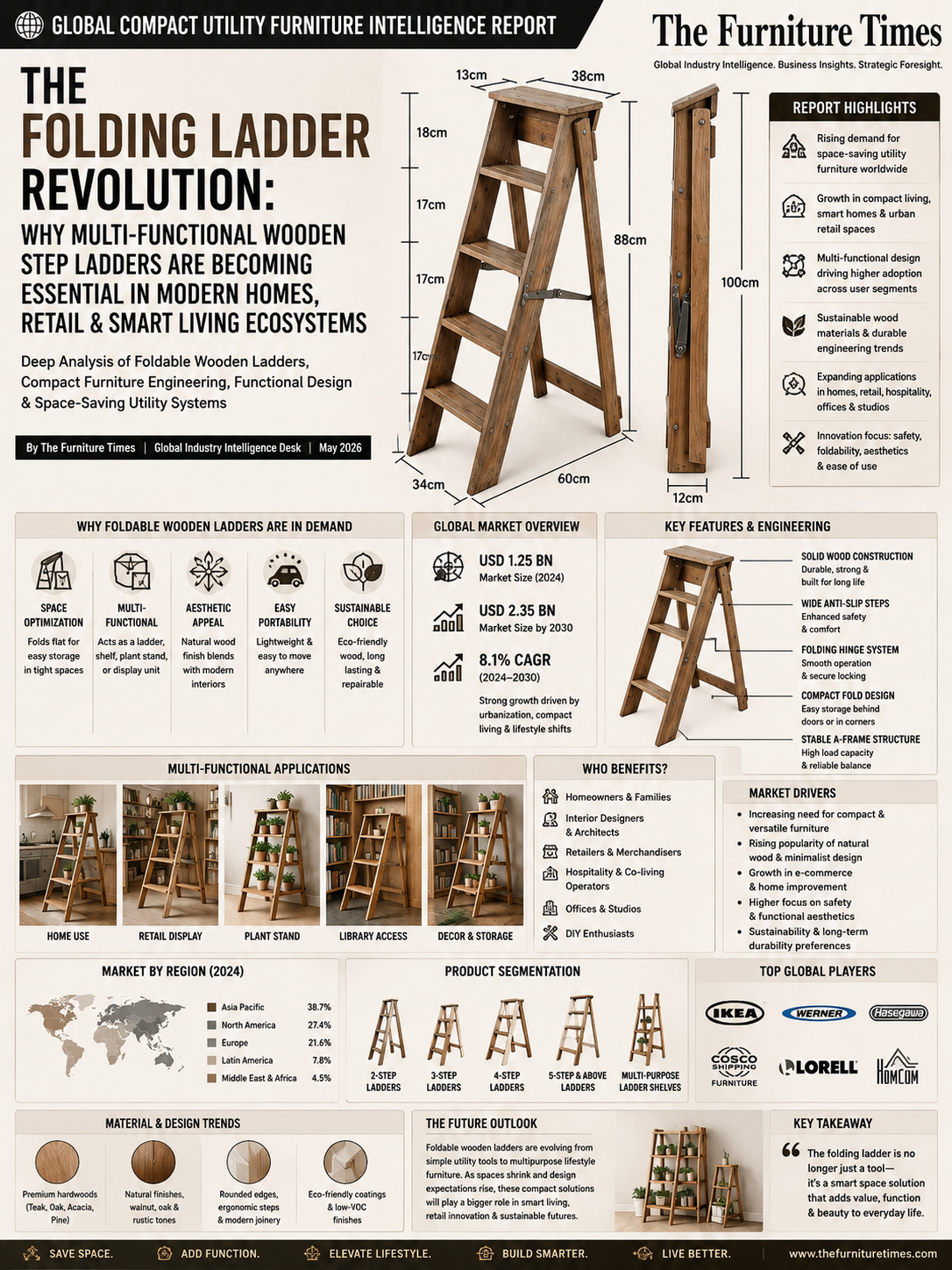
The uploaded image may appear to display a simple wooden folding ladder.
But in reality, the image represents one of the fastest-growing movements in modern furniture and interior ecosystems:
functional compact living.
The foldable wooden ladder shown in the image is not merely a climbing tool.
It is:
a utility furniture product
a space-saving engineering system
a compact living solution
a smart household accessory
a multifunctional interior component
And globally, products like these are becoming increasingly important because modern consumers now demand:
furniture that does more with less space.
The Rise of Functional Furniture
The global furniture industry is undergoing a major transformation.
Traditionally, furniture focused mainly on:
decoration
comfort
storage
aesthetics
Today, however, furniture increasingly combines:
utility
engineering
mobility
compactness
flexibility
hidden functionality
The folding ladder in the image perfectly reflects this shift.
The Image Represents Intelligent Simplicity
The uploaded image documents:
folding mechanisms
product dimensions
structural proportions
compact storage capability
ladder ergonomics
mechanical support systems
This is not simply woodworking.
It is:
utility engineering through furniture design.
The ladder combines:
accessibility
portability
safety
foldability
compact storage
into one efficient product.
Why Folding Ladders Are Growing Globally
Foldable ladders are becoming increasingly popular because they solve multiple modern lifestyle problems simultaneously.
1. Space Saving
Modern homes increasingly lack storage space.
Foldable ladders allow:
compact storage
wall-side placement
hidden storage capability
without permanently occupying floor space.
2. Multi-Functional Living
Consumers increasingly seek products that:
serve multiple functions
maximize utility
improve household efficiency
A folding ladder supports:
storage access
kitchen usage
library access
maintenance work
decorative functionality
3. Compact Urban Homes
Urban apartments globally are shrinking because of:
rising property prices
urban density
compact housing trends
This creates strong demand for:
compact utility furniture.
Analysis of the Product Dimensions
The image carefully documents:
height dimensions
width proportions
folding thickness
ladder spacing
standing footprint
This demonstrates:
ergonomic product engineering.
The measurements are designed to balance:
stability
portability
user safety
compact storage efficiency
Why Step Distance Matters
The image shows:
consistent 17cm step spacing.
This is extremely important because step spacing affects:
climbing comfort
balance
safety
accessibility
Poorly designed spacing creates:
instability
awkward movement
safety risk
This demonstrates:
human-centered utility engineering.
The Importance of Folding Thickness
The folded ladder thickness shown:
approximately 12cm.
This is one of the most important design elements.
Why?
Because compact folding allows:
storage behind doors
wall hanging
closet integration
minimalist interior compatibility
The future of utility furniture increasingly depends on:
compact transformation capability.
Wood as a Utility Material
The ladder uses:
natural wood construction.
This matters because consumers increasingly prefer:
warm materials
natural textures
organic aesthetics
timeless finishes
Unlike industrial metal ladders,
wooden ladders integrate visually into:
living rooms
kitchens
cafés
bookstores
boutique interiors
This transforms the ladder from:
tool → furniture piece.
Why Wooden Utility Products Are Rising
Globally, consumers increasingly prefer:
lifestyle-oriented utility products
aesthetically integrated tools
furniture-inspired household accessories
The ladder shown in the image reflects:
lifestyle utility design.
Scandinavian & Japanese Design Influence
The design philosophy behind the ladder strongly reflects:
Scandinavian minimalism
Japanese compact living philosophy
Key principles include:
simplicity
functionality
clean geometry
efficient storage
natural materials
These philosophies increasingly dominate modern interior trends globally.
The Compact Living Economy
The global compact living movement is accelerating because of:
urbanization
micro apartments
tiny homes
modular housing
minimalist lifestyles
Products that save space while maintaining functionality are becoming:
premium lifestyle solutions.
Hospitality & Commercial Usage
Foldable wooden ladders are increasingly used in:
cafés
bookstores
boutique hotels
retail spaces
libraries
studio apartments
because they combine:
functionality
aesthetics
compactness
mobility
The Rise of Multi-Use Furniture
The future furniture industry increasingly focuses on:
transformable products.
Consumers increasingly seek:
foldable furniture
hidden storage systems
movable interiors
modular products
compact utility systems
The ladder shown in the image is part of this broader global trend.
Safety Engineering & Structural Stability
The image carefully highlights:
support brackets
folding joints
locking systems
weight distribution geometry
This reflects:
mechanical safety engineering.
Poor-quality ladders create:
instability
collapse risk
injury hazards
Modern utility furniture increasingly prioritizes:
structural integrity
ergonomic balance
material durability
Why Hardware Systems Matter
The metal hinge and support systems shown are critical.
These components control:
opening angle
load distribution
structural locking
folding movement
The future of furniture increasingly depends on:
hybrid material engineering.
Wood provides:
warmth
appearance
tactile comfort
Metal provides:
structural reinforcement
mechanical movement
durability
Sustainability & Long-Life Utility Products
Foldable wooden ladders support:
long-term usage
repairability
sustainable material systems
reduced disposable culture
Unlike cheap plastic alternatives,
well-designed wooden utility products often last for:
decades.
This aligns strongly with:
sustainability
circular economy thinking
long-life furniture systems
DIY & Home Improvement Culture
The growth of:
DIY interiors
home improvement
organization culture
compact living content
through social media platforms increases demand for:
utility furniture
portable ladders
multifunctional systems
Consumers increasingly view household utility products as:
lifestyle products.
Furniture Industry Transformation
Traditionally, ladders belonged mainly to:
construction
industrial hardware
maintenance sectors
Now, however, they increasingly overlap with:
interior design
furniture ecosystems
lifestyle décor
compact living systems
This represents:
category convergence.
Asia’s Growing Demand
Asia is becoming one of the strongest markets for:
compact furniture
multifunctional utility products
foldable systems
Especially in:
Japan
Singapore
Hong Kong
Malaysia
South Korea
urban India
where:
space efficiency is increasingly critical.
Europe’s Minimalist Utility Culture
Europe strongly influenced the rise of:
utility minimalism
compact organization
lifestyle functionality
Scandinavian interiors especially normalized:
functional beauty
clean utility products
natural material integration
The ladder shown in the image reflects this philosophy strongly.
The Psychology of Functional Design
Modern consumers increasingly seek:
uncluttered homes
organized interiors
efficient living systems
visual simplicity
Products that combine:
utility
compactness
aesthetics
create emotional value because they reduce:
visual stress and spatial chaos.
Future of Smart Utility Furniture
The future may increasingly include:
foldable utility systems
AI-assisted transformable furniture
robotic compact furniture
smart storage integration
hidden-access furniture systems
The ladder shown in the image represents:
early-stage intelligent utility living.
TFT Philosophical Industry Insight
The uploaded image reveals an important truth about the future furniture industry:
The next generation of furniture may not be defined only by luxury or decoration.
It may be defined by how intelligently products solve everyday living challenges.
The folding ladder symbolizes:
efficiency
simplicity
functionality
intelligent design
compact living philosophy
In a world where living space is shrinking,
products that maximize utility without sacrificing beauty will become increasingly valuable.
Final Thought
The folding wooden ladder shown in the image is far more than a household tool.
It represents:
compact architecture
multifunctional furniture
intelligent space usage
utility engineering
modern living optimization
transformable design systems
And as global cities continue becoming:
denser
more expensive
more compact
the demand for:
foldable furniture
hidden utility systems
multifunctional living products
will continue growing strongly.
Closing Insight
“The future of furniture may belong not only to products that look beautiful, but to products that intelligently adapt to the realities of modern living, smaller spaces, and functional human needs.”
