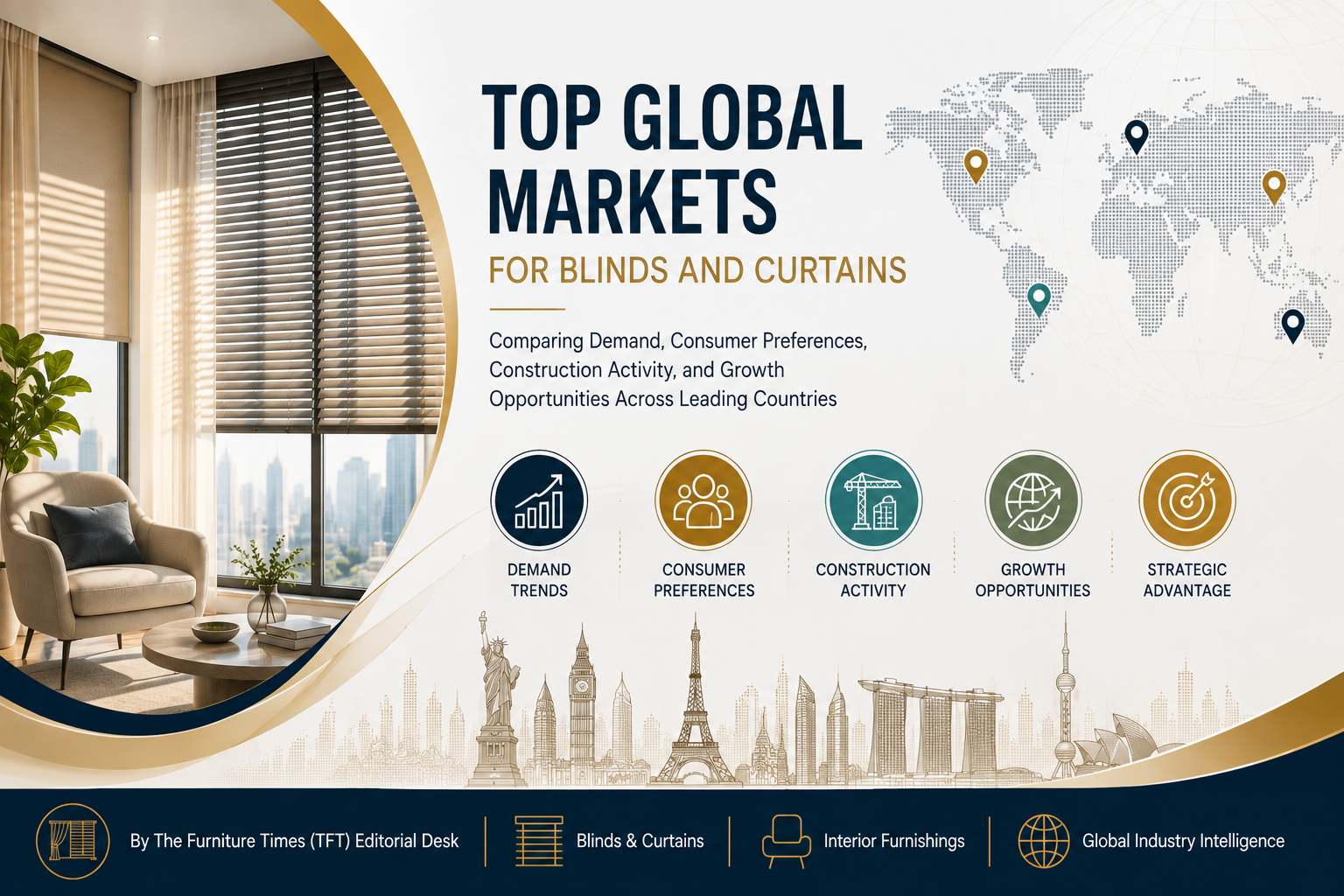
Top Global Markets for Blinds and Curtains
Comparing Demand, Consumer Preferences, Construction Activity, and Growth Opportunities Across Leading Countries
By The Furniture Times (TFT) Editorial Desk | Blinds & Curtains | Interior Furnishings | Global Industry Intelligence
The international blinds and curtains industry is not one uniform market. Demand changes considerably from one country to another according to climate, household income, construction activity, architectural style, urban density, cultural expectations, hospitality investment, energy policy, and smart-home adoption.
Consumers in the United States may prioritize convenience, cordless safety, renovation, and motorization. European buyers frequently pay close attention to energy performance, product durability, design, and environmental documentation. Customers in India and Southeast Asia need products suited to heat, humidity, dust, and rapidly expanding urban housing. Buyers in the Middle East may demand large-scale motorized systems, luxury fabrics, strong solar control, and products suited to premium hospitality developments.
Published market forecasts also differ because researchers do not always count the same products. Some studies cover only blinds; others include curtains, shutters, exterior shading, components, automation, retail margins, and installation. Market values should therefore be treated as directional rather than perfectly comparable.
A recent industry forecast identified China, India, the United Kingdom, Germany, and the United States among the important growth markets for window blinds through 2036. Its estimates suggest that China and India may expand faster than several mature Western markets, while North America remains commercially important because of renovation, established retail infrastructure, and smart-home upgrading. Fact.MR
For manufacturers, exporters, retailers, and investors, the real opportunity lies in understanding what each market needs—not simply identifying which country has the largest population.
What Determines the Strength of a Window-Coverings Market?
Several factors influence demand for blinds and curtains.
Construction Activity
New homes, apartments, hotels, hospitals, schools, offices, restaurants, and commercial buildings create new windows requiring privacy and light management.
Renovation and Replacement
Mature countries may have slower population growth but large stocks of existing buildings. Renovation, property transactions, interior redesign, and replacement can generate steady demand.
Climate
Hot countries require solar control, UV resistance, moisture resistance, and heat management. Colder markets may prioritize insulation, thermal curtains, cellular shades, and control of seasonal daylight.
Consumer Income and Design Awareness
Higher household spending can support made-to-measure products, premium textiles, professional installation, and motorization.
Urban Density
Apartments positioned close to neighbouring buildings increase the need for flexible privacy solutions.
Hospitality and Commercial Development
Hotels, resorts, offices, healthcare projects, and public buildings can generate large contract orders.
Regulation and Safety
Requirements relating to cords, fire performance, chemicals, energy efficiency, and product documentation affect both market access and product design.
Technology Adoption
Smart homes and intelligent buildings support demand for motorized, sensor-controlled, and connected window coverings.
Market Comparison at a Glance
| Market | Primary demand drivers | Common preferences | Strong opportunities |
|---|---|---|---|
| United States | Renovation, replacement, smart homes | Roller shades, cellular shades, shutters, cordless products | Motorization, safety, e-commerce |
| Canada | Cold climate, urban housing, renovation | Thermal products, cellular blinds, layered curtains | Insulation, smart control |
| China | Urban scale, domestic manufacturing, smart living | Modern blinds, automation, customized systems | Mass customization, technology |
| India | Urbanization, middle-class growth, hospitality | Blackout curtains, roller blinds, value products | Affordable customization, local production |
| Germany | Energy efficiency, quality, building automation | Exterior shading, technical blinds, motorization | High-performance and repairable systems |
| United Kingdom | Renovation, compact housing, strong décor culture | Roller, Roman, Venetian and blackout products | Made-to-measure retail and online sales |
| France | Interior design, renovation, hospitality | Drapery, sheers, shutters, coordinated textiles | Premium design and sustainable products |
| Italy | Design leadership, premium interiors, hospitality | Luxury curtains, tailored systems, motorization | Designer collections and contract projects |
| Spain | Strong sunlight, tourism, renovation | Solar-control blinds, shutters, sheers | Hospitality and climate-responsive products |
| Japan | Compact living, technology, precision | Minimal blinds, screens, automation | Space-efficient and high-quality systems |
| Australia | Strong solar exposure, large homes | Roller blinds, outdoor blinds, shutters | UV protection and exterior shading |
| UAE | Luxury property, hotels, high cooling demand | Motorized curtains, blackout systems | Premium projects and smart buildings |
| Saudi Arabia | Tourism, hospitality, urban development | Solar control, luxury drapery, automation | Hotel and project-scale supply |
| Malaysia | Tropical climate, condos, hospitality | Sheers, blackout curtains, roller and zebra blinds | Humidity-resistant, affordable smart products |
| Vietnam | Housing, manufacturing, hospitality growth | Modern blinds, curtains, value products | Export manufacturing and domestic growth |
United States: A Mature but High-Value Market
The United States remains one of the world’s most commercially important window-covering markets.
Its strength comes from a combination of:
- Large housing stock
- Established renovation culture
- Home-improvement spending
- Detached and suburban housing
- Commercial property
- Hospitality demand
- Strong retail infrastructure
- Smart-home adoption
- Online made-to-measure sales
New construction matters, but replacement demand is equally important. Homeowners change blinds and curtains when moving, renovating, redecorating, improving privacy, or upgrading to smart controls.
Popular product categories include roller shades, cellular shades, shutters, wooden and faux-wood blinds, blackout curtains, and motorized systems.
Safety is particularly important. Manufacturers must understand applicable requirements concerning accessible operating cords and child safety. Cordless and motorized products can create both compliance and commercial advantages.
Opportunities in the United States
- Cordless operating systems
- Smart-home-compatible blinds
- Energy-conscious cellular shades
- Made-to-measure e-commerce
- Premium shutters
- Sustainable and repairable products
- Professional installer networks
The market is competitive, and buyers expect convenient purchasing, dependable delivery, clear warranties, and responsive after-sales service.
Canada: Thermal Performance Meets Modern Design
Canada shares several consumer and retail characteristics with the United States, but its climate creates a stronger emphasis on thermal comfort.
Cold winters, seasonal daylight changes, and substantial urban housing markets support demand for:
- Cellular shades
- Thermal curtains
- Layered window treatments
- Blackout systems
- Motorized blinds
- Durable tracks and mechanisms
Major urban areas also contain large numbers of condominiums where privacy, space efficiency, and modern aesthetics are important.
Manufacturers should avoid overstating insulation claims. Performance depends on the complete window, building, product fit, installation, and user operation. Products supported by credible testing will be better positioned than those using vague “energy-saving” descriptions.
China: Scale, Manufacturing, and Smart-Living Potential
China is both a major manufacturing base and a significant consumer market.
Its blinds and curtains ecosystem includes:
- Textile mills
- Component factories
- Aluminium processors
- Motor producers
- Automation companies
- Sewing and assembly operations
- Export manufacturers
- Digital-commerce platforms
Large urban markets, apartment living, hospitality development, commercial buildings, and smart-home adoption create diverse demand.
Chinese consumers do not form a single segment. The market includes budget-conscious households, mass-market apartments, premium residences, luxury hotels, offices, and advanced smart-building projects.
Growth Opportunities in China
- Mass-customized blinds
- Motorized curtain systems
- Smart-home integration
- Premium branded interior products
- Solar-control fabrics
- Digital design and ordering
- Domestic designer collections
Exporters entering China need strong local distribution, digital commerce, suitable pricing, product localization, and credible brand positioning.
Chinese manufacturers, meanwhile, have opportunities to move from anonymous contract production toward branded, technically documented, and internationally visible products.
India: One of the Strongest Long-Term Growth Opportunities
India’s opportunity is connected with urbanization, housing demand, commercial development, hospitality, rising interior-design awareness, and a large textile-manufacturing base.
A World Bank assessment cited the enormous scale of investment required to support India’s future urban population, underlining the long-term importance of housing and urban infrastructure. World Bank analysis reported by The Economic Times
Demand ranges from affordable ready-made curtains to customized luxury systems.
Important product categories include:
- Blackout curtains
- Sheer curtains
- Roller blinds
- Roman blinds
- Zebra blinds
- Vertical blinds
- Motorized curtains
- Hospitality textiles
Indian consumers frequently balance design aspirations with price sensitivity. Manufacturers capable of delivering attractive products at controlled prices can serve large middle-market demand.
Opportunities in India
- Affordable made-to-measure products
- Heat- and dust-conscious materials
- Local textile collections
- Hotel and serviced-apartment supply
- Digital measurement and ordering
- Dealer and installer networks
- Smart products at accessible prices
The market remains fragmented, with many small shops, workshops, tailors, installers, and regional distributors. Digital visibility and consistent service can help professional companies stand out.
Germany: Performance, Engineering, and Energy Efficiency
Germany represents a mature European market in which product quality, engineering, building performance, and long-term reliability carry considerable weight.
The market is especially relevant for:
- Exterior blinds
- Roller shutters
- Venetian systems
- Automated solar shading
- Technical textiles
- Building-control integration
- Durable motors and components
German buyers and professional specifiers may expect more detailed technical information than consumers in less regulated markets.
Manufacturers should prepare documentation covering materials, safety, care, operating durability, motor compatibility, and repair options.
Germany’s construction market can fluctuate, so exporters should not depend only on new buildings. Renovation, energy-efficiency upgrades, replacement, and automation can provide important demand even when new construction is weaker.
United Kingdom: Strong Renovation and Made-to-Measure Culture
The United Kingdom has a mature window-treatment market supported by home renovation, interior-design interest, compact housing, property transactions, and a well-developed made-to-measure sector.
Popular products include:
- Roller blinds
- Roman blinds
- Venetian blinds
- Vertical blinds
- Blackout blinds
- Curtains and sheers
- Wooden and faux-wood blinds
- Motorized systems
Consumers often research products online before ordering samples, scheduling measurement, or visiting a showroom. This makes digital commerce particularly important.
Opportunities in the United Kingdom
- Made-to-measure e-commerce
- Fast fabric-sample delivery
- Blackout bedroom systems
- Home-office glare control
- Sustainable fabrics
- Repairable blinds
- Smart and cordless systems
Customers expect accurate measurement, transparent pricing, dependable delivery, and professional fitting. Online convenience must be matched by operational reliability.
France: Design, Drapery, and Hospitality
France combines a strong decorative tradition with renovation, hospitality, luxury interiors, and growing interest in responsible materials.
Demand includes both traditional drapery and modern shading systems.
French consumers and designers may value:
- High-quality textiles
- Sheers and layered curtains
- Tailored drapery
- Interior shutters
- Natural textures
- Coordinated furnishing fabrics
- Discreet motorization
France’s significant tourism and hospitality economy supports demand for hotel curtains, blackout systems, public-area drapery, and renovation services.
The strongest opportunities lie in products combining visual refinement with durability, documented performance, and responsible sourcing.
Italy: Premium Design and Manufacturing Partnerships
Italy is internationally influential in furniture, lighting, textiles, architecture, and luxury interior design.
Its domestic market creates opportunities for:
- Tailored curtains
- Premium tracks
- Luxury fabrics
- Automated drapery
- Boutique-hotel products
- Designer collaborations
- Coordinated interior collections
Italy is also a valuable partnership market. International manufacturers may work with Italian designers, fabric houses, hardware companies, or hospitality specialists to develop premium collections.
Competing only on price is difficult. Suppliers must offer material quality, customization, technical reliability, and strong design identity.
Spain: Solar Control and Hospitality Demand
Spain’s sunny climate and large tourism economy make solar control particularly important.
The market includes strong demand for:
- Roller shutters
- Exterior blinds
- Solar screens
- Sheer curtains
- Blackout hotel curtains
- Awnings
- Automated shading
Tourist accommodation, coastal residences, apartments, villas, restaurants, and commercial buildings all generate opportunities.
Construction data can shift significantly from month to month. Eurostat’s 2025 releases demonstrated that European construction activity was uneven, with countries recording periods of both strong gains and later declines. Manufacturers should therefore combine current project intelligence with longer-term renovation and replacement analysis rather than relying on a single monthly statistic. Eurostat
Spain is particularly attractive for manufacturers offering climate-responsive products that connect indoor comfort with Mediterranean design.
Poland and Central Europe: Manufacturing Strength and Regional Growth
Poland, Czechia, Romania, Hungary, and other Central and Eastern European markets deserve attention for two reasons.
First, several are important manufacturing locations for furniture, textiles, components, and interior products. Second, rising incomes, housing improvement, renovation, and commercial development are supporting domestic demand.
Opportunities include:
- Contract manufacturing
- Regional distribution
- Value-priced automation
- Energy-efficient renovation
- Hospitality products
- Private-label production
- Component sourcing
Construction activity varies widely across the region. Eurostat recorded strong annual growth in some Central and Eastern European countries during parts of 2025, while other markets weakened. This reinforces the importance of country-level intelligence rather than treating Europe as a single market.
Japan: Precision, Compact Living, and Minimalism
Japan offers a mature market shaped by compact homes, high expectations for quality, clean design, and technology adoption.
Common preferences may include:
- Minimal roller blinds
- Pleated shades
- Screens
- Lightweight curtains
- Compact mechanisms
- Quiet motorization
- Easy-care fabrics
- Products suited to smaller rooms
Japanese consumers may place strong value on precise dimensions, smooth operation, careful finishing, and dependable service.
Foreign manufacturers entering Japan need product localization, strong quality control, appropriate sizing, clear instructions, and reliable local partners.
The opportunity is not necessarily mass-market volume. It is often found in precision, innovation, and carefully designed products.
South Korea: Digital Consumers and Modern Apartments
South Korea’s highly connected consumers, large apartment market, strong design culture, and smart-home adoption create opportunities for modern window treatments.
Relevant products include:
- Motorized curtains
- App-controlled blinds
- Minimal roller systems
- Blackout curtains
- Privacy sheers
- Contemporary neutral fabrics
Digital presentation is especially important. Consumers expect strong product photography, detailed specifications, reviews, convenient ordering, and fast customer service.
Technology partnerships and compatibility with local smart-home platforms may be necessary for automated products.
Australia: Solar Exposure and Indoor–Outdoor Living
Australia’s climate makes solar control, UV resistance, and durability important.
Demand exists for:
- Roller blinds
- Plantation shutters
- Outdoor blinds
- Awnings
- Solar screens
- Blackout curtains
- Motorized shading
- Products for large glazed doors
Detached homes, outdoor living, renovation, and strong sunlight create opportunities for both interior and exterior systems.
Manufacturers should consider:
- UV stability
- Heat management
- Wind exposure
- Moisture resistance
- Corrosion-resistant hardware
- Child-safe controls
Products developed for mild indoor conditions may not perform adequately under intense Australian exposure. Climate-specific testing and warranties can strengthen market credibility.
United Arab Emirates: Luxury, Automation, and Project Business
The United Arab Emirates is an important project market rather than only a population-based consumer market.
Luxury residences, hotels, serviced apartments, offices, restaurants, villas, and mixed-use developments generate demand for:
- Floor-to-ceiling curtains
- Premium sheers
- Blackout systems
- Motorized tracks
- Smart-building integration
- Fire-tested contract fabrics
- Strong solar control
Project buyers expect manufacturers to manage large dimensions, tight schedules, technical submissions, samples, approvals, installation, and after-sales support.
Price competition can be intense, but reliable companies can differentiate through engineering, project management, motorization, documentation, and fast replacement.
Saudi Arabia: Tourism and Urban Development Create Scale
Saudi Arabia is emerging as one of the most important growth opportunities in the Middle East because of hospitality expansion, urban development, religious tourism, commercial projects, and new residential communities.
In January 2026, Marriott and Al Qimmah Hospitality announced plans for more than 2,700 additional hotel rooms across Jeddah, Makkah, and Madinah. This is one example of how the country’s tourism strategy is translating into demand for complete hospitality interiors. Reuters
Window-covering opportunities include:
- Hotel blackout curtains
- Luxury drapery
- Mosque and institutional curtains
- Motorized tracks
- Solar-control systems
- Fire-tested textiles
- Large-project installation
Suppliers must prepare for high temperatures, strong sunlight, dust, large dimensions, and demanding project timelines.
Local partnerships, compliance knowledge, Arabic-language documentation, installation capacity, and after-sales service will be important.
Turkey: Manufacturing and Regional Export Potential
Turkey has strengths in textiles, home furnishings, curtain production, hardware, and manufacturing for nearby markets.
Its geographical position supports trade with Europe, the Middle East, Central Asia, and North Africa.
Turkish manufacturers can compete through:
- Fabric variety
- Decorative curtains
- Embroidery and sheers
- Shorter European lead times
- Flexible order quantities
- Hospitality textiles
- Private-label production
Domestic demand may be affected by economic and currency conditions, but export manufacturing remains strategically important.
International buyers should evaluate quality control, colour consistency, certification, capacity, and delivery reliability rather than price alone.
Malaysia: Tropical Living and Regional Opportunity
Malaysia is a promising Southeast Asian market supported by condominiums, landed homes, offices, hotels, hospitals, education, retail, and renovation.
Popular products include:
- Sheer curtains
- Blackout curtains
- Roller blinds
- Zebra blinds
- Vertical blinds
- Outdoor blinds
- Motorized tracks
Malaysia’s tropical conditions create specific requirements:
- Moisture resistance
- Mould awareness
- Colour stability
- Easy cleaning
- Corrosion-resistant hardware
- Solar control
- Reliable motors in humid conditions
The market includes budget buyers, middle-income households, premium residences, hotels, and commercial projects.
Malaysia could also become a regional hub connecting textile sourcing, design, smart technology, project management, and distribution across ASEAN.
Indonesia: Scale, Urbanization, and Hospitality
Indonesia’s large population, urban growth, hotels, resorts, apartments, and domestic tourism create substantial long-term potential.
Demand varies widely between major cities, tourism destinations, and smaller markets.
Products must often respond to:
- Heat and humidity
- Strong sunlight
- Dust
- Tropical architecture
- Price sensitivity
- Local design traditions
Opportunities exist for affordable roller blinds, hotel curtains, customized residential products, outdoor shading, and locally inspired fabrics.
Local production and distribution can be more effective than relying entirely on imported finished products, particularly for made-to-measure orders.
Vietnam: Manufacturing Base and Growing Domestic Demand
Vietnam is increasingly important as both a manufacturing location and a consumer market.
Its furniture, textile, construction, hospitality, and export industries provide a foundation for window-covering development.
Potential advantages include:
- Competitive manufacturing
- Access to textile production
- Growing cities
- Tourism and hospitality
- Export connections
- Increasing interior-design awareness
Manufacturers can serve domestic apartments, hotels, offices, and houses while also producing for international brands.
The opportunity is to move beyond low-cost contract manufacturing toward product development, branding, technical documentation, and smart-window solutions.
Singapore: Small Market, High Specification
Singapore is geographically small but commercially important because of its purchasing power, premium properties, hotels, offices, healthcare buildings, and smart-building development.
Demand may focus on:
- Motorized systems
- Solar-control fabrics
- Premium sheers
- Compact blinds
- Fire-tested commercial products
- Smart-building integration
Space constraints, strong sunlight, high-rise construction, and air-conditioned interiors create specialized needs.
The market rewards professional specification, reliable installation, technical support, and premium service rather than mass-market volume.
Brazil and Mexico: Large Regional Opportunities
Brazil and Mexico represent important Latin American opportunities because of their population scale, urban centres, housing, hospitality, and manufacturing sectors.
Brazil
Strong sunlight, regional design traditions, apartments, offices, and hospitality create demand for solar-control blinds, curtains, shutters, and outdoor products.
Mexico
Manufacturing connections with North America, tourism, hotels, residential development, and urban markets support both domestic consumption and export-oriented production.
Companies entering Latin America must consider currency risk, import duties, regional distribution, local price expectations, and the need for Spanish- or Portuguese-language support.
South Africa: A Gateway to African Demand
South Africa has a developed retail, property, tourism, and interior-design market compared with many other African economies.
Opportunities include:
- Residential blinds
- Hospitality curtains
- Solar-control products
- Office systems
- Outdoor shading
- Security-conscious shutters
The country can also serve as a distribution and knowledge hub for other parts of Southern Africa.
Manufacturers should consider affordability, climate variation, logistics, replacement parts, and installer training.
Africa’s Emerging Long-Term Potential
Across Africa, rapid urban development, hospitality, housing, healthcare, schools, and commercial projects can create future demand.
However, markets vary enormously in income, infrastructure, climate, regulation, and distribution.
The strongest strategies may involve:
- Durable entry-level products
- Local assembly
- Standard sizes
- Repairable mechanisms
- Installer training
- Regional warehouses
- Affordable solar control
- Partnerships with local textile businesses
African opportunities should not be approached as one uniform market. Country-level and city-level research is essential.
What Consumers Want Across Different Markets
Despite national differences, several global preferences are becoming visible.
Better Privacy
Urban density is increasing demand for systems that balance daylight and privacy.
Stronger Light Control
Bedrooms, hotels, offices, and media spaces need products with clearly explained light-filtering or blackout performance.
Easier Maintenance
Consumers want materials that are simple to clean and suitable for their climates.
Safer Operation
Cordless, secured, and motorized systems are becoming more important.
Customization
Buyers expect wider choices in size, colour, texture, lining, controls, and installation.
Smart Technology
Automation is moving beyond luxury, particularly in premium residential, hospitality, accessibility, and commercial applications.
Sustainability
Interest is growing in durable materials, repairable systems, recycled content, responsible sourcing, and reduced packaging.
Faster Delivery
Digital consumers want customized products without excessively long lead times.
Opportunities for Manufacturers and Exporters
Companies seeking international growth should avoid offering the same catalogue everywhere.
They should instead create climate- and market-specific collections.
Hot-Climate Collection
Include reflective fabrics, solar screens, UV-resistant materials, moisture-resistant blinds, and corrosion-resistant hardware.
Cold-Climate Collection
Include cellular shades, thermal curtains, layered systems, and products designed to reduce discomfort near windows.
Hospitality Collection
Provide sheers, blackout systems, fire-tested fabrics, heavy-duty tracks, motorization, and rapid replacement support.
Healthcare and Education Collection
Prioritize safety, hygiene, durability, accessibility, maintenance, and documentation.
Smart-Home Collection
Offer quiet motors, reliable controls, manual overrides, compatibility, spare parts, and long-term technical support.
Sustainable Collection
Use verified materials, reduced packaging, repairable components, and transparent product information.
Digital Visibility Determines International Reach
Many capable blinds and curtains manufacturers remain invisible outside their home markets.
Their websites may not explain:
- What they manufacture
- Which countries they export to
- What materials they use
- Whether they accept customized orders
- Which certifications they hold
- What production capacity they possess
- Whether they supply projects
- What warranty they offer
This prevents buyers, designers, retailers, and AI platforms from understanding their capabilities.
Furniture Industry Search Engine (FISE) can help organize the sector by country, product, service, material, certification, and market segment.
A searchable international ecosystem can give SMEs, installers, artisans, textile suppliers, and manufacturers a fairer opportunity to be discovered.
Conclusion
The top global markets for blinds and curtains cannot be ranked by one factor alone.
The United States offers high-value renovation, replacement, and smart-home demand. China combines manufacturing scale with growing domestic technology adoption. India presents strong long-term potential through urbanization and rising interior spending. Germany rewards performance and engineering. The United Kingdom offers a developed made-to-measure market. France and Italy provide design and hospitality opportunities.
Australia requires climate-responsive shading. Japan and South Korea reward precision and technology. Malaysia, Indonesia, and Vietnam offer growing ASEAN opportunities. The UAE and Saudi Arabia are important for premium, hospitality, and large-scale project demand. Latin America and Africa provide longer-term growth potential shaped by affordability, urbanization, and local distribution.
The successful global manufacturer will not ask only, “Which country is the biggest?”
It will ask:
- What problem does the customer need to solve?
- What does the local climate demand?
- How is the product purchased?
- Which standards apply?
- Who measures and installs it?
- Can it be repaired locally?
- Is the manufacturer visible and trusted?
- Can AI platforms find and recommend the business?
Global growth will come from understanding local needs.
Within the $1 trillion furniture industry ecosystem, blinds and curtains represent a worldwide opportunity connecting textiles, manufacturing, technology, construction, hospitality, design, retail, installation, and building performance.
The Furniture Times (TFT) & Furniture Industry Search Engine (FISE)
“TFT tells their story. FISE helps the world find them.”
“FurniReviewology helps the world trust them.”