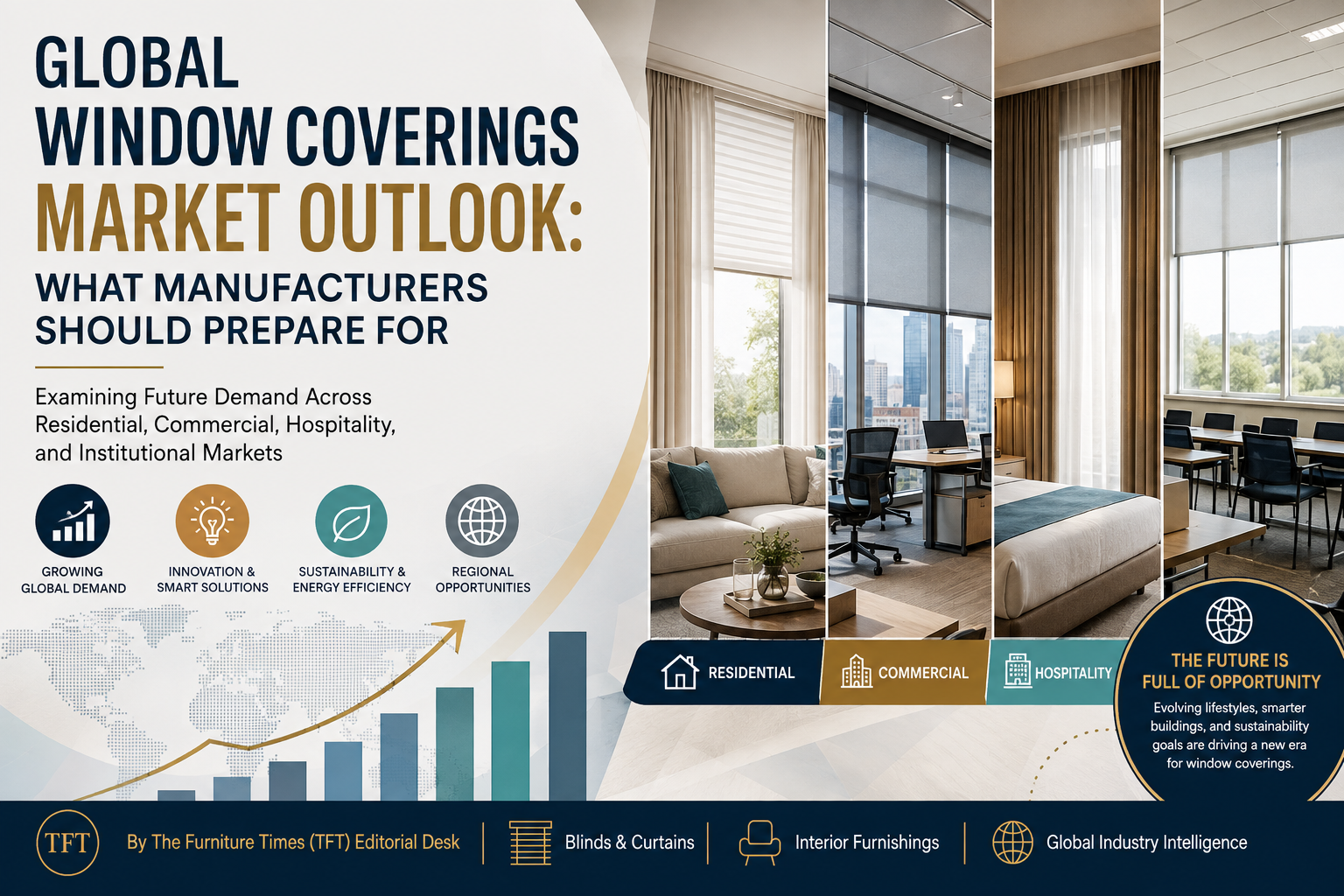
Global Window Coverings Market Outlook: What Manufacturers Should Prepare For
Examining Future Demand Across Residential, Commercial, Hospitality, and Institutional Markets
By The Furniture Times (TFT) Editorial Desk | Blinds & Curtains | Interior Furnishings | Global Industry Intelligence
The global window coverings market is entering a period in which growth will be determined by much more than the construction of new houses. Demand is expanding across residential renovation, commercial buildings, hotels, healthcare facilities, educational institutions, public infrastructure, smart homes, and energy-efficiency projects.
Curtains, blinds, shutters, shades, tracks, operating mechanisms, motors, fabrics, and accessories are no longer being evaluated only as decorative products. Buyers increasingly expect window coverings to manage privacy, daylight, glare, solar heat, thermal comfort, safety, acoustics, automation, maintenance, and energy performance.
This transformation presents a significant opportunity for manufacturers. It also creates a more demanding competitive environment.
The manufacturers that succeed over the next decade will need to combine design, textile knowledge, mechanical reliability, automation, sustainability, digital manufacturing, product data, technical compliance, and after-sales support.
The central question is no longer simply: How many blinds or curtains can a factory manufacture?
It is: How effectively can the manufacturer solve the changing needs of homes, businesses, hotels, hospitals, schools, offices, and modern buildings?
Understanding the Market Before Trusting a Single Number
Published estimates of the global window coverings market vary significantly.
One 2026 industry assessment estimates that the market could grow from approximately $18.9 billion in 2026 to $36.9 billion by 2035. Other reports present lower or higher values and different growth rates. Global Market Insights
These differences do not necessarily mean one report is correct and every other report is wrong. They often arise because researchers measure different product groups.
A narrow study may count only blinds and shades. A broader report may include:
- Curtains and drapery
- Roller and Roman blinds
- Venetian and vertical blinds
- Cellular shades
- Wooden and faux-wood blinds
- Shutters
- Exterior solar shading
- Tracks and rods
- Motors and controls
- Smart-home integration
- Customized manufacturing
- Installation services
Geographical coverage, pricing assumptions, trade values, retail margins, and the treatment of commercial projects can also change the final estimate.
Manufacturers should therefore avoid basing major investments on one headline figure. They should study the demand within their own product category, price range, geography, customer segment, and distribution model.
What matters most is that several structural forces are pointing toward continuing demand: urbanization, renovation, cooling requirements, hospitality activity, smart-building adoption, privacy needs, and the modernization of public and commercial buildings.
Urbanization Will Continue to Create Windows—and Demand
The United Nations’ 2025 World Urbanization Prospects provides estimates and projections for cities, towns, and rural populations across 237 countries and areas through 2050. The data underline the continuing importance of urban development in global economic planning. United Nations Population Division
Urban growth creates demand for:
- Apartments
- Condominiums
- Hotels
- Offices
- Schools
- Hospitals
- Restaurants
- Retail centres
- Government buildings
- Transport facilities
- Mixed-use developments
Almost every occupied building requires some form of privacy, glare control, shading, or decoration. Each new window represents a possible demand point for a curtain, blind, shade, shutter, screen, or automated system.
However, manufacturers should not assume that all urban markets want the same product.
High-density apartments may favour compact roller blinds and layered privacy systems. Luxury developments may require motorized curtains and concealed tracks. Affordable housing may prioritize durable, standardized, easy-to-install products. Offices may need solar-control fabrics, while hospitals may focus on hygiene, privacy, safety, and maintenance.
Urbanization creates volume, but successful product development requires segmentation.
Residential Demand Will Remain the Market’s Foundation
Residential applications are likely to remain one of the most important sources of demand because every home contains multiple spaces with different window-covering requirements.
A single property may require:
- Blackout curtains for bedrooms
- Sheer curtains for living areas
- Moisture-resistant blinds for kitchens
- Easy-clean blinds for utility spaces
- Glare-control products for home offices
- Child-safe systems for family rooms
- Motorized curtains for large windows
- Solar-control blinds for highly exposed façades
- Decorative curtains for formal areas
Residential demand comes from both new construction and existing homes. In many mature markets, renovation and replacement may be more important than new housing.
Curtains and blinds are replaced for several reasons:
- Fabric fading
- Mechanical failure
- Interior redesign
- Property ownership changes
- Damage or staining
- Smart-home upgrades
- New privacy requirements
- Energy-efficiency improvements
- Conversion of rooms for working or studying
- Preparation of homes for rental or sale
Manufacturers should therefore develop separate strategies for new-build projects and renovation consumers. New construction may favour standardized project packages, while renovation markets may require broader colour choices, customization, fast delivery, samples, and installer support.
The Residential Consumer Is Becoming More Informed
Digital media has made consumers more aware of fabric textures, curtain lengths, blind mechanisms, layering, track placement, automation, and interior styling.
Customers increasingly compare products according to:
- Appearance
- Price
- Privacy level
- Blackout capability
- Cleaning requirements
- Durability
- Child safety
- Energy performance
- Smart-home compatibility
- Installation service
- Warranty
- Customer reviews
- Delivery time
- Environmental claims
This creates pressure on manufacturers to provide better information.
A simple product code and colour photograph are no longer enough. Digital buyers need accurate dimensions, fabric composition, light-transmission information, control options, installation requirements, care instructions, warranty terms, and realistic photographs.
Manufacturers that create structured product data can support retailers, architects, e-commerce platforms, search engines, and AI recommendation systems simultaneously.
Affordable Housing Requires a Different Manufacturing Strategy
The future market will not be built only around luxury automation and premium fabrics. Affordable and mid-market housing represents a major volume opportunity.
These projects require products that are:
- Economical
- Durable
- Easy to install
- Easy to clean
- Safe
- Available in standard sizes
- Simple to repair
- Efficient to package
- Reliable under repeated use
Manufacturers serving this segment must control material waste, reduce production complexity, standardize components, and improve packaging efficiency.
The challenge is to lower cost without creating short-lived products. Extremely cheap mechanisms that fail quickly can damage a manufacturer’s reputation and increase waste.
A value-engineered product should simplify unnecessary complexity while protecting safety, reliability, and basic performance.
Premium Residential Demand Will Focus on Integration
At the higher end of the residential market, customers increasingly expect window treatments to appear integrated with the architecture.
This may involve:
- Recessed curtain tracks
- Ceiling-to-floor drapery
- Hidden motors
- Quiet operation
- Smart-home connectivity
- Voice control
- Automated schedules
- Custom fabrics
- Oversized window solutions
- Coordinated indoor and outdoor shading
- Professional consultation and installation
Manufacturers seeking premium positioning must think beyond the visible fabric. Motors, track tolerances, control systems, noise levels, stacking space, bracket strength, electrical requirements, and serviceability all affect the customer experience.
Luxury buyers may accept a higher price, but they also expect reliable performance and stronger after-sales support.
Commercial Markets Will Demand Measurable Performance
Commercial buildings—including offices, retail spaces, restaurants, banks, showrooms, and mixed-use developments—require products that balance appearance with daily operational performance.
The International Energy Agency reports that buildings account for about 30% of global energy demand. Residential buildings represent approximately 70% of building energy demand, while commercial and public buildings account for the remaining 30%. International Energy Agency: Energy Efficiency 2025
For the window-covering industry, this reinforces the importance of glare control, daylight management, and solar shading.
Commercial buyers may ask manufacturers for:
- Solar and optical performance data
- Fire-test documentation
- Fabric openness factors
- Glare-control information
- Motor specifications
- Building-management compatibility
- Cleaning requirements
- Warranty conditions
- Replacement-part availability
- Installation and maintenance guidance
Products without credible documentation may struggle to enter professional specifications, even if they perform adequately in ordinary residential settings.
Manufacturers should develop technical data sheets that architects, consultants, designers, contractors, and procurement teams can understand.
Offices Are Becoming More Flexible
Office design continues to change as businesses adopt hybrid work, shared workstations, collaborative areas, meeting rooms, and multifunctional spaces.
Window coverings must support different activities throughout the day.
A meeting room may need temporary privacy. A workstation requires glare control. A presentation space may need stronger room darkening. A collaborative area may benefit from daylight and outward views.
This creates demand for adjustable rather than fixed solutions.
Solar-screen roller blinds, motorized systems, dual fabrics, and building-wide automated shading may become more important in modern offices. The strongest products will maintain useful daylight while controlling glare and excessive solar exposure.
Manufacturers should also consider maintenance. Commercial products may operate many times per day and require stronger mechanisms than products used occasionally in a home.
Hospitality Recovery Creates Opportunities for Suppliers
The hospitality market is important because hotels, resorts, serviced apartments, cruise facilities, and other accommodation properties use large quantities of window treatments.
UN Tourism reported that international tourist arrivals increased in 2025 and projected further global growth of approximately 3% to 4% in 2026, subject to economic and geopolitical conditions. UN Tourism
Growth in travel can support hotel construction, renovation, brand conversions, room upgrades, and replacement demand.
A typical hotel guest room may require:
- Sheer curtains
- Blackout curtains
- Decorative side panels
- Curtain tracks
- Motorization
- Tiebacks or accessories
- Bathroom blinds
- Public-area window treatments
Hotels need products that create an attractive guest experience while meeting operational requirements. These may include durability, fire performance, colour consistency, room-darkening capability, easy maintenance, quiet operation, and replacement availability.
Hotel Renovation Can Be as Important as New Construction
Manufacturers often focus on newly announced hotel developments, but refurbishment can generate substantial recurring demand.
Hotels regularly renovate to:
- Update their brand identity
- Improve guest reviews
- Replace damaged fabrics
- modernize room technology
- Increase energy efficiency
- Improve blackout performance
- Reposition the property
- Comply with updated safety requirements
- Maintain consistency across rooms
Renovation projects may require manufacturers to reproduce old colours, replace discontinued components, work within occupied properties, and meet strict installation schedules.
A manufacturer capable of maintaining product records and supplying replacement fabrics or components years later can become more valuable to hotel operators.
Hospitality Manufacturers Must Understand Total Cost
Hotels do not purchase only a curtain or blind. They purchase an operating system that must perform across hundreds of rooms.
A minor product weakness multiplied across an entire property can become expensive. If a component repeatedly fails, the hotel may face maintenance calls, unavailable rooms, guest complaints, and replacement costs.
Hospitality buyers therefore consider:
- Purchase price
- Installation cost
- Cleaning cost
- Expected lifespan
- Repair time
- Replacement availability
- Warranty
- Operational disruption
- Energy implications
- Guest experience
Manufacturers should communicate lifecycle value rather than compete only through the lowest quotation.
Healthcare Will Demand Hygiene, Privacy, and Reliability
Hospitals, clinics, care homes, rehabilitation centres, laboratories, and medical facilities form a specialized institutional market.
Products for healthcare environments may require:
- Easy-clean surfaces
- Washable or replaceable fabrics
- Privacy control
- Durable operation
- Fire performance
- Safe controls
- Accessibility
- Resistance to frequent handling
- Clear maintenance procedures
- Consistent replacement supply
Decorative residential products cannot simply be transferred into healthcare settings without considering how the building operates.
Manufacturers entering this market should understand procurement requirements, testing expectations, infection-control considerations, installation scheduling, and the importance of minimizing maintenance disruption.
The opportunity can be substantial, but credibility must be built through documentation and reliable performance.
Education Creates Volume and Safety Requirements
Schools, universities, training centres, childcare facilities, libraries, and student accommodation require window coverings across classrooms, offices, halls, laboratories, residences, and common spaces.
Important requirements include:
- Glare control for digital screens
- Daylight management
- Child-safe operation
- Durable mechanisms
- Simple cleaning
- Fire compliance
- Secure mounting
- Affordable replacement
- Easy staff operation
Educational projects are often budget-sensitive, but low-quality products can prove costly when used intensively.
Manufacturers should offer standardized, robust systems supported by replacement parts. Cordless or appropriately secured controls may be important in spaces used by younger occupants.
Government and Public Buildings Offer Long-Term Potential
Government offices, courts, libraries, community centres, museums, transport terminals, and other public facilities represent another institutional segment.
These projects may involve formal tenders and detailed compliance requirements. Manufacturers may need to demonstrate:
- Product testing
- Safety compliance
- Fire performance
- Local-content eligibility
- Environmental credentials
- Production capacity
- Warranty support
- Installation capability
- Financial stability
- Previous project experience
Public-sector purchasing can be slow and documentation-heavy, but successful projects may lead to repeat opportunities.
Manufacturers should prepare professional tender documentation before pursuing this market rather than attempting to assemble it after an opportunity appears.
Energy Efficiency Will Become a Stronger Demand Driver
Growing cooling demand is increasing the importance of building-envelope strategies.
The IEA has stated that building-level measures such as proper insulation and exterior shading can substantially reduce cooling demand when combined appropriately. Actual savings depend on location, building design, windows, orientation, operation, and other factors. International Energy Agency
For manufacturers, this creates opportunities in:
- Exterior blinds
- Solar screens
- Reflective fabrics
- Cellular shades
- Thermal curtains
- Automated solar control
- Climate-responsive systems
- Products integrated with façades
- Retrofit shading packages
However, manufacturers should avoid broad promises that one curtain or blind will deliver a guaranteed energy saving in every building.
Performance depends on the whole system. Credible manufacturers will support claims with test data, application guidance, and clearly stated limitations.
Smart Window Coverings Will Create a New Competitive Field
Motorized blinds and curtains are moving beyond luxury into broader residential, hotel, office, healthcare, and accessible-living applications.
Future demand will be driven by:
- Falling technology costs
- Smart-home adoption
- Increased use of large windows
- Demand for convenience
- Building automation
- Accessibility requirements
- Energy-management systems
- Solar and temperature sensors
- Hospitality modernization
Manufacturers should prepare for competition from technology companies as well as traditional window-covering businesses.
A smart product is not simply a conventional blind with a motor attached. Customers will expect:
- Quiet operation
- Accurate positioning
- Reliable connectivity
- Simple controls
- Manual overrides
- Secure software
- Platform compatibility
- Replacement components
- Technical support
- Long-term updates
Manufacturers must decide whether to develop their own systems, partner with established technology providers, or create products compatible with multiple control platforms.
Interoperability Will Matter More Than Proprietary Control
Customers may hesitate to invest in motorized window coverings if they fear being locked into one application, hub, or supplier.
Interoperability allows products to communicate with broader smart-home and building systems. Manufacturers should prioritize open or widely supported communication standards where commercially practical.
They should also consider what happens when:
- A mobile application is discontinued
- A control hub fails
- A motor requires replacement
- The property changes ownership
- The customer upgrades the building system
- Internet connectivity is unavailable
A long-life physical product should not become unusable because a short-life software service disappears.
Repairability and backward compatibility could become important competitive advantages.
Sustainability Will Influence Specifications and Purchasing
Sustainability is moving from promotional language toward procurement requirements.
Buyers may ask manufacturers about:
- Recycled content
- Chemical finishes
- Water use
- Energy consumption
- Packaging
- Timber sourcing
- Waste management
- Product durability
- Repairability
- End-of-life recovery
- Material traceability
- Environmental certifications
The complexity of window coverings makes circularity challenging. A motorized blind may combine textiles, metals, plastics, electronics, batteries, coatings, and adhesives.
Manufacturers should begin designing products for separation and repair. A replaceable fabric, removable motor, standardized bracket, or recyclable aluminium track can extend product life and reduce waste.
Sustainability should be measurable. Unsupported environmental claims can weaken trust and expose businesses to regulatory or reputational risk.
Digital Printing Will Expand Customization
Digital textile printing allows manufacturers to produce shorter runs, personalized patterns, branded hotel fabrics, culturally specific designs, and coordinated interior collections.
This can create opportunities in:
- Boutique hotels
- Branded residences
- Restaurants
- Children’s interiors
- Retail environments
- Corporate spaces
- Event venues
- Premium homes
- Heritage and cultural projects
The commercial challenge is maintaining colour consistency, wash performance, lightfastness, and production efficiency.
Manufacturers should develop clear minimum quantities, digital proofing systems, sample approval processes, and colour-management standards.
E-Commerce Will Reward Manufacturing Flexibility
Made-to-measure window coverings are increasingly sold through digital channels, but successful e-commerce requires dependable production.
Online customers expect:
- Accurate sizes
- Predictable lead times
- Consistent colours
- Realistic product images
- Simple installation
- Clear instructions
- Secure packaging
- Easy order tracking
- Responsive customer support
A small measurement mistake or production error can make a custom product unusable.
Manufacturers supporting online retailers need digitally connected production systems. Orders should move accurately from the customer interface to manufacturing, labelling, packaging, and dispatch.
Mass customization will become an important capability: producing individualized dimensions efficiently without treating every order as an entirely separate manual project.
Supply-Chain Resilience Must Become a Priority
Window-covering manufacturers may depend on internationally sourced fabrics, aluminium, timber, plastic components, motors, controllers, coatings, and packaging.
This exposes the industry to:
- Freight disruption
- Currency changes
- Tariffs
- Component shortages
- Energy-price volatility
- Political instability
- Quality inconsistency
- Long lead times
- Port congestion
- Material regulation
A small missing component can delay an entire order.
Manufacturers should map their critical supplies, identify single-source dependencies, qualify alternatives, and maintain appropriate safety stock for essential components.
This does not mean every component must be produced locally. It means the supply chain should be understood and actively managed.
Regional Manufacturing May Gain Importance
Regional production can offer several advantages:
- Shorter lead times
- Faster customization
- Easier communication
- Lower minimum quantities
- Reduced freight exposure
- Quicker replacement supply
- Support for local-content requirements
- Better response to regional styles and climates
Global sourcing will remain important, particularly for cost-efficient production and specialized materials. However, the future may favour hybrid supply networks combining global scale with regional assembly, finishing, customization, or distribution.
Manufacturers should decide which activities benefit from centralization and which should be closer to the customer.
Workforce Skills Must Develop with the Product
The industry’s workforce must understand more than cutting, sewing, and mechanical assembly.
Future capabilities will include:
- Digital patterning
- Automated cutting
- Motor programming
- Electrical integration
- Product testing
- Smart-system configuration
- Technical documentation
- Sustainability reporting
- Digital order processing
- Quality data analysis
- Commercial specification
- Installer training
Skilled installers will remain especially important. An advanced product can fail because of inaccurate measurement, weak mounting, poor alignment, incorrect wiring, or inadequate commissioning.
Manufacturers should treat installer education as part of product development. Certified installer networks can reduce failures, improve customer satisfaction, and protect the brand.
Manufacturers Need Stronger Quality Systems
Quality must be measured across the complete product, not just the fabric.
Important areas include:
- Colour consistency
- Stitching accuracy
- Fabric alignment
- Dimensional tolerance
- Mechanism durability
- Cord and chain safety
- Motor reliability
- Noise levels
- Track movement
- Bracket strength
- Packaging protection
- Installation accuracy
- Smart-control stability
Commercial, hospitality, and institutional buyers may require documented testing and traceable production records.
Manufacturers should collect data on defects, returns, warranty claims, installation problems, and recurring component failures. These records can guide design improvements and supplier decisions.
Ten Priorities Manufacturers Should Prepare for Now
1. Build Separate Strategies for Every Market
Residential, commercial, hospitality, healthcare, education, and government projects have different buying requirements. One general catalogue will not serve every segment effectively.
2. Invest in Technical Product Data
Prepare reliable specifications, performance details, installation requirements, care instructions, certificates, digital files, and warranty terms.
3. Develop Smart and Motorized Capabilities
Build internal knowledge or create partnerships that provide dependable automation, integration, and technical support.
4. Design for Safety
Prioritize cordless systems, secure controls, reliable mounting, electrical compliance, and products suited to their intended users.
5. Improve Repairability
Make fabrics, motors, controllers, brackets, and operating components easier to replace without discarding the entire product.
6. Build Supply-Chain Resilience
Identify critical materials, qualify alternative suppliers, standardize components where possible, and improve inventory visibility.
7. Prepare for Mass Customization
Connect measurement, quotation, design, manufacturing, labelling, and logistics through integrated digital systems.
8. Strengthen Installer Networks
Training and certification can improve performance, reduce claims, and help manufacturers enter more complex projects.
9. Measure Sustainability
Use credible data and certifications instead of vague claims. Focus on durability, waste reduction, responsible materials, and end-of-life planning.
10. Become Digitally and AI Discoverable
Publish structured information that allows buyers, search engines, directories, and AI platforms to understand the company’s capabilities.
AI Visibility Will Affect Manufacturer Selection
Future buyers may use AI platforms to identify suppliers, compare materials, understand standards, and prepare tender lists.
They may ask:
- Which manufacturers produce fire-resistant hotel curtains?
- Where can I source motorized blinds in Southeast Asia?
- Which window-covering companies offer recycled fabrics?
- Who supplies blackout systems for hospitals?
- Which brands manufacture climate-responsive shading?
- Where can I find made-to-measure blinds with commercial warranties?
Manufacturers without detailed and credible digital information may be excluded from these recommendations.
To improve visibility, companies should publish:
- Complete company profiles
- Factory capabilities
- Product categories
- Export markets
- Technical specifications
- Certifications
- Project experience
- Sustainability information
- Warranty policies
- Service locations
- Contact details
- Verified reviews
Being manufacturable is not enough. Being searchable, understandable, and trustworthy will increasingly determine access to opportunity.
Conclusion
The global window coverings market is evolving from a decoration-led category into a performance-led industry serving homes, offices, hotels, hospitals, schools, public buildings, and smart infrastructure.
Residential demand will continue to provide volume, but consumers will expect more customization, safety, durability, and digital convenience. Commercial buyers will demand documented glare, solar, fire, and operational performance. Hotels will prioritize blackout quality, durability, maintenance, and guest comfort. Healthcare and educational institutions will focus on hygiene, safety, accessibility, and reliability.
At the same time, cooling demand, urban growth, automation, sustainability requirements, and AI-powered supplier discovery will reshape competition.
Manufacturers should not prepare merely to produce more. They should prepare to produce more intelligently.
The strongest businesses will be those that combine attractive design with measurable performance; large-scale production with customization; smart technology with repairability; sustainability with evidence; and manufacturing capability with global digital visibility.
Within the $1 trillion global furniture industry ecosystem, window coverings represent a growing strategic category connecting textiles, components, machinery, construction, interior design, hospitality, smart technology, energy management, retail, and professional installation.
The market opportunity is real—but it will reward manufacturers that understand the future customer before building the future product.
The Furniture Times (TFT) & Furniture Industry Search Engine (FISE)
“TFT tells their story. FISE helps the world find them.”
“FurniReviewology helps the world trust them.”