The Global Blinds and Curtains Industry: Market Growth, Innovation, and Future Opportunities
How Changing Lifestyles, Urban Development, and Interior Design Trends Are Expanding the Window-Covering Economy
By The Furniture Times (TFT) Editorial Desk | Blinds & Curtains | Interior Furnishings | Global Industry Intelligence
Blinds and curtains were once treated mainly as decorative products added at the final stage of furnishing a room. That perception is changing rapidly. Window coverings are becoming important building-performance products that influence privacy, daylight, heat control, energy consumption, acoustics, safety, automation, and the overall experience of an interior.
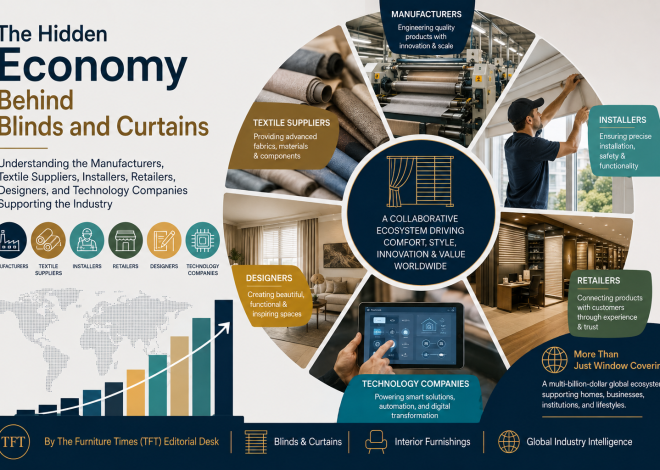
This transformation is expanding the blinds and curtains industry beyond conventional fabric suppliers and local curtain shops. Its ecosystem now includes textile producers, component manufacturers, motor and control-system companies, interior designers, architects, installers, retailers, e-commerce platforms, smart-home developers, property companies, hospitality operators, and building-energy specialists.
Urban development, changing lifestyles, climate concerns, home renovation, hospitality investment, smart-home adoption, and growing demand for personalized interiors are collectively strengthening the economic importance of this industry.
The future window-covering market will therefore be shaped not only by what looks attractive, but also by what performs intelligently.
A Global Industry Larger Than It First Appears
The global blinds and curtains industry includes a diverse range of products:
- Roller blinds
- Roman blinds
- Venetian blinds
- Vertical blinds
- Zebra or day-and-night blinds
- Cellular and honeycomb shades
- Panel-track systems
- Wooden and faux-wood blinds
- Blackout curtains
- Sheer curtains
- Thermal curtains
- Acoustic curtains
- Fire-resistant curtains
- Exterior solar-shading systems
- Motorized blinds and curtains
- Smart and sensor-controlled window coverings
- Curtain tracks, rods, brackets, motors, fabrics, linings, and accessories
This wide product scope makes market valuation difficult. Published estimates often vary substantially because researchers do not always measure the same categories. Some reports count only blinds and shades, while others include curtains, shutters, exterior shading, hardware, automation, installation, and customized window-treatment services.
For example, one 2026 estimate places the broader global window-coverings market at approximately $26.8 billion and forecasts it could reach about $44.1 billion by 2036. Other studies report different totals and growth rates because of differences in product coverage, geography, and research methodology. These forecasts should therefore be read as directional indicators rather than as one universally accepted market value. Future Market Insights
What appears consistent across most assessments is the direction of travel: the industry is expected to expand as buildings, consumers, and designers demand more from windows.
Urbanization Is Creating New Demand
Every new house, apartment, hotel, hospital, school, restaurant, office, and retail space contains windows that may require some form of privacy, shading, decoration, or daylight control.
Urban development therefore creates an extensive downstream market for window-covering businesses. The opportunity extends from the initial construction stage to furnishing, occupancy, renovation, replacement, and eventual refurbishment.
High-density urban living can increase the importance of privacy. Apartments may face neighbouring buildings, public roads, shared areas, or other residential units. Consumers need products that allow daylight to enter while reducing direct visibility from outside.
This is encouraging demand for:
- Sheer curtains combined with blackout layers
- Dual roller blinds
- Zebra blinds
- Top-down and bottom-up shades
- Translucent privacy fabrics
- Automated blinds programmed for different times
- Customized treatments for unusually shaped windows
Urban living also tends to place greater pressure on available space. Consumers may prefer streamlined products that occupy less room, integrate with minimalist interiors, and remain easy to operate. As a result, compact roller blinds, concealed tracks, recessed curtain systems, and motorized solutions are becoming increasingly relevant.
Changing Lifestyles Are Reshaping Window Treatments
The home is no longer used only for rest and family life. It may also function as a workplace, classroom, studio, entertainment area, exercise space, and content-production environment.
These overlapping activities create different window-covering requirements throughout the day.
A home office may require glare reduction without eliminating daylight. A bedroom may need effective blackout performance. A living room may benefit from layered curtains that create softness and visual warmth. A media room may require strong light control. A ground-floor apartment may prioritize privacy, while a tropical home may need protection from solar heat.
This means consumers are increasingly seeking flexible systems rather than a single decorative curtain.
Layering is one response. A room may combine sheer curtains with heavier drapery, or a roller blind with decorative side panels. This allows occupants to change the level of light, privacy, insulation, and visual formality according to the time and activity.
The industry is consequently moving from selling individual products toward providing complete window-management solutions.
Interior Design Is Becoming More Personal
Consumers now encounter a constant flow of interior inspiration through websites, digital catalogues, property platforms, design applications, and social media. This exposure has increased awareness of colour coordination, fabric texture, curtain length, track placement, decorative layering, and the visual relationship between windows and furniture.
Window treatments can change the apparent dimensions of a room. Curtains installed closer to the ceiling can make a space feel taller. Wider tracks can make windows appear larger. Light-coloured sheers can soften daylight, while darker fabrics may create a more dramatic atmosphere.
As consumers become more design-aware, demand is growing for:
- Made-to-measure products
- Wider selections of fabrics and colours
- Natural and textured materials
- Minimalist hardware
- Custom patterns
- Decorative borders and trims
- Coordinated cushions and upholstery
- Personalized digital printing
- Concealed tracks
- Wave-fold and other contemporary curtain styles
This creates opportunities for manufacturers and retailers capable of delivering customization at a controlled cost and within reliable lead times.
Customization, however, also introduces complexity. Every project may involve different dimensions, fabrics, linings, tracks, accessories, mounting conditions, and operating systems. Successful companies will need accurate measurement, effective order management, skilled production, dependable installation, and clear after-sales service.
Window Coverings Are Becoming Building-Performance Products
One of the most important changes in the industry is the growing connection between window treatments and energy efficiency.
Windows bring valuable daylight into a building, but they can also allow unwanted solar heat to enter or indoor heat to escape. Correctly selected shading can help manage glare, heat gain, daylight, and occupant comfort.
The International Energy Agency has identified proper insulation and exterior shading among the building-level measures that can substantially reduce cooling demand when combined effectively. The precise result depends on climate, glazing, orientation, construction, user behaviour, and the type of shading installed. International Energy Agency
This development gives blinds and curtains a much more strategic role. Products may now be evaluated according to:
- Solar heat control
- Light transmission
- Glare reduction
- Insulation value
- Reflective performance
- Daylight management
- Automation capability
- Compatibility with heating and cooling systems
- Contribution to occupant comfort
The European Union’s approach to building-energy performance also considers the building envelope, including insulation and windows, as part of overall energy use. This strengthens the wider case for treating shading and window management as part of building design rather than as an afterthought. European Commission
Climate Change Is Increasing the Importance of Solar Control
Hotter conditions, longer cooling seasons, rising electricity costs, and greater use of glass in architecture are increasing interest in solar shading.
Large glazed façades can produce attractive, daylight-filled interiors, but they may also contribute to overheating and glare if they are not managed properly. Exterior blinds, awnings, shutters, solar screens, reflective roller blinds, and automated shading systems can help buildings respond to these challenges.
External shading may block solar radiation before it passes through the glass, while internal blinds and curtains can manage light, privacy, and some aspects of heat transfer. The correct solution depends on the building, climate, orientation, budget, and design objectives.
In tropical markets such as Malaysia and other parts of Southeast Asia, heat and glare management can become a major product advantage. Manufacturers serving these markets may find opportunities in:
- Solar-reflective fabrics
- UV-resistant materials
- Moisture-resistant blinds
- Mould-resistant textiles
- Automated external shading
- Easy-clean products
- Corrosion-resistant components
- Fabrics designed for humid conditions
In colder regions, demand may focus more heavily on thermal curtains, cellular blinds, insulated shutters, and products that help reduce discomfort near glazing.
The market is therefore becoming more climate-specific. A universal product strategy will be less effective than a portfolio designed for different environmental conditions.
Smart Blinds and Curtains Are Moving Toward the Mainstream
Motorized window coverings were once associated primarily with luxury houses, premium hotels, executive offices, and expensive commercial projects. Technology is gradually making automation more accessible.
Modern systems may be operated through:
- Wall switches
- Handheld remote controls
- Mobile applications
- Voice assistants
- Timers and schedules
- Sunlight sensors
- Temperature sensors
- Occupancy sensors
- Smart-home platforms
- Building-management systems
The greater opportunity is not simply the ability to open or close a blind remotely. The real value lies in coordinated operation.
A smart shading system can close sun-facing blinds during the hottest part of the day, open selected blinds to make use of natural light, protect furnishings from strong ultraviolet exposure, and adjust privacy settings in the evening. In commercial buildings, automated shading can potentially work alongside lighting and climate-control systems.
This transition is bringing new businesses into the window-covering ecosystem, including motor manufacturers, software companies, electrical contractors, smart-home integrators, and sensor developers.
It also creates new requirements. Customers will expect reliable connectivity, quiet motors, simple controls, installation support, replacement parts, warranty protection, and compatibility with other systems. Manufacturers must consider cybersecurity and software longevity as well as fabric and mechanical performance.
Hospitality and Commercial Projects Remain Important
Hotels, resorts, offices, hospitals, schools, restaurants, and public buildings represent a major professional market for blinds and curtains.
These projects generally require more than visual appeal. Products may need to satisfy detailed requirements relating to:
- Fire resistance
- Light control
- Acoustic performance
- Hygiene
- Durability
- Accessibility
- Child safety
- Maintenance
- Colour consistency
- Motorization
- Replacement availability
- Project documentation
Hotels, for example, may combine sheer curtains with blackout drapery to give guests flexible privacy and sleep conditions. Offices may use blinds to control screen glare. Healthcare facilities may require washable, antimicrobial, or easy-maintenance materials. Educational buildings need robust products that can withstand frequent use.
Suppliers that understand specifications, testing, certification, installation scheduling, and project management can position themselves beyond the consumer retail segment.
However, project business also brings risks. Payment cycles may be longer, margins can face pressure, and installation errors may affect an entire building. Companies must price logistics, site coordination, warranty obligations, and possible replacement costs carefully.
Residential Renovation Supports Recurring Demand
The industry does not depend entirely on new construction. Existing properties generate recurring demand because window coverings become worn, stained, faded, outdated, damaged, or incompatible with new interior designs.
Renovation can be triggered by:
- Buying or renting a new property
- Repainting a room
- Replacing furniture
- Converting a room into a home office
- Improving privacy
- Reducing glare
- Preparing a property for sale
- Upgrading to smart-home technology
- Improving cooling efficiency
- Renovating a hotel or commercial space
This replacement cycle gives retailers and installers an opportunity to build long-term customer relationships. A homeowner who initially purchases bedroom blinds may later require products for the living room, kitchen, office, or another property.
Businesses that retain accurate measurements, fabric references, installation records, and customer preferences can make future orders easier and more reliable.
Sustainability Is Becoming a Competitive Requirement
The environmental impact of blinds and curtains begins with raw-material production and continues through dyeing, coating, manufacturing, transportation, use, maintenance, and disposal.
The industry uses natural and synthetic fibres, aluminium, steel, wood, plastic, foam, electronic motors, batteries, packaging materials, and chemical finishes. Products combining several materials can be difficult to separate and recycle at the end of their useful life.
Sustainability strategies may include:
- Recycled or responsibly sourced fibres
- Lower-impact dyes
- Reduced water and energy use
- Durable fabrics and mechanisms
- Repairable components
- Replaceable motors
- Reduced plastic packaging
- Take-back programs
- Recycling of production offcuts
- Transparent material documentation
- Local or regional production
- Products designed for disassembly
Durability is especially important. A product that remains functional and visually acceptable for many years may create less waste than one marketed as environmentally friendly but replaced quickly.
Companies must also avoid vague environmental claims. Buyers increasingly want to know what percentage of a product is recycled, which components are certified, where materials were produced, how the product can be repaired, and what will happen at the end of its life.
E-Commerce Is Transforming the Buying Journey
Selling ready-made curtains online is relatively straightforward. Selling accurately fitted blinds and made-to-measure curtains is more difficult.
The customer must understand how to measure the window, select an installation position, choose a material, decide on light transmission, identify the correct control side, evaluate colours, and understand how the final product will look.
Digital tools are helping businesses reduce this uncertainty through:
- Measurement videos
- Interactive buying guides
- Fabric sample services
- Online consultations
- Augmented-reality previews
- Room visualization
- Instant quotation systems
- Digital order tracking
- Installer-booking platforms
- Clear product comparison tools
The strongest retail model may not be purely online or purely physical. It may be an integrated system in which consumers discover products online, request samples, receive professional measurement, approve a digital proposal, and arrange installation through the same platform.
This approach preserves convenience while reducing the costly mistakes that can occur in customized orders.
AI Search Will Influence Which Brands Get Discovered
Search behaviour is beginning to move beyond conventional search engines. Consumers, architects, property managers, and procurement teams can now ask AI platforms questions such as:
- Which blinds are suitable for a hot and humid climate?
- Where can I find a motorized-curtain supplier near me?
- Which curtain fabrics are appropriate for a hotel?
- What is the difference between blackout and dim-out fabric?
- Which manufacturer provides fire-resistant commercial curtains?
- What type of blind is best for a home office?
AI systems can only recommend businesses they can find, understand, and consider credible. Many blinds and curtains companies remain digitally invisible because their websites contain limited information, poor product descriptions, incomplete locations, outdated contact details, or no evidence of completed projects.
To become discoverable, companies need structured and trustworthy digital information, including:
- Complete company profiles
- Accurate product categories
- Materials and specifications
- Service locations
- Project photographs
- Certifications
- Installation capabilities
- Warranty information
- Customer reviews
- Frequently asked questions
- Clear contact information
Digital visibility is no longer just a marketing function. It is becoming part of market access.
Opportunities for SMEs, Artisans, and Local Businesses
The blinds and curtains industry remains accessible to small and medium-sized enterprises because many customers value local measurement, customization, installation, repair, and personal service.
A smaller business may not compete with a global manufacturer on production scale, but it can compete through:
- Faster local response
- Personal consultations
- Specialist knowledge
- Custom stitching
- Difficult installations
- Repair services
- Unique textiles
- Cultural designs
- Small-order flexibility
- Strong local reputation
Artisans and small workshops can also serve premium niches through hand finishing, embroidery, natural fabrics, heritage patterns, decorative detailing, and limited-edition collections.
The central challenge is visibility. Many capable businesses rely almost entirely on referrals or social media pages that are difficult to search and verify. Industry directories, search platforms, professional websites, digital catalogues, and verified reviews can help smaller enterprises reach customers beyond their immediate location.
Supply-Chain Risks Cannot Be Ignored
The blinds and curtains supply chain may involve fabrics from one country, motors from another, tracks from a third, and final assembly or installation in the customer’s home market.
This international structure can expose companies to:
- Freight disruption
- Currency movements
- Tariffs
- Raw-material price changes
- Shipping delays
- Component shortages
- Inconsistent dye lots
- Quality variations
- Geopolitical risks
- Changing product regulations
A missing bracket, motor, controller, or length of track can delay an entire installation even when the main fabric is ready.
Manufacturers and retailers should therefore treat component availability as a strategic issue. Alternative suppliers, standardized parts, accurate inventory systems, quality inspections, and stronger demand forecasting can improve resilience.
Local and regional sourcing may also grow where customers value shorter lead times, easier customization, and more reliable after-sales support.
Safety and Standards Will Shape Product Development
Window coverings must be safe as well as attractive. Accessible cords and chains can present risks, particularly in environments used by young children. Product design, professional installation, operating instructions, and compliance with applicable local standards are therefore essential.
Commercial projects may also require fire-performance documentation, electrical compliance for motorized products, material testing, and accessibility considerations.
Manufacturers that invest in safer operating systems, cordless designs, concealed controls, dependable mounting hardware, and clear documentation will be better positioned as standards and buyer expectations develop.
Safety should not be treated as an optional feature or a marketing message. It must be built into product design, manufacturing, installation, and customer education.
Major Future Opportunities
The next phase of industry growth is likely to create opportunities in several connected areas.
Smart and Automated Shading
Demand should expand as smart-home systems become easier to install and more affordable. The greatest value will come from automation that improves comfort and building performance rather than technology added only for novelty.
Energy-Efficient Products
Thermal curtains, cellular blinds, solar-control fabrics, reflective materials, and exterior shading can become more important as governments, businesses, and consumers focus on cooling and heating costs.
Made-to-Measure Digital Commerce
Businesses that simplify online measurement, visualization, ordering, and installation can reach consumers beyond the limits of traditional showrooms.
Hospitality and Healthcare Projects
Specialized products that combine aesthetics with fire performance, blackout capability, hygiene, durability, and reliable replacement services can create higher-value opportunities.
Sustainable and Repairable Products
Long-lasting window treatments with replaceable components, verified materials, and reduced packaging can attract environmentally conscious buyers and professional specifiers.
Emerging Urban Markets
Rapidly growing cities in Asia, Africa, and the Middle East can generate demand across residential development, hotels, offices, hospitals, educational facilities, and retail spaces.
AI Visibility and Industry Search
Searchable product data, verified supplier profiles, detailed specifications, and trustworthy reviews can connect previously invisible manufacturers and installers with global buyers.
Challenges the Industry Must Address
The industry’s future is promising, but growth will not be automatic. Businesses must address several weaknesses:
- Heavy price competition
- Inconsistent product quality
- Shortage of skilled installers
- Measurement and fitting errors
- Limited product standardization
- Weak digital visibility
- Sustainability concerns
- Complex international supply chains
- Technology compatibility
- Cybersecurity for connected products
- Lack of repair and recycling systems
- Misleading environmental claims
- Consumer confusion over product performance
Companies that compete only on price may find it increasingly difficult to maintain quality and service. The stronger strategy is to compete through documented performance, trustworthy advice, reliable installation, customization, safety, warranty support, and digital accessibility.
The Industry Is Moving from Decoration to Intelligent Performance
The central message for the global blinds and curtains industry is clear: window coverings are no longer secondary decorative accessories.
They are becoming active components of modern living and building performance. They help manage light, heat, privacy, glare, sound, safety, energy consumption, and interior identity. As technology develops, they will increasingly respond automatically to changes in sunlight, temperature, occupancy, and user preference.
This evolution will bring the window-covering sector closer to architecture, energy management, smart-home technology, property development, and the wider furniture industry ecosystem.
Manufacturers must innovate. Retailers must educate. Installers must professionalize. Designers must consider performance as well as appearance. Digital platforms must make credible suppliers easier to find. Consumers must be given clearer information about materials, safety, sustainability, and long-term value.
The businesses that recognize these changes early will be positioned to serve a much larger opportunity. They will not simply sell blinds or curtains. They will deliver privacy, comfort, efficiency, atmosphere, intelligence, and control.
Conclusion
The global blinds and curtains industry is entering a period of meaningful transformation. Urban development continues to create new windows and new customers. Renovation provides recurring demand. Changing lifestyles require flexible spaces. Interior design encourages personalization. Climate pressures increase the importance of shading and insulation. Smart technology makes automated control more practical. Digital commerce opens new markets, while AI search changes how suppliers are discovered.
The future belongs to companies that connect design with measurable performance.
A beautiful product may attract attention, but a product that is beautiful, durable, safe, energy-conscious, digitally discoverable, professionally installed, and supported after purchase will create lasting value.
Within the $1 trillion global furniture industry ecosystem, blinds and curtains deserve greater recognition as a strategic category connecting textiles, components, interiors, architecture, construction, technology, retail, and sustainability.
The Furniture Times (TFT) & Furniture Industry Search Engine (FISE)
“TFT tells their story. FISE helps the world find them.”
“FurniReviewology helps the world trust them.”